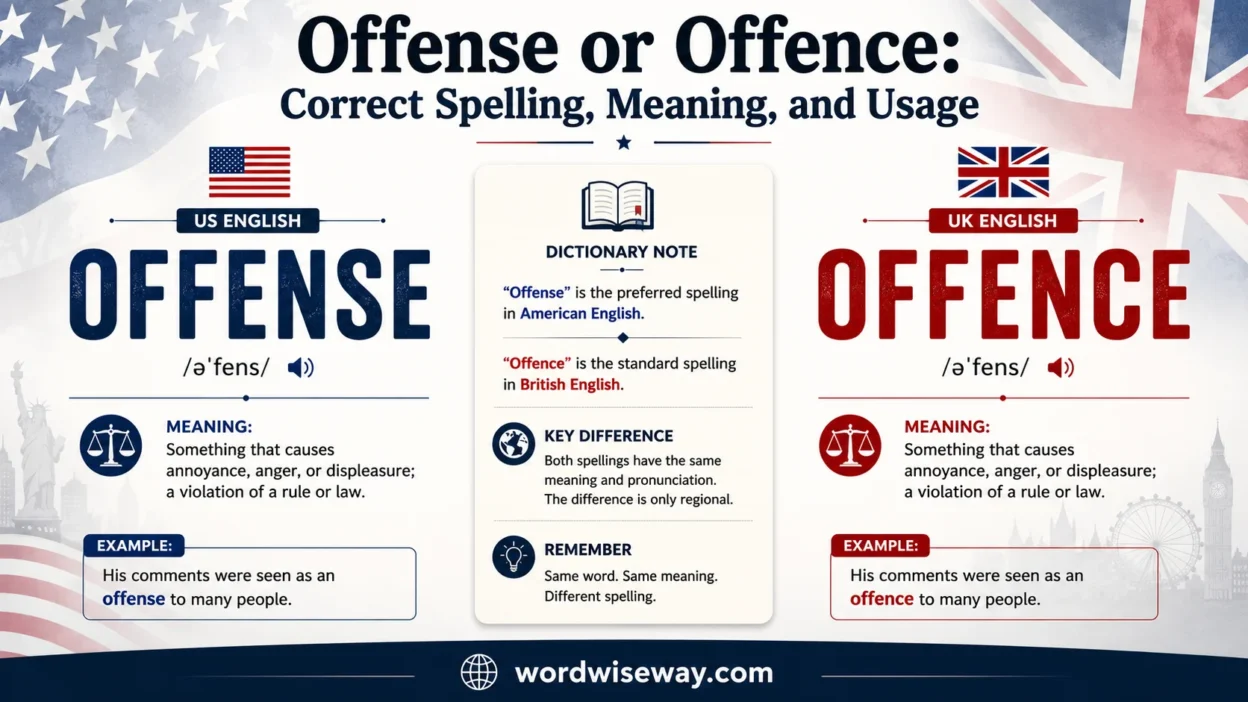
Offense or Offence: Correct Spelling, Meaning, and Usage explains why both spellings appear in English.
Many students, bloggers, writers, and professionals search for the correct spelling of offense and offence. Both are correct, but American English uses offense, while British English prefers offence. This language variation happens because spelling rules change by region. You may find these forms in books, news articles, and online posts. Understanding these regional differences helps improve writing accuracy, communication, and readability.
The meaning and usage of both words remain the same. They can describe an act causing resentment, anger, or displeasure, a violation of a moral code or law, or a crime. In sports, offense refers to tactics used to make a score. Learning word origin, usage examples, and language differences helps English learners choose the right word choice for their audience.
Quick Answer
If you’re in a hurry, here’s the rule:
- Offense = American English (US spelling)
- Offence = British English (UK, Commonwealth spelling)
That’s it.
But the story behind it is more interesting. And if you write blogs, essays, or legal documents, understanding the difference matters a lot more than it seems.
Offense vs Offence: Side-by-Side Comparison Table
| Feature | Offense | Offence |
| English type | American English | British English |
| Common regions | USA | UK, Canada, Australia, India |
| Legal usage | Yes | Yes |
| Emotional usage | Yes | Yes |
| Sports usage | Very common | Rare |
| Spelling style | Simplified | Traditional |
This table makes it clear: meaning stays the same, spelling changes based on geography.
Why “Offense or Offence” Confuses So Many People
This confusion doesn’t happen in isolation. English is full of spelling twins that behave the same way.
You’ve probably seen:
- color vs colour
- defense vs defence
- license vs licence
- organize vs organise
So when you see offense and offence, your brain naturally pauses.
Here’s the real reason:
English split into two major standards over time:
- American English simplified spelling
- British English preserved traditional forms
So neither spelling is “wrong.” They just belong to different systems.
Offense or Offence Meaning Explained Simply
Before we talk spelling rules, let’s clear meaning first.
Both words share the same core meanings:
1. Legal Meaning
A violation of law or rules.
- Example (US): “He committed a criminal offense.”
- Example (UK): “He committed a criminal offence.”
2. Emotional Meaning
Something that insults or hurts feelings.
- Example (US): “She took offense at the comment.”
- Example (UK): “She took offence at the comment.”
3. Sports Meaning (Mostly US Usage)
In sports, especially American football and basketball:
- “The team has a strong offense.”
In UK English, this usage is rare. Instead, people often say:
- attack
- attacking side
- forward line
Why Two Spellings Exist: A Simple Language History
Let’s step back for a moment.
English didn’t always look like it does today. Over time, spelling reforms and regional differences shaped how words appear.
American English Reform
In the 18th and 19th centuries, American lexicographer Noah Webster pushed for simplified spelling.
His goal was simple:
- Remove unnecessary letters
- Make spelling easier to learn
- Create a distinct American identity
That’s why:
- colour → color
- defence → defense
- offence → offense
British English Preservation
British English kept older forms from Latin and French influences.
So:
- offence stayed offence
- defence stayed defence
Think of it like two branches of the same river. Same source, different paths.
When to Use “Offense” (American English Rules)
You should use offense if your audience is mainly in the United States or follows American English standards.
Use it in:
- US blogs and websites
- American academic writing
- Sports journalism in the US
- Legal content for US readers
Examples:
- “Cyber offense laws are becoming stricter in the US.”
- “The offense scored three touchdowns in the first half.”
- “He pleaded guilty to a federal offense.”
Simple rule:
If your keyboard is “speaking American,” choose offense.
When to Use “Offence” (British English Rules)
Use offence if you are writing for the UK or countries that follow British English.
Use it in:
- UK websites and newspapers
- Commonwealth countries (India, Pakistan, Australia, etc.)
- Academic papers using British standards
- Formal legal writing outside the US
Examples:
- “The court ruled the offence was minor.”
- “Public offence was caused by the statement.”
- “Driving under influence is a serious offence.”
Simple rule:
If your audience follows British spelling traditions, go with offence.
Common Mistakes Writers Make with Offense and Offence
Even experienced writers slip up here. Let’s fix that.
Mistake 2: Assuming one is correct
Both are correct. Context decides.
Mistake 3: Ignoring audience
Writing “offense” for UK readers can feel unnatural.
Mistake 4: Overthinking it
You don’t need to memorize rules. Just match the region.
Easy Memory Trick to Never Forget Again
Here’s a simple mental shortcut:
- S = States = Offense
- C = Commonwealth = Offence
It’s quick, visual, and surprisingly effective.
Real-Life Examples of Offense vs Offence in Context
Let’s make this practical.
Legal Example
- US: “The defendant was charged with a cyber offense.”
- UK: “The defendant was charged with a cyber offence.”
Sports Example
- US: “Their offense dominated the second half.”
- UK: “The attacking side controlled the game.”
Everyday Example
- US: “I didn’t mean to cause offense.”
- UK: “I didn’t mean to cause offence.”
Same meaning. Different spelling rhythm.
Case Study: Confusion Between Offense and Offence
A student preparing an academic assignment became confused about whether to use offense or offence. Different books, articles, and online sources showed both spellings, making the student unsure about the correct spelling. After research, the student discovered that both forms are correct but belong to different English styles.
Case Study: Understanding American and British Spelling
The student learned that American English uses offense, while British English prefers offence. The meaning, pronunciation, and usage remain the same, but the spelling changes because of regional differences and language variation.
Case Study: Applying the Right Spelling Choice
While submitting work to a British institution, the student used offence consistently throughout the document. Later, when writing for American readers, the student selected offense. This improved writing accuracy, consistency, and communication with the intended audience.
Case Study: Learning the Value of Consistency
The experience taught the student that spelling variations are not always mistakes. Understanding regional spelling rules helps students, writers, and professionals make better word choices. Choosing the correct form based on the reader’s location makes writing clearer and more effective.
Key Insights
Both Spellings Are Accepted
Offense and offence are both correct spellings. The difference comes from regional language preferences rather than a difference in meaning.
Regional English Differences
American English commonly uses offense, while British English uses offence. These variations developed because different regions follow different spelling rules.
Meaning Remains the Same
Both words describe an act that causes anger, resentment, or displeasure. They can also refer to a violation, crime, or an attacking strategy in sports.
Consistency Improves Writing
Choosing one spelling style and using it consistently helps create clear and professional writing. The right choice depends on your audience, location, and preferred English style.
Related Word Confusions You Should Know
If “offense or offence” confuses you, these likely will too.
Defense vs Defence
- US: defense
- UK: defence
License vs Licence
- US: license (all uses)
- UK: licence (noun), license (verb)
Practice vs Practise
- US: practice (all uses)
- UK: practice (noun), practise (verb)
Organize vs Organise
- US: organize
- UK: organise
Pattern alert: US simplifies, UK preserves structure.
My Experience with Offense and Offence
As someone who works with English professionally, I get asked this all the time: “Is it offense or offence?”
The short answer: both spellings are correct. It comes down to where you’re writing for. In American manuscripts, I use offense; for British clients, it becomes offence the same regional pattern as color/colour or organize/organise.
My rule of thumb: match the spelling to your audience. US publication? Use offense. UK-based? Use offence. Just stay consistent throughout the piece.
The meaning never changes between the two. Both can describe:
- An act causing anger, resentment, or displeasure
- A violation of law or moral code
- In sports, the tactics or players focused on scoring — this sense usually keeps the American spelling (offense) even in British writing, since it’s borrowed from American sports terms.
check your audience, pick your regional spelling, and stay consistent. That’s what makes writing look polished.
Read More: Modeling or Modelling: Correct Spelling, Meaning, and Usage
FAQs
What is the correct spelling, offense or offence?
Both offense and offence are correct spellings. The choice depends on the variety of English you use. Offense is common in American English, while offence is preferred in British English.
Is there any difference in the meaning of offense and offence?
No, there is no difference in meaning. Both words describe something that causes anger, resentment, or displeasure. They can also refer to breaking a law, rule, or social standard.
Why do Americans spell it offense instead of offence?
American English often removes the letter “c” from words where British English keeps it. This spelling difference developed through changes in American language standards over time.
Which spelling should I use in academic writing?
Use the spelling that matches your audience or institution. If you are writing for an American audience, choose offense. For British audiences, offence is usually the better option.
Can offense and offence be used in sports?
Yes, both spellings can describe an attacking strategy in sports. American English usually writes offense, while British English commonly uses offence.
Are offense and offence pronounced differently?
No, both words have the same pronunciation. The difference appears only in their spelling, not in how native speakers say them.
How can I remember the difference between offense and offence?
Think about your target audience. Use offense for the United States and offence for the United Kingdom and many other British English regions.
Is offence always the British spelling?
Mostly yes. Offence is the standard spelling in British English, Canadian English, Australian English, and other regions influenced by British spelling rules.
Do dictionaries accept both spellings?
Yes, most modern dictionaries recognize both forms. They usually explain that the difference is based on regional spelling preferences.
How do I avoid mistakes when choosing offense or offence?
Check your writing style, audience, and preferred English version before publishing. Consistency is the key to using the correct spelling throughout your work.
Conclusion
Understanding the difference between offense and offence makes your writing clearer and more professional. Both words have the same meaning, but their spelling depends on whether you follow American English or British English rules. Once you know this regional difference, choosing the right spelling becomes simple.
Whether you are a student, writer, blogger, or professional, using consistent spelling helps your readers understand your message easily. Learning these small language variations improves your overall writing skills and helps you communicate more confidently in English.

Amelia Sanders has spent 14 years in Harvard University’s English Department, helping students navigate literary analysis, interpretive theory, and narrative techniques. Her academic pursuits center on 18th-century British prose, romantic poetry, diasporic writing, and digital editing exploring how textual choices influence cultural perspectives. Amelia has spoken at major international meetings and contributed essays to respected academic volumes, demonstrating her dedication to thoughtful scholarship and effective teaching.