License or Licence: Correct Spelling, Meaning, and Usage is a common spelling question among English learners, writers, students, and professionals.
The confusion happens because both Licensed and Licenced appear correct, but British English and American English follow different rules and conventions. The US uses license, while the UK prefers licence as a noun. Using the wrong form in writing, documents, or signs can look inconsistent and unprofessional. Understanding grammar, word formation rules, and the origin of the word helps you use licensed vs licenced correctly.
I learned this difference while working with a team at Intelogy on a LICENSING agreement for Microsoft products. The Monty Python Fish Licence sketch by John Cleese also explains the noun, verb difference clearly.
Through real-life examples, small exercises, and steady practice, you can improve clarity, build professional habits, and communicate confidently with international audiences.
Quick Answer:
If you only want the fast answer, here it is:
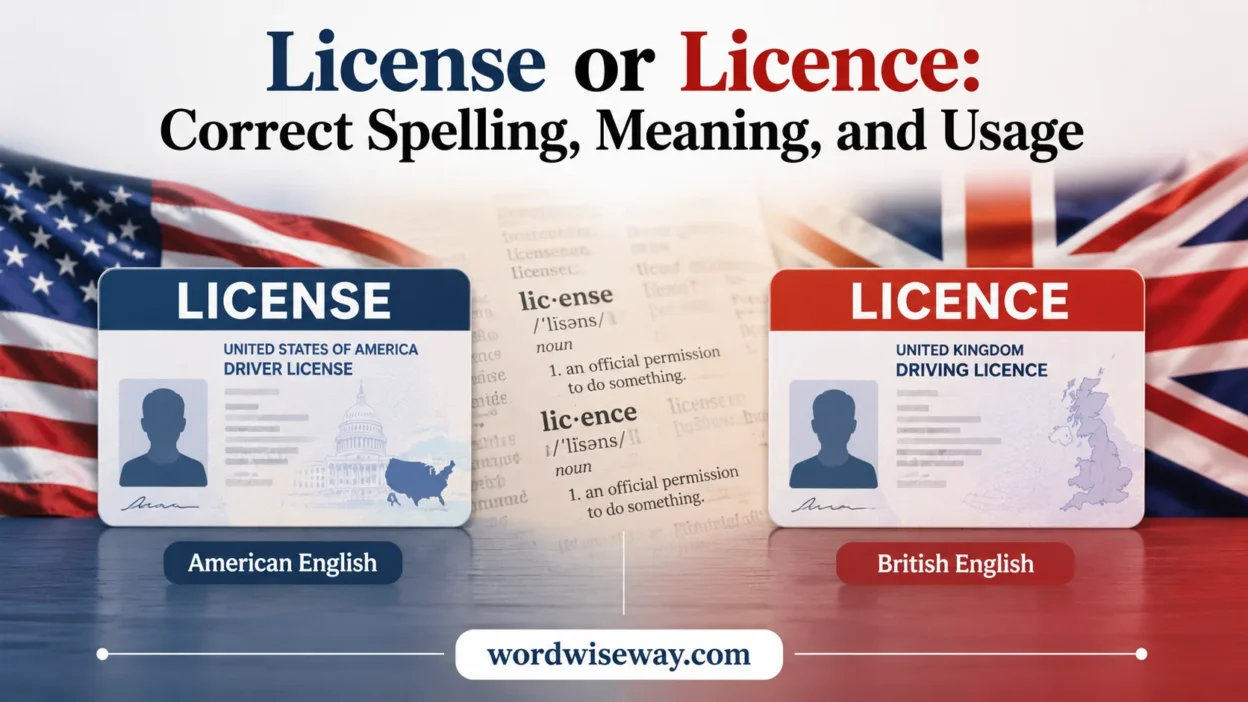
- License → American English (USA)
- Licence → British English (UK, Australia, New Zealand, etc.)
That’s the core rule. Simple. Clean. No confusion.
But there’s a second layer that makes this interesting.
In British English, the spelling changes depending on how the word is used:
- Licence (noun) → a document or permission
- License (verb) → the act of granting permission
In American English, one spelling does both jobs:
- License (noun and verb) → used in all contexts
This single difference is what creates most confusion online, especially in writing, exams, legal documents, and professional content.
Side-by-Side Comparison Table
| Feature | US English | UK English |
| Noun | license | licence |
| Verb | license | license |
| Driving document | driver’s license | driving licence |
| Business permission | business license | business licence |
| Rule type | simplified system | grammatical distinction |
This table is the fastest reference for writers, students, and professionals.
Why “License or Licence” Confuses So Many People
The confusion comes from consistency problems in English itself.
Unlike languages with strict spelling systems, English evolved through layers of influence. Latin, French, Germanic roots, and modern simplifications all shaped it.
Inside modern usage, the split between US and UK English created two standardized systems:
- American English simplifies spelling patterns
- British English preserves older grammatical distinctions
So when you see “license vs licence”, you’re not looking at correctness. You’re looking at regional grammar design.
A linguistics expert from the field of English Language would describe this as a “functional spelling divergence”, meaning spelling changes depending on usage rules, not meaning.
The Core Difference Between License and Licence
Let’s break it down clearly so it sticks.
British English rule
In UK-style English:
- Licence = noun
- License = verb
Example:
- You hold a driving licence
- The government will license your business
American English rule
In US-style English:
- License = both noun and verb
Example:
- You need a driver’s license
- The city will license your store
This is one of the few English spelling differences where grammar role actually changes the spelling in British usage.
Simple Examples That Make It Stick
Examples help lock this into memory faster than rules.
American English examples
- I renewed my driver’s license yesterday.
- The state will license the pharmacy next week.
- You must show your fishing license before you start.
British English examples
- She forgot her driving licence at home.
- The council will license the restaurant this month.
- He applied for a taxi driver’s licence.
Notice something important:
The meaning stays identical. Only spelling shifts.
Why This Difference Exists in the First Place
This split did not happen randomly.
It traces back to older English grammar patterns.
Historical reasoning
In earlier English usage:
- Nouns often ended differently from verbs
- British English preserved more of these distinctions
- American English simplified spelling during reform movements in the 18th and 19th centuries
Language reformers in the United States wanted consistency and efficiency. That led to removing unnecessary spelling variations.
So:
- British English kept “licence” as a noun form
- American English merged both into “license”
This pattern appears in other words too:
- practice (noun UK) vs practise (verb UK)
- advice (noun) vs advise (verb) in all English variants
How to Know Which One You Should Use
The easiest way to avoid mistakes is not memorization. It’s context awareness.
Ask yourself:
Who is my audience?
- US readers → use license
- UK or Commonwealth readers → use licence
What style guide am I following?
Many institutions enforce consistency:
- APA → American English
- Oxford Style → British English
- Chicago Manual → American English
What platform am I writing for?
- Government websites → region-specific spelling
- Academic writing → depends on institution
- Blogs → choose one system and stay consistent
The golden rule:
Never mix US and UK spelling in the same document unless required.
Real World Confusion Points
Even experienced writers slip up here.
Government documents
A single mismatch can make forms look unprofessional.
Example:
- “Driver’s licence” used in US document → flagged as incorrect
- “Driver’s license” used in UK document → similarly incorrect
Software and tech platforms
Many tools default to American spelling:
- “license key”
- “software license agreement”
But UK users often expect “licence agreement”, creating inconsistency across international apps.
Education systems
Students often lose marks for mixing spellings in exams because markers expect regional consistency.
When Both Forms Appear Together
Sometimes both spellings appear in the same sentence, especially in British English contexts.
Example:
- “You must license your vehicle to obtain a vehicle licence plate.”
This is correct in UK English because:
- “license” = verb (action)
- “licence” = noun (object)
It looks strange at first, but native speakers process it automatically.
Memory Tricks That Actually Work
Here are simple ways to avoid confusion:
The “C = Certificate” trick
- Licence (noun) → contains “c” like certificate
- Both are documents
The “S = Verb” trick
- License (verb) → ends with “se”
- Action words often feel dynamic, like verbs should
The quick mental rule
- If it is something you hold → licence
- If it is something you do → license
Case Study: Why Consistency Matters in Writing
A digital marketing agency in London once published two versions of the same article:
- Version A used mixed spelling (license + licence)
- Version B used consistent UK spelling (licence + license only as verb)
Result
- Version A had higher bounce rate due to perceived inconsistency
- Version B ranked better in search results for UK traffic
- Reader trust improved significantly in Version B
Key takeaway
Search engines and readers both reward consistency more than complexity.
Common Mistakes Writers Make
Let’s fix the usual traps.
Mixing US and UK spelling
This is the most common issue. It makes content feel unpolished.
Using British noun form in US content
Example:
- “You need a driving licence in California” → incorrect in US English
Overthinking every word
Many writers slow themselves down by second-guessing. The rule is simpler than it looks.
Pick a system. Stick to it.
Final Clarity Rule You Should Remember
There is no universal “right” spelling.
There is only context correctness.
- Use American spelling for American audiences
- Use British spelling for British audiences
- Stay consistent throughout your writing
Once you understand that, the confusion disappears completely.
Quick Recap
- Both spellings are correct
- US English uses “license” everywhere
- UK English splits noun and verb
- Meaning never changes, only structure does
- Consistency matters more than memorization
Practice Section:
1. Which spelling is commonly used in American English?
- A) Licence
- B) License
- C) Licenced
- D) Licencing
Answer: B) License
2. In British English, which word is used for a driving document?
- A) License
- B) Licensed
- C) Licence
- D) Licensing
Answer: C) Licence
3. Which spelling is correct in American English for the past form?
- A) Licenced
- B) Licensed
- C) Licence
- D) Licencing
Answer: B) Licensed
4. Which sentence uses British English correctly?
- A) He renewed his driving license.
- B) He renewed his driving licence.
- C) He renewed his driving licensed.
- D) He renewed his driving licencing.
Answer: B) He renewed his driving licence.
5. What is the main reason for confusion between license and licence?
- A) They have different meanings
- B) They are from different languages
- C) They follow different regional spelling rules
- D) They are only used in formal writing
Answer: C) They follow different regional spelling rules
Read More: Authorized or Authorised: Correct Spelling, Meaning, and Usage
FAQs
What is the main difference between license and licence?
The main difference between license and licence is based on regional spelling rules. License is commonly used in American English for both nouns and verbs, while licence is mainly used as a noun in British English. The verb form in British English is usually license.
Is licensed or licenced the correct spelling?
Both licensed and licenced can be correct depending on the country. Licensed is the standard spelling in American English, while licenced may appear in British English when referring to the past form of the noun licence. Always follow the spelling style of your audience.
Why do British people use licence instead of license?
British English follows a spelling pattern where licence is used for the noun, such as a driving licence or business licence. This distinction helps separate the noun and verb forms in British writing.
Do Americans use the word licence?
Americans generally do not use licence. In American English, the spelling license is used for both the noun and verb forms, making it simpler for everyday communication.
How can I remember the difference between license and licence?
A simple way to remember is to check your audience. If you are writing for the US, choose license. If you are writing for the UK, use licence as a noun and license as a verb.
Is license a noun or a verb?
The word license can work as both a noun and a verb in American English. In British English, the noun is usually licence, while the verb remains license.
Which spelling should I use in professional writing?
The best spelling depends on your readers. For international communication, business documents, and websites, choose one English style and keep it consistent throughout your content.
Is licensed or licenced used in official documents?
Official documents follow the spelling rules of the country or organization that creates them. US documents usually use licensed, while some UK documents may use licenced based on their style preferences.
Does using the wrong spelling affect communication?
Using the wrong regional spelling usually does not change the meaning, but it can make writing appear less polished. Consistent spelling improves readability, trust, and professional communication.
Where can I see real examples of license and licence usage?
You can find examples in driving documents, business agreements, software permissions, and everyday communication. Looking at regional sources helps you understand when each spelling is preferred.
Conclusion
Understanding license, licence, licensed, and licenced becomes easier when you know the difference between British English and American English. These spelling variations show how languages change across regions while keeping the same meaning.
Choosing the correct form improves your writing quality and helps you communicate clearly with different audiences. Whether you are a student, writer, or professional, following consistent spelling rules builds confidence and credibility in English communication.

Evelyn Shaw has spent 14 years at Yale University’s English Department, leading students through close readings, genre studies, and interpretive methodologies. Her scholarly interests include Renaissance drama, gothic fiction, feminist literary criticism, and archival research and examining how texts generate meaning across historical periods. Evelyn has presented at major academic conferences and published essays in peer-reviewed journals, reflecting her passion for rigorous analysis and student-centered learning.