
Affect vs Effect: Meaning, Difference, and Correct Usage explains why the affect vs effect word pair is easy to mix up.
These words sound the same and have similar meanings, creating confusion among writers, learners, and English speakers. The main difference between affect and effect is that affect is usually a verb showing an impact, while effect is generally a noun describing a result or outcome. Understanding their meaning, definitions, and correct usage helps improve grammar, vocabulary, and clear communication.
Learning Affect vs Effect: Meaning, Difference, and Correct Usage makes word choice easier in writing. Writers can remember that affect usually refers to an action or influence, while effect refers to the result caused by something.
Using the correct word improves reader understanding, supports precise language, and creates effective writing. Examples, context, and practice help learners remember the difference and avoid common confusion.
Quick Answer
In most situations, affect is a verb that means to influence or change something, while effect is a noun that means the result or outcome of a change.
Quick example:
- The heavy rain affected our travel plans.
- The rain had a significant effect on traffic.
A simple way to remember the difference is this:
| Word | Part of Speech | Meaning | Example |
| Affect | Verb | To influence | Lack of sleep can affect your memory. |
| Effect | Noun | A result or outcome | Lack of sleep has a negative effect on memory. |
This rule works correctly in the vast majority of everyday conversations and writing.
Affect vs Effect: The Quick Difference
Although these words are closely related, they answer different questions.
- Affect answers “What changed something?”
- Effect answers “What happened because of that change?”
Think of it as a chain of events.
Action → Influence → Result
Someone or something affects a situation. The effect is what happens afterward.
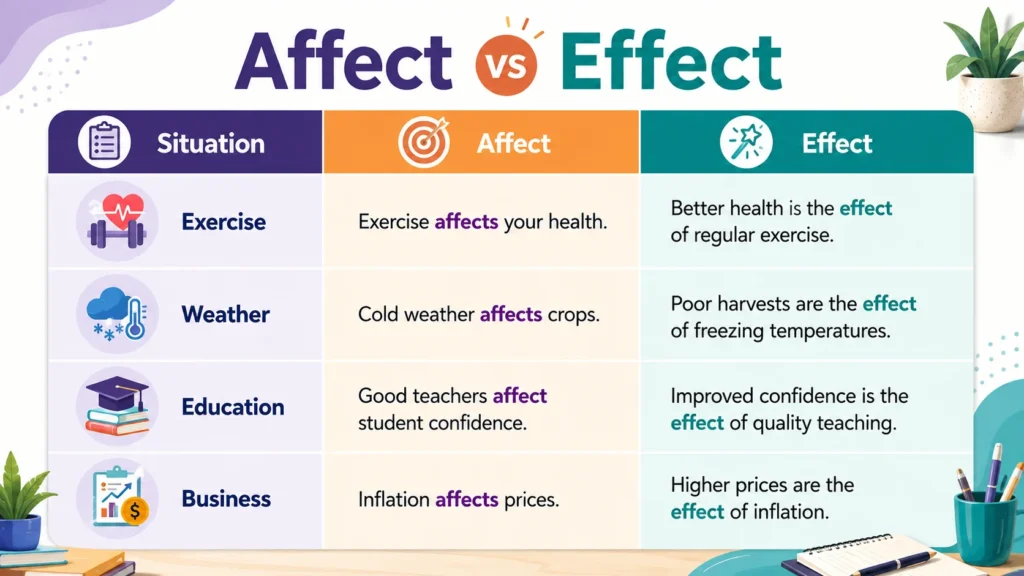
| Situation | Affect | Effect |
| Exercise | Exercise affects your health. | Better health is the effect of regular exercise. |
| Weather | Cold weather affects crops. | Poor harvests are the effect of freezing temperatures. |
| Education | Good teachers affect student confidence. | Improved confidence is the effect of quality teaching. |
| Business | Inflation affects prices. | Higher prices are the effect of inflation. |
When you think in terms of cause and result, choosing the correct word becomes much easier.
What Does Affect Mean?
Affect Definition
The word affect usually functions as a verb. It means to influence, change, alter, or have an impact on someone or something.
An action happens first. That action changes another person, object, or situation.
When to Use Affect
Use affect whenever you describe something that changes another thing.
Common situations include:
- Health
- School
- Work
- Weather
- Relationships
- Technology
- Finance
- Sports
- Government policies
If something creates a change instead of describing the final result, affect is probably the correct choice.
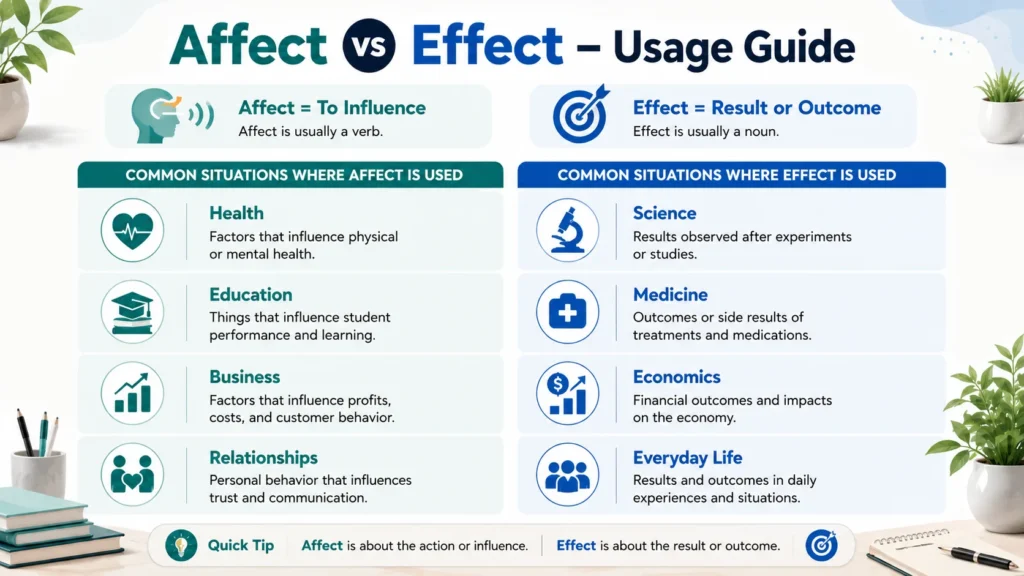
Common Situations Where Affect Is Used
Health
Doctors often discuss factors that affect physical and mental health.
Examples:
- Eating nutritious food affects your energy level.
- Regular exercise affects heart health positively.
- Stress affects sleep quality.
Education
Teachers frequently talk about what affects student performance.
Examples:
- Daily reading affects vocabulary growth.
- Attendance affects academic success.
- Motivation affects learning outcomes.
Business
Companies analyze factors that affect profits and customer satisfaction.
Examples:
- Rising fuel prices affect transportation costs.
- Customer reviews affect buying decisions.
- Strong leadership affects company culture.
Relationships
Personal behavior can affect trust and communication.
Examples:
- Honest conversations affect friendships positively.
- Poor communication affects teamwork.
- Respect affects long-term relationships.
Affect Example Sentences
Here are practical examples that show how naturally affect fits into everyday English.
Everyday Examples
- Loud music affects my concentration.
- Weather changes affect outdoor events.
- Social media affects the way people communicate.
- Good habits affect long-term success.
- Traffic affects my commute every morning.
Workplace Examples
- Employee training affects productivity.
- Clear goals affect team performance.
- Better software affects efficiency.
- Customer feedback affects future products.
- Leadership decisions affect every department.
Academic Examples
- Reading every day affects writing skills.
- Classroom participation affects final grades.
- Sleep affects memory during exams.
- Technology affects modern education.
- Practice affects language fluency.
Notice that every sentence describes something causing change.
What Does Effect Mean?
Effect Definition
The word effect is usually a noun. It refers to the result, consequence, or outcome produced by a cause.
Instead of describing the action itself, effect names what happened afterward.
When to Use Effect
Choose effect whenever you’re talking about the result of something.
Common contexts include:
- Science
- Medicine
- Economics
- Business
- Education
- Psychology
- Environmental studies
- Daily conversations
Common Situations Where Effect Is Used
Science
Scientists observe effects after conducting experiments.
Examples:
- Researchers measured the effect of sunlight on plant growth.
- Scientists studied the effect of pollution on rivers.
Medicine
Doctors often explain treatment effects.
Examples:
- The medicine had an immediate effect.
- Fatigue is a common side effect.
- The treatment produced positive effects after two weeks.
Economics
Economists evaluate financial outcomes.
Examples:
- Inflation has a major effect on household budgets.
- Interest rate changes affect borrowing, while lower borrowing costs are the effect consumers notice.
Everyday Life
You use effect far more often than you might realize.
Examples:
- Coffee had little effect on my tiredness.
- Kindness has a lasting effect.
- Music has a calming effect.
- Exercise has a positive effect on mood.
Effect Example Sentences
Simple Examples
- The new policy had a positive effect.
- Rain had little effect on the tournament.
- The lesson had a lasting effect on students.
- Healthy eating has a noticeable effect.
- Technology has changed the effect of communication worldwide.
Professional Examples
- The campaign produced an immediate effect on sales.
- Customer loyalty had a measurable effect on revenue.
- The software upgrade had a positive effect on productivity.
- The investment had a long-term effect on growth.
Formal Writing Examples
- Researchers examined the effect of climate change on agriculture.
- The study evaluated the long-term effect of sleep deprivation.
- Scientists measured the effect of fertilizer on crop production.
Affect vs Effect: Side-by-Side Examples
Looking at both words together helps reinforce the difference.
| Incorrect | Correct | Why |
| The rain had no affect. | The rain had no effect. | Result = noun. |
| Stress can effect sleep. | Stress can affect sleep. | Influence = verb. |
| Pollution has many affects. | Pollution has many effects. | Multiple results. |
| The medicine quickly affected. | The medicine had a quick effect. | Describing the outcome. |
| Poor lighting had little affect. | Poor lighting had little effect. | Refers to the result. |
| New laws will effect prices. | New laws will affect prices. | They influence prices. |
| Exercise has a good affect. | Exercise has a good effect. | Outcome. |
| The speech effected my emotions. | The speech affected my emotions. | It influenced emotions. |
| The storm had serious affect. | The storm had serious effects. | Consequences. |
| His words effected everyone deeply. | His words affected everyone deeply. | Influence. |
| Heat can effect electronics. | Heat can affect electronics. | Cause change. |
| The movie had an emotional affect. | The movie had an emotional effect. | Emotional result. |
| Their decision effected attendance. | Their decision affected attendance. | Changed attendance. |
| The policy showed immediate affect. | The policy showed an immediate effect. | Outcome. |
| Lack of sleep effects memory. | Lack of sleep affects memory. | Influences memory. |
Studying these sentence pairs builds confidence because you learn to identify whether the sentence describes an influence or a result.

The Grammar Rule Behind Affect vs Effect
Grammar provides the simplest explanation for remembering these two words.
Affect as a Verb
Most of the time, affect functions as an action word.
Ask yourself:
Is something changing or influencing something else?
If the answer is yes, use affect.
Examples:
- Heat affects metal.
- Noise affects concentration.
- Exercise affects physical fitness.
- Poor nutrition affects children.
- Technology affects communication.
Each sentence contains an action that changes another thing.
Effect as a Noun
Most of the time, effect names the consequence of that action.
Ask yourself:
Am I talking about the result?
If yes, choose effect.
Examples:
- Heat has an effect on metal.
- Noise has a negative effect on concentration.
- Exercise has a positive effect on health.
- Good nutrition has lasting effects on children.
- Technology has had a dramatic effect on communication.
Notice that the sentence focuses on the outcome, not the action itself.
Why This Rule Works Most of the Time
English contains many exceptions, but this particular rule remains remarkably consistent.
In everyday writing:
- Affect = influence
- Effect = result
This guideline works for newspapers, business reports, essays, emails, blog posts, and casual conversations. Mastering it eliminates the vast majority of mistakes people make when choosing between these two words.
The Rare Exceptions
Many grammar guides stop after explaining the basic rule. However, understanding the uncommon exceptions makes your writing even stronger.
Effect as a Verb
In formal English, effect can also be used as a verb.
Here, it means to bring about, accomplish, or make something happen.
Examples include:
- The committee hopes to effect meaningful reform.
- The new agreement will effect major organizational changes.
- Strong leadership helped effect lasting improvements.
This usage appears mostly in legal, academic, government, and business writing. In everyday conversation, you’ll rarely encounter it.
Affect as a Noun
Although uncommon, affect can also function as a noun in psychology and psychiatry. In this context, it refers to a person’s observable emotional expression rather than their internal feelings.
Mental health professionals use this term when describing how emotions appear during an evaluation.
Examples:
- The patient displayed a flat affect throughout the interview.
- Her cheerful affect matched the positive news.
- The doctor noted an appropriate affect during the assessment.
Unless you’re reading psychology or medical literature, you’ll almost always use affect as a verb.
Affect vs Effect in Different Writing Styles
The meaning of these words stays the same across writing styles. However, the situations where they appear most often can vary.
Affect vs Effect in Academic Writing
Academic writing frequently discusses causes and outcomes, making these words especially common.
Examples:
- Climate change affects biodiversity.
- The study examined the effect of exercise on heart health.
- Researchers investigated factors that affect memory.
Affect vs Effect in Business Writing
Business reports often explain how decisions influence performance and what results those decisions produce.
Examples:
- Rising costs affect profit margins.
- The marketing campaign had a positive effect on sales.
- Customer feedback affects future product development.
Affect vs Effect in Professional Emails
Professional communication should use these words precisely.
Examples:
- The delay may affect the project timeline.
- The update had no effect on existing accounts.
- Weather conditions could affect deliveries.
Affect vs Effect in Journalism
News articles often explain events and their consequences.
Examples:
- The storm affected thousands of residents.
- The new law had an immediate effect on local businesses.
Affect vs Effect in Everyday Conversation
You probably use these words more than you realize.
Examples:
- Does coffee affect your sleep?
- That movie had a strong effect on me.
- Music affects my mood every day.
Common Collocations
Some phrases naturally pair with one word and never the other.
Common Phrases with Affect
- adversely affect
- directly affect
- greatly affect
- significantly affect
- positively affect
- negatively affect
- affect behavior
- affect performance
- affect health
- affect confidence
Common Phrases with Effect
- take effect
- side effect
- cause and effect
- have an effect
- little effect
- ripple effect
- greenhouse effect
- placebo effect
- special effects
- in effect
Learning these word combinations helps your writing sound more natural.
Memory Tricks to Remember the Difference
A simple memory trick can save you from second-guessing yourself.
The A = Action Rule
The word Affect starts with A.
Think:
A = Action
An action influences something.
Example:
- Stress affects sleep.
The E = End Result Rule
The word Effect starts with E.
Think:
E = End Result
The result comes after the action.
Example:
- Stress has an effect on sleep.
Another Helpful Trick
Replace the sentence mentally.
If influence works, choose affect.
If result works, choose effect.
Example:
- Inflation influences prices.
- Inflation affects prices.
Example:
- Inflation has a major result on prices.
The sentence doesn’t sound natural because result needs an article or different wording, making effect the correct choice.
Which Memory Trick Works Best?
Most teachers recommend remembering:
Affect = Action
Effect = End Result
It is short, accurate, and works in nearly every everyday situation.
Common Mistakes People Make
Even experienced writers occasionally confuse these words.
Using Affect Instead of Effect
Incorrect:
- The medicine had a positive affect.
Correct:
- The medicine had a positive effect.
Using Effect Instead of Affect
Incorrect:
- Stress can effect your health.
Correct:
- Stress can affect your health.
Forgetting the Rare Exception
People sometimes assume effect is never a verb.
In formal writing, this sentence is correct:
- The committee hopes to effect change.
Although grammatically correct, most everyday writers can safely ignore this rare usage.
Trusting Spell Check Too Much
Spell check won’t usually catch these mistakes because affect and effect are both correctly spelled words.
That’s why understanding their meaning matters more than relying on software.
Affect vs Effect in Popular Expressions
Many common expressions always use one specific word.
| Expression | Correct Word | Meaning |
| Cause and effect | Effect | Relationship between an action and its result |
| Take effect | Effect | Begin working |
| Side effect | Effect | Secondary result |
| Ripple effect | Effect | One result leading to many others |
| Greenhouse effect | Effect | Warming caused by trapped heat |
| Effect change | Effect | Bring about change (formal) |
Notice that effect appears in most fixed expressions because they describe outcomes.
Affect vs Effect in American and British English
Unlike many spelling differences between American and British English, affect and effect remain the same.
| Feature | American English | British English |
| Affect | Same | Same |
| Effect | Same | Same |
| Meaning | Same | Same |
| Grammar | Same | Same |
Whether you’re writing for readers in the United States, the United Kingdom, Canada, Australia, or elsewhere, the grammar rules do not change.
Synonyms and Related Words
Sometimes another word communicates your meaning more clearly.
Synonyms for Affect
- influence
- impact
- alter
- change
- shape
- modify
- transform
- sway
Synonyms for Effect
- result
- outcome
- consequence
- impact
- aftermath
- product
- reaction
- conclusion
When You Shouldn’t Replace Them
Although synonyms can improve variety, they aren’t always interchangeable.
For example:
- The greenhouse effect is the correct scientific term.
- The side effect of a medicine is a fixed expression.
- Cause and effect is an established phrase.
Changing these expressions would sound unnatural.
Real-Life Practice Quiz
Choose the correct word.
- Lack of exercise can _____ your health.
- The new policy had an immediate _____.
- Cold weather _____ crop production.
- The medicine took _____ within an hour.
- Social media can _____ young people.
- The advertisement had little _____ on customers.
- Rising prices _____ consumer spending.
- The new software had a positive _____ on productivity.
- Poor lighting can _____ your eyesight.
- The decision had a lasting _____ on the company.
Answer Key
| Question | Answer |
| 1 | affect |
| 2 | effect |
| 3 | affects |
| 4 | effect |
| 5 | affect |
| 6 | effect |
| 7 | affect |
| 8 | effect |
| 9 | affect |
| 10 | effect |
If you answered most of these correctly, you’ve already mastered the basic rule.
Affect vs Effect Cheat Sheet
| If You Mean… | Use |
| Influence something | Affect |
| Change something | Affect |
| Result or outcome | Effect |
| Consequence | Effect |
| Bring about change (formal verb) | Effect |
| Emotional expression (psychology noun) | Affect |
Bookmark this table for quick reference whenever you’re unsure.
Commonly Confused Word Pairs
Learning related word pairs strengthens your grammar even further.
Affect vs Impact
Both can describe influence, although impact works as both a noun and a verb in modern English.
Effect vs Result
Both refer to outcomes, but effect often emphasizes the consequence of a specific cause.
Affect vs Influence
These words are close in meaning, although affect appears more often in formal grammar discussions.
Effect vs Consequence
A consequence often suggests something significant or unavoidable, while an effect can be either positive, negative, or neutral.
Affect vs Change
Affect means to influence.
Change usually means to make something different completely.
Expert Insight on Affect vs Effect
Affect usually works as a verb when something influences or changes another thing. Effect generally works as a noun when describing the result, outcome, or consequence. This distinction is the most reliable way to choose the correct word in everyday English writing.
For clearer grammar, check the sentence structure before making your word choice. If you can replace the word with influence, use affect. If you can replace it with result, use effect. This simple test helps writers avoid common errors and communicate ideas more precisely.
Read More: Pronunciation or Pronounciation: Correct Spelling, and Usage
FAQs
What is the main difference between affect and effect?
The main difference between affect and effect is their role in a sentence. Affect is usually used as a verb and means to influence or change something. Effect is usually a noun and refers to the result or outcome caused by an action.
Remembering this basic rule can help avoid common grammar mistakes. However, there are some exceptions, such as when effect is used as a verb meaning to bring about a change.
How can I easily remember when to use affect or effect?
A simple way to remember the difference is to use the phrase Affect = Action because it is commonly a verb. Effect = End result because it usually describes the outcome of something.
Using examples and practicing sentences can make the correct usage easier to remember. Over time, recognizing the context will help you choose the right word naturally.
Is affect always a verb and effect always a noun?
No, although this is the most common rule, there are exceptions. Affect can sometimes be a noun in psychology, where it describes someone’s emotional expression or mood.
Similarly, effect can be used as a verb when it means to cause something to happen or bring about a result. These uses are less common but important to understand.
Why do people confuse affect and effect?
People often confuse affect and effect because they sound very similar and have related meanings. Both words are connected to change, influence, and results, which makes them difficult for many learners.
Even experienced writers sometimes mix them up. Understanding their definitions, sentence roles, and context can help prevent mistakes.
Can affect and effect be used in the same sentence?
Yes, both words can appear in the same sentence when discussing an action and its result. For example, an action can affect something and create a noticeable effect.
Using both words together can actually help show the difference between influence and outcome. It highlights how one thing causes a change in another.
What is an example of affect used correctly?
An example of affect is: “The weather can affect my travel plans.” Here, affect means that the weather influences or changes the plans.
Since the word describes an action or influence, it works as a verb in this sentence. It shows how one thing impacts another.
What is an example of effect used correctly?
An example of effect is: “The new policy had a positive effect on employees.” In this sentence, effect refers to the result created by the policy.
The word describes an outcome rather than an action, making it a noun. This is the most common use of effect.
Does correct usage of affect and effect improve writing?
Yes, using affect and effect correctly improves clarity and professionalism in writing. Choosing the right word helps readers understand your message without confusion.
Good word choice also strengthens communication because small grammar details can change the meaning of a sentence. Accurate language builds stronger writing skills.
Are affect and effect important in English grammar?
Yes, affect and effect are important grammar concepts because they are frequently used in everyday communication. Learning their difference helps improve vocabulary and sentence accuracy.
These words appear in academic writing, professional documents, and casual conversations. Understanding them makes English usage more confident and effective.
What is the best way to learn affect vs effect?
The best way to learn affect vs effect is through regular practice, examples, and understanding sentence context. Memorizing the basic rule is helpful, but seeing how these words work in real sentences creates stronger understanding.
Reading, writing, and reviewing common mistakes can improve your ability to use them correctly. With practice, choosing between affect and effect becomes much easier.
Conclusion
Affect vs Effect: Meaning, Difference, and Correct Usage is an important topic for anyone who wants to improve their English writing and communication skills. Although these two words look and sound similar, their meanings and grammatical roles are different. Affect usually describes an action or influence, while effect usually represents the result or outcome of that action.
Understanding the difference between affect and effect helps writers communicate ideas more clearly and avoid common grammar mistakes. By practicing examples, focusing on context, and remembering simple usage rules, learners can confidently choose the correct word. Strong vocabulary and accurate word choice create clearer, more effective writing.