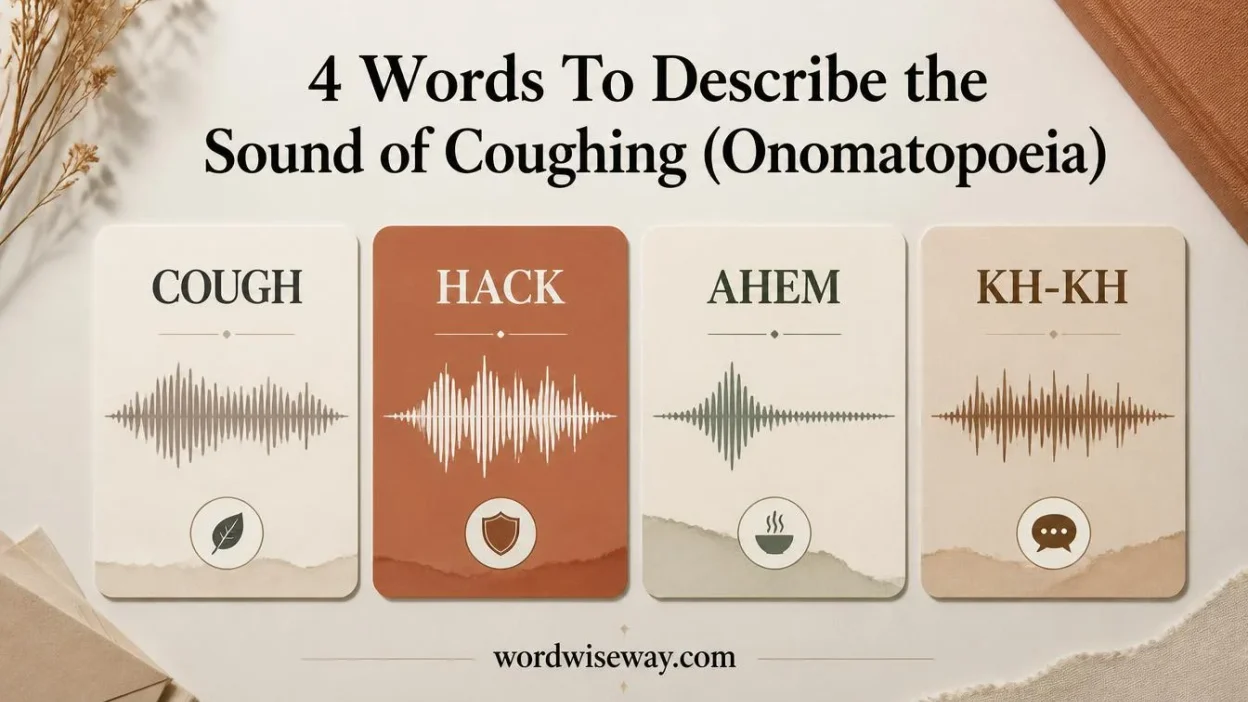
4 Words To Describe the Sound of Coughing help readers understand how different coughing sounds affect a conversation or scene. Sometimes, we can’t find the right words to describe sounds naturally. That’s when onomatopoeia becomes useful. These words imitate real sounds and make descriptions easier to imagine. For example, “hack,” “ahem,” and “cough” can represent different ways someone coughs. Each word creates a slightly different impression, helping readers picture the situation more clearly.
Choosing the best word depends on the type of cough and the context. A dry cough may sound sharp and rough, while a gentle cough might barely interrupt a conversation. When we use suitable sound words, we can explain what we hear without lengthy descriptions. These expressions also make stories, articles, and everyday conversations more engaging. By selecting words that match the sound, you can describe coughing more clearly and naturally.
Quick Answer:
Four words or written forms can help describe coughing and related throat sounds: cough, hack, ahem, and kh-kh. Each serves a slightly different purpose.
- Cough: Describes an ordinary coughing sound or the action itself.
- Hack: Suggests a harsh, rough, or forceful cough.
- Ahem: Represents deliberate throat clearing, often to attract attention.
- Kh-kh: Offers an informal phonetic way to represent a short, repeated throat sound.
The best choice depends on what you want readers to imagine. Use cough for a general description, hack for a rougher sound, ahem for deliberate throat clearing, and kh-kh when an informal phonetic effect suits the context.
4 Words To Describe the Sound of Coughing
Cough
The word cough describes a familiar sound produced when air is suddenly expelled through the respiratory tract. It also names the action itself, making it one of the most direct words for describing this everyday occurrence.
For example, a character might cough once to interrupt a sentence or cough repeatedly during a conversation. The word communicates the action without requiring an elaborate description.
Consider these examples:
- She gave a small cough before speaking.
- A sudden cough broke the silence in the room.
- He coughed twice and reached for his glass of water.
- One sharp cough interrupted the teacher’s explanation.
Each sentence uses cough to establish the action. Additional words such as small, sudden, and sharp provide details about the sound.
When should you use “cough”?
Choose this word when you want a clear, familiar description without exaggerating the sound. It works well in fiction, everyday writing, dialogue tags, and factual descriptions.
Although cough is associated with a recognizable sound, it primarily names the action or the sound-producing event. It does not always reproduce the exact noise a person makes. For that reason, it is useful to distinguish ordinary cough descriptions from more expressive sound imitations.
Hack
A hack is a harsh, rough cough. The word often suggests a forceful sound or a series of unpleasant, repeated coughs.
Compared with the neutral word cough, hack gives readers a stronger auditory impression. It can make a scene feel more immediate without requiring a long explanation.
For example, imagine someone trying to speak while struggling with a persistent cough. Describing the sound as a hack conveys a rough quality that the general word might not capture.
Here are some examples:
- He let out a harsh hack before finishing his sentence.
- A dry hack echoed through the otherwise quiet room.
- The character paused between hacking coughs.
- She covered her mouth after a sudden hack.
The surrounding words matter. A dry hack suggests a different quality from a wet-sounding cough, while repeated hacking emphasizes frequency rather than a single sound.
When should you use “hack”?
Use hack when you want to emphasize the roughness or force of a cough. It can work particularly well in descriptive prose, where the sound helps readers understand the atmosphere of a scene.
Keep the distinction clear, though. Hack is also a verb with several other meanings, including cutting roughly and gaining unauthorized access to a computer system. In a sentence about coughing, the context establishes the intended meaning.
Ahem
Ahem is a conventional written representation of throat clearing. People often clear their throats deliberately when they want attention, feel awkward, or prepare to speak.
Unlike an ordinary cough, an ahem usually suggests a purposeful vocal gesture. Someone might use it to remind another person that they are waiting, draw attention to an overlooked detail, or signal that a conversation needs to move forward.
Consider these examples:
- “Ahem,” she said, waiting for him to notice her.
- “Ahem! I believe you forgot something,” the teacher remarked.
- He gave an awkward ahem before introducing himself.
- “Ahem,” the speaker began, trying to regain the audience’s attention.
In these sentences, ahem does more than describe a sound. It also helps communicate intention, mood, and social context.
For instance, a quiet ahem may suggest hesitation or politeness. A sharply delivered ahem! can signal impatience or playful disapproval. Punctuation and dialogue provide clues about how the sound should be interpreted.
When should you use “ahem”?
Choose ahem when a character deliberately clears their throat rather than experiencing an ordinary cough. It is especially useful in dialogue, humorous scenes, and descriptions of social interactions.
Remember that ahem is not usually a direct representation of an involuntary coughing fit. Its main function is to convey a recognizable throat-clearing sound and the intention behind it.
Kh-kh
Kh-kh is an informal phonetic rendering that a writer might use to represent a short, repeated throat sound. Unlike cough and ahem, it does not have one widely established spelling convention in standard English writing.
Its usefulness depends on the sound the writer wants to suggest. In informal dialogue, comic-style writing, or a deliberately phonetic description, a form such as kh-kh may help readers imagine a brief throat noise.
For example:
- “Kh-kh,” he muttered before attempting to speak.
- She made a brief kh-kh sound to get his attention.
- A soft kh-kh interrupted the character’s whispered sentence.
These examples illustrate a possible creative use rather than a universal English spelling for coughing. Readers may interpret the form differently depending on their language background and familiarity with phonetic writing.
When should you use “kh-kh”?
Use it sparingly when a phonetic effect suits the character’s voice or the style of your writing. If you want the meaning to be immediately clear to a broad English-speaking audience, coughed softly, gave a short cough, or cleared his throat may work better.
The main point is clarity. A sound spelling should help readers imagine the intended noise rather than make them stop and wonder what it means.
How To Choose the Right Word for a Coughing Sound
Choosing a word becomes easier when you focus on the sound’s quality and purpose. A general cough, a rough hacking noise, and deliberate throat clearing are related, but they are not interchangeable in every sentence.
Use the following table as a practical guide.
| Word | Sound or action | Best use |
| Cough | General coughing sound or action | Everyday descriptions and neutral narration |
| Hack | Harsh or forceful coughing | Rough coughs and vivid descriptions |
| Ahem | Deliberate throat clearing | Dialogue, hesitation, and attracting attention |
| Kh-kh | Informal phonetic throat sound | Creative writing when the intended sound is clear |
Consider the Intensity of the Sound
A mild cough does not need the same description as a harsh, forceful one. Adding an appropriate adjective often provides enough detail without making the sentence complicated.
For example:
- Mild: She gave a quiet cough.
- Sharp: He let out a sudden cough.
- Harsh: A rough hack interrupted the conversation.
- Repeated: He coughed several times before answering.
Notice that these sentences use familiar vocabulary. The descriptive words explain what the cough sounds like without relying on an unusual spelling.
Consider the Purpose of the Sound
The reason behind a throat sound can be just as important as its quality.
Someone may cough involuntarily while speaking, but another person might clear their throat deliberately to signal that they want to contribute. These actions call for different descriptions.
For example, She coughed before answering describes an action without suggesting a particular intention. In contrast, She gave an ahem to get everyone’s attention makes the purpose explicit.
When writing dialogue, consider what the character wants to communicate. The right word can reveal that intention without adding unnecessary explanation.
Consider Your Audience
Writers should also consider whether their readers will recognize a sound spelling immediately. Familiar words generally work best when clarity matters.
- Cough* and hack are recognizable descriptions of coughing. Ahem is a familiar representation of throat clearing. A phonetic form such as kh-kh may require additional context.
If readers cannot easily interpret the sound, describe the action instead. Clear writing matters more than an elaborate attempt to reproduce a noise.
Is “Cough” an Example of Onomatopoeia?
The word cough is closely associated with a recognizable sound, but it is primarily the conventional word for the action and the sound-producing event. Whether it counts as onomatopoeia depends on how the term is being used and how broadly the category is defined.
Onomatopoeia refers to words that imitate or evoke sounds. Familiar examples include buzz, hiss, bang, and tick-tock. These words resemble or conventionally represent the noises they describe.
Coughing presents a slightly different case. The word cough names a bodily action that produces sound, but its written form does not reproduce every acoustic detail of an actual cough.
Compare these examples:
- Action: He coughed into his sleeve.
- Sound quality: He produced a harsh, dry cough.
- Expressive representation: “Ahem,” she said before continuing.
The first sentence names an action. The second describes the sound’s quality. The third uses a conventional written representation of a throat-clearing noise.
These categories can overlap in ordinary writing. However, distinguishing them helps you select a word that conveys the right information.
Why Do Writers Use Coughing Onomatopoeia?
Sound words can make writing more vivid by helping readers imagine what happens in a scene. They can also establish timing, interrupt dialogue, and convey a character’s mood.
For example, compare these sentences:
- He made a sound before speaking.
- He gave a short cough before speaking.
- “Ahem,” he said, glancing toward the people who had interrupted him.
The first sentence is vague. The second identifies the sound. The third adds a social purpose and a small glimpse of the character’s behavior.
Onomatopoeia works best when it adds something useful. If the sound does not contribute to the scene, a simple description may be more effective.
How To Use Coughing Onomatopoeia in a Sentence
Writing a coughing sound involves more than choosing a word. Sentence structure, punctuation, repetition, and context all influence how readers interpret it.
Use Sound Words in Dialogue
Dialogue is a natural place for expressions such as ahem. A character can use a throat-clearing sound to begin speaking, interrupt someone, or express discomfort.
Examples:
- “Ahem,” Maya said, waiting for the conversation to pause.
- “Ahem! I still have a question,” Daniel added.
- “Excuse me,” she said after a brief cough.
The sound should fit the character’s intention. A polite throat clearing differs from an impatient interruption, even when both use the same written expression.
Describe the Sound in Narrative Writing
Narrative descriptions often work better when they combine a familiar verb with one precise detail.
Examples:
- A dry cough interrupted the silence.
- He coughed once and continued reading.
- A harsh hack came from the next room.
- She cleared her throat before addressing the group.
These sentences communicate the event without distracting readers with complicated sound spellings.
When a sound is important to the atmosphere, you can also vary sentence length. A short sentence can make an interruption feel sudden, while a longer sentence can place the cough within a detailed scene.
Use Repetition Carefully
Repeated sound words can convey a series of noises, particularly in comics or highly stylized fiction. However, too much repetition may make prose feel exaggerated.
Compare the following examples:
- Simple: He coughed twice before answering.
- Descriptive: Two rough coughs interrupted his response.
- Stylized: “Cough, cough!” he said, trying to regain his voice.
The first two examples describe the event directly. The third reproduces the sound in a more theatrical style.
Choose the form that suits your genre. A comic panel may benefit from a written sound effect, while a formal narrative usually needs only a concise description.
Use Punctuation to Clarify Meaning
Punctuation can change how a written sound feels to the reader.
For example, “Ahem,” she said suggests a relatively restrained throat clearing. “Ahem!” she exclaimed gives the sound greater emphasis.
Quotation marks often help identify a sound that functions as dialogue. Italics can also highlight a sound effect in some styles, although consistent formatting matters more than any single convention.
Do not rely on punctuation alone to communicate the situation. A short phrase explaining the character’s action can remove ambiguity.
A Practical Comparison: Which Coughing Word Fits the Scene?
Imagine three people sitting in a quiet room. One coughs unexpectedly, another has a rough coughing spell, and the third wants to interrupt a conversation politely.
The same word will not describe all three situations equally well.
| Situation | Suitable wording | Why it works |
| Someone coughs once | She gave a short cough. | Neutral and direct |
| Someone makes a rough coughing noise | He let out a harsh hack. | Emphasizes the rough sound |
| Someone wants to attract attention | “Ahem,” she said. | Suggests deliberate throat clearing |
| A writer wants an informal phonetic effect | A brief kh-kh interrupted him. | Attempts to reproduce a particular throat sound |
Case Study: Improving a Vague Description
Consider this sentence:
He made a noise before answering the question.
The sentence tells readers that something happened, but it leaves the sound unclear. A more precise version depends on the intended meaning.
If he coughed involuntarily:
He gave a short cough before answering the question.
If the cough sounded rough:
He let out a harsh hack before answering the question.
If he deliberately cleared his throat:
“Ahem,” he said before answering the question.
Each revision communicates a different event. The strongest version is not necessarily the most dramatic one. It is the version that matches what the writer wants readers to understand.
Read More: By Now: Meaning, Usage, and Examples
FAQs
What are the best words to describe the sound of coughing?
The best words include hack, cough, ahem, and wheeze. Each word describes a different sound or quality, helping readers picture what someone hears.
What is an onomatopoeia word for coughing?
An onomatopoeia word imitates a real sound. Words such as “hack” can suggest a rough cough, making descriptions more vivid and easier to understand.
How do you describe a dry coughing sound?
A dry cough often sounds sharp, rough, or harsh. You can use these descriptive words to help readers imagine the sound without adding unnecessary details.
What word describes a loud cough?
Words such as “hack” can describe a loud, forceful cough. You can also use terms like “bark” when the cough has a sharp, abrupt quality.
How can I describe a quiet cough in writing?
You can describe a quiet cough as soft, slight, gentle, or muffled. These words help readers understand that the sound is subtle rather than disruptive.
Is the word “hack” used to describe coughing?
Yes, “hack” can describe a harsh, repetitive cough. It works particularly well in stories and informal writing when you want readers to imagine a rough coughing sound.
What is the difference between a cough and a wheeze?
A cough is a sudden action that pushes air out of the lungs. A wheeze is a high-pitched whistling sound that can occur during breathing.
How can coughing sounds improve storytelling?
Coughing sounds can make a scene feel more realistic. Choosing an appropriate word helps readers imagine the character’s actions and understand what is happening.
Can I use sound words for coughing in an article?
Yes, sound words can make an article more engaging and descriptive. Use each word naturally and explain its meaning when readers might not recognize it.
Why should writers use different words for coughing sounds?
Different words communicate different qualities, such as loudness, roughness, or softness. Using precise vocabulary prevents repetition and helps readers form a clearer picture of the scene.
Conclusion
Finding the right words to describe coughing sounds can make your writing clearer and more interesting. Words like hack, ahem, cough, and wheeze help readers imagine different sounds without needing lengthy explanations. Each word carries a slightly different meaning, so choosing the right one depends on the situation you want to describe.
Onomatopoeia is especially useful when you want readers to hear a sound in their minds as they read. Whether you’re writing a story, an article, or a simple conversation, sound-related words can bring your descriptions to life. Instead of repeating the word cough several times, try choosing expressions that match the sound and context.
Ultimately, the best word is the one that communicates your meaning naturally. Consider whether the cough sounds harsh, gentle, sudden, or repetitive before selecting your description. With a little practice, you’ll find it easier to describe coughing sounds accurately and make your writing feel more vivid, natural, and engaging.

Emma Smith has dedicated 14 years to Princeton University’s English Department, mentoring students in textual interpretation, literary movements, and critical frameworks. Her research explores Shakespearean drama, Victorian serial fiction, postcolonial narrative theory, and manuscript studies and probing how literary forms evolve across cultures and centuries. Emma has delivered lectures at international humanities congresses and published findings in distinguished academic journals, underscoring her commitment to scholarly depth and vibrant teaching.