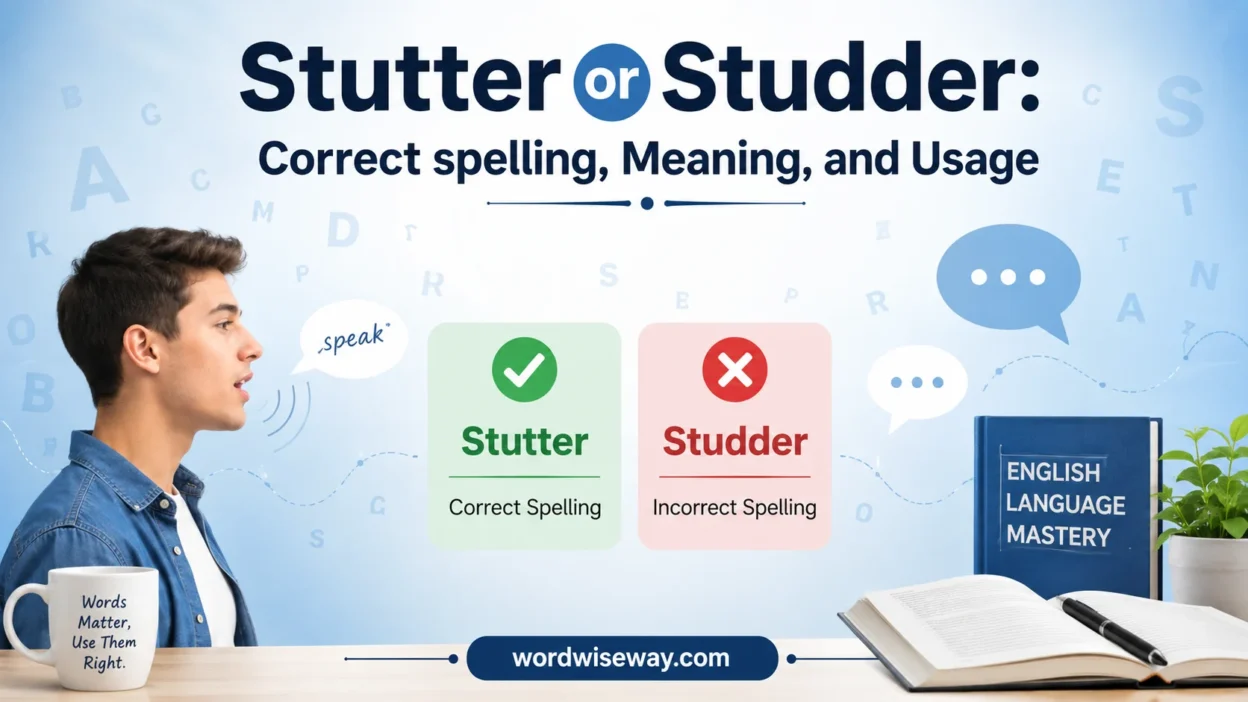
If you have ever typed Studder and wondered if it looks right, you are not alone. This guide on Stutter or Studder: Correct Spelling, Meaning, and Usage explains the correct spelling, meaning, and usage clearly.
Many people confuse these words because their sound, sounds, and pronunciation are similar in the English language. Stutter is the correct word, while Studder is an incorrect spelling and a common misspelling. The spellchecker and spell check usually flag Studder because it is not a recognized word.
The stu-der sound can trick the brain into adding the letter d instead of t, creating spelling confusion. This guide helps students, writers, and English learners understand the difference, grammar rules, and proper word usage.
Learning the correct spelling improves your writing skills, communication skills, and overall English vocabulary. This guide makes Stutter vs Studder simple with clear examples and useful explanations.
Quick Answer:
Here’s the straight truth:
- Correct spelling: stutter
- Incorrect spelling: studder
The word “stutter” refers to a speech pattern where a person repeats sounds, syllables, or struggles to produce smooth speech.
The word “studder” does not exist in standard English dictionaries. It is simply a common spelling mistake caused by how the word sounds when spoken quickly.
If you remember one thing from this article, remember this:
“Stutter” is the only correct spelling in English. “Studder” is always incorrect.
What Does “Stutter” Mean in Stutter or Studder Spelling Confusion?
To fully understand why the correct spelling matters, we first need to understand the word itself.
Stutter refers to a disruption in normal speech flow. A person who stutters may:
- Repeat sounds (like “b-b-book”)
- Stretch sounds (“ssssun”)
- Get stuck on words without sound coming out
- Experience blocks in speech
This is not just a typing issue or casual speech habit. In many cases, stuttering is a speech condition that can vary in intensity.
Everyday meaning of stutter
In simple terms, stutter means:
A person has difficulty speaking smoothly and repeats or pauses in their speech.
Example sentences
- “He started to stutter when he was nervous during the presentation.”
- “She worked hard in therapy to reduce her stutter.”
- “Stress can make a stutter more noticeable.”
Why Do People Spell It as “Studder”?
This is where things get interesting.
Even though “stutter” is correct, many people instinctively write “studder.” That happens for a few real reasons.
Pronunciation confusion
When people say “stutter” quickly, it can sound like:
- “stud-der”
- “stuh-der”
So the brain tries to match spelling with sound, and “studder” feels right even though it is not.
Typing habits and muscle memory
Fast typing often leads to:
- Doubling incorrect letters
- Guessing spelling based on sound
- Not checking dictionaries
Influence of informal writing
On social media and texting apps, people often prioritize speed over accuracy. Once a wrong spelling spreads, it gets repeated by others.
Autocorrect limitations
Some devices may not immediately correct “studder,” especially if the dictionary is not strict or updated.
Stutter vs Stammer: Are They the Same Thing?
This is a very common follow-up question, and it matters for understanding language differences.
Both words describe speech disruptions, but they are used differently depending on region.
| Term | Meaning | Common Region |
| Stutter | Speech disorder involving repetition or blocking | United States |
| Stammer | Same general condition as stutter | United Kingdom |
Key takeaway
- They describe the same speech condition
- The difference is mostly regional preference, not medical difference
So if someone in the US says “stutter” and someone in the UK says “stammer,” they are still talking about the same experience.
Is “Studder” Ever a Real Word in English?
No. Not in any official sense.
Here’s what you need to know clearly:
- “Studder” is not in dictionaries
- It is not used in medical language
- It has no linguistic origin
- It is always considered a spelling error
If you use “studder” in formal writing, it will be marked incorrect by teachers, editors, and grammar tools.
Think of it like a ghost word—something that appears in writing mistakes but never actually lived in the language.
The Linguistic Reason “Stutter” Looks Confusing
English spelling often feels messy because it doesn’t always follow sound rules. “Stutter” is a good example.
Breaking the word down
- stut + ter
The double “t” in the middle is important because it reflects repetition, which also matches the meaning of the word itself.
Why not “studder”?
There is no historical or linguistic reason for a “d” in the word. The sound people think they hear does not match the actual spelling system of English.
Correct vs Incorrect Usage Examples
Seeing examples helps lock the difference into memory.
Incorrect usage (never use this)
- ❌ “He has a slight studder when speaking.”
- ❌ “She overcame her studder in childhood.”
- ❌ “Stress can worsen a studder.”
Correct usage
- ✔ “He has a slight stutter when speaking.”
- ✔ “She overcame her stutter in childhood.”
- ✔ “Stress can worsen a stutter.”
Even if the meaning is clear, spelling still matters in formal communication.
Common Spelling Mistakes Related to “Stutter”
“Studder” is not the only mistake people make. Here are other variations that appear online:
- stuter
- stuttr
- stutterr
- studur
Why these happen
Most mistakes come from:
- Rapid typing
- Mishearing pronunciation
- Lack of familiarity with speech terms
- Predictive text errors
English learners especially struggle because the spelling is not fully phonetic.
Memory Tricks to Remember “Stutter”
If spelling it correctly feels tricky, use these simple tricks.
Trick 1: Double T = Repeated sound
The word has two “t’s” because speech repeats in a stutter.
Trick 2: Think of “utter”
“Utter” means to say something.
So:
stutter = stut + utter (speech breaks while speaking)
Trick 3: Visual pattern
Write it a few times:
- stutter
- stutter
- stutter
Your brain will start recognizing the pattern automatically.
Where You’ll Commonly See the Word “Stutter”
The word appears in many real-world contexts.
Medical and speech therapy
Speech therapists work with people who stutter to improve fluency.
Psychology
Researchers study stuttering as part of speech development and communication disorders.
Everyday conversation
People use it casually when describing nervous speech.
Media and storytelling
Movies and books sometimes include characters who stutter to show realism and emotional depth.
Case Study: Understanding Stuttering in Real Life
To understand the difference between spelling and reality, let’s look at a simple example.
Case: A student presentation anxiety
A student named Ali often speaks smoothly at home. But during class presentations, he begins to repeat sounds and pause frequently.
- At home: normal speech
- In class: speech interruptions appear
This is a typical pattern seen in situational stuttering, where stress triggers speech disruption.
With practice and speech therapy techniques like:
- Slow breathing
- Controlled pacing
- Gradual exposure to speaking situations
many people improve their fluency over time.
This case shows why the word “stutter” is used in both medical and everyday contexts.
Why Correct Spelling Matters More Than You Think
Spelling is not just about grammar rules. It affects communication clarity.
Here’s what correct spelling does:
- Improves professionalism
- Builds trust in writing
- Prevents misunderstanding
- Helps search engines find accurate content
For example, someone searching “studder meaning” is usually trying to find “stutter.” Correct spelling ensures better results and understanding.
Read More: Jewelry or Jewellery: Which Spelling Is Correct?
FAQs
What is the correct spelling, Stutter or Studder?
Stutter is the correct spelling in English. Studder is not a recognized English word and is usually considered a common spelling mistake.
Why do people confuse Stutter and Studder?
People often confuse Stutter and Studder because both words sound similar when spoken. The pronunciation can make people think a d belongs in the spelling.
What does the word Stutter mean?
Stutter means speaking with repeated sounds, words, or involuntary pauses. It is also used to describe a speech difficulty that affects fluency.
Is Studder a real word in the English language?
No, Studder is not a standard English word. It is an incorrect spelling of Stutter and should be avoided in formal writing.
How can I remember the correct spelling of Stutter?
You can remember that Stutter has two t’s. Thinking about the correct letter pattern can help prevent the mistake of writing Studder.
Is Stutter spelled differently in British and American English?
No, both British English and American English use the same spelling: Stutter. There is no difference between the two versions.
Can spellcheck help identify Stutter and Studder?
Yes, a spellchecker can help. Most spelling tools mark Studder as incorrect and suggest Stutter as the correct word.
Is Stuttering a speech disorder?
Yes, stuttering is a speech disorder related to speech fluency. It may involve repeated sounds, repeated words, or pauses while speaking.
How can writers avoid the Stutter and Studder spelling mistake?
Writers can avoid this mistake by checking dictionaries, using grammar tools, proofreading their work, and learning the correct spelling of commonly confused words.
Why is learning the difference between Stutter and Studder important?
Understanding the difference improves writing accuracy, English vocabulary, and communication. Using the correct word helps readers understand your message clearly.
Conclusion:
Understanding the difference between Stutter and Studder helps you avoid a common spelling confusion in English. While both words may sound similar, only Stutter is the correct spelling and recognized word. By learning its meaning, usage, and proper word form, you can improve your writing skills, English vocabulary, and everyday communication. Checking a dictionary, using a spellchecker, and practicing correct spelling can make your writing more accurate.
This guide makes the Stutter vs Studder difference simple by explaining the correct form, common mistakes, and examples in an easy way. Whether you are a student, writer, or English learner, knowing the right spelling helps you communicate clearly and confidently in both formal and informal writing.

Evelyn Shaw has spent 14 years at Yale University’s English Department, leading students through close readings, genre studies, and interpretive methodologies. Her scholarly interests include Renaissance drama, gothic fiction, feminist literary criticism, and archival research and examining how texts generate meaning across historical periods. Evelyn has presented at major academic conferences and published essays in peer-reviewed journals, reflecting her passion for rigorous analysis and student-centered learning.