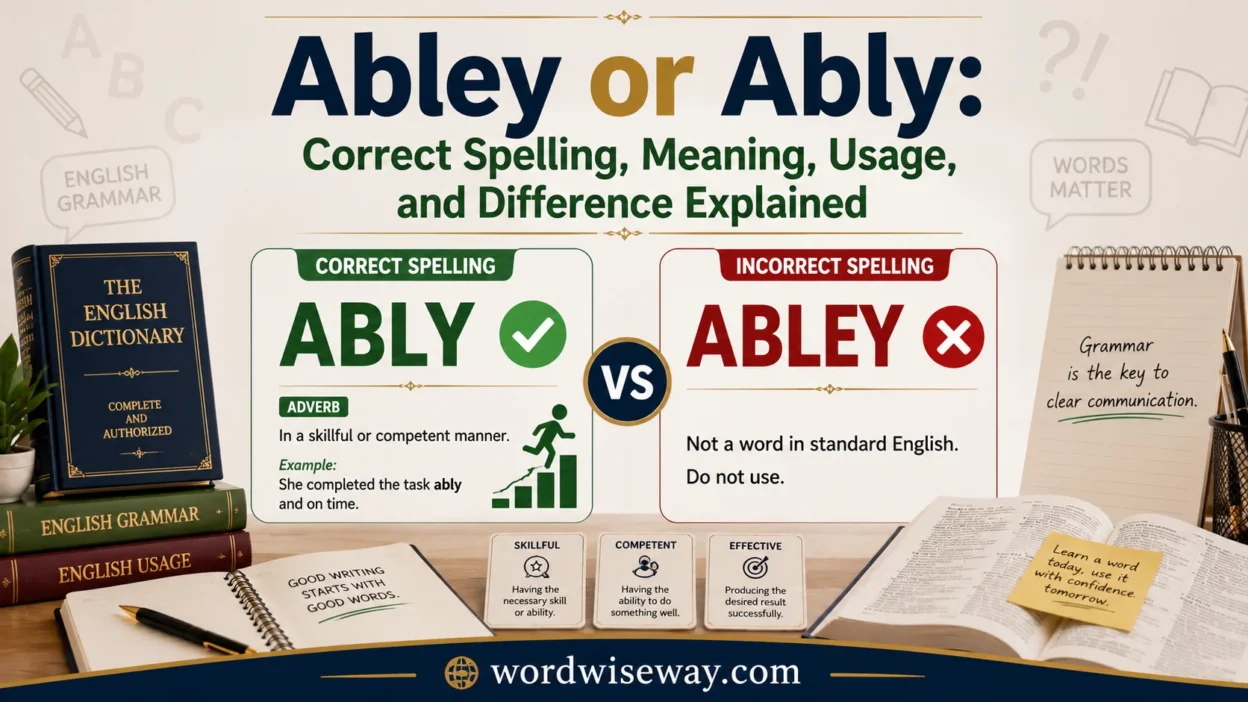
Abley or Ably: Correct Spelling, Meaning, Usage, and Difference explains the frequent point of confusion for many individuals aiming for clear and professional writing. While the root adjective able makes the addition of a y seem logical, standard English orthography requires dropping the e when converting it into an adverb form. Consequently, major dictionary sources confirm that ably is the only correct standard spelling used to describe an action performed with skill or competence.
By comparison, the spelling Abley is categorized as a common misspelling when intended as an adverb, though it legitimately exists as a proper noun or surname in public records. Understanding this specific linguistic pattern is essential for business communication, formal essays, and digital reports where maintaining credibility and a professional tone is paramount. Paying close attention to these minor spelling rules ultimately strengthens overall writing accuracy, vocabulary precision, and communication clarity.
This guide explains the meaning of ably, why abley is incorrect and ensures that your text consistently reflects the accepted standard, boosting your confidence in everyday writing.
Quick Answer:
The correct spelling is ably.
Ably is a standard English adverb that means doing something in a skilled, capable, or effective way. It describes how someone performs an action.
On the other hand, abley is not recognized as a standard English word. Although people sometimes write it because it appears to follow a logical spelling pattern, dictionaries do not accept it as the correct form.
| Word | Correct or Incorrect | Meaning |
| Ably | ✅ Correct | In a skilled, capable, or effective manner |
| Abley | ❌ Incorrect | Common misspelling of ably |
Why Do People Write Abley Instead of Ably?
The confusion happens because the base word is able.
When people see:
able + ly
they naturally think:
ablely or ably?
Many English learners expect the original word to stay unchanged when adding a suffix. However, English often changes spelling during word formation.
For example:
| Base Word | Correct Adverb |
| Able | Ably |
| Gentle | Gently |
| Simple | Simply |
| Comfortable | Comfortably |
The final e often disappears before adding -ly.
Quick Memory Trick for Ably
Remember this simple pattern:
Able loses the “e” and becomes ably.
Think of the extra “e” as taking a small vacation before -ly joins the word.
✅ She handled the situation ably.
❌ She handled the situation abley.
What Does Ably Mean?
The word ably works as an adverb. It explains the quality or manner of an action.
According to standard English usage, ably means:
- Skillfully
- Competently
- Successfully
- Effectively
- With ability
When someone completes a task ably, they do it with confidence and skill.
For example:
“The manager ably guided the team through the difficult transition.”
This sentence tells readers that the manager did more than simply guide the team. The manager handled the responsibility well.
Ably Definition Explained Simply
Imagine two people organizing the same event.
The first person completes the task but struggles with every step.
The second person plans carefully, solves problems quickly, and keeps everything organized.
The second person handled the responsibility ably.
The word focuses on the quality of performance.
Ably as an Adverb
An adverb describes a verb. It answers questions like:
- How?
- In what way?
- With what level of skill?
Examples:
- The doctor ably treated the patient.
- The teacher ably explained the difficult lesson.
- The athlete ably performed under pressure.
In each example, ably describes how the action happened.
Ably vs Able: Understanding the Difference
Although able and ably come from the same root word, they have different jobs in a sentence.
Able is an adjective. It describes someone’s ability or capability.
Ably is an adverb. It describes the way someone performs an action.
| Word | Part of Speech | Meaning | Example |
| Able | Adjective | Having the ability to do something | She is able to solve the problem. |
| Ably | Adverb | Doing something skillfully | She solved the problem ably. |
When to Use Able
Use able when you are talking about capability.
Examples:
- I am able to finish the assignment today.
- He is able to speak three languages.
- The machine is able to process large amounts of data.
In these sentences, able describes whether someone or something has the ability to do something.
When to Use Ably
Use ably when you describe the performance of an action.
Examples:
- She ably managed the customer complaints.
- The leader ably handled the crisis.
- The writer ably explained the complicated topic.
Here, ably does not describe a person’s ability. Instead, it describes how the action was completed.
Why Is Ably Spelled Without the Extra “E”?
English spelling rules can feel like a puzzle box. Some patterns are predictable while others come from centuries of language development.
The word ably comes from:
Able + ly = Ably
The final “e” is removed because the suffix -ly already begins with a letter that allows the word to remain easy to pronounce.
Understanding the Word Formation
The adjective:
Able = having the skill or power to do something
becomes the adverb:
Ably = doing something with skill
This transformation changes the role of the word.
Compare:
- He is an able employee.
- He works ably with the team.
The first sentence describes the person.
The second sentence describes the person’s performance.
Similar Spelling Changes
Many English words follow similar patterns.
| Original Word | New Word | Meaning |
| Capable | Capably | In a capable way |
| Comfortable | Comfortably | In a comfortable way |
| Probable | Probably | Most likely |
| Reasonable | Reasonably | In a reasonable way |
Common Mistakes When Using Ably
Even though ably is a simple word, writers often make a few mistakes when using it. Understanding these errors helps you avoid them and improve your overall writing accuracy.
Writing Abley Instead of Ably
The most common mistake is adding the extra “e” and writing abley.
Incorrect:
The manager abley handled the difficult situation.
Correct:
The manager ably handled the difficult situation.
The incorrect version looks reasonable at first glance because it keeps the spelling of able. However, standard English removes the final e before adding -ly.
A helpful rule to remember:
Able → Ably
Capable → Capably
Comfortable → Comfortably
The spelling changes slightly, but the meaning stays connected.
Using Ably as an Adjective
Another common mistake happens when people use ably to describe a person.
Incorrect:
She is an ably employee.
Correct:
She is an able employee.
Why?
Because able describes a person’s capability, while ably describes an action.
Compare:
| Incorrect Use | Correct Use |
| He is an ably worker. | He is an able worker. |
| She is an ably leader. | She is an able leader. |
| He completed the task able. | He completed the task ably. |
A quick test can help:
- If you are describing someone or something, use able.
- If you are describing how an action happens, use ably.
Using Ably Without an Action
Because ably is an adverb, it usually needs a verb to modify.
Incorrect:
The employee was ably.
Correct:
The employee worked ably.
The word needs an action because it explains the quality of that action.
Examples:
- The lawyer argued ably.
- The engineer solved the problem ably.
- The teacher explained the lesson ably.
Without an action, the sentence feels incomplete.
Ably in Different Types of Writing
The word ably appears frequently in formal writing because it describes competence and successful performance. It works especially well when discussing leadership, teamwork, professional skills, or achievements.
Using Ably in Professional Writing
In workplaces, ably often appears in:
- Performance reviews
- Business reports
- Recommendation letters
- Company announcements
- Project summaries
For example:
The project manager ably coordinated the team and delivered the project before the deadline.
This sentence highlights both leadership and successful execution.
Another example:
Sarah ably managed customer relationships during the company’s expansion.
Here, ably shows that Sarah handled her responsibilities effectively.
Using Ably in Academic Writing
Students and researchers can use ably when describing someone’s ability to explain, analyze, or complete academic work.
Examples:
The author ably explains the connection between technology and education.
The researcher ably presents evidence to support the argument.
However, academic writing should avoid unnecessary praise. Use ably when the skill or effectiveness is genuinely relevant.
Using Ably in Everyday Conversations
Although ably sounds slightly formal, people use it naturally in many situations.
Examples:
- My brother ably organized the family event.
- She ably answered all the interview questions.
- The captain ably led the team during the match.
In casual conversations, people may choose simpler words like well, skillfully, or successfully.
For example:
She handled the situation well.
and:
She handled the situation ably.
Both are correct, but ably sounds more polished and emphasizes skill.
Ably Synonyms and Alternatives
The English language offers several words with meanings close to ably. However, each synonym carries a slightly different shade of meaning.
Choosing the right word makes your writing more precise.
| Synonym | Meaning | Example |
| Skillfully | With technical ability or expertise | The artist skillfully created the painting. |
| Competently | With enough ability to complete a task | She competently managed the assignment. |
| Effectively | Producing the desired result | The team effectively solved the issue. |
| Successfully | Achieving the intended goal | He successfully completed the project. |
| Efficiently | Completing something with minimal waste | The company efficiently managed resources. |
Ably vs Skillfully
Both words show ability, but they focus on different things.
Ably focuses on overall successful performance.
Skillfully focuses more on technique or talent.
Examples:
The surgeon ably managed the operation.
This emphasizes professional handling.
The artist skillfully painted the portrait.
This emphasizes artistic technique.
Ably vs Effectively
These words are close but not identical.
Ably focuses on capability.
Effectively focuses on results.
Compare:
The teacher ably explained the topic.
This means the teacher explained it with skill.
The teacher effectively explained the topic.
This means students understood the topic because of the explanation.
Sometimes both words work, but they highlight different qualities.
Examples of Ably Used in Sentences
Seeing real examples makes the meaning easier to remember.
Workplace Examples
- The supervisor ably guided the new employees through training.
- The manager ably solved problems during the busy season.
- The consultant ably advised the company on important decisions.
Academic Examples
- The student ably defended the research project.
- The professor ably explained complex scientific concepts.
- The writer ably presented the historical background.
Leadership Examples
- The leader ably managed the organization during a challenging period.
- The captain ably motivated the team before the competition.
- The director ably handled unexpected changes.
Everyday Examples
- She ably organized the neighborhood event.
- He ably repaired the equipment.
- They ably completed the difficult assignment.
Case Study: How Choosing Ably Improves Writing
Consider these two sentences:
Sentence 1:
The manager did a good job handling the project.
Sentence 2:
The manager ably handled the project.
Both sentences communicate a positive idea. However, the second sentence is more specific.
The word ably tells readers that the manager demonstrated skill and competence. It removes vague wording like “did a good job” and replaces it with a precise description.
This matters in professional writing where clear language creates stronger impressions.
For example:
A performance review might say:
“John ably managed the department’s transition to the new system.”
This sounds more professional than:
“John did well with the new system.”
The first sentence provides a clearer picture of John’s ability.
Facts About the Word Ably
Here are some useful facts about ably:
- Word type: Adverb
- Root word: Able
- Suffix: -ly
- Meaning: In a capable or skilled manner
- Common mistake: Writing “abley”
- Opposite meanings: Poorly, badly, incompetently
- Common contexts: Leadership, professional writing, academic discussions, reviews
Read More: Complaint vs Complain: Meaning, Difference, Correct Usage
Frequently Asked Questions:
1. Is “abley” a real word in the English language?
No, “abley” is not recognized as a real word or a valid adverb in standard English dictionaries. It is considered a spelling error when people try to turn the adjective “able” into an adverb.
2. What is the correct adverb form of the word “able”?
The correct adverb form is “ably.” When adding the adverbial suffix “-ly” to words ending in a consonant followed by “le” (like able, gentle, or humble), you drop the “le” before adding the suffix.
3. What does the word “ably” mean?
“Ably” means to perform an action with skill, competence, talent, or in an efficient manner. If you do a job ably, you do it well.
4. Why do so many people write “abley” instead of “ably”?
Many writers make this mistake because they look at the base adjective “able” and naturally assume you just add “-ly” to the end of it, similar to how “quick” becomes “quickly.”
5. Can “Abley” ever be used correctly as a proper noun?
Yes, “Abley” can be correctly used when it is a proper noun, such as a surname (family last name) or the name of a specific company, place, or brand.
6. How can I use the word “ably” in a sentence?
You can use it to describe how an action is performed. For example: “She ably managed the entire project from start to finish.”
7. Does the spelling difference change between US and UK English?
No, both American English and British English recognize “ably” as the only correct spelling for the adverb. Neither style guide accepts “abley.”
8. How can I remember to drop the “e” when writing this word?
A good trick is to remember that “ably” rhymes with “capably” and “dependably.” Adjectives ending in “-able” always drop the “e” to become “-ably.”
9. What are some common synonyms for the adverb “ably”?
Some common words with the same meaning include competently, skillfully, efficiently, effectively, and expertly.
10. Will spellcheckers catch the word “abley” if I type it?
Yes, most modern word processors, email clients, and digital communication tools will flag “abley” as a misspelling and suggest “ably” as the correction.
Conclusion:
In summary, understanding the distinction between ably and abley is a simple yet powerful way to elevate the quality of your professional writing. While the root word able frequently tricks the eye into adding a standard suffix, standard English conventions strictly dictate dropping the “e” to form the correct adverb, ably. Falling into the habit of using the incorrect form can subtly undermine your professional tone and reader perception in critical formats like essays, emails, and reports.
Ultimately, maintaining writing accuracy relies heavily on internalizing these core grammar patterns and relying on trusted style guides. By consciously replacing spelling confusion with the proper adverb, you preserve your communication clarity and build stronger workplace credibility. Prioritizing these subtle details ensures your voice remains authoritative, competent, and polished across all forms of digital and formal communication.

Emma Smith has dedicated 14 years to Princeton University’s English Department, mentoring students in textual interpretation, literary movements, and critical frameworks. Her research explores Shakespearean drama, Victorian serial fiction, postcolonial narrative theory, and manuscript studies and probing how literary forms evolve across cultures and centuries. Emma has delivered lectures at international humanities congresses and published findings in distinguished academic journals, underscoring her commitment to scholarly depth and vibrant teaching.