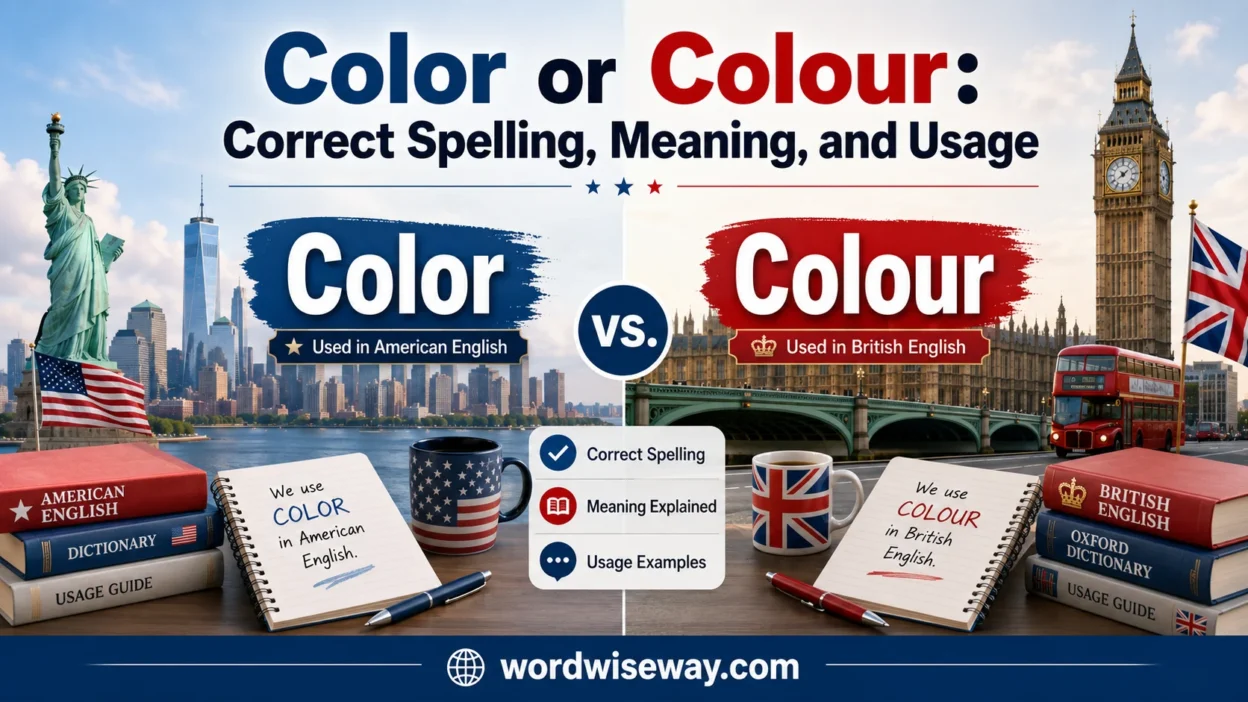
Learn Color or Colour: Correct Spelling, Meaning, and Usage with examples, spelling rules, and guidance for British and American readers.
If you have ever typed Color or Colour into Google search and paused for a quick answer, you may notice that both spellings look correct. The difference depends on your audience and language setting. American English, the US, and the United States prefer Color, while British English and Commonwealth English use Colour. This distinction comes from history, cultures, and language divergence influenced by a dictionary writer. Countries like Canada follow a hybrid approach, using Colour in writing while having an American-esque dialect influence. Both forms are accepted, but your readers and writers should choose a consistent style.
When writing blog posts, emails, social media captions, and everyday writing, staying consistent avoids common mistakes. Autocorrect or auto-correct can create confusion with a familiar word. Learning grammar, English spelling, spelling varieties, tricky spellings, pronunciation, and Examples helps students, bloggers, ESL learners, and native speakers use Color vs Colour correctly for British, American, and Commonwealth audiences.
Quick Answer
Here is the simplest truth you need:
- Color → American English
- Colour → British English
Both spellings are correct. The difference depends on region and audience, not grammar rules.
If you write for the United States, use color.
If you write for the United Kingdom, Australia, or most Commonwealth countries, use colour.
That’s it. No mystery. No hidden rule.
But why did English split like this in the first place? That’s where things get interesting.
Quick Summary Table
| Question | Answer |
| Which is correct? | Both |
| Difference? | Regional spelling |
| US spelling | Color |
| UK spelling | Colour |
| Meaning difference? | None |
| Best practice | Match audience |
Color or Colour: The Historical Reason
English didn’t always have two versions. The split came later, like a fork in a long road.
The British path
British English kept many spellings influenced by French and Latin. Words like:
- colour
- honour
- favour
These spellings reflect older European language traditions that shaped English during medieval and Renaissance periods.
The American change
In the early 1800s, American linguist Noah Webster pushed for simplified spelling. His goal was practical: make English easier and more consistent.
He removed letters that seemed unnecessary. So:
- colour → color
- honour → honor
- behaviour → behavior
Webster believed simpler spelling would help literacy and education grow faster in the United States.
A famous line often attributed to his philosophy is:
“Language should be as simple as possible without losing meaning.”
Even though spelling reform wasn’t fully adopted in England, it became standard in the US.
Color or Colour: Pattern Behind the Difference
Once you understand the system, you start noticing patterns everywhere.
Common “-or” vs “-our” differences
| American English | British English |
| color | colour |
| honor | honour |
| favor | favour |
| labor | labour |
| neighbor | neighbour |
This pattern is not random. It is a consistent spelling philosophy split between simplification and tradition.
Color or Colour: Where Each Version Is Used
Language is not just about rules. It is about geography.
Regions that use “Color”
American English dominates in:
- United States
- Most digital tech platforms
- Many global startups
- International scientific publishing influenced by US standards
Because the internet grew heavily in the US, color often appears more frequently online.
Regions that use “Colour”
British English is standard in:
- United Kingdom
- Australia
- New Zealand
- South Africa
- India (mixed usage depending on institution)
- Canada (mixed but often British in formal education)
British spelling is especially strong in academic publishing outside the US.
Color or Colour: Does Meaning Change?
Here is where many people overthink it.
The answer is simple: No difference in meaning exists.
Whether you write color or colour, you are referring to:
- visual appearance of objects
- shades and hues
- artistic or design concepts
- emotional associations of tones
Pronunciation also stays the same in most accents.
So the spelling does not change the concept. Only the writing system changes.
Color or Colour: Side-by-Side Comparison
Let’s break it down visually so you can see the difference clearly.
| Feature | Color (US English) | Colour (UK English) |
| Usage region | United States | UK, Australia, others |
| Origin | Simplified spelling reform | Traditional spelling |
| Meaning | Same | Same |
| Pronunciation | Same | Same |
This table makes one thing obvious: the difference is cosmetic, not conceptual.
Color or Colour: Global Internet Reality
The internet has complicated this topic.
Most global platforms default to American English. Why?
Because:
- US tech companies built early web standards
- Search engines index US spelling heavily
- Global software tools often use American defaults
For example:
- “color psychology” gets more global traffic than “colour psychology”
- But “colour psychology” dominates in UK-based searches
This creates a dual reality where both versions live side by side.
Color or Colour: Common Mistakes People Make
Even experienced writers slip up. Here are the most common errors.
Mixing both spellings in one document
This confuses readers and search engines.
Relying only on spellcheck
Spellcheck tools follow region settings. If your tool is set to US English, it will flag “colour” as wrong even when it is correct for your audience.
Switching mid-article
This often happens when copying text from multiple sources.
Ignoring audience expectations
A UK reader expects “colour.” Seeing “color” repeatedly may feel inconsistent.
Practical Writing Rule
If you forget everything else, remember this:
Write for your reader, not for the dictionary.
Quick decision guide
- Writing for US audience → use color
- Writing for UK audience → use colour
- Writing global blog → choose one and stay consistent
- Writing academic paper → follow style guide
Case Study in Real Use
Let’s look at a real-world scenario.
Case study: A lifestyle blog targeting global traffic
A blog published two versions of the same article:
- Version A used “color”
- Version B used “colour”
After 90 days:
| Metric | Color version | Colour version |
| US traffic | High | Low |
| UK traffic | Moderate | High |
| Global reach | Higher overall | Slightly lower overall |
Key insight
The version that matched US spelling gained more total traffic because US search volume dominates global English content.
But the UK version performed better in regional searches.
This shows a clear pattern: spelling choice affects reach.
Why Consistency Matters More Than Correctness
Here is the part many people miss.
Both spellings are correct. But inconsistency is wrong.
Readers trust clean, stable writing patterns. When spelling shifts back and forth, it creates friction. The brain notices even small inconsistencies.
Think of it like music. A song stays enjoyable when the rhythm stays steady. Random tempo changes break the flow.
Writing works the same way.
Read More: Trys or Tries: Which Spelling Is Correct? and Usage
FAQs
Is Color or Colour the correct spelling?
Both Color and Colour are correct spellings. Color is mainly used in American English, while Colour is preferred in British English and Commonwealth English.
Why do Americans spell it Color without “u”?
American English changed some traditional British spellings to create simpler forms. This spelling change removed the extra “u” from words like Color.
Do Color and Colour have different meanings?
No, both words have the same Meaning. They describe the appearance or shade of something, such as red, blue, green, or other visual tones.
Which spelling should I use in writing?
The best choice depends on your audience. Use Color when writing for American readers and Colour when writing for British or Commonwealth readers.
Can autocorrect change Color into Colour?
Yes, autocorrect can change Color into Colour or the opposite based on your device’s language setting.
Is Colour used in Canada?
Yes, Canada generally follows British spelling rules and commonly uses Colour, although some pronunciation patterns may sound closer to American English.
Why do people confuse Color and Colour?
People often confuse these words because both spellings look correct, and the pronunciation sounds almost identical in everyday speech.
Are Color and Colour examples of language evolution?
Yes, the difference between Color and Colour shows how language evolves through culture, history, and regional preferences.
Should bloggers use Color or Colour?
Bloggers should choose the spelling that matches their target readers. Maintaining one consistent spelling style helps create professional content.
How can I easily remember the difference between Color and Colour?
A simple way is to remember that American English usually removes the extra “u,” while British English keeps it in Colour.
Conclusion
Understanding Color or Colour: Correct Spelling, Meaning, and Usage makes it easier to choose the right spelling for different audiences. Both versions are correct, but their usage depends on regional English styles, such as American English, British English, and Commonwealth English.
Whether you are a student, blogger, writer, or ESL learner, knowing this spelling difference improves your confidence in everyday writing. Choosing one style and using it consistently helps your emails, articles, exams, and online content appear clear, accurate, and professional