Understanding Complaint vs Complain: Meaning, Difference, Correct Usage remains essential for every writer aiming for complete accuracy. From my years of editing, I have noticed that few grammar pairs trip up eager English learners and even seasoned fluent writers or native speakers as much as this precise linguistic distinction.
In everyday talk, rapid online exchanges, and casual conversations, these two words look and sound so similar that people regularly mistype them, causing an unnecessary hullabaloo in clear communication. The secret always lies in choosing the right grammatical roles: a complaint acts as the noun form, representing physical or emotional things like discontent, pain, grief, unhappiness, discomfort, unease, or general dissatisfaction.
When we look up trusted resources like Merriam-Webster, Cambridge Dictionary, Britannica, or follow Oxford-style usage, the rules for maintaining structural accuracy are clear. In formal settings such as drafting academic writing, structuring complex legal writing documents, logging medical reports regarding a patient, or sending crucial workplace emails about unforeseen delays a single error or a few careless errors can instantly alter your professional tone.
This comprehensive guide highlights the distinct functions of each word, using clear sentence examples and structured tables to break down the exact grammar patterns industry professionals rely on to communicate effectively.
Quick Answer:
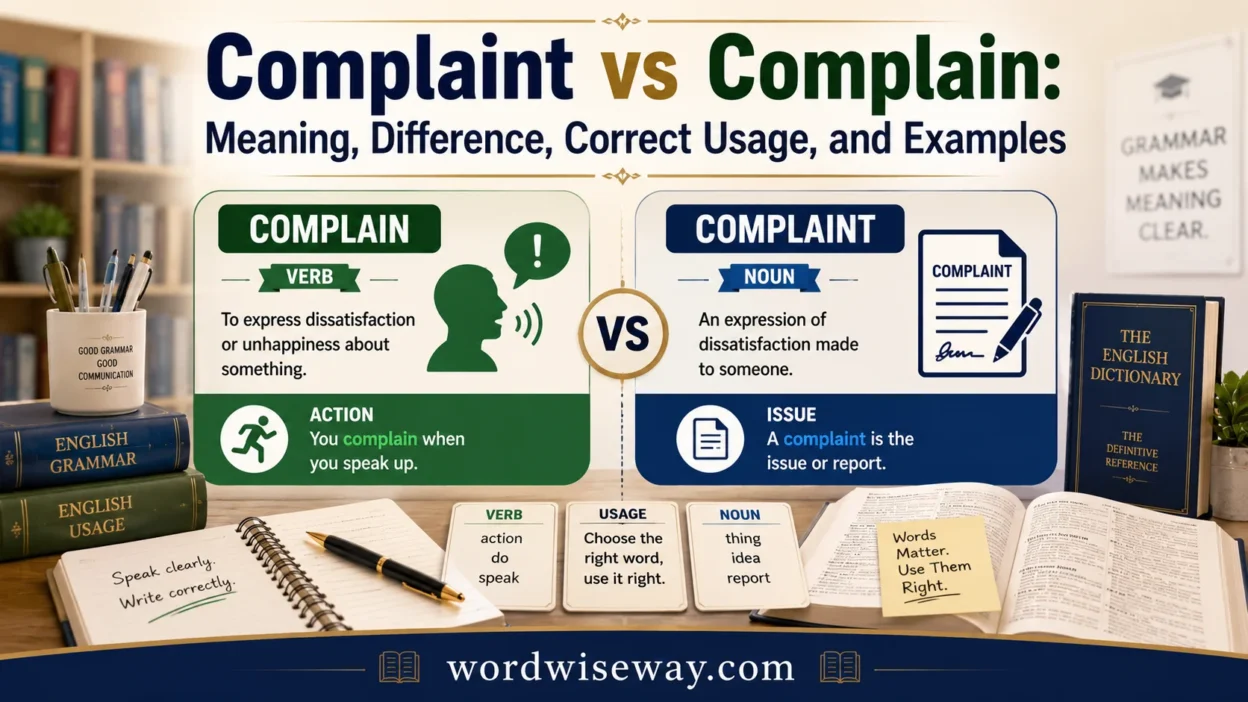
Complain is a verb that means to express dissatisfaction, annoyance, or unhappiness about something.
Complaint is a noun that means a problem, concern, or statement made because someone is unhappy with a situation.
| Word | Part of Speech | Meaning | Example |
| Complain | Verb | To express dissatisfaction | Customers complain about late deliveries. |
| Complaint | Noun | A problem or statement of dissatisfaction | Customers filed a complaint about late deliveries. |
A quick memory trick:
You complain. You make a complaint.
If someone performs the action, use complain. If you are talking about the issue itself, use complaint.
Complaint vs Complain: Main Difference Explained
Although these words look almost identical, they perform different jobs in English sentences.
Think about the difference between an action and a result:
- Running is an action.
- A race is the event connected to that action.
The same idea applies here:
- Complain is the action.
- Complaint is the issue or statement created from that action.
For example:
Sarah complained about the poor internet connection. Her complaint was sent to the service provider.
In this example:
- Complained explains what Sarah did.
- Complaint explains what was submitted.
Both words are connected, but each has a separate role.
What Does Complain Mean?
Complain is a verb that means to express dissatisfaction, disagreement, discomfort, or unhappiness about something.
People complain about many different situations, including:
- Poor customer service
- Workplace problems
- Unfair treatment
- Physical discomfort
- Delays or mistakes
- Personal frustrations
When you use complain, you are describing an action someone takes.
Examples of Complain in Sentences
- She complained about the noisy neighbors.
- Many customers complain when orders arrive late.
- He complained that the instructions were confusing.
- Employees often complain about unclear communication.
In each example, someone is actively expressing dissatisfaction. That is why complain works as a verb.
Common Sentence Patterns With Complain
English speakers usually use complain in a few common sentence structures.
Complain About Something
This is the most common pattern.
Examples:
- I complained about the damaged product.
- They complain about the high prices.
- The passengers complained about the flight delay.
The word about introduces the thing causing dissatisfaction.
Complain That Something Is Wrong
This structure explains the reason behind the complaint.
Examples:
- She complained that the room was too cold.
- Employees complained that the new schedule was difficult.
- He complained that nobody answered his questions.
The word that connects the complaint with the situation being described.
Complain To Someone
Use this structure when you mention the person or organization receiving the complaint.
Examples:
- I complained to the manager.
- The customer complained to the company.
- She complained to her teacher about the unfair decision.
The person after to receives the complaint.
What Does Complaint Mean?
Complaint is a noun that refers to an expression of dissatisfaction, a problem, or an official report about something unwanted.
Unlike complain, which shows an action, complaint names the issue.
Common phrases with complaint include:
- Make a complaint
- File a complaint
- Submit a complaint
- Receive a complaint
- Investigate a complaint
- Resolve a complaint
Examples of Complaint in Sentences
- The customer filed a complaint about the damaged package.
- The manager received several complaints from employees.
- Her main complaint was the lack of communication.
- The company responded to the customer’s complaint quickly.
Here, the complaint exists as a thing, so it works as a noun.
Types of Complaints and Their Uses
The meaning of complaint stays similar, but its purpose changes depending on the situation.
Formal Complaints
A formal complaint usually follows an official process. People use this type of complaint when they expect an organization or authority to respond.
Common examples include:
- Workplace complaints
- Consumer complaints
- School complaints
- Service complaints
Example:
A customer filed a formal complaint after receiving a damaged product.
The complaint creates a record that can be reviewed and handled.
Informal Complaints
Informal complaints happen in normal conversations. They usually express personal frustration rather than request official action.
Examples:
- My only complaint about this restaurant is the slow service.
- His biggest complaint is the lack of free time.
- Their complaint was about the loud music.
These complaints are often personal opinions.
Legal Complaints
In legal settings, a complaint has a specific meaning.
A legal complaint is an official document that explains a person’s claim and begins a legal process in many court systems.
Examples:
- A person files a complaint against a company.
- A business responds to a legal complaint.
This meaning is more formal than everyday complaints.
Complaint vs Complain: Grammar Difference
The main grammar difference between these words is their function.
| Feature | Complaint | Complain |
| Grammar role | Noun | Verb |
| Describes | A problem or statement | An action |
| Can follow “a/the”? | Yes | No |
| Common phrase | File a complaint | Complain about something |
| Example | I made a complaint. | I complained yesterday. |
A simple grammar test can help:
Ask:
Is someone doing the action?
If yes, use complain.
Example:
- They complained about the service.
Ask:
Is this the problem, report, or issue?
If yes, use complaint.
Example:
- Their complaint was about the service.
Common Mistakes When Using Complaint and Complain
Many writers understand that complaint and complain are related, but they still use them incorrectly in sentences. These mistakes usually happen because the words look similar and share the same meaning.
The easiest way to avoid errors is to remember their grammar roles:
- Complain = action
- Complaint = thing, issue, or report
Let’s look at the most common mistakes and how to fix them.
Using Complaint as a Verb
One of the most frequent mistakes is using complaint when you need a verb.
Incorrect:
I want to complaint about the poor service.
Correct:
I want to complain about the poor service.
Why?
Because want to must be followed by a verb. The action you want to perform is complain, not complaint.
More examples:
❌ She will complaint about the noise.
✅ She will complain about the noise.
❌ They complaint about the delay yesterday.
✅ They complained about the delay yesterday.
Using Complain as a Noun
Another common mistake is using complain as if it were a noun.
Incorrect:
I submitted a complain to the company.
Correct:
I submitted a complaint to the company.
Why?
The word after a must usually be a noun. Since you are submitting a report or issue, you need complaint.
More examples:
❌ The manager received a customer complain.
✅ The manager received a customer complaint.
❌ He made a complain about the product.
✅ He made a complaint about the product.
Confusing Complaint With Complaining
Many people also confuse complaint with complaining.
Although they are connected, they have different meanings.
| Word | Meaning | Example |
| Complaint | A specific issue or statement | Her complaint was about the late delivery. |
| Complaining | The activity of expressing dissatisfaction | Constant complaining can affect teamwork. |
Compare these sentences:
His complaint was reasonable.
This means his specific concern made sense.
His complaining was annoying.
This means the repeated action of expressing dissatisfaction became frustrating.
Complaint vs Complain vs Complaining vs Complained
English changes word forms depending on how you use them in a sentence.
Understanding these forms helps you write naturally.
| Word Form | Grammar Role | Meaning | Example |
| Complaint | Noun | A problem or statement of dissatisfaction | She filed a complaint. |
| Complain | Base verb | To express dissatisfaction | Customers complain about delays. |
| Complained | Past tense verb | Expressed dissatisfaction in the past | He complained yesterday. |
| Complaining | Verb form/Gerund | The act of expressing dissatisfaction | Complaining will not solve the problem. |
How Each Form Works
Complaint
Use it when you talk about the issue itself.
Example:
The customer’s complaint was investigated.
The company is investigating the problem, not the action.
Complain
Use it when someone performs the action.
Example:
The customer complained to the manager.
The customer is doing something.
Complained
Use it when the action happened before now.
Example:
Several employees complained about the new policy last week.
Complaining
Use it when the action continues or acts as a noun.
Example:
Complaining without offering solutions does not help.
Complaint vs Complain Examples in Different Situations
The difference becomes clearer when you see both words used in real-life situations.
Customer Service Examples
Customer service is one of the most common areas where these words appear.
Imagine you purchase a laptop online, but it arrives damaged.
You might say:
I want to complain about the damaged laptop.
Here, complain describes your action.
The company may respond:
We have received your complaint and will review the issue.
Here, complaint refers to the official record of the problem.
A customer service team usually tracks complaints because they represent specific issues that need solutions.
Workplace Examples
Work environments often involve complaints about communication, workload, policies, or management decisions.
Example:
Employees complained about the lack of training.
The employees expressed dissatisfaction.
Later, a manager might say:
We reviewed the employees’ complaints and created a new training program.
The complaints became documented issues that required attention.
A workplace complaint can help organizations identify problems before they grow into bigger challenges.
Everyday Conversation Examples
In casual conversations, people often use complain to describe regular expressions of frustration.
Examples:
My brother always complains about homework.
This means he often expresses unhappiness about homework.
Another example:
Her only complaint about the movie was the ending.
This means the ending was the one problem she noticed.
Notice how both words can appear in the same topic:
Tom complained about the restaurant, but his only complaint was the slow service.
The first word describes the action. The second describes the specific issue.
Complaint vs Complain: Synonyms and Related Words
Learning similar words can improve your vocabulary, but you should understand that synonyms often carry slightly different meanings.
Synonyms for Complaint
Common alternatives include:
| Word | Meaning | Example |
| Grievance | A serious complaint about unfair treatment | She reported a workplace grievance. |
| Concern | A worry or issue that needs attention | He raised concerns about safety. |
| Objection | A disagreement with something | They expressed an objection to the decision. |
| Criticism | A negative opinion or evaluation | The product received criticism from users. |
| Protest | A public expression of disagreement | The group organized a protest. |
Not every synonym fits every situation.
For example:
- A customer usually makes a complaint.
- An employee may raise a grievance.
- A person may express a concern.
The right word depends on the situation.
Synonyms for Complain
Common alternatives include:
| Word | Meaning | Example |
| Grumble | Complain in an annoyed way | He grumbled about the weather. |
| Protest | Express strong disagreement | They protested against the decision. |
| Object | Say you disagree | She objected to the new rule. |
| Criticize | Point out problems | Experts criticized the design. |
| Report | Inform someone about a problem | He reported the issue to support. |
Some words are stronger than others.
For example:
- Grumble sounds casual and slightly negative.
- Protest sounds more serious and public.
- Report sounds more neutral and professional.
How to Remember the Difference Between Complaint and Complain
A simple memory trick can prevent most mistakes.
Remember:
Complain = Complete the action
Someone complains.
Complaint = Complete the issue
Someone makes or files a complaint.
Here is a simple sentence that uses both correctly:
The customer complained about the broken product, and the company recorded the complaint.
The first word tells what happened. The second word identifies the problem.
Another easy trick:
If you can put “a” before the word, you probably need complaint.
Correct:
I made a complaint.
Incorrect:
I made a complain.
If you need a verb after words like:
- want to
- need to
- will
- should
- can
use complain.
Examples:
- I want to complain.
- You should complain.
- They will complain.
Read More: Yea or Nay: Meaning, Difference, Correct Usage
Frequently Asked Questions
1. What is the main difference between “complaint” and “complain”?
The core distinction lies in their grammatical roles. Complaint is a noun form that represents a tangible statement, document, or feeling of discontent. Conversely, complain (and its variations like complains) is a verb form that describes the actual actions or expression of those negative feelings.
2. How can I easily remember when to use the noun form?
A great memory trick for non-native users and English learners is to look at the last letter of the word. Complaints end with a “T,” which stands for “thing” or a tangible object (like a written letter or a formal notification).
3. What are some sentence examples using “complain” as a verb?
In everyday speech or online exchanges, you use it to show action:
- “Customers often complain about shipping delays.”
- “He complains whenever the restaurant serves a cold meal.”
4. What are some sentence examples using “complaint” as a noun?
You use this form when referring to a specific issue, formal statement, or product defect:
- “The HR department filed a formal complaint.”
- “The patient logged a severe complaint about back pain.”
5. Why do fluent writers sometimes make errors with these words?
Because they sound and look incredibly similar, even fluent writers or native speakers can mistype them during rapid conversations or when drafting workplace emails. It is usually a mechanical typo rather than a lack of understanding.
6. Where can I find trusted resources to verify grammar patterns?
For absolute linguistic accuracy, you can check authoritative dictionaries like Merriam-Webster, Cambridge Dictionary, Britannica, or follow traditional Oxford-style usage guides to study their distinct functions.
7. How does mixing up these terms affect academic writing or legal writing?
Using the wrong form introduces a grammatical error that disrupts the tone and clarity of your documents. In professional environments like legal writing or medical reports, these errors look unprofessional and obscure your precise meaning.
8. Is “complaint” only used for formal grievances?
No, it applies to both real-life scenarios and formal settings. It can represent a major lawsuit or a minor expression of unease, grief, unhappiness, discomfort, or dissatisfaction during casual conversations.
9. Can “complain” be used as a synonym for “hullabaloo”?
No, they serve completely different roles. While making a complaint can sometimes cause a hullabaloo (a fuss or commotion), complain is an action verb, so choosing the exact term matters significantly for structural precision.
10. How can I practice to avoid these common mistakes?
Reviewing curated tables that contrast the noun and verb forms side-by-side is highly effective. Practicing with real-world context—like writing product reviews, managing customer service messages, or drafting school assignments—will quickly build your writing confidence.
Conclusion:
Mastering the distinction between complaint as a noun form and complain as a verb form is a vital milestone for English learners and fluent writers alike. Solidifying your understanding of these grammatical roles instantly eliminates a frequent error from your daily speech, online exchanges, or school assignments, ensuring your text remains completely flawless.
Maintaining this structural accuracy in academic writing, legal writing, or workplace emails directly safeguards your professional tone. Prioritizing semantic precision over an incorrect synonym when describing a service issue or lodging formal grievances ensures your core meaning hits its intended mark without creating any unnecessary hullabaloo.

Emma Smith has dedicated 14 years to Princeton University’s English Department, mentoring students in textual interpretation, literary movements, and critical frameworks. Her research explores Shakespearean drama, Victorian serial fiction, postcolonial narrative theory, and manuscript studies and probing how literary forms evolve across cultures and centuries. Emma has delivered lectures at international humanities congresses and published findings in distinguished academic journals, underscoring her commitment to scholarly depth and vibrant teaching.