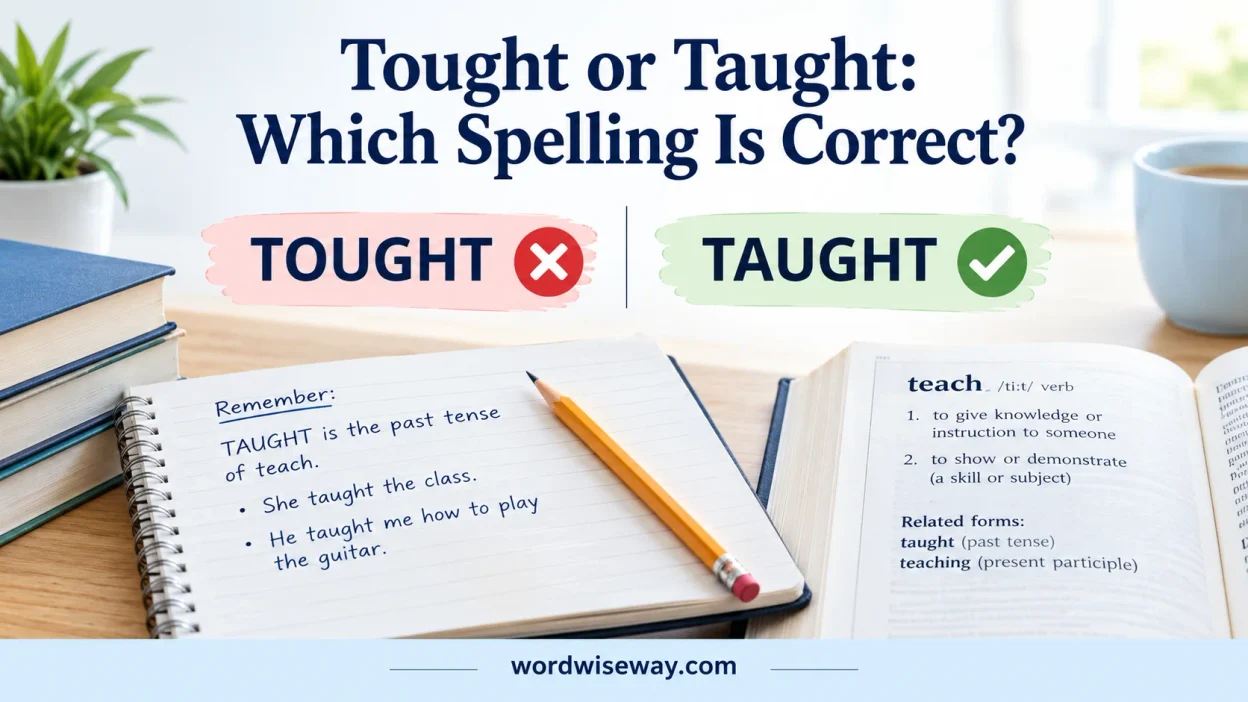
Tought or Taught: Correct Spelling,Meaning, and Usage can confuse English learners and native speakers because the forms look and sound similar. The correct spelling is taught, while tought is a common spelling mistake. This difference matters in essays, emails, school assignments, and professional communication.
Taught is the past tense and past participle of teach. Writers often choose tought because English pronunciation doesn’t always match spelling. Understanding the correct meaning, grammar, and usage can help you avoid this error in writing, online posts, and daily communication.
Simple memory tips and common examples can make the difference easier to remember. Once you understand why tought is incorrect and how taught works in real-life sentences, you can write more clearly and confidently.
Quick Answer:
Taught is the correct spelling.
Tought is incorrect when you mean the past tense or past participle of teach.
| Word | Correct? | Meaning |
| Taught | ✅ Yes | Past tense and past participle of teach |
| Tought | ❌ No | Common misspelling of taught |
| Thought | ✅ Yes | Past tense and past participle of think |
The easiest rule is:
Teach → Taught
If someone gave another person knowledge, instruction, training, or a skill in the past, use taught.
Correct: My mother taught me how to cook.
Incorrect: My mother tought me how to cook.
Taught: Meaning and Definition
Taught is the past tense and past participle of the irregular verb teach. It describes an action where someone gives another person knowledge, information, instruction, training, or a practical skill.
Teaching doesn’t have to happen inside a classroom. A parent can teach a child how to ride a bicycle. A coach can teach an athlete a new technique. An experience can even teach someone an important lesson.
Consider these examples:
- My teacher taught us English grammar.
- My father taught me how to swim.
- The coach taught the players a new technique.
- My grandmother taught me how to bake.
- That experience taught me to be more patient.
The meaning changes slightly with context, but the central idea remains the same: someone gains knowledge or understanding through instruction or experience.
What Does Taught Mean?
The word taught can describe several kinds of learning.
It can mean someone:
- gave another person knowledge
- instructed someone in a subject
- trained someone to perform a task
- showed someone how to do something
- explained an idea or process
- helped someone develop a skill
- gave someone a lesson through an experience
For example:
My brother taught me how to fix a bicycle.
Here, taught means he showed or explained how to perform a particular task.
Now consider:
The mistake taught me to check my work carefully.
In this sentence, the mistake isn’t literally standing in front of someone giving a lesson. Instead, the experience provided a lesson.
That’s a common and natural use of taught.
Taught as the Past Tense of Teach
The biggest clue in the tought or taught question is the verb’s unusual past form.
Teach is an irregular verb. That means you don’t form its past tense by simply adding -ed.
Here are its main forms:
| Verb Form | Word | Example |
| Base form | teach | I teach English. |
| Simple past | taught | I taught English yesterday. |
| Past participle | taught | I have taught English for years. |
| Present participle | teaching | I am teaching English. |
| Third-person singular | teaches | She teaches English. |
Notice something important: the past tense isn’t teached.
It’s taught.
This is similar to other irregular verbs:
- go → went
- buy → bought
- think → thought
- catch → caught
- teach → taught
English has many irregular verbs, so memorizing their forms often works better than trying to force every verb into a regular pattern.
Why Isn’t “Teached” Correct?
A common assumption is that you can make the past tense of any verb by adding -ed.
That works with regular verbs:
- walk → walked
- clean → cleaned
- jump → jumped
- work → worked
However, teach doesn’t follow that pattern.
Its past form is:
teach → taught
So these forms aren’t standard:
❌ I teached him English.
❌ She teached the class yesterday.
The correct versions are:
✅ I taught him English.
✅ She taught the class yesterday.
Tought: Is It a Word?
When someone writes tought, they usually mean taught.
In standard English, tought isn’t the correct spelling for the past tense of teach. If you’re writing an essay, school assignment, website article, email, resume, or professional document, use taught.
For example:
❌ My teacher tought me how to write.
✅ My teacher taught me how to write.
The incorrect version may look reasonable because English contains several words with similar spelling patterns. Yet spelling depends on the specific word and its history, not simply on how another word looks.
That’s why it’s better to remember the complete relationship:
teach → taught
rather than trying to build the spelling from scratch.
Why Do People Spell Taught as Tought?
The confusion usually comes from a mixture of sound, spelling patterns, and similar words.
English spelling doesn’t always match pronunciation in a predictable way. As a result, you may hear a word and choose letters that seem logical without realizing that the standard spelling follows a different pattern.
There’s another culprit, too: thought.
Look at these words:
- taught
- thought
- bought
- brought
- caught
They have similar visual patterns, but they come from different verbs and have different meanings.
The correct relationships are:
Teach → Taught
Think → Thought
Buy → Bought
Bring → Brought
Catch → Caught
The spelling tought can feel like a mixture of taught and thought. It isn’t the standard spelling of either verb form.
Taught vs. Thought
The distinction between taught and thought deserves special attention because both are genuine English words.
Taught
Taught comes from teach.
It refers to giving instruction, knowledge, training, or a lesson.
My father taught me how to ride a bicycle.
Thought
Thought comes from think.
It can refer to considering something, having an idea, or believing something.
I thought you were already home.
The two words may look similar, but swapping them can completely change your sentence.
| Word | Base Verb | Meaning | Example |
| Taught | Teach | Gave instruction | She taught me French. |
| Thought | Think | Considered or believed | I thought about your idea. |
A useful memory trick is:
Teach = Taught
Think = Thought
If the sentence involves instruction, choose taught. If it involves thinking or believing, choose thought.
Taught vs. Teach
Teach and taught aren’t alternative spellings. They’re different forms of the same verb.
Use teach for the base form and many present-tense constructions.
I teach English.
Use taught when the teaching happened in the past.
I taught English last year.
Compare the two:
| Word | Use | Example |
| Teach | Base or present form | I teach mathematics. |
| Taught | Past form | I taught mathematics yesterday. |
The time reference often gives you the answer.
Words such as yesterday, last week, last year, and when I was younger can indicate that you’re describing something that happened in the past.
How to Use Taught in a Sentence
Once you know the spelling, the next step is understanding how taught works in real sentences.
Taught + Person + Subject
This pattern tells you who received instruction and what they learned.
Examples:
- She taught me mathematics.
- He taught his students history.
- My aunt taught us Spanish.
- The professor taught the class biology.
You can also say:
She taught mathematics to me.
However, taught me mathematics often sounds more natural when the person receiving instruction is important to the sentence.
Taught + Person + How to + Verb
Use this structure when someone shows another person how to perform an action.
Examples:
- My father taught me how to drive.
- She taught her brother how to swim.
- The instructor taught us how to use the machine.
- My friend taught me how to edit videos.
This structure appears frequently in everyday English because people constantly teach one another practical skills.
Taught + Lesson or Idea
Taught can also describe lessons that come from experiences.
Examples:
- The experience taught me patience.
- The mistake taught him an important lesson.
- Failure taught her to prepare more carefully.
- That journey taught us the value of planning.
Here, the “teacher” can be an event rather than a person.
Taught as a Past Participle
Taught has another grammatical role that often gets overlooked.
It’s both the simple past and past participle of teach.
You can use the past participle with auxiliary verbs such as has, have, and had.
Examples:
- She has taught English for five years.
- They have taught hundreds of students.
- He had taught the class before.
- I have taught several beginners.
Compare these two sentences:
She taught English last year.
She has taught English for several years.
The first sentence uses taught as the simple past.
The second uses taught as a past participle in the present perfect construction.
The spelling stays exactly the same in both cases.
Taught in Passive Sentences
You can also use taught in passive constructions.
For example:
- I was taught English at school.
- The students were taught basic grammar.
- She was taught how to play the piano.
- We were taught to follow the instructions carefully.
Compare an active sentence with a passive one:
Active:
The teacher taught us grammar.
Passive:
We were taught grammar by the teacher.
Both sentences describe the same general event. The difference lies in what the sentence emphasizes.
The active version highlights the teacher. The passive version puts more attention on the students.
Taught Pronunciation
The spelling taught can seem unusual because its pronunciation doesn’t closely resemble the spelling of teach.
In many varieties of English, taught contains a vowel sound similar to the one heard in words such as thought and bought. However, exact pronunciation can vary by regional accent.
That variation doesn’t change the spelling.
Write:
taught
not:
tought
Pronunciation can help you recognize a word when you’re listening, but it isn’t always a reliable spelling guide. English contains many words whose written forms need to be learned separately from their sounds.
Common Mistakes With Taught
Mistake 1: Writing Tought Instead of Taught
❌ My mother tought me how to cook.
✅ My mother taught me how to cook.
The correct past form of teach is taught.
Mistake 2: Writing Teached Instead of Taught
❌ He teached me English.
✅ He taught me English.
Teach is irregular, so its past form doesn’t use -ed.
Mistake 3: Confusing Taught With Thought
❌ I taught you were coming.
✅ I thought you were coming.
The sentence means “I believed you were coming.” Therefore, it needs the past form of think, which is thought.
Mistake 4: Using Taught After Did
❌ Did she taught you English?
✅ Did she teach you English?
This is a grammar issue rather than a spelling issue.
When you use did, the main verb returns to its base form.
Compare:
| Sentence | Correct Form |
| She ___ me English. | taught |
| Did she ___ you English? | teach |
| She didn’t ___ me English. | teach |
The reason is simple: did already carries the past tense.
Mistake 5: Using Teach for a Completed Action
❌ My teacher teach us this yesterday.
✅ My teacher taught us this yesterday.
The word yesterday establishes a completed past action, so taught fits the sentence.
Taught in Different Contexts
Taught appears in far more situations than traditional classroom lessons.
Education
The professor taught chemistry at the university.
Here, taught refers to formal academic instruction.
Parenting
Her parents taught her good manners.
The word describes guidance and instruction at home.
Practical Skills
My uncle taught me how to repair a bicycle.
The lesson involves a hands-on skill rather than an academic subject.
Professional Training
The instructor taught employees how to use the new software.
This describes workplace instruction.
Personal Experience
The experience taught him to think before making decisions.
Here, an event provides the lesson.
This broad range is important because taught doesn’t mean only “educated in a classroom.” It can describe almost any situation where someone gains knowledge, understanding, or a useful lesson through instruction or experience.
Taught Synonyms and Related Words
Several words overlap with taught, but their meanings aren’t identical.
| Word | Typical Meaning | Example |
| Taught | Gave knowledge or instruction | She taught me French. |
| Instructed | Gave directions or formal instruction | He instructed the workers. |
| Trained | Developed someone’s ability through practice | She trained the new employees. |
| Coached | Guided someone toward better performance | He coached the players. |
| Tutored | Provided focused academic help | She tutored him in mathematics. |
| Mentored | Offered longer-term guidance | Her manager mentored her. |
| Educated | Developed knowledge or understanding | The program educated students about science. |
These words shouldn’t always be swapped freely.
For example, a basketball coach may coach players while a mathematics teacher teaches students. A senior professional might mentor a beginner without formally conducting lessons.
Taught vs. Similar Irregular Verbs
Seeing taught beside other irregular verbs can make its spelling easier to remember.
| Present | Past | Past Participle |
| Teach | Taught | Taught |
| Think | Thought | Thought |
| Buy | Bought | Bought |
| Bring | Brought | Brought |
| Catch | Caught | Caught |
These forms share some spelling patterns, but you can’t simply apply one pattern to every verb.
For teach, the correct form is always:
teach → taught
That is the pair worth memorizing.
Everyday Examples of Taught
The following examples show how naturally taught can fit into different types of sentences:
- My teacher taught us a new grammar rule.
- My grandmother taught me how to bake.
- He taught himself to play the guitar.
- The coach taught the players a new technique.
- Experience taught her to plan ahead.
- They taught their children to be responsible.
- She has taught at this school for years.
- I was taught to double-check my work.
- The course taught me several useful skills.
- His mistake taught him an important lesson.
Notice how taught can describe formal lessons, practical skills, personal development, and knowledge gained through experience.
Tought or Taught: A Simple Grammar Rule
If you’re still unsure which spelling to choose, reduce the question to one connection:
Teach → Taught
Then check the meaning.
If the sentence means gave instruction, provided training, or helped someone learn, use taught.
For example:
My sister taught me how to use the computer.
If the sentence means considered, believed, or had an idea, use thought.
I thought the computer was broken.
This simple meaning-based check can prevent both spelling and vocabulary mistakes.
How to Remember the Correct Spelling
The easiest memory trick is to learn taught as part of a verb pair instead of memorizing it alone.
Remember:
Teach → Taught
Then keep the other similar-looking pair separate:
Think → Thought
You can make the distinction even clearer by connecting each word to its meaning.
Teach → instruction → taught
Think → ideas → thought
For example:
My teacher taught me grammar.
I thought about the grammar lesson.
The first sentence involves teaching. The second involves thinking.
Once those two pairs become familiar, tought starts to look as unusual as it actually is.
Read More: Biting or Bitting: Which Spelling Is Correct?
FAQs
Is “Tought” a Correct English Word?
No. Tought is a misspelling of taught, the past tense and past participle of teach.
What Is the Correct Spelling: Tought or Taught?
The correct spelling is taught. You should use it when referring to something that someone taught in the past.
What Does Taught Mean?
Taught means that someone gave another person knowledge, skills, or information. It’s the past form of teach.
Why Do People Spell Taught as Tought?
People often write tought because its pronunciation can make the spelling difficult to remember. English spelling doesn’t always follow pronunciation perfectly.
Is Tought Ever Acceptable in Formal Writing?
No. Tought isn’t considered a standard English spelling, so you should avoid it in essays, emails, professional documents, and other formal writing.
How Do You Use Taught in a Sentence?
You can use taught when describing something someone taught in the past. For example, “My teacher taught me how to solve the problem.”
Is Taught the Past Tense of Teach?
Yes. Taught is both the simple past tense and past participle of teach.
What Is the Difference Between Teach and Taught?
Teach is the present form, while taught is the past and past participle form. For example, you can teach someone today, but you taught them yesterday.
How Can I Remember the Spelling of Taught?
A useful memory trick is to connect taught directly with teach. Remember that the past form is taught, not tought.
Can I Use Tought in Emails and School Assignments?
You shouldn’t. Use taught instead because tought is a spelling error and can make your writing look incorrect.
Conclusion
When you’re deciding between tought or taught, the correct choice is taught when you mean Understanding taught vs tought becomes much easier once you remember that taught is the correct English spelling. It’s the past tense and past participle of teach, while tought is simply a common spelling mistake. Although the two forms may sound similar, only taught belongs in standard English writing.
Using the correct word matters when you’re writing essays, emails, assignments, blog posts, or professional documents. If you’re unsure, connect taught with the verb teach and remember its spelling rather than relying only on pronunciation. A little attention to this small difference can prevent an otherwise avoidable error.
Once you’ve learned the difference, you can use taught confidently in everyday sentences and formal writing. Keep the correct spelling in mind, practice it in a few examples, and tought vs taught won’t have to trip you up again.