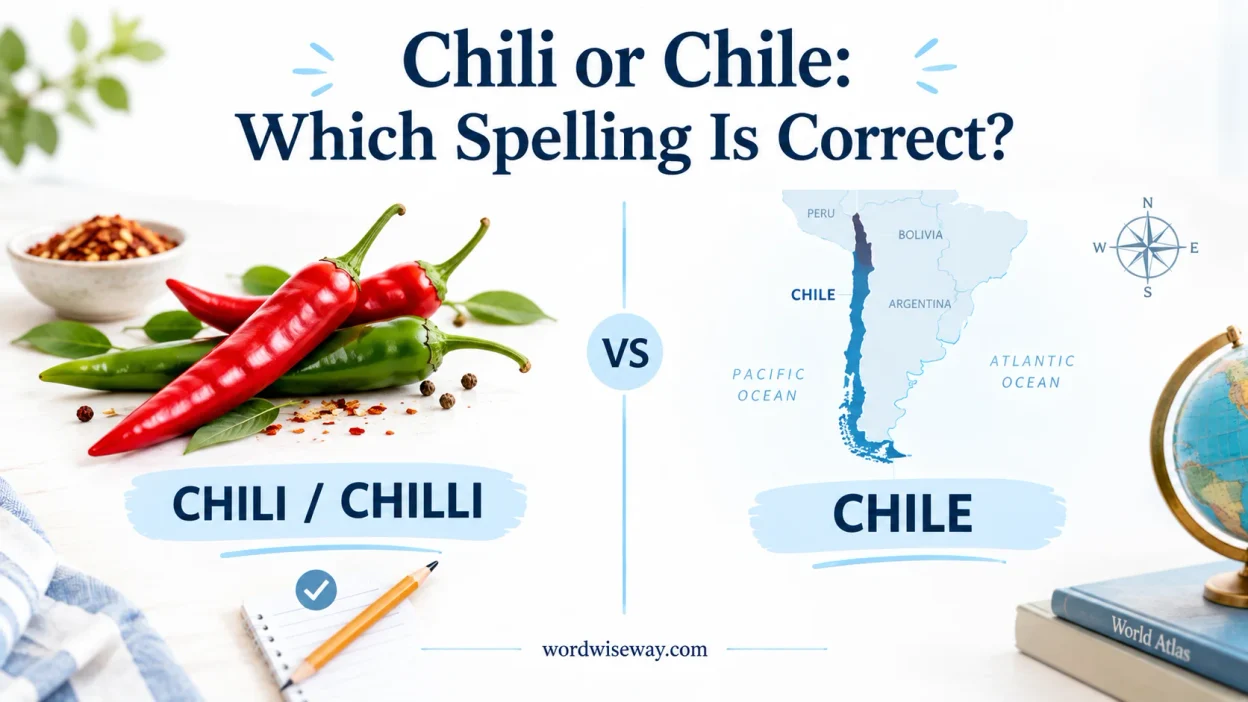
Chili or Chile: Meaning, Usage, and Difference can feel confusing because both spellings are correct, yet they don’t always refer to the same thing. In American English, chili is common for the spicy stew, while chile often refers to the pepper itself. You’ll see both in chili pepper, chile pepper, chili con carne, chili powder, and green chile peppers.
Regional usage adds another layer. Chile is common in New Mexico, the American Southwest, Mexican cuisine, and Mexican food writing, while chili remains widely accepted in general US English. A hot pepper, red chili, green chili, dried chili, or fresh chile may appear differently depending on the context, setting, and editorial style.
For English learners, food writers, and travelers, understanding the spelling difference, meaning of chili, meaning of chile, pronunciation, and plural forms makes writing clearer. These words also appear in recipes, emails, and social media, so knowing regional preferences helps you avoid common mistakes and choose the right spelling.
Quick Answer:
Use chili when you mean a hot pepper or, in American English, the spicy dish commonly made with meat, beans, and other ingredients. Use Chile when you mean the South American country.
Chilli is the common British English spelling for the hot pepper. In American English, chili is the usual spelling.
| Word | Main meaning | English variety | Example |
| chili | Hot pepper or spicy dish | US English | I added fresh chili to the sauce. |
| chilli | Hot pepper or spicy dish | UK English | She chopped two red chillies. |
| Chile | Country in South America | All English varieties | They traveled to Chile. |
| chile | Hot pepper | Also used in US English | The recipe uses roasted green chiles. |
The simplest rule is easy to remember:
Chili/chilli = food or pepper.
Chile = country.
Cambridge Dictionary identifies chili as the US spelling of chilli and defines both forms as referring to hot peppers. It also lists Chile as the name of the South American country.
What Does “Chili” Mean?
Chili has more than one food-related meaning. In American English, it commonly describes a hot pepper, a spicy dish, or related ingredients such as chili powder.
The context usually tells you which meaning the writer intends.
Chili as a Hot Pepper
A chili is a hot pepper used to add heat and flavor to food. It can be fresh or dried and may appear in sauces, curries, soups, marinades, and countless other dishes.
For example:
- I sliced a red chili for the salsa.
- Add one green chili to the mixture.
- The sauce contains fresh chili peppers.
- She removed the seeds from the chili before cooking.
Cambridge defines chili as the small red or green seed case from certain pepper plants that people use to make food spicy. It also lists chili pepper as a common expression.
The word can also appear in compounds such as chili sauce, chili oil, and chili powder.
Chili as a Dish
In American English, chili can also mean a spicy cooked dish. The dish often contains meat, beans, onions, tomatoes, peppers, and seasonings, although recipes vary considerably.
For example:
We made a big pot of chili for dinner.
Here, chili doesn’t mean a single pepper. It refers to the prepared dish.
Cambridge Dictionary describes this meaning as a spicy dish containing ingredients such as meat, onions, chilies or chili powder, and usually beans.
That’s why the sentence “I made chili” has a different meaning from “I chopped a chili.” The first describes a meal. The second describes a pepper.
Example Sentences With Chili
These examples show how the word works in everyday American English:
- Chili peppers can add considerable heat to a dish.
- I bought three green chilies from the market.
- Please add some chili powder to the soup.
- We cooked vegetarian chili for dinner.
- The recipe calls for two dried chilies.
- This sauce has a strong chili flavor.
Notice that chili can function as part of several food-related expressions. Context does most of the heavy lifting.
What Does “Chile” Mean?
Chile is primarily the name of a country in South America. It is a proper noun, so it begins with a capital letter when referring to the country.
Chile occupies a long, narrow strip along the western edge of South America. The Chilean government describes the country as stretching along the Pacific coast between the Andes and the Pacific Ocean. Its continental territory extends for roughly 4,270 kilometers from north to south.
For example:
- She wants to visit Chile someday.
- Chile is located along the western coast of South America.
- Santiago is the capital of Chile.
- They studied the geography of Chile.
- Chilean culture has diverse regional influences.
In these sentences, Chile has nothing to do with a pepper.
Chile as a Country
When Chile refers to the country, capitalization matters.
Compare these sentences:
- They traveled to Chile.
- They added a green chile to the recipe.
The first sentence refers to the country. The second uses chile as a culinary term for a pepper.
That capital letter isn’t decorative. It helps readers identify the word as a proper name.
The official Chilean government describes Chile as a country on the western side of the South American Southern Cone, bordered by Peru, Bolivia, and Argentina on its continental portion.
Example Sentences With Chile
Here are several examples using Chile correctly:
- Chile is known for its long Pacific coastline.
- My friend moved to Chile last year.
- We learned about Chile in geography class.
- The Andes extend along much of Chile’s eastern side.
- Santiago is one of the major cities in Chile.
- She hopes to study abroad in Chile.
In every example, the word refers to the country.
What’s the Difference?
The central difference comes down to meaning.
Chili belongs primarily to the world of food. Chile belongs to the world of geography when capitalized as the country’s name.
| Feature | Chili | Chile |
| Refers to a country? | ❌ No | ✅ Yes |
| Refers to a hot pepper? | ✅ Yes | Sometimes, as lowercase chile |
| Refers to a spicy dish? | ✅ Yes | ❌ No |
| Usually capitalized? | ❌ No | Yes when referring to the country |
| Common in US English? | ✅ Yes | ✅ Yes |
| Common British pepper spelling | Usually chilli | Chile for the country |
This distinction becomes especially important in writing because the words can look nearly identical on the page.
Consider:
She visited Chile.
This clearly means she visited the country.
Now consider:
She visited the market for chili.
The second sentence concerns food or peppers.
One letter and capitalization can send the reader down an entirely different path.
Chili vs. Chile vs. Chilli
Adding chilli to the mix makes the spelling question slightly more complicated. Fortunately, the underlying rule remains straightforward.
Chili
Chili is the standard American English spelling for the hot pepper. American English also uses chili for the spicy dish.
Examples include:
- chili pepper
- chili sauce
- chili powder
- chili oil
- beef chili
- vegetarian chili
Cambridge labels chili as the US form and gives chilli as the UK form.
Chilli
Chilli is commonly used in British English for the hot pepper. The plural is generally chillies.
For example:
- Add two chopped chillies.
- She bought fresh red chillies.
- The curry contains green chilli.
- Sprinkle some chilli powder over the dish.
Cambridge’s British English entry lists chilli as the UK spelling and chili as the US spelling.
Therefore, chilli isn’t simply a misspelling. It’s a legitimate regional spelling.
Chile
Chile is the country’s name. When you mean the country, don’t change it to chili or chilli.
For example:
- Correct: She lives in Chile.
- Incorrect: She lives in Chili.
- Incorrect: She lives in Chilli.
The country’s name remains Chile across English varieties.
Why Are Chili and Chile Confused?
The confusion makes sense because the words look and sound extremely similar.
In many English pronunciations, chili and Chile are pronounced alike or very nearly alike. That means you can’t always distinguish them by hearing the word alone.
The written context becomes important.
For example, if someone says:
“I’m going to Chile.”
The surrounding phrase makes it clear that they mean the country.
But if someone says:
“I’m adding chile to the recipe.”
The food context points toward the pepper.
This is a classic example of context doing linguistic detective work. The spelling may be similar, but the surrounding words usually reveal the intended meaning.
Is “Chile” Ever Correct for a Pepper?
Yes. This is one of the details that makes the topic more nuanced than a simple chili = pepper, Chile = country rule.
Cambridge lists chile as a US English form for the hot pepper.
You may therefore see expressions such as:
- green chile
- red chile
- roasted chile
- chile sauce
- chile powder
This usage appears particularly often in American culinary contexts.
For example:
The restaurant serves roasted green chile with its sandwiches.
Here, chile refers to a pepper rather than the country.
The capitalization changes the meaning:
- Chile = the country
- chile = a pepper in some US English usage
That distinction is worth remembering if you’re writing about food, especially regional American cuisine.
Is “Chilli” Correct in American English?
Chilli isn’t the standard American spelling of the pepper. American English generally uses chili.
However, English contains many regional variations, and readers may encounter chilli in international writing, restaurant menus, recipes, packaging, or websites influenced by British English.
Cambridge explicitly identifies chilli as the British form and chili as the American form.
So, if you’re writing specifically for a US audience, use:
chili
If you’re following British English conventions, use:
chilli
Consistency matters more than treating one regional form as universally correct.
Chili or Chile in American English
For US English, the distinction becomes fairly practical.
Use chili for the pepper:
I chopped a fresh chili.
Use chili for the spicy dish:
We’re having chili tonight.
Use Chile for the country:
My cousin traveled to Chile.
You may also encounter lowercase chile for a pepper in American culinary writing:
The recipe uses roasted green chile.
Cambridge’s American English entries recognize both chili and chile as pepper-related forms, while Chile refers to the country.
US English Examples
| Meaning | Preferred example |
| Pepper | I chopped a fresh chili. |
| Spicy dish | We made chili for dinner. |
| Country | They traveled to Chile. |
| Culinary regional usage | The recipe uses roasted green chile. |
For general US writing, chili is usually the clearest choice when you mean the pepper.
Chili or Chile in British English
British English normally uses chilli for the pepper.
For example:
Add one chopped red chilli.
The plural is chillies.
British English also uses chilli for the spicy dish:
We had vegetarian chilli for dinner.
But the country remains:
We visited Chile.
Cambridge’s British English dictionary gives chilli as the UK form and identifies chili as the US spelling.
This creates a useful three-way distinction:
- US: chili
- UK: chilli
- Country: Chile
Chili and Chile in Related Terms
These words appear in several common compounds. Understanding them helps prevent mistakes beyond the basic spelling question.
Chili Pepper
Chili pepper is a common American English expression for a hot pepper.
Example:
The recipe requires two fresh chili peppers.
The phrase removes ambiguity because pepper immediately tells readers that the subject is food.
Chili Powder
Chili powder refers to a powdered spice product made from dried chilies. The exact composition can vary, especially between commercial blends and ground dried peppers.
Example:
Add one teaspoon of chili powder to the sauce.
The term appears frequently in American recipes and food writing.
Chile Pepper
Chile pepper is also used, particularly in American culinary contexts.
Example:
Roasted chile peppers add a smoky flavor to the dish.
This doesn’t mean the peppers come from the country of Chile. Here, chile functions as a culinary noun.
Chilean
The adjective and demonym associated with the country is Chilean.
Examples include:
- Chilean food
- Chilean culture
- Chilean history
- Chilean people
- Chilean geography
For example:
We studied Chilean geography in class.
You wouldn’t use chilian or chillian for the country.
Common Mistakes
Mistake: Using Chili for the Country
Incorrect:
She traveled to Chili.
Correct:
She traveled to Chile.
The country is always written Chile in standard English.
Mistake: Using Chile When You Mean the Country’s Food
Incorrect:
Add Chile to the soup.
If you mean a pepper, the lowercase form chile can be appropriate in some American culinary contexts. Chili is also common in US English.
Better:
Add a chopped chili to the soup.
Or, in a culinary context where that spelling is preferred:
Add a chopped chile to the soup.
Mistake: Assuming Chilli Is Wrong
Incorrect assumption:
“Chilli” is always misspelled.
That’s not true.
Chilli is a standard British English spelling. Cambridge explicitly identifies it as the UK form.
Mistake: Forgetting Capitalization
Compare:
They moved to Chile.
with:
They bought green chile.
The capital letter distinguishes the country from the culinary term.
How to Remember the Difference
A simple memory trick can keep these spellings straight.
1.Think of Chile with a capital C as a place on a map.
2.Think of chili as something you might find in your kitchen.
3.Think of chilli as the British spelling of the food-related word.
You can remember it like this:
Chile = country
Chili = American food spelling
Chilli = British food spelling
There’s another useful clue. When you see Chile capitalized in a sentence about geography, travel, politics, cities, or people, it’s almost certainly the country.
When you see chili beside words such as pepper, sauce, powder, oil, beans, or meat, the culinary meaning becomes obvious.
Example Sentences
Seeing the words in context makes the distinction much easier.
Chili Examples
- I added a fresh chili to the salsa.
- This chili powder has a smoky flavor.
- We cooked vegetarian chili for dinner.
- She prefers mild chili peppers.
- The recipe calls for three dried chilies.
Chile Examples
- They traveled across Chile during their vacation.
- Chile stretches along the Pacific coast of South America.
- Santiago is the capital of Chile.
- She wants to learn more about Chile.
- The documentary explored northern Chile.
Chilli Examples
- Chop two red chillies and add them to the pan.
- The curry needs one fresh chilli.
- She bought green chillies at the market.
- Add a little chilli powder for extra heat.
The pattern becomes clear once the words leave isolation and enter real sentences.
A Practical Comparison
| Question | Chili | Chilli | Chile |
| Is it a pepper? | Yes | Yes | Sometimes, lowercase in US usage |
| Is it a spicy dish? | Yes | Yes | No |
| Is it a country? | No | No | Yes |
| US spelling | Common | Less typical | Country name |
| UK spelling | Less typical | Common | Country name |
| Capitalized for the food? | Usually no | Usually no | No, when culinary |
| Capitalized for the country? | No | No | Yes |
The table captures the main rule, but context still matters. English spelling isn’t always a tidy filing cabinet. Regional usage can create legitimate alternatives.
Read More: Agree or Disagree: Meaning, Usage, Grammar, and Examples
FAQs
Is chili or chile the correct spelling?
Both chili and chile can be correct. The choice depends on what you mean, where you are, and the style of writing you’re following.
What is the difference between chili and chile?
Chili is common in American English for the spicy dish and can also refer to a pepper. Chile is often used for the pepper itself, particularly in Southwestern and Mexican contexts.
Is chili pepper or chile pepper more common?
Both terms are used. Chili pepper is common in general American English, while chile pepper appears frequently in Southwestern and Mexican food writing.
Does Chile with a capital C mean the country?
Yes. Chile with a capital letter refers to the South American country. The lowercase chile can refer to a type of hot pepper.
Is chili used for the spicy stew?
Yes. In American English, chili commonly refers to a spicy stew made with ingredients such as meat, beans, tomatoes, and seasonings.
Is chile more common in Mexican food writing?
Chile is widely used in Mexican and Mexican-influenced food terminology, especially when referring to specific peppers or regional dishes.
Should I use chili or chile in American English?
For general American English, chili is a common choice. However, chile may be more appropriate when discussing a particular pepper or following a regional style.
Are chili and chile pronounced differently?
In many English contexts, chili and chile have the same or very similar pronunciation. Their main difference is usually spelling and usage rather than sound.
What is the plural of chili or chile?
The plural can vary by usage and style. Chilies and chiles are commonly used when referring to multiple peppers, while chili can also function as an uncountable food term.
Which spelling should I use in a recipe?
Follow the recipe’s regional and editorial style. Chili works well in general American food writing, while chile can identify peppers more specifically, particularly in Southwestern or Mexican contexts.
Conclusion
Understanding chili and chile becomes much easier once you connect each spelling with its context. Although both can describe peppers, chili is especially common in general American English and can also name the familiar spicy stew. Chile, meanwhile, often appears when writers mean the pepper itself, particularly in Southwestern and Mexican food contexts.
Regional usage can still shape the spelling you encounter. American English, Mexican cuisine, and Southwestern food writing may favor different forms, while Chile with a capital letter identifies the South American country. Paying attention to the surrounding words, intended meaning, and editorial style can help you avoid unnecessary confusion.
Whether you’re an English learner, food writer, cook, or traveler, knowing this distinction makes everyday writing more precise. Once you understand the meaning, spelling, and regional usage of both forms, choosing between chili and chile becomes a straightforward part of clear communication.

Evelyn Shaw has spent 14 years at Yale University’s English Department, leading students through close readings, genre studies, and interpretive methodologies. Her scholarly interests include Renaissance drama, gothic fiction, feminist literary criticism, and archival research and examining how texts generate meaning across historical periods. Evelyn has presented at major academic conferences and published essays in peer-reviewed journals, reflecting her passion for rigorous analysis and student-centered learning.