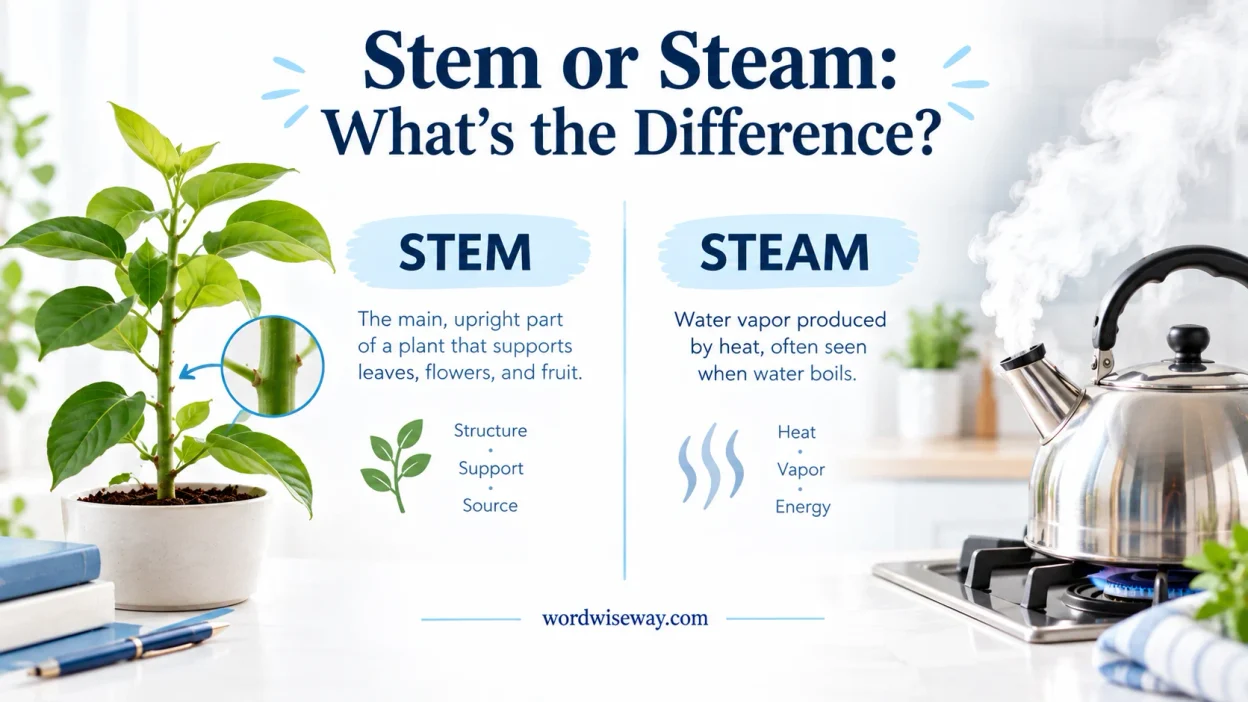
Stem or Steam: Meaning, Usage, and Difference can seem confusing because these words look and sound similar, but their meanings are different. The STEM is an acronym for science, technology, engineering, and math, while STEAM adds another area to this educational approach.
The STEM education covers important topics that help students learn, know, and understand how the world works. STEAM creates useful differences and similarities in education, while STEAM-focused experiments help kids explore ideas at home. These activities can explain the inner workings and importance of both approaches.
The usage of stem and steam differs in English. A missing letter can change a sentence, causing a mistake in writing, emails, blogs, or school work. Stem cells and a flower stem use stem, while steam means hot vapor from boiling water. Knowing their origins, spelling rules, examples, and common mistakes helps you choose the right word in different situations.
Quick Answer:
Use stem when you’re talking about a supporting structure, central part, source, cause, or word component.
Use steam when you’re talking about hot water vapor, cooking with vapor, or expressions involving energy and momentum.
| Word | Main Meaning | Example |
| Stem | A supporting part of a plant | “The flower has a strong stem.” |
| Stem | A source or cause | “The problem stems from poor planning.” |
| Stem | A central part of a word | “The word has a recognizable stem.” |
| Steam | Hot water vapor | “Steam rose from the kettle.” |
| Steam | Cooking with hot vapor | “She steamed the vegetables.” |
| Steam | Energy or momentum | “The project is gaining steam.” |
A quick memory trick works well: stem connects with structure or source, while steam connects with heat or energy.
What Does “Stem” Mean?
Stem has several meanings, but most of them involve the idea of something central, supporting, originating, or stopping something from progressing.
You can encounter the word in gardening, everyday conversation, grammar, science, and formal writing. Its meaning changes according to the context.
Stem as a Part of a Plant
The most familiar meaning of stem is the main stalk or supporting structure of a plant.
A plant stem can support leaves, flowers, and branches. It also plays an important role in transporting water and nutrients through the plant.
For example:
- “The rose has a long green stem.”
- “The flower’s stem bent under its weight.”
- “Cut the stem before placing the flowers in water.”
- “New leaves are growing from the stem.”
Whenever you’re talking about the stalk that supports a plant’s leaves or flowers, stem is the natural choice.
Stem as a Supporting Part
The word stem isn’t limited to plants. It can describe a narrow or central supporting part of an object.
For example, a wine glass has a stem between its bowl and base.
You might say:
- “Hold the glass by the stem.”
- “The stem connects the upper section to the base.”
- “The handle is attached near the stem.”
In each case, stem refers to something that forms part of a larger structure.
Stem as a Source or Cause
One of the most useful forms of the word is stem from.
When something stems from another thing, it originates from it or happens because of it.
Consider these examples:
- “The problem stems from poor communication.”
- “Her interest in art stems from childhood.”
- “The disagreement stemmed from a misunderstanding.”
- “Most of the delays stem from a lack of planning.”
This is where people often accidentally use steam.
The correct expression is always stem from when you’re describing an origin or cause.
Correct: “The problem stems from poor planning.”
Incorrect: “The problem steams from poor planning.”
A useful test is to replace stems from with comes from. If the sentence still makes sense, stem is probably the word you need.
Stem in Word Formation
Stem also has a specialized meaning in language and grammar.
A word stem is a core part of a word that can take different endings or additions. Understanding stems can help you recognize relationships between different forms of a word.
For example, related forms may share a central element while their endings change.
This meaning appears in grammar lessons, language studies, dictionaries, and discussions about how words are built.
So, stem can describe both a physical structure and a linguistic structure.
Stem as a Verb Meaning “Stop”
There is another useful meaning of stem as a verb.
To stem something can mean to stop, slow, or control its growth or spread.
For example:
- “The new measures helped stem the decline.”
- “The organization is trying to stem the spread of false information.”
- “Officials introduced changes to stem further losses.”
- “The treatment helped stem the problem.”
Here, stem has nothing to do with plants or word formation.
Instead, it means to hold something back or prevent it from getting worse.
What Does “Steam” Mean?
Steam has a completely different meaning from stem.
Most commonly, steam refers to the hot vapor associated with heated water. The word can also function as a verb when you cook food using steam.
It also appears in several common English expressions.
Steam as Hot Water Vapor
When water becomes very hot, it can produce vapor that we commonly call steam.
You see steam in many everyday situations.
For example:
- “Steam escaped from the kettle.”
- “The bathroom mirror was covered with steam.”
- “Steam rose from the pot.”
- “A cloud of steam filled the kitchen.”
The word also appears in phrases connected with machines and technology, such as steam engine, steam turbine, and steam power.
Steam in Cooking
Steam can also work as a verb.
When you steam food, you cook it using hot vapor rather than directly placing it in boiling water or oil.
For example:
- “Steam the vegetables until they’re tender.”
- “She steamed the dumplings.”
- “We steamed the fish for dinner.”
- “He steamed the rice before serving it.”
The related forms are straightforward:
- steam = present form
- steamed = past form
- steaming = -ing form
So, if vegetables were cooked with steam yesterday, you can say:
“We steamed the vegetables.”
Steam in Figurative Expressions
English also uses steam in several expressions that have nothing to do with actual vapor.
These expressions often describe energy, frustration, motivation, or momentum.
Let Off Steam
To let off steam means to release frustration, anger, or built-up emotional energy.
For example:
“After a stressful day, she went for a walk to let off steam.”
The expression creates a mental image of pressure escaping from a container.
Run Out of Steam
To run out of steam means to lose energy, enthusiasm, or momentum.
For example:
“The project started strongly but ran out of steam after several months.”
You can use this phrase for people, projects, campaigns, teams, and ideas.
Pick Up Steam
To pick up steam means to gain momentum or become increasingly active.
For example:
“Interest in the new program began to pick up steam.”
This expression is common when something starts slowly and then becomes more successful or active.
Key Differences
The easiest way to understand stem vs. steam is to compare their core meanings.
| Feature | Stem | Steam |
| Pronunciation | /stem/ | /stiːm/ |
| Core idea | Structure, source, or central part | Hot vapor or energy |
| Plant use | ✓ | ✗ |
| Cause or origin | ✓ | ✗ |
| Word structure | ✓ | ✗ |
| Hot water vapor | ✗ | ✓ |
| Cooking | ✗ | ✓ |
| Energy or momentum expressions | ✗ | ✓ |
| Example | “The problem stems from confusion.” | “Steam rose from the pot.” |
The words differ by only one vowel, but their meanings don’t overlap in ordinary usage.
Stem vs. Steam Pronunciation
Stem and steam also have different vowel sounds.
In US English, stem uses the short e sound. It has the same general vowel sound you hear in words such as bed and red.
Steam uses the long e sound. You hear a similar vowel in words such as team, green, and dream.
Compare:
- stem → /stem/
- steam → /stiːm/
The spelling gives you a useful clue. The ea in steam creates the long vowel sound.
Try saying these pairs aloud:
- stem / steam
- met / meat
- men / mean
- bed / bead
The difference becomes much easier to hear when you compare the short and long vowel sounds side by side.
When to Use “Stem”
Use stem when you’re talking about:
- A plant’s supporting stalk.
- A central or supporting part of an object.
- The origin or cause of something.
- The core part of a word.
- Stopping or slowing something.
- The phrase stem from.
Examples of “Stem” in Sentences
- “The flower has a thick stem.”
- “The leaves grow from the stem.”
- “Hold the glass by its stem.”
- “The problem stems from poor communication.”
- “The delay stemmed from a technical issue.”
- “The new rules helped stem the decline.”
- “The teacher explained the word stem.”
Notice the common thread: structure, source, or control.
When to Use “Steam”
Use steam when you’re talking about:
- Hot water vapor.
- Cooking food with hot vapor.
- Steam-powered machinery.
- Frustration or emotional release.
- Energy or momentum.
Examples of “Steam” in Sentences
- “Steam rose from the kettle.”
- “The pot released a cloud of steam.”
- “She steamed the vegetables.”
- “The windows became covered with steam.”
- “The old machine used steam power.”
- “He went outside to let off steam.”
- “The project is finally picking up steam.”
- “The team ran out of steam.”
If heat, vapor, cooking, energy, or momentum appears in the context, steam may be the right choice.
Common Mistakes
These words cause mistakes because their spellings are nearly identical.
Mistake 1: Writing “Steam From” Instead of “Stem From”
This is one of the most common errors.
Incorrect: “The problem steams from poor planning.”
Correct: “The problem stems from poor planning.”
When you’re explaining where something originated, use stem from.
For example:
“The confusion stems from unclear instructions.”
The confusion has its source in the unclear instructions.
Mistake 2: Using “Stem” for Hot Water Vapor
Incorrect: “Stem rose from the kettle.”
Correct: “Steam rose from the kettle.”
A kettle doesn’t produce a plant stalk. It produces steam.
This is a straightforward context clue. If you’re talking about boiling water or hot vapor, choose steam.
Mistake 3: Confusing “Stemmed” and “Steamed”
The past forms create another trap.
Stemmed can mean originated from something or stopped something from progressing.
Steamed means cooked with steam. In informal English, it can also describe someone who has become very angry.
Compare:
- “The argument stemmed from a misunderstanding.”
- “She steamed the vegetables.”
- “The measures stemmed the decline.”
- “He was steamed after hearing the news.”
The context tells you which word belongs.
Mistake 4: Confusing “Stemming” and “Steaming”
The -ing forms can look confusing at first.
Stemming relates to originating from something or stopping something.
Steaming relates to producing or using steam.
Compare:
- “The problem is stemming from poor planning.”
- “The vegetables are steaming in the pot.”
One describes a source. The other involves heat and vapor.
Stemmed vs. Steamed
| Word | Meaning | Example |
| Stemmed | Originated from something | “The conflict stemmed from a misunderstanding.” |
| Stemmed | Stopped or slowed something | “The new measures stemmed the decline.” |
| Steamed | Cooked with steam | “She steamed the vegetables.” |
| Steamed | Very angry, informally | “He was steamed about the mistake.” |
The easiest way to separate these forms is to identify the action.
If something originated, think stemmed.
If something was cooked with vapor, think steamed.
Stemming vs. Steaming
The difference remains clear when you add -ing.
What Does “Stemming” Mean?
Stemming can mean originating from a particular source.
For example:
- “The complaints are stemming from poor service.”
- “Several problems are stemming from the outdated system.”
It can also mean stopping or slowing something.
“The new policy is aimed at stemming the increase.”
What Does “Steaming” Mean?
Steaming relates to steam or the process of cooking with steam.
For example:
- “The vegetables are steaming.”
- “She is steaming the rice.”
- “The kitchen was filled with steaming pots.”
A quick glance at the context usually solves the problem.
Stem or Steam in Common Phrases
Certain phrases make the correct spelling much easier to remember.
| Phrase | Correct Word | Meaning |
| stem from | Stem | Originate from |
| plant stem | Stem | Supporting plant structure |
| word stem | Stem | Central word component |
| stem the decline | Stem | Stop or slow a decline |
| steam from a kettle | Steam | Hot water vapor |
| steam vegetables | Steam | Cook using steam |
| let off steam | Steam | Release frustration |
| run out of steam | Steam | Lose energy or momentum |
| pick up steam | Steam | Gain momentum |
| full steam ahead | Steam | Move forward energetically |
Learning these expressions as complete phrases can make the spelling stick.
Stem or Steam in Different Contexts
Context often gives you the answer before spelling even becomes a problem.
In Gardening
Use stem.
“The tomato plant has a strong stem.”
You’re describing the structure that supports the plant.
In Cooking
Use steam.
“Steam the vegetables until they’re tender.”
You’re describing a cooking method involving hot vapor.
In Writing and Grammar
Use stem.
“The students identified the stem of the word.”
You’re discussing word structure.
In Cause-and-Effect Statements
Use stem from.
“The disagreement stems from a misunderstanding.”
You’re identifying the origin of the disagreement.
In Everyday Expressions
Use steam in phrases such as:
- let off steam
- run out of steam
- pick up steam
- full steam ahead
These expressions use steam as a metaphor for pressure, energy, or momentum.
A Simple Real-World Example of Stem and Steam
Imagine you’re working in a small garden.
You notice a tomato plant with a thick green stem. The stem supports the leaves and developing fruit.
Later, you go inside and place vegetables over boiling water. Steam rises through the container as the food cooks.
Then you explain why the kitchen became humid:
“The moisture stemmed from the boiling water.”
Finally, after a long and exhausting day, you say:
“I need to let off some steam.”
Four different uses. Two spellings. The meaning determines the word every time.
That’s the real secret to remembering stem or steam.
How to Remember the Difference Between Stem and Steam
You don’t need a complicated rule.
Remember these two ideas:
Stem = structure or source.
Think about a flower. Its stem supports it.
Then think about a problem. It can stem from another problem.
Steam = heat or energy.
Think about a kettle. It produces steam.
Then think about motivation. You can run out of steam.
You can also use the vowels as a memory clue:
- STEM → short e
- STEAM → long e
A quick mental picture can help more than memorizing a long definition.
Side-by-Side Examples
| Sentence | Correct? | Why? |
| “The flower has a green stem.” | ✓ | Refers to a plant structure |
| “Steam rose from the boiling water.” | ✓ | Refers to hot water vapor |
| “The problem steams from poor planning.” | ✗ | The correct phrase is stems from |
| “The vegetables were stemmed for dinner.” | ✗ | The correct cooking word is steamed |
| “The problem stems from poor planning.” | ✓ | Describes an origin |
| “She steamed the vegetables.” | ✓ | Describes cooking with steam |
| “The project is picking up steam.” | ✓ | Describes growing momentum |
| “The project is picking up stem.” | ✗ | The established expression uses steam |
| “The team ran out of steam.” | ✓ | Means it lost energy |
| “The team ran out of stem.” | ✗ | This isn’t the standard expression |
These examples show why you shouldn’t treat stem and steam as alternate spellings.
They’re separate words.
Which One Should You Use?
Use stem when the sentence involves structure, support, origin, word formation, or stopping something from spreading.
Use steam when the sentence involves hot vapor, cooking, steam power, frustration, energy, or momentum.
When you’re unsure, examine the words around it.
1.If you’re explaining a cause, try stem from.
2.If you’re describing boiling water, choose steam.
3.If you’re talking about a plant, choose stem.
4.If you’re describing cooking with hot vapor, choose steam.
The simplest rule is:
Stem = structure or source.
Steam = hot vapor or energy.
Once you connect each word with its core meaning, this common spelling confusion becomes much easier to avoid.
Read More: Chili or Chile: Meaning, Usage, and Difference
FAQs
What does stem mean in English?
Stem has several meanings depending on context. It can refer to the main supporting part of a plant, the origin or source of something, or a basic part of a word. In science, stem cells are another common use.
What does steam mean in English?
Steam means the hot vapor produced when water is heated. You might see steam rising from boiling water, a hot drink, or a cooking pot. It can also describe the vapor produced by other heated liquids.
Is STEM different from stem?
Yes. STEM is an acronym for science, technology, engineering, and math, while stem is an ordinary English word with several meanings. Context and capitalization help distinguish them.
Why do people confuse stem and steam?
People often confuse them because the words have similar spelling and pronunciation. The extra a in steam changes the word completely, so a small spelling mistake can change the intended meaning.
Should you write stem cells or steam cells?
The correct term is stem cells. These are specialized cells studied in biology and medicine. Steam cells is not the standard term for this scientific concept.
What is a flower stem?
A flower stem is the part of a plant that supports a flower. It helps hold the flower upright and connects it with the plant’s other structures, including systems that transport water and nutrients.
Can steam come from boiling water?
Yes. When water is heated to its boiling point, it produces water vapor, commonly called steam. This is why you can see steam rising from boiling water.
Does stem have more than one meaning?
Yes. Stem can describe a plant structure, the source or origin of something, or a basic part of a word. Its exact meaning depends on the sentence and subject.
How can you remember the difference between stem and steam?
A simple way to remember them is to connect steam with heat and water. Think of the extra a as belonging to a word associated with hot vapor. Stem has no extra a.
Why is choosing the correct word important in writing?
Choosing the correct word keeps your writing clear and prevents confusion. Using stem when you mean steam, or vice versa, can make an otherwise simple sentence unclear or incorrect.
Conclusion
Stem and steam may look and sound similar, but they carry completely different meanings. Stem can describe a plant part, an origin, or a basic word element, while steam refers to hot vapor produced by heated water. Remembering this simple distinction can prevent common spelling mistakes in everyday English.
STEM also has a separate meaning as an acronym for science, technology, engineering, and math, while STEAM expands that educational approach. Keeping these terms separate makes their usage easier to understand, especially in education, science, and professional writing.
When you’re unsure whether to use stem or steam, look at the meaning of the sentence before choosing the spelling. A quick context check can help you avoid confusion in emails, school work, blogs, and other situations where clear writing matters.

Emma Smith has dedicated 14 years to Princeton University’s English Department, mentoring students in textual interpretation, literary movements, and critical frameworks. Her research explores Shakespearean drama, Victorian serial fiction, postcolonial narrative theory, and manuscript studies and probing how literary forms evolve across cultures and centuries. Emma has delivered lectures at international humanities congresses and published findings in distinguished academic journals, underscoring her commitment to scholarly depth and vibrant teaching.