Your friend texts, “PM me the details.” Your calendar reminds you about a 3 PM meeting. Then your manager mentions that the PM will join the call. Same two letters, three completely different meanings.
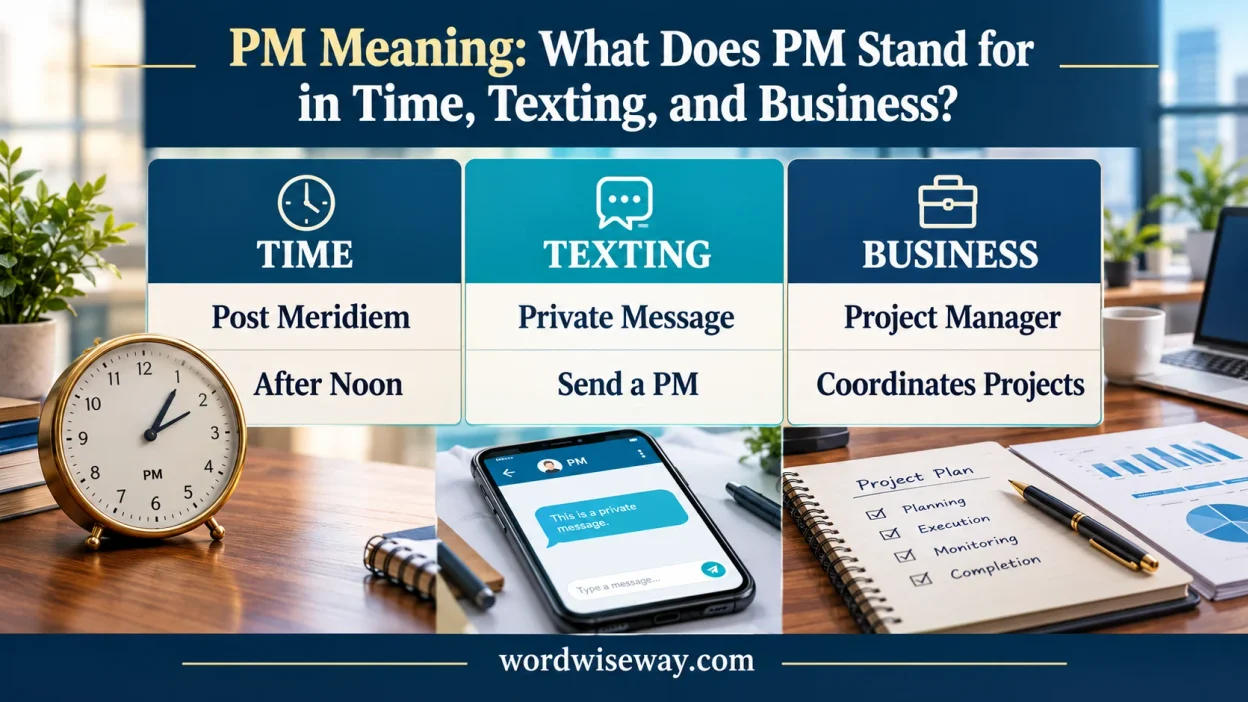
PM meaning depends entirely on where you see it. On a clock, it stands for post meridiem, the hours after noon. In texting and social media, it usually means private message. At work, it often refers to a project manager or product manager. This guide explains each meaning with clear examples, so you can tell which one you’re looking at in seconds.
I kept the bolding to the primary keyword and the core definitions so it stays scannable. If you’d like it lighter, drop the bold from “texting” and “social media.”
Quick Answer: What Does PM Mean?
PM most commonly means post meridiem in time notation and private message in online communication. Its meaning changes depending on the situation.
Here are the most common interpretations:
| Context | PM Stands For | Example |
| Time | Post meridiem | The meeting starts at 3 PM. |
| Texting | Private message | PM me the address. |
| Social media | Private message | Check your PMs. |
| Project management | Project manager | The PM updated the schedule. |
| Product development | Product manager | The PM reviewed the feature. |
| Government | Prime minister | The PM announced a new policy. |
| Maintenance | Preventive maintenance | The machine is due for PM. |
| Technology | Power management | The device uses power management settings. |
The quickest way to identify the correct meaning is to examine the surrounding words. If PM appears beside a clock time, it probably refers to the time of day. If someone asks you to send a PM, they want you to communicate privately.
What Does PM Mean in Time?
When you see PM next to a number on a clock, it refers to the time of day. The abbreviation comes from the Latin phrase post meridiem, which means “after midday.”
The 12-hour clock divides the day into two periods: AM and PM. AM covers the hours before noon, while PM covers the hours after noon and before midnight in ordinary timekeeping.
What Does PM Stand for in Time?
PM stands for post meridiem. The Latin word meridiem refers to midday, so the phrase describes the hours after noon.
People use PM to distinguish afternoon and evening times from morning times. For example, 8 AM means eight in the morning, while 8 PM means eight in the evening.
Here are a few everyday examples:
- 1 PM: One o’clock in the afternoon.
- 3 PM: Three o’clock in the afternoon.
- 6 PM: Six o’clock in the evening.
- 9 PM: Nine o’clock at night.
- 11 PM: Eleven o’clock at night, shortly before midnight.
The meaning stays the same even when the activity changes. A 7 PM class, a 7 PM dinner, and a 7 PM appointment all take place at the same time of day.
What Time Does PM Start and End?
PM begins at noon and continues until midnight. In a standard 12-hour clock, the hours run from 12 PM through 11:59 PM.
| Time | Meaning |
| 12:00 PM | Noon |
| 1:00 PM | One in the afternoon |
| 5:00 PM | Five in the afternoon |
| 8:00 PM | Eight in the evening |
| 11:59 PM | One minute before midnight |
| 12:00 AM | Midnight, marking the start of a new day |
For example, if a store closes at 9 PM, you should arrive before nine in the evening. If an online application closes at 11:59 PM on October 20, the deadline falls one minute before midnight at the end of that date, subject to the stated time zone.
Remember: PM doesn’t mean only nighttime. It includes the afternoon, evening, and later nighttime hours.
Is 12 PM Noon or Midnight?
This is one of the most common questions about PM meaning. The conventional distinction is 12 PM means noon, while 12 AM means midnight.
However, these labels can cause confusion at the exact transition points. For important schedules, writing “noon” or “midnight” instead of relying on 12 AM or 12 PM can prevent mistakes.
Consider these examples:
- “The event begins at noon” clearly identifies midday.
- “The flight leaves at midnight at the start of Friday” identifies the beginning of Friday.
- “The office closes at midnight on Friday” may need clarification because readers could interpret the date differently.
When a deadline matters, use the date, time, and time zone together. Clear wording prevents missed appointments and scheduling mistakes.
Examples of PM Times in Everyday Life
PM appears in school schedules, work calendars, appointment reminders, and travel plans.
| Written Time | Meaning | Example |
| 12:30 PM | Half past noon | Lunch appointment |
| 2:15 PM | Quarter past two in the afternoon | Online class |
| 4:45 PM | Quarter to five in the afternoon | School pickup |
| 7:30 PM | Half past seven in the evening | Family dinner |
| 10:00 PM | Ten at night | Bedtime reminder |
One helpful trick is to connect the time with a familiar daily activity. Lunch often happens in the early afternoon, dinner often happens in the evening, and bedtime usually comes later at night. These activities provide clues, although exact routines vary.
What Does PM Mean in Texting?
In texting and online conversations, PM usually stands for private message. It refers to a message sent privately to another person instead of posting information in a public comment or discussion.
For example, imagine someone asks a question beneath a public post. Another person replies, “PM me, and I’ll explain.” They’re asking the first person to continue the conversation privately.
The term is common in online communities, discussion forums, marketplace conversations, and social media. Some people also use “personal message,” but “private message” is a widely recognized expansion.
What Does PM Me Mean?
“PM me” means “send me a private message.” The sender wants you to contact them through a private messaging feature rather than sharing the information publicly.
Here are several examples:
- “PM me the details.” This means the person wants the details sent privately.
- “PM me if you’re interested.” This invites interested people to contact the sender privately.
- “I’ll send you a PM later.” This means the sender plans to send a private message.
- “Check your PMs.” This asks you to look at your private-message inbox.
Consider this short conversation:
Alex: Does anyone know where I can find the assignment instructions?
Jordan: I have them. PM me, and I’ll send them over.
Jordan wants to share the instructions privately. The abbreviation doesn’t refer to the time of day because the sentence describes communication rather than a schedule.
What Does PM Mean in a Text Message From a Friend?
The meaning depends on the wording around it. If a friend writes, “I’ll call you at 8 PM,” the letters refer to evening time. If they write, “Send me a PM,” they mean a private message.
Use these context clues to interpret the abbreviation:
- A number before PM: It usually indicates a time, such as 6 PM.
- A request to send, check, or receive a PM: It usually refers to a private message.
- A workplace discussion: It may refer to a professional title.
- A news headline: It may refer to a prime minister.
For example, “Let’s talk at 8 PM” identifies a time. Meanwhile, “PM me when you get home” asks someone to send a private message after arriving home.
Is PM the Same as DM?
PM and DM often describe the same kind of online communication, although the terminology varies by platform.
PM stands for private message, while DM stands for direct message. Both generally refer to a message that isn’t publicly displayed as a post or comment.
| Term | Full Form | Common Use |
| PM | Private message | Forums, online communities, and general messaging |
| DM | Direct message | Social media and private online conversations |
| PM me | Send me a private message | Asking someone to contact you privately |
| DM me | Send me a direct message | Asking someone to contact you through direct messaging |
For instance, someone selling a used desk might write, “DM me for the price.” Another seller might write, “PM me for details.” Both are asking interested people to contact them privately.
The distinction isn’t always strict. A platform may use a different label for its messaging feature, so follow the terminology that the service itself uses.
Read More: 6 Words for the Sound of Throwing Up
What Does PM Mean on Social Media?
On social media, PM commonly refers to a private message. People use the abbreviation when they want to move a conversation away from a public post or comment.
A private message can be useful for sharing details, asking questions, arranging a meeting, or discussing something that doesn’t belong in a public conversation. However, private messages aren’t automatically confidential in every circumstance, and users should still protect sensitive information.
PM Meaning on Facebook
On Facebook, people may use PM to mean a private message sent through the platform’s messaging features.
For example, someone advertising a secondhand bicycle might comment, “PM me if you’re interested.” They want interested buyers to contact them privately instead of posting personal details in the comments.
Common examples include:
- “PM me for more information.”
- “I’ll send you a PM with the address.”
- “Please PM me your question.”
- “Check your messages. I sent you a PM.”
These phrases all point toward private communication. The exact messaging interface can change, but the intended meaning remains understandable from the context.
PM Meaning on Instagram
On Instagram, PM can refer generally to private messaging. However, DM, short for direct message, is the more familiar term on the platform.
For example, a creator might write, “DM me your questions,” inviting followers to contact them through the messaging feature. Someone else might say “PM me,” intending the same action.
The two abbreviations are often interchangeable in casual conversation. Still, using “DM” is generally the clearest choice when referring specifically to direct messaging on Instagram.
PM Meaning in Online Groups and Forums
Online forums and community groups have long used PM to describe private communication between members. The term helps distinguish a message sent to one person from a comment that other members can read.
Imagine a student forum where someone asks for help finding a particular textbook. Another member replies, “I have a copy of the reading list. Send me a PM.”
The reply invites a private conversation rather than a public exchange. Similar wording appears in hobby groups, gaming communities, discussion boards, and online marketplaces.
A few common phrases include:
- “PM sent”: A private message has been sent.
- “Check your PMs”: Look at your private messages.
- “Open to PMs”: The person is willing to receive private messages.
- “PM for details”: Contact the person privately to get more information.
Be careful when a stranger asks for personal or financial information. A private message can still contain scams, misleading claims, or unsafe requests.
What Does PM Mean at Work?
In professional communication, PM can refer to a job title or an operational term. Two especially common interpretations are project manager and product manager.
The distinction matters because these roles have different responsibilities. A project manager generally focuses on coordinating work toward a defined goal, while a product manager focuses on a product’s direction and value.
PM Meaning as Project Manager
A project manager (PM) coordinates the work needed to complete a project. Depending on the organization, responsibilities may include planning, deadlines, budgets, team communication, risks, and delivery.
For example, a company developing a website might assign a project manager to coordinate designers, developers, content writers, and reviewers. The PM helps everyone understand their tasks and keeps the project moving toward its agreed goals.
You might encounter sentences such as:
- “The PM updated the project timeline.”
- “Please ask the PM about the deadline.”
- “Our PM scheduled a meeting with the development team.”
- “The PM is tracking outstanding tasks.”
In these examples, PM refers to the person coordinating the project. It doesn’t mean a private message because the sentence describes responsibilities and project activities.
PM Meaning as Product Manager
A product manager (PM) helps guide a product’s strategy, priorities, and development. The role often involves understanding customer needs, setting product goals, working with design and engineering teams, and deciding which improvements deserve attention.
For example, a company building a learning app might have a product manager investigate which features students need most. The PM may work with developers to prioritize improvements such as better search, clearer lessons, or easier navigation.
Common examples include:
- “The PM reviewed the customer feedback.”
- “The PM prioritized the next release.”
- “Ask the PM why this feature is being developed.”
- “The PM shared the product roadmap.”
Product manager and project manager can both be abbreviated as PM. In a technology company, you may need additional context to tell which role a message describes.
Project Manager vs. Product Manager
Although the titles sound similar, the roles usually focus on different questions.
| Feature | Project Manager | Product Manager |
| Main focus | Delivering a project | Building and improving a product |
| Typical question | How will the work be completed? | What should the product accomplish? |
| Common responsibilities | Schedule, coordination, resources, risks | Product strategy, user needs, priorities |
| Example | Coordinating a website launch | Deciding which website features to build |
These responsibilities can overlap, especially in small companies. Some organizations combine the roles, while others assign them to separate people.
Context is the key: A PM discussing deadlines and task assignments may be a project manager. A PM discussing customer needs and product features may be a product manager.
PM Meaning as Prime Minister
In government and news reporting, PM often stands for prime minister. A prime minister is the head of government in a country that uses this title.
For example, a news article might say, “The PM announced a new economic policy.” The surrounding story will usually make clear which country’s prime minister the article discusses.
You may see the abbreviation in:
- Political news reports.
- Government announcements.
- International relations coverage.
- Discussions about elections and public policy.
The context separates this meaning from professional job titles. A story about national leadership is more likely to use the PM for prime minister than for project manager.
How to Identify the Correct PM Meaning at Work
Workplace abbreviations can create confusion when several people use the same shorthand. Fortunately, the subject of the conversation usually provides useful clues.
Try this simple method:
- Look for the topic. Deadlines and deliverables suggest project management. Product features and customer needs suggest product management.
- Check the document. A project plan, product roadmap, or maintenance schedule can reveal the intended meaning.
- Read the whole sentence. Words such as “feature,” “budget,” “minister,” and “maintenance” narrow the possibilities.
- Ask for clarification. If two meanings remain possible, request the full job title or phrase.
For example, “The PM approved the new feature” could refer to a product manager. In a project meeting, however, it might refer to the project manager responsible for coordinating the release.
When clarity matters, writing the full title on first use can prevent misunderstandings. After defining it, the writer can use PM throughout the rest of the document.
Other Meanings of PM
PM doesn’t have one universal definition outside timekeeping and messaging. Different industries use the abbreviation for specific roles, processes, or technical concepts.
The surrounding subject is usually the strongest clue. Here are several additional meanings worth knowing.
PM Meaning in Medicine
In medical settings, PM can have different meanings depending on the document, specialty, and local conventions. It may appear in appointment schedules, clinical notes, medication instructions, and other healthcare records.
For example, a clinic might schedule an appointment for 4 PM. In that sentence, PM simply identifies the time.
However, abbreviations in clinical notes can have specialized meanings. Their interpretation may depend on the surrounding information and the healthcare organization’s standards. Never assume that PM has the same meaning in every medical record.
If you encounter an unfamiliar abbreviation on a prescription or medical document, ask a qualified healthcare professional to explain it rather than guessing.
PM Meaning in Maintenance
In maintenance and engineering, PM commonly stands for preventive maintenance. This refers to planned work intended to reduce equipment failures and keep machinery operating reliably.
For example, a factory might schedule preventive maintenance on a machine every month. Technicians could inspect components, replace worn parts, clean equipment, or perform other manufacturer-recommended tasks.
You might encounter these sentences:
- “The machine is due for PM this week.”
- “The maintenance team completed the scheduled PM.”
- “Please check the PM schedule before operating the equipment.”
In these examples, PM refers to maintenance work rather than a person or a time.
Preventive maintenance aims to identify potential problems before they cause unexpected breakdowns. The exact schedule depends on the equipment, operating conditions, and maintenance requirements.
PM Meaning in Technology
In technology, PM can stand for power management. This term describes methods used to control electrical power consumption in devices and computer systems.
For example, a laptop may use power-management settings to reduce energy consumption when it runs on battery power. A device might lower its power use when idle or adjust its behavior to extend battery life.
PM can also appear in technology discussions about project managers and product managers. Therefore, the technical subject alone may not settle the meaning.
Compare these examples:
- “Enable the PM settings to extend battery life.” Here, PM may refer to power management.
- “The PM approved the new app design.” Here, PM may refer to a product manager.
- “The PM revised the software delivery schedule.” Here, PM may refer to a project manager.
Reading the entire sentence is more reliable than interpreting the letters in isolation.
PM Meaning in Other Professional Contexts
Some organizations use PM as shorthand for terms specific to their operations. The same abbreviation may carry different meanings across industries.
Examples include:
- Portfolio management: Overseeing a collection of investments, projects, or other assets, depending on the field.
- Project management: Planning and coordinating work to achieve a defined objective.
- Preventive maintenance: Scheduling maintenance to reduce the risk of equipment failure.
- Power management: Controlling power use in electronic devices and systems.
These meanings aren’t interchangeable. A maintenance technician and a software product manager may use PM every day but mean entirely different things.
When an abbreviation appears in a specialized document, consult the document’s glossary or the organization’s terminology guide. That approach is more reliable than choosing the first definition you find.
Other Related Articles: Rung or Rang: Correct Spelling, Meaning, Rules, and Examples
PM vs. AM: What’s the Difference?
AM and PM divide the day into two periods on a 12-hour clock. Although they look similar, each abbreviation identifies a different part of the day.
AM comes from the Latin phrase ante meridiem, meaning “before midday.” PM comes from post meridiem, meaning “after midday.”
Each period covers 12 hours in the conventional 12-hour system.
What Does AM Mean?
AM stands for ante meridiem. It identifies the hours from midnight until just before noon.
Examples include:
- 6 AM: Six in the morning.
- 8 AM: Eight in the morning.
- 10 AM: Ten in the morning.
- 11:30 AM: Half past eleven in the morning.
People commonly use AM for morning appointments, school schedules, early work shifts, and other activities before noon.
For example, if a class begins at 9 AM, students should arrive in the morning. The abbreviation helps distinguish that time from 9 PM, which occurs in the evening.
What Does PM Mean?
PM stands for post meridiem. It identifies the hours after noon and before midnight in the conventional 12-hour clock.
Examples include:
- 12:30 PM: Half past noon.
- 2 PM: Two in the afternoon.
- 5 PM: Five in the afternoon.
- 8 PM: Eight in the evening.
- 11 PM: Eleven at night.
For example, an appointment scheduled for 5 PM takes place in the late afternoon. An appointment scheduled for 5 AM takes place early in the morning.
AM vs. PM Comparison Table
| Feature | AM | PM |
| Full Latin phrase | Ante meridiem | Post meridiem |
| Meaning | Before midday | After midday |
| General time period | Midnight to noon | Noon to midnight |
| Example | 9 AM | 9 PM |
| Common activities | Morning classes and early appointments | Afternoon meetings and evening events |
Easy Ways to Remember AM and PM
You don’t need to memorize complicated rules to tell AM and PM apart. A few simple associations make the difference easier to remember.
AM means before noon. Think about breakfast, morning classes, or the beginning of a workday.
PM means after noon. Think about afternoon appointments, dinner plans, or evening activities.
Remember that these are broad descriptions. Someone might work overnight or eat dinner earlier than usual, but the clock time still determines whether AM or PM applies.
One final detail matters: 12 AM is midnight, and 12 PM is noon in conventional usage. When writing an important deadline or schedule, spelling out “midnight” or “noon” can eliminate uncertainty.
How to Use PM Correctly
Knowing what PM means is only part of the picture. You also need to recognize how writers use it in sentences, schedules, and professional documents.
The most useful rule is simple: make sure the abbreviation matches the context and gives the reader enough information.
Writing PM in Sentences
When PM refers to time, writers commonly place it after the number.
Examples include:
- The webinar starts at 3 PM.
- The library closes at 6:30 PM.
- Please arrive by 7 PM.
- The application deadline is 11:59 PM on October 20.
In American English, 3 PM, 3:00 PM, and 3 p.m. are recognizable formats. Style preferences differ among publications and organizations, so consistency matters more than switching between formats.
For instance, if your article uses “4 PM” in one paragraph, avoid changing to “4:00 p.m.” without a reason. A consistent format makes schedules easier to scan.
Common PM Mistakes
Several mistakes can make an otherwise clear message confusing.
Confusing noon with midnight. These times mark different points in the day. Use the words “noon” and “midnight” when the distinction matters.
Assuming the PM always means private messages. The abbreviation can refer to time, professional roles, maintenance, and other concepts.
Confusing project managers with product managers. Both titles can use PM, but their responsibilities often differ.
Using unexplained abbreviations with unfamiliar readers. A team may understand its internal shorthand, while a new employee or customer may not.
Leaving out the date or time zone for important deadlines. A time alone may not tell readers which day or location applies.
For example, “Submit the report by 11:59 PM” leaves a crucial question unanswered: which date? A clearer instruction specifies the deadline’s date and time zone when necessary.
When Should You Spell Out PM?
Spell out the full term when readers might misunderstand the abbreviation.
In a general article, write “private message (PM)” the first time you introduce the online meaning. You can then use PM in later references.
In a workplace document, define the relevant role. For example, write “project manager (PM)” when the document concerns project coordination.
In a news article, make the country clear when using PM for prime minister. This helps readers understand which government official the story discusses.
For time notation, the abbreviation is usually familiar enough to stand on its own. Still, writing “noon” or “midnight” can improve clarity at important transition points.
Visit Us: 7 Good Words for the Sound of Thunder
FAQs
What Does PM Mean in a Text?
PM usually means private message when someone uses it to discuss online communication. For example, “PM me the details” means the person wants you to send the information privately.
However, PM can also indicate a time. In “I’ll call you at 8 PM,” it means eight in the evening.
What Does PM Stand For?
PM most commonly stands for post meridiem in time notation and private message in online communication. It can also mean project manager, product manager, prime minister, preventive maintenance, or power management.
The surrounding words help determine the intended definition.
Does PM Mean Private Message or Personal Message?
PM commonly stands for private message. Some people use “personal message” informally to describe the same kind of communication.
The wording varies, but the basic idea is similar: a message sent privately rather than shared in a public post or comment.
What Does PM Me Mean on Facebook?
“PM me” generally means “send me a private message.” Someone might use the phrase when offering information, answering a question, or arranging a conversation away from public comments.
What Does PM Mean on Instagram?
PM can refer to private messaging on Instagram, although DM, meaning direct message, is the more common platform-specific term.
If someone asks you to DM them, they want you to contact them through the platform’s direct messaging feature.
Does PM Mean Nighttime?
Not always. PM includes the afternoon, evening, and nighttime hours after noon and before midnight.
For example, 2 PM is in the afternoon, while 10 PM is at night.
Is 12 PM Noon?
Yes, in conventional time notation, 12 PM means noon and 12 AM means midnight.
For important schedules, writing “noon” or “midnight” directly can prevent confusion.
Is it 7 PM in the morning or Evening?
7 PM means seven in the evening. By contrast, 7 AM means seven in the morning.
The two times are exactly 12 hours apart.
What Does PM Mean in Business?
In business, PM can mean project manager or product manager. It may also refer to other professional or operational terms depending on the industry.
A discussion about deadlines may involve a project manager, while a conversation about product features may involve a product manager.
What Is the Difference Between PM and DM?
PM stands for private message, while DM stands for direct message. Both commonly describe private communication between users on an online platform.
The preferred term depends on the service and the way its users communicate.
What Does PM Mean in Maintenance?
PM often means preventive maintenance in industrial and engineering settings. It refers to planned inspections or servicing intended to reduce equipment failures and improve reliability.
For example, “The machine is due for PM” means scheduled maintenance is required.
What Does PM Mean in Government?
PM commonly stands for prime minister in government and political news. The prime minister is the head of government in countries that use this title.
The country’s name and the surrounding political discussion usually clarify the reference.
Conclusion:
The meaning of PM depends on where you encounter it. In time notation, PM stands for post meridiem, referring to the hours after noon. In texting and social media, it usually means private message.
Professional and technical settings introduce other meanings, including project manager, product manager, prime minister, preventive maintenance, and power management.
To identify the correct meaning, pay attention to the surrounding words and the subject of the conversation. A clock time, a private message request, and a workplace discussion each provide different clues.
The key takeaway: PM has several meanings, but context makes the intended definition much easier to understand.