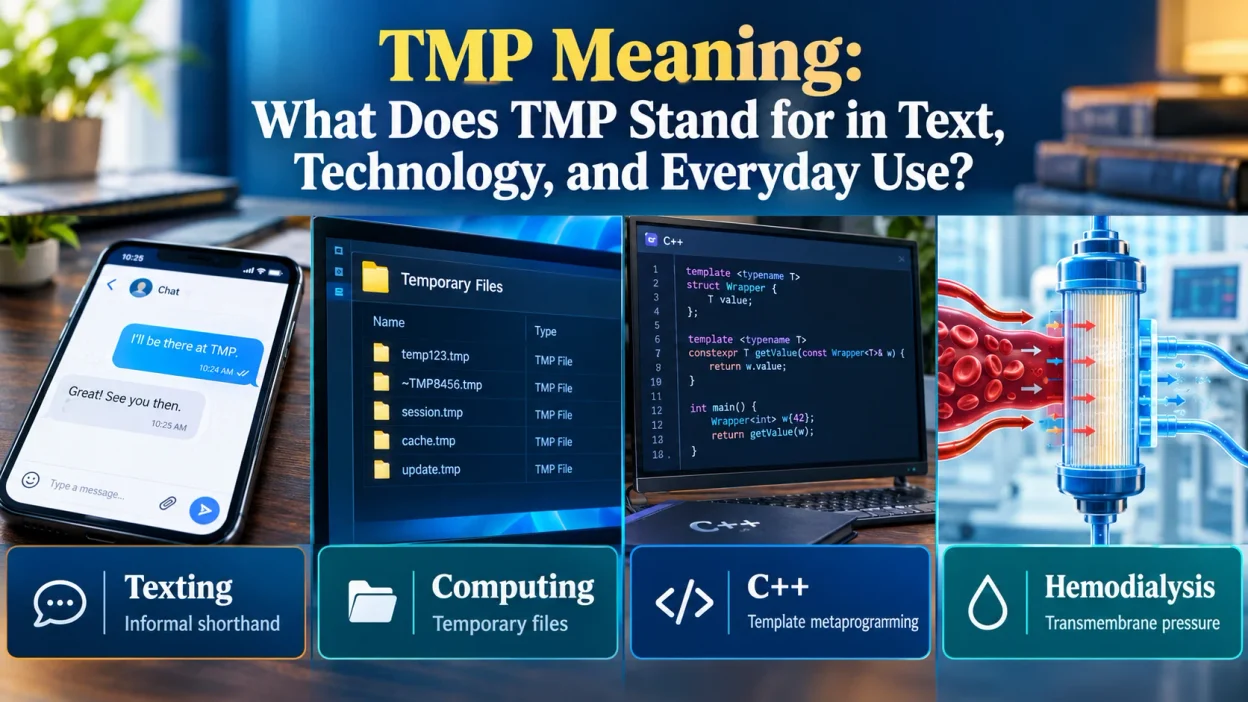
If you searched what does TMP stand for, the short answer is that there’s no single official expansion. The TMP meaning changes with the setting. The TMP full form could be “temporary,” “template metaprogramming,” or “transmembrane pressure,” depending on who is using it and why.
This guide sorts the definitions by where you’re most likely to run into them. It covers the TMP meaning in text and social conversations, the TMP file meaning and TMP meaning in computers, the TMP meaning in C++, and the TMP meaning in medicine. Each section gives a quick clue for spotting the right interpretation, plus what to do when the context still doesn’t settle it.
Quick Answer: What Does TMP Mean?
TMP most commonly refers to “temporary” in computing and digital contexts. However, it has several established meanings in specialized fields.
Here are the main interpretations:
- Computing: Temporary files, folders, or data used for a limited time.
- Text messages: Informal shorthand whose meaning depends on the sender and conversation.
- Programming: A temporary variable or template metaprogramming in C++.
- Medicine: Transmembrane pressure, particularly in dialysis.
- Other technical fields: Different terms defined by the industry or application.
For example, a file named report.tmp may contain temporary application data. Meanwhile, a programmer discussing TMP alongside C++ templates probably means template metaprogramming.
The surrounding context is the best clue to the intended meaning.
What Does TMP Mean in Text Messages?
When someone sends you TMP in a text message, its meaning might not be immediately clear. Unlike widely recognized abbreviations such as LOL and BRB, TMP doesn’t have one universally accepted meaning in everyday texting.
Some people use TMP to mean “Text Me Please” or “Text My Phone.” These are possible informal interpretations, but you shouldn’t assume that every sender uses them. The abbreviation could also be personal shorthand or a reference to something temporary.
Common TMP Meanings in Texting
| Possible meaning | Explanation | Example |
| Text Me Please | A request to send a text message | “TMP when you’re free.” |
| Text My Phone | A request to communicate by text | “The app isn’t working. TMP instead.” |
| Temporary | Something intended for short-term use | “This is my tmp account.” |
| Personal shorthand | An abbreviation understood by specific people | Meaning depends on the conversation |
The first two expansions are informal possibilities rather than universal definitions. The sender’s intended meaning matters more than the letters themselves.
Examples of TMP in Text Conversations
Consider these examples to see how context changes the interpretation.
Example 1: Asking someone to send a message
- Alex: “Can we talk after class?”
- Sam: “Sure, TMP when you’re free.”
Sam may be asking Alex to send a text message later. The surrounding conversation makes that interpretation plausible.
Example 2: Choosing another way to communicate
- Jordan: “I don’t check this app very often.”
- Taylor: “No problem. TMP if anything changes.”
Taylor may be asking Jordan to send a text instead of continuing the conversation in the app.
Example 3: Describing a temporary account
- Riley: “Is that your new account?”
- Casey: “No, it’s just a tmp account for now.”
Here, TMP refers to something temporary. The message isn’t asking anyone to send a text.
Example 4: Using personal shorthand
- Morgan: “What does TMP mean?”
- Jamie: “It’s something my friends and I use.”
In this situation, TMP may have a meaning specific to Jamie’s social circle. Other people might not recognize it.
How Can You Tell What TMP Means in a Message?
Before interpreting the abbreviation, consider three things:
- The topic: Is the conversation about communication, technology, or a temporary arrangement?
- The sentence: Does TMP appear as a request or describe something?
- The sender: Does the person regularly use informal abbreviations?
If the meaning remains unclear, simply ask, “What do you mean by TMP here?” A short clarification can prevent an unnecessary misunderstanding.
Other Related Posts: FR Meaning in Text: What Does FR Mean in a Text Message?
What Does TMP Mean on Social Media?
TMP can appear in direct messages, comments, group chats, and online communities. However, the platform alone doesn’t determine its meaning.
TMP in Direct Messages
In a private conversation, someone might use TMP as shorthand for asking you to send a text. Another person might use it while discussing a temporary account, link, or arrangement.
For example, “This is only a tmp profile” suggests that the profile isn’t intended to be permanent.
However, “TMP when you get home” could be a request for a message, depending on the sender’s habits and the conversation.
TMP in Online Communities
Technical communities often use abbreviations that have specific meanings within their subjects.
A programming discussion might use TMP for template metaprogramming. A computer troubleshooting conversation might use it to describe temporary files.
The same letters can therefore mean different things to different groups.
Remember: TMP doesn’t have one official definition that applies to every social media conversation. Always interpret it in context.
What Does TMP Mean in Computers?
In computing, TMP commonly relates to the word temporary. Programs and operating systems often use temporary files to store information while completing a task.
Imagine editing a document. The application may need to store intermediate information while you work. Temporary files can help manage that information without treating every intermediate version as a permanent document.
Software may create temporary files during installations, downloads, document editing, data processing, and other operations.
What Is a TMP File?
A TMP file is a file that uses the .tmp extension. Applications often use these files to store temporary data, although the precise purpose depends on the software that created them.
For example:
- A document editor may create temporary data while you edit a file.
- An installer may store information while preparing software components.
- A data-processing program may save intermediate results before completing a task.
- An application may use temporary data to support certain recovery operations.
A .tmp extension doesn’t automatically mean that a file is unnecessary or problematic. It may be part of normal software activity.
Why Do Computers Create TMP Files?
Temporary files help programs manage information during a task. Their purpose varies by application, but several common uses explain why they exist.
Holding intermediate data: A program may need to store information before producing its final result.
Supporting software installation: An installer may use temporary storage while preparing or copying files.
Managing application operations: Programs can use temporary files during editing, conversion, or data processing.
Supporting recovery: Some applications use temporary information to help restore work after an interruption.
Not every application handles temporary files in the same way. Some remove them automatically, while others may leave them behind after a task finishes.
Are TMP Files Safe to Delete?
Sometimes, but deleting every TMP file without checking can cause problems.
A temporary file may still support an open application, an installation, or an unfinished task. Removing it at the wrong time could interrupt an operation or cause data loss.
Before deleting a TMP file, follow these precautions:
- Close the application that may have created it.
- Let installations and software updates finish.
- Use your operating system’s built-in cleanup tools when possible.
- Avoid deleting unfamiliar files from system folders.
- Leave a file alone if you can’t determine its purpose.
Important: The .tmp extension doesn’t guarantee that a file is safe, unnecessary, or harmless. Its location, source, and purpose all matter.
Visit Us: What Are Moots? Meaning, Examples and Usage Guide
What Does TMP Mean in Programming?
In programming, TMP can refer to temporary variables or template metaprogramming. These concepts are related to software development, but they serve different purposes.
TMP as a Temporary Variable
Programmers often use tmp as a shortened form of temporary when naming variables. A temporary variable holds a value briefly while the program performs an operation.
For example, imagine a program that needs to exchange the values of two variables. If variable A contains 5 and variable B contains 9, a temporary variable can preserve A’s original value during the exchange.
The process works like this:
- Variable A starts with the value 5.
- Variable B starts with the value 9.
- A temporary variable stores A’s original value.
- Variable A receives B’s value.
- Variable B receives the saved value.
The result is that A contains 9 and B contains 5.
| Step | Variable A | Variable B | Temporary variable |
| Initial values | 5 | 9 | Empty |
| Save A’s value | 5 | 9 | 5 |
| Update A | 9 | 9 | 5 |
| Update B | 9 | 5 | 5 |
The name tmp is simply a naming choice. In most programming languages, it isn’t a special keyword with an automatic meaning.
TMP in C++: Template Metaprogramming
In C++, TMP commonly stands for template metaprogramming. This technique uses templates to perform computations or make decisions during compilation.
Instead of performing every operation when a program runs, template metaprogramming allows certain calculations and type-related operations to happen while the compiler builds the program.
Developers may use it to:
- Calculate certain values at compile time.
- Build reusable generic programming components.
- Select types based on specified conditions.
- Generate specialized implementations.
- Reduce some computations that would otherwise happen during execution.
For example, a C++ library may use templates to select an appropriate type for a particular operation. The compiler evaluates the relevant template logic during compilation.
Template metaprogramming can be powerful, but complicated template logic can also make programs harder to understand and maintain.
TMP File vs. TMP Variable vs. Template Metaprogramming
These terms share the same letters, but their meanings differ.
| Term | Meaning | Purpose |
| .tmp file | File associated with temporary data | Stores information during an operation |
| tmp variable | A programmer-chosen variable name | Holds a value temporarily |
| TMP in C++ | Template metaprogramming | Performs compile-time computations and type-related operations |
If you encounter TMP in source code, look at how the programmer uses it. A variable declaration suggests one meaning, while a discussion of templates and compilation suggests another.
What Does TMP Mean in Medicine?
In medical settings, TMP can stand for transmembrane pressure. This term is particularly relevant to hemodialysis and other filtration processes.
During hemodialysis, blood and dialysis fluid pass through separate compartments divided by a semipermeable membrane. A pressure difference across that membrane helps drive fluid movement.
TMP describes this pressure difference and helps clinicians assess filtration conditions.
Why Is Transmembrane Pressure Important?
TMP provides information about the pressure conditions across a filter membrane. During treatment, clinicians may monitor changes in TMP alongside other measurements to assess how the filtration process is performing.
For example, a rising TMP reading may indicate increasing resistance to fluid movement. However, the reading must be interpreted in context because several factors can affect it.
TMP is therefore a technical measurement rather than a general description of a patient’s condition.
This meaning differs entirely from TMP in texting or computer files. If the abbreviation appears in a dialysis report, the medical context is a strong clue that it refers to transmembrane pressure.
TMP Meaning in Different Contexts
The following table brings together the main definitions and shows where each one is most relevant.
| Context | Meaning | What it refers to |
| General digital use | Temporary | Something intended for short-term use |
| Computer files | Temporary file | A file that may hold intermediate application data |
| Text messages | Informal shorthand | A phrase whose meaning depends on the sender |
| Programming | Temporary variable | A variable used to hold a value briefly |
| C++ development | Template metaprogramming | Compile-time computations and type-related techniques |
| Hemodialysis | Transmembrane pressure | The pressure difference across a dialysis membrane |
Some definitions are established technical terms, while others are informal interpretations. This distinction matters when you want to explain TMP accurately.
How to Identify the Correct TMP Meaning
You don’t need to memorize every possible definition of TMP. Instead, use the surrounding context to narrow down the possibilities.
Check Where TMP Appears
If TMP appears in a text message, read the complete sentence. The sender may be using personal shorthand or asking you to send a message.
If it appears in a computer folder or filename, check whether it relates to temporary data.
If you encounter TMP in programming documentation, look for references to variables, templates, or compilation.
If it appears in a medical report discussing dialysis, it may refer to transmembrane pressure.
Look at the Words Around It
The surrounding words often reveal the intended meaning.
For example:
- “Delete the old TMP file” suggests a computing context.
- “Use TMP to calculate the value at compile time” suggests template metaprogramming.
- “Check the TMP reading during dialysis” suggests transmembrane pressure.
- “TMP when you’re available” may be informal shorthand for requesting a text.
These examples aren’t universal rules, but they demonstrate how context narrows the possibilities.
Ask for Clarification When Necessary
Sometimes, the abbreviation won’t provide enough information. Rather than guessing, ask the person what they intended.
In a casual conversation, you could say, “What does TMP mean here?”
In a technical discussion, you could ask, “Do you mean a temporary file or something else?”
A direct question is often the fastest way to resolve ambiguity.
Is TMP an Acronym, an Abbreviation, or Slang?
TMP can function as an abbreviation or initialism, depending on how someone uses it.
An abbreviation is a shortened form of a word or expression. An initialism is formed from initial letters that are pronounced separately. An acronym is commonly understood as an abbreviation pronounced as a word.
Informal slang, meanwhile, consists of expressions used within particular social groups or communities.
For example, a programmer who names a variable tmp is usually shortening the word temporary. Someone discussing TMP in C++ is using an established technical abbreviation for template metaprogramming.
A person using TMP in a private message might have a personal interpretation that other people don’t recognize.
The most useful approach is to identify the intended meaning rather than assume that every use belongs to the same category.
FAQs
What does TMP stand for?
TMP commonly relates to temporary in computing. It can also stand for template metaprogramming in C++ and transmembrane pressure in hemodialysis. Informal texting interpretations depend on the conversation.
What does TMP mean in texting?
In texting, TMP may mean “Text Me Please” or “Text My Phone.” These are possible informal interpretations rather than universally accepted definitions. Check the surrounding message to understand what the sender intends.
What does TMP mean on social media?
TMP doesn’t have one universal social media meaning. Someone might use it as personal shorthand in a direct message, while a technical community might use it for a programming concept.
What does a TMP file mean?
A TMP file uses the .tmp extension and often stores temporary application data. Its exact purpose depends on the program that created it.
Are TMP files viruses?
Not necessarily. Many applications create legitimate temporary files during normal operations. However, the extension alone cannot establish whether a file is safe. Consider its source, location, and behavior before opening or deleting an unfamiliar file.
What does TMP mean in C++?
In C++, TMP commonly stands for template metaprogramming. It uses templates for compile-time computations and type-related operations.
What does TMP mean in medicine?
In hemodialysis, TMP can stand for transmembrane pressure. It describes the pressure difference across a dialysis membrane and helps clinicians assess filtration conditions.
Is TMP the same as temp?
Not exactly. Both can relate to something temporary, but temp is a common shortened form of temporary. TMP can also represent several unrelated technical terms.
How should you respond when someone sends TMP?
If you understand the message, respond naturally. If you don’t, ask, “What does TMP mean here?” That simple question is more reliable than guessing.
Conclusion
TMP has several meanings, and context determines which one applies. In computing, it commonly relates to temporary files or data. In C++, it can stand for template metaprogramming, while in hemodialysis it refers to transmembrane pressure.
In casual texting, people may use TMP as shorthand for requesting a text message. However, these informal interpretations aren’t universal.
The easiest way to understand TMP is to consider where it appears, read the surrounding words, and identify the subject being discussed.
Once you recognize the context, the abbreviation becomes much easier to interpret. And when the meaning remains unclear, asking for clarification is always a sensible choice.

Emma Smith has dedicated 14 years to Princeton University’s English Department, mentoring students in textual interpretation, literary movements, and critical frameworks. Her research explores Shakespearean drama, Victorian serial fiction, postcolonial narrative theory, and manuscript studies and probing how literary forms evolve across cultures and centuries. Emma has delivered lectures at international humanities congresses and published findings in distinguished academic journals, underscoring her commitment to scholarly depth and vibrant teaching.