Humor or Humour: Correct Spelling, Meaning, and Usage is a common topic for writers, students, and content creators who want to choose the right spelling.
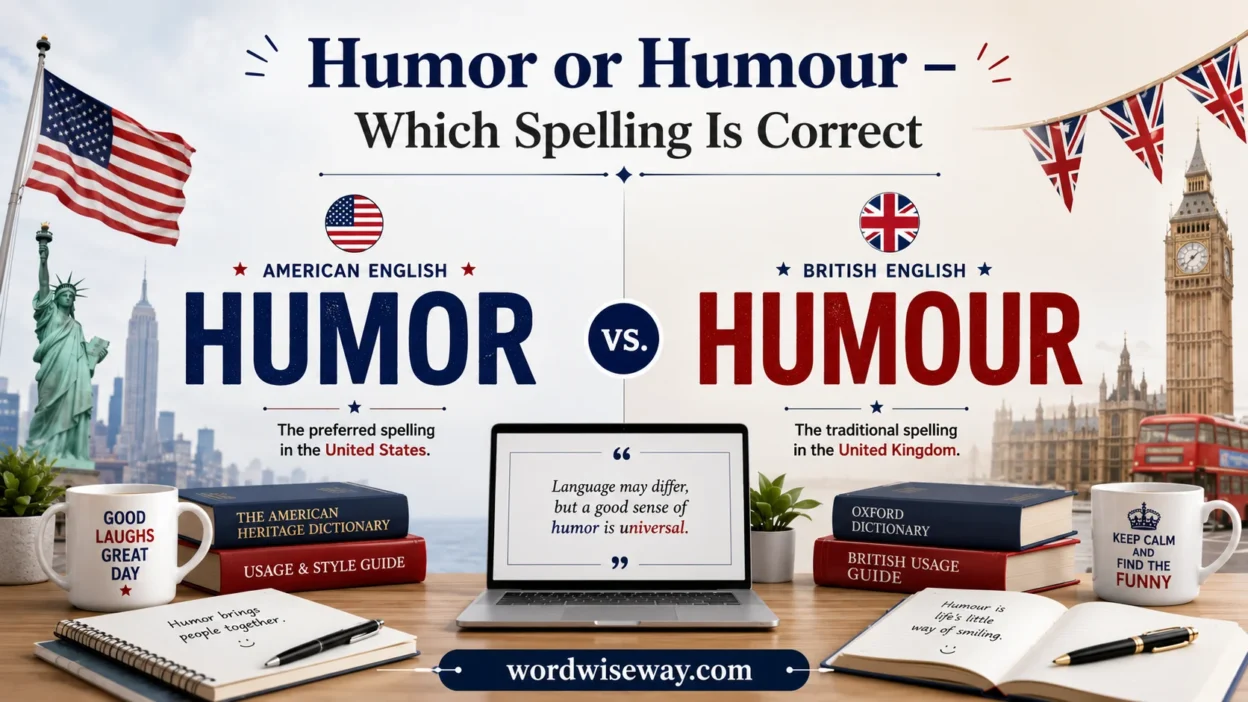
Both Humor and Humour are correct spellings, but they belong to different varieties of English. The word describes amusement, comedy, a sense of something funny, and in some contexts, a person’s mood or temperament. American English uses Humor, while British English and Commonwealth countries use Humour.
From my writing experience, I have seen many people confuse these versions. This common spelling comparison helps you understand spelling differences, pronunciation, and regional usage. The correct choice depends on your audience and context. Using the right version in emails, articles, and formal writing keeps your content clear and professional.
Quick Answer:
Let’s clear the fog immediately.
- Humor = American English spelling
- Humour = British English spelling
Both words mean the same thing:
- Comedy
- Amusement
- Wit
- A funny or entertaining mood
Quick rule you can actually use
If your reader is in the United States, use humor.
If your reader is in the UK, Canada, Australia, or most Commonwealth countries, use humour.
That’s it. No mystery left.
But the real story gets more interesting when you look deeper.
Quick Comparison Table Humor vs Humour
| Feature | Humor | Humour |
| Region | US | UK, Commonwealth |
| Meaning | Comedy, wit | Same |
| Origin | Simplified spelling | Traditional spelling |
| Correctness | Correct in US English | Correct in British English |
Why Humor and Humour Have Two Spellings
To understand this spelling split, you need to step back into the history of English. English has never been a perfectly uniform language. It evolved across regions, politics, and publishing traditions.
The historical split
In the early days, English borrowed heavily from French and Latin. The word humour comes from Old French humour, which itself came from Latin humor, meaning fluid or moisture.
Originally, it had nothing to do with jokes. It referred to bodily fluids believed to control human temperament.
Later, it evolved into meaning mood, and eventually, comedy.
Enter American simplification
In the 18th and 19th centuries, American linguist Noah Webster pushed for spelling reform. His goal was simple: make English easier and more logical.
He removed extra letters in many words:
- colour → color
- favour → favor
- honour → honor
- humour → humor
This created the modern American spelling system.
The British retention
British English kept older spellings, including humour. It preserved the French-influenced structure.
So the difference is not random. It is a result of two standardized versions of English evolving separately.
Does Humor or Humour Change Meaning?
This is where many writers get confused. The answer is simple:
No, the meaning never changes.
Whether you write:
- “She has a great sense of humor.”
- “She has a great sense of humour.”
Both sentences mean exactly the same thing.
The only difference is:
- Geography
- Style preference
- Editorial consistency
Think of it like two roads leading to the same destination. The scenery changes, but the place you arrive at is identical.
Where Each Spelling Is Used Around the World
Understanding regional usage helps you avoid mistakes in publishing and in other paper work
Global usage breakdown
| Region | Preferred Spelling | Notes |
| United Kingdom | humour | Strictly used in formal writing |
| Canada | humour | British influence, but US spelling appears online |
| Australia | humour | Follows British conventions |
| India | humour | British English influence |
| Global internet | mixed | Depends on audience targeting |
Important insight
Digital platforms do not enforce one spelling. Instead, they adapt based on the audience.
If you are writing online, you are not writing for “the internet.” You are writing for a specific group of humans in a specific place.
What Style Guides Say About Humor vs Humour
Professional writing does not rely on opinion. It relies on style guides.
AP Style (United States)
- Uses humor
- Common in journalism and US media
Chicago Manual of Style
- Prefers humor
- Used in publishing and academic writing in the US
Oxford and British Style Guides
- Use humour
- Standard for UK publishing
Key takeaway
Style guides are not debating which is better. They simply enforce consistency.
If you are writing professionally, your editor will expect you to follow one system and stick to it.
Common Mistakes Writers Make
Even experienced writers slip up with this simple word.
Mistake 1: Mixing spellings in one article
This breaks consistency and looks careless.
Example:
- “British humour is different from American humor.”
This feels uneven and distracts readers.
Mistake 2: Copying without checking audience
Many writers default to American spelling without considering their readers.
Mistake 3: Overthinking correctness
Some assume one spelling is wrong. It is not.
Mistake 4: Ignoring style guides
Professional editors will always enforce consistency.
How to Choose the Right Spelling Every Time
You can avoid confusion by following a simple decision process.
Step 1: Identify your audience
Ask yourself:
- Where are my readers located?
Step 2: Check your platform
- US publication → humor
- UK publication → humour
Step 3: Follow your style guide
If one is provided, always prioritize it.
Step 4: Stay consistent
This is the most important rule.
Simple decision rule
- US audience → humor
- UK/Commonwealth audience → humour
- Global audience → choose one and stick with it
Real-World Examples from Media and Publishing
Let’s see how this works in practice.
US media examples
American newspapers and magazines consistently use:
- humor
They follow AP or Chicago style rules.
UK media examples
British outlets such as newspapers and broadcasters use:
- humour
They follow Oxford-based conventions.
Books and publishing
- US novels → humor
- UK novels → humour
Digital platforms
Online platforms may switch depending on:
- region settings
- editorial teams
- target audience
Does Spelling Affect Tone or Perception?
Even though meaning stays the same, perception can shift slightly.
Subtle differences readers feel
- “humor” may feel more modern and direct in US English
- “humour” may feel more traditional or formal in British English
However, this is perception, not grammar.
Important truth
No spelling is more “intelligent” or “correct” than the other. They are parallel systems, not competitors.
Case Study: How a Blog Improved Its Audience Connection by Changing Spelling
Background
A lifestyle blog created content for readers from the United Kingdom but used Humor throughout its articles. Although the spelling was correct, it did not match the language style expected by its target readers.
The Challenge
- The blog used American English spelling for a British audience.
- Readers noticed inconsistent language patterns.
- The content style did not fully match local writing preferences.
- The brand voice appeared less connected with its audience.
The Changes Made
- Replaced Humor with Humour across articles.
- Updated headings and written content to follow British spelling rules.
- Reviewed other spelling choices to maintain consistency.
- Adjusted the overall writing style for the target audience.
The Results
- Readers found the content more familiar and natural.
- Engagement improved because the language matched audience expectations.
- The blog developed a more consistent brand identity.
- The writing style became clearer and more professional.
Key Lesson
Small spelling choices can influence how readers connect with content. Humor and Humour have the same meaning, but choosing the version that fits your audience creates a better reading experience.
What Style Guides Say About Humor vs Humour
Professional writers do not choose between Humor and Humour randomly. They follow trusted style guides that provide rules for spelling, grammar, and consistency. These guides help writers, editors, publishers, and journalists maintain a clear writing style for their specific audience.
AP Style: The American English Standard
The AP Style guide is widely used in American journalism, newspapers, and media writing. It follows American English conventions, so it prefers Humor without the extra letter “u.” Writers using AP Style should use Humor consistently throughout their content to match US spelling standards.
Chicago Manual of Style: Rules for US Publishing
The Chicago Manual of Style is commonly used in American books, academic writing, and publishing. Like AP Style, it recommends Humor as the preferred spelling. Authors and editors following this guide usually choose the American spelling to maintain consistency across their work.
Oxford and British Style Guides: The Humour Preference
Oxford and British style guides follow traditional British English spelling rules. They prefer Humour with the extra “u.” This spelling is common in the United Kingdom and many regions influenced by British English, including several Commonwealth countries.
Professional Writing Rules for Choosing Between Humor and Humour
The main rule in professional writing is not that one spelling is better than the other. The important factor is consistency. Writers should consider their audience, location, publication requirements, and style guide before choosing a spelling. Using both versions in the same article can make the content look inconsistent, while following one spelling system creates a more polished and professional impression.
Read More: Fulfil or Fulfill: Correct Spelling, Meaning, and Usage
FAQs
What is the correct spelling between Humor and Humour?
Both Humor and Humour are correct spellings. The difference depends on the variety of English you use. Humor is preferred in American English, while Humour is commonly used in British English and many Commonwealth countries.
Why does American English use Humor without the extra letter?
American English often simplifies some spellings compared to British English. The spelling Humor follows American spelling rules, while Humour keeps the traditional British form.
Do Humor and Humour have different meanings?
No, both words have the same meaning and usage. They describe amusement, comedy, a sense of something funny, or even a person’s mood and temperament depending on the context.
Is Humour wrong in American English?
No, Humour is not wrong, but it may look less common in American writing. If you are writing for an American audience, Humor is usually the better choice.
Is Humor acceptable in British English?
Yes, people can understand Humor, but Humour is the standard spelling in British English. Writers usually follow the spelling style expected by their readers.
How can I remember the difference between Humor and Humour?
A simple memory trick is to connect Humor with the United States and Humour with the United Kingdom. The extra “u” in Humour can remind you of British spelling traditions.
Do Humor and Humour have the same pronunciation?
Yes, both spellings have essentially the same pronunciation. The difference appears only in spelling, not in how the word is spoken.
Which spelling should I use in formal writing?
Choose the spelling based on your audience and location. Use Humor for American documents and Humour for British or Commonwealth formal writing.
Why do people search for Humor vs Humour?
People search for Humor vs Humour because English spelling changes across regions. Writers often want to avoid confusion and make their content more consistent and professional.
Does choosing Humor or Humour affect writing quality?
The choice itself does not change the quality of writing. However, using the correct regional spelling improves readability and helps your content match the expectations of your audience.
Conclusion
Understanding the difference between Humor and Humour makes writing easier and more accurate. Both versions communicate the same idea, but choosing the right spelling shows awareness of regional English differences. Whether you write articles, emails, social media posts, or formal documents, matching your spelling style with your audience creates a smoother reading experience.
As English continues to grow worldwide, these small spelling variations remind us that language can have different paths while keeping the same meaning. By remembering the simple rule of Humor for American English and Humour for British English, you can confidently use the correct form in any situation.

Evelyn Shaw has spent 14 years at Yale University’s English Department, leading students through close readings, genre studies, and interpretive methodologies. Her scholarly interests include Renaissance drama, gothic fiction, feminist literary criticism, and archival research and examining how texts generate meaning across historical periods. Evelyn has presented at major academic conferences and published essays in peer-reviewed journals, reflecting her passion for rigorous analysis and student-centered learning.