Drank or Drunk: Correct Spelling, Meaning, and Usage helps English learners, students, and writers understand why drank and drunk create confusion.
Both words come from the verb drink, but they are used differently because of English verb tenses. Drank describes a past action, while drunk is used with helping verbs. Many native speakers and learners make common grammar mistakes by choosing the wrong form.
Knowing the correct spelling, meaning, and usage improves writing, speaking, and language skills. These grammar rules, real-life examples, and common mistakes help you use the correct verb form confidently in conversations and written English.
Quick Answer:
Let’s remove the confusion in one clean step:
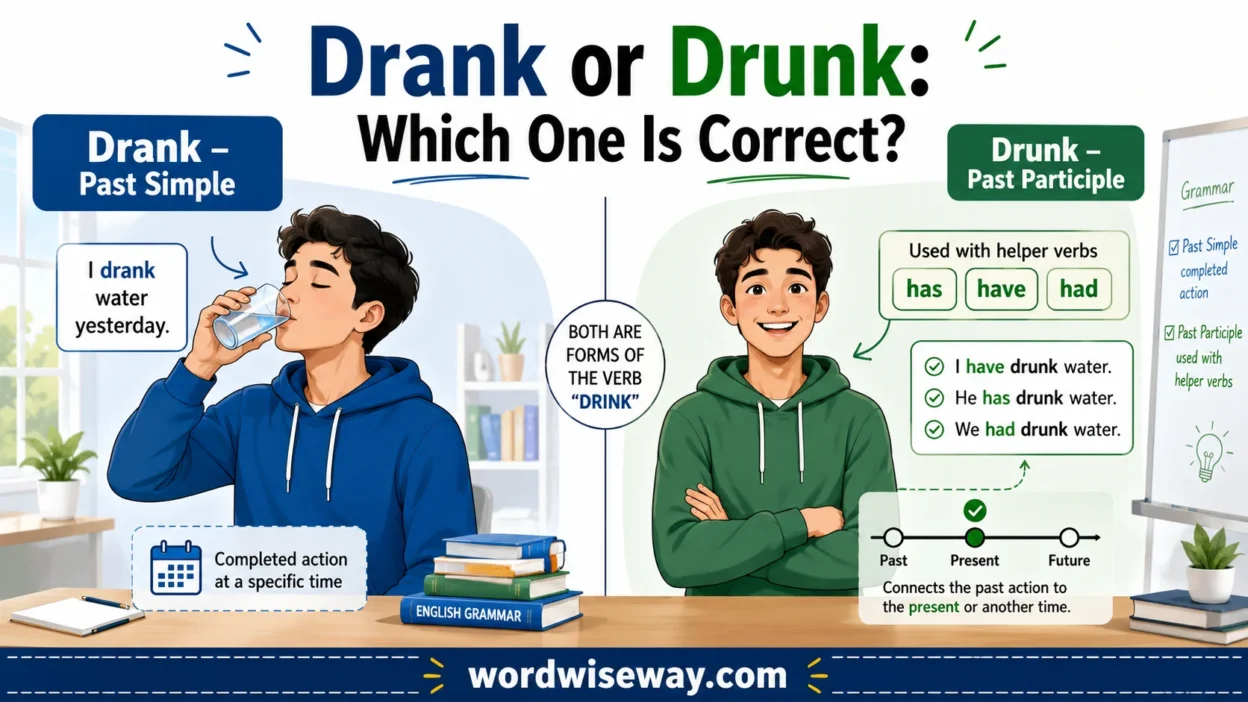
- Drank = past simple
- Drunk = past participle
They come from the verb:
Drink → Drank → Drunk
That’s the full chain. Once you understand it, the confusion starts to fade fast.
Here’s the key idea most learners miss:
- You use drank when the action stands alone in the past
- You use drunk when another verb helps it (has, have, had)
Simple rule. Big difference.
Side-by-Side Comparison of Drank vs Drunk
Let’s make it crystal clear.
Comparison Table
| Incorrect Sentence | Correct Sentence | Why |
| I drunk water | I drank water | No helper verb |
| I have drank water | I have drunk water | Needs past participle |
| She drunk tea yesterday | She drank tea yesterday | Past simple needed |
| They have drank juice | They have drunk juice | Wrong verb form |
Understanding “Drink” as a Verb
Before diving deeper into drank vs drunk, you need to see the full verb system clearly. English verbs change form depending on time and structure.
Let’s break it down.
Verb Forms of Drink
| Form | Word | Example |
| Base form | drink | I drink water daily. |
| Past simple | drank | I drank water yesterday. |
| Past participle | drunk | I have drunk water today. |
Each form plays a different role in sentence structure.
Think of it like a toolkit:
- “drink” is your main tool
- “drank” is your past action tool
- “drunk” is your helper-tool version
When to Use “Drank” (Past Simple Explained Clearly)
“Drank” describes a finished action in the past. No helpers. No extra verbs. Just a clean action that already happened.
Basic Rule
Use drank when:
- The action is complete
- You mention a specific time
- No auxiliary verbs appear
Sentence Pattern
Subject + drank + object
Real Examples
- I drank tea after school.
- She drank cold water in the morning.
- They drank juice at the party.
- We drank coffee before class started.
Time Clues That Signal “Drank”
If you see these, “drank” usually fits:
- yesterday
- last night
- two days ago
- in 2023
- this morning (if finished)
Mini Insight
“Drank” feels like a snapshot of the past. The action is done and closed, like a book you already put back on the shelf.
When to Use “Drunk” (Past Participle Explained Properly)
Now things shift. “Drunk” does not usually stand alone. It needs help from another verb.
Key Rule
Use drunk with:
- has / have / had
- is / was (in passive or formal structures)
Sentence Pattern
Subject + has/have/had + drunk + object
Real Examples
- I have drunk three bottles of water today.
- She has drunk all the juice.
- They had drunk tea before the guests arrived.
- We have drunk enough coffee for one day.
Important Insight
“Drunk” signals a connection to another time or action. It doesn’t stand alone. It leans on helper verbs like a partner holding its hand.
Why “I Have Drank” Is Wrong
This is the most common error.
Let’s break it down:
- “Have” requires a past participle
- The past participle of drink is drunk, not drank
So:
❌ I have drank water
✔ I have drunk water
Why the brain gets tricked
Your mind sees “have” and assumes past form. But English doesn’t work that way here. It uses a different verb form entirely.
Common Mistakes with Drank and Drunk
Let’s fix the most frequent errors learners make.
Mistake 1: Using “drunk” alone
❌ I drunk water
✔ I drank water
Mistake 2: Mixing perfect tense incorrectly
❌ I have drank coffee
✔ I have drunk coffee
Mistake 3: Forgetting time structure
❌ Yesterday I have drunk tea
✔ Yesterday I drank tea
Quick Memory Trick That Actually Works
Forget complicated grammar rules for a moment. Try this simple mental shortcut:
Drank stands alone. Drunk needs a helper.
Or even easier:
- If you see has / have / had, use drunk
- If you don’t, use drank
Think of “drunk” as someone who never walks alone in grammar. It always shows up with company.
Real-Life Usage Difference (How It Sounds in Conversation)
English speakers naturally switch between these forms depending on context.
Casual Speech Example
- “I drank too much coffee yesterday, so I couldn’t sleep.”
Present Perfect Example
- “I have drunk coffee all morning, and I still want more.”
Notice the difference:
- One describes a finished moment
- The other connects past actions to now
Advanced Usage: When “Drunk” Appears Without Obvious Helpers
Sometimes “drunk” appears in less obvious structures.
Passive or formal structures
- The water was drunk quickly during the heatwave.
- All the milk had been drunk before I arrived.
These forms show action happening to the object rather than the subject doing it.
Case Study: How Learners Confuse Drank and Drunk in Real Life
Let’s look at a common classroom scenario.
Student Writing Sample
Ali writes:
“Yesterday I have drank three glasses of water.”
Teacher Correction
Correct version:
“Yesterday I drank three glasses of water.”
What went wrong?
- “Yesterday” already sets past simple context
- “Have drank” mixes two different tense systems
- The learner applied a rule where it didn’t belong
Lesson learned
When time is clearly in the past, avoid “have + verb” structures.
Quick Practice Section (Test Yourself)
Try filling in the blanks:
- I ___ tea last night.
- She has ___ all the juice.
- They ___ water after the match.
- We have ___ enough coffee today.
Answers
- drank
- drunk
- drank
- drunk
Related Confusions You Should Know
Once you understand drank vs drunk, these follow the same pattern:
Sing / Sang / Sung
- I sang yesterday
- I have sung before
Go / Went / Gone
- I went home
- I have gone home
Eat / Ate / Eaten
- I ate dinner
- I have eaten dinner
These verbs follow the same “three-form system.”
My Personal Experience
As an English language specialist, I have seen many learners struggle with the difference between drank and drunk because both words come from the same verb, “drink.” During my teaching experience, I noticed that students often use “drunk” when they want to describe a simple past action or use “drank” with helping verbs.
I explain this difference by connecting grammar rules with everyday examples, which makes learning easier and more practical. Over time, I have helped many students improve their understanding of irregular verbs by focusing on correct usage instead of memorizing rules alone. Learning the difference between drank and drunk may seem small, but it builds confidence in speaking, writing, and overall English communication.
My experience has shown me that clear explanations and real-life examples can turn confusing grammar topics into simple lessons.
Read More: Were or Was: Difference and Usage? A Complete Grammar Guide
FAQs
What is the main difference between drank and drunk?
Drank and drunk are both forms of the verb drink, but they are used in different situations. Drank is the simple past form and is used for an action that happened in the past, while drunk is used with helping verbs like has, have, or had.
Is “I have drank water” grammatically correct?
No, “I have drank water” is incorrect in standard English. The correct sentence is “I have drunk water” because perfect tenses require the past participle form, which is drunk.
When should I use the word drank?
Use drank when you are talking about a completed action in the past. For example, “I drank coffee this morning” shows that the drinking happened and finished in the past.
When should I use the word drunk?
Use drunk when it appears with a helping verb. Examples include “I have drunk enough water” or “She had drunk tea before leaving.”
Why do people confuse drank and drunk?
People often confuse these words because both come from the same verb, drink, and both relate to consuming a liquid. Their similar appearance and pronunciation make them a common grammar challenge.
Is drunk ever used without a helping verb?
In standard grammar, drunk usually needs a helping verb when it means the action of drinking. However, drunk can also be an adjective describing someone affected by alcohol, such as “a drunk person.”
Are drank and drunk spelled differently in British and American English?
No, the spelling of drank and drunk is the same in both British English and American English. The grammar rules and usage remain the same.
How can I remember the difference between drank and drunk?
A simple way to remember is that drank stands alone for past actions, while drunk usually needs a helping verb. Think of “I drank yesterday” and “I have drunk today.”
Can using drank instead of drunk affect my writing?
Yes, using the wrong form can make your writing sound less accurate. Correct use of verb forms improves clarity in emails, essays, professional writing, and everyday communication.
What is the easiest way to learn drank and drunk?
Practice with short sentences and focus on verb tenses. Reading examples, writing your own sentences, and noticing how native speakers use these words can make the difference easier to understand.
Conclusion
Understanding the difference between drank and drunk makes English grammar easier and helps you avoid one of the most common verb mistakes. Although both words come from drink, their uses depend on tense and sentence structure. Learning these small grammar rules can make your speaking and writing clearer.
With regular practice, real-life examples, and attention to verb forms, you can confidently choose between drank and drunk. Whether you are writing an essay, sending an email, or having a conversation, using the correct form helps your English sound more natural and accurate.