Weather or Whether: Difference, Meaning, and Correct Usage helps explain why these words create confusion in English.
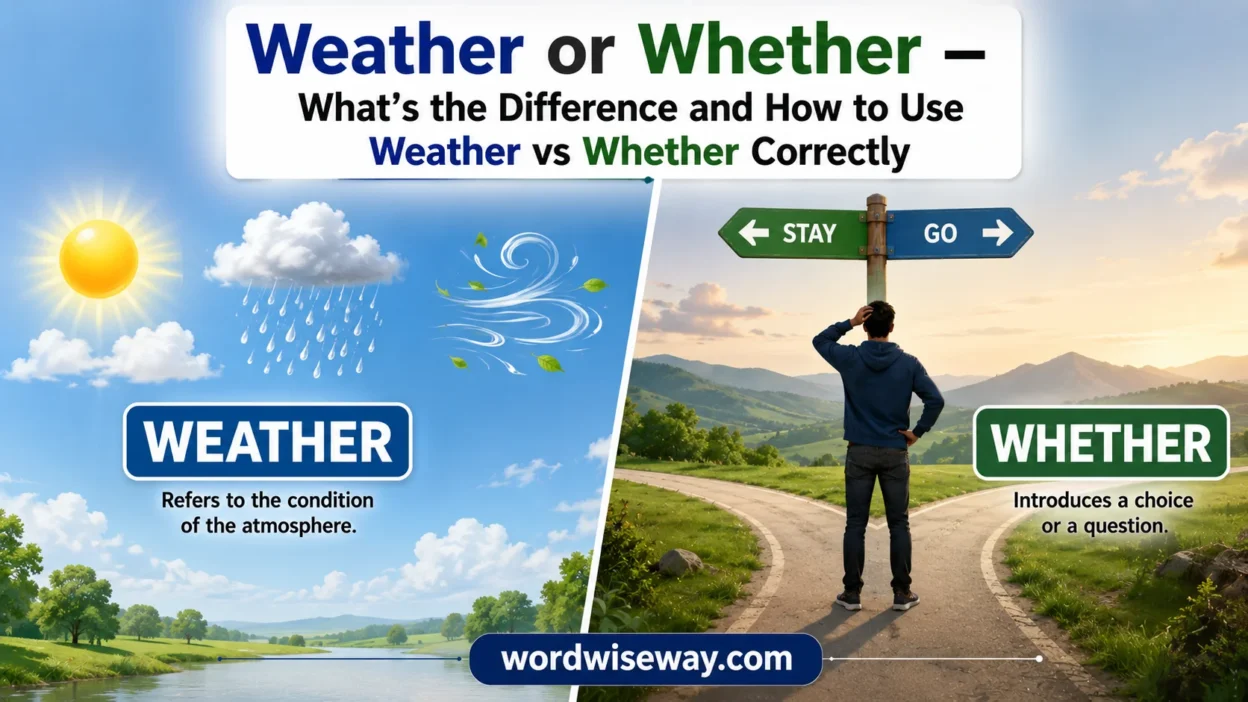
Many learners get confused because weather and whether sound the same but have completely different meanings. Weather describes the state of the atmosphere, including rain, sun, snow, and storms, while whether shows choices, possibilities, and alternatives. Knowing their correct usage is important for writing, school, emails, and conversations.
These word pairs are often mixed by fluent speakers and writers because they are identical when spoken. Understanding the difference, grammar rules, and common mistakes helps you avoid errors.
Through real-life examples and practical tips, you can learn each word, remember their spelling, and write confidently every time.
Quick Answer:
✅ Weather = the condition of the atmosphere, like rain, sun, snow, and storms.
✅ Whether = used for choices, possibilities, or alternatives.
❌ Weather does not mean a decision or option.
❌ Whether does not describe climate or atmospheric conditions.
✅ Remember: Weather is about the sky, while whether is about choices.
What’s the Difference and Why It Confuses So Many People
Let’s start with the confusion itself.
You hear both words exactly the same way:
- “weather”
- “whether”
Same sound. Different meanings. Different jobs in a sentence.
That’s where most mistakes begin.
Here’s the classic confusion:
- ❌ I don’t know weather he will come.
- ✔️ I don’t know whether he will come.
At first glance, the incorrect sentence feels fine. That’s why this mistake is so common. Your brain hears the sound, not the spelling.
But English doesn’t always trust sound. It trusts meaning.
Why this mistake happens so often
- They are homophones (same pronunciation)
- Context isn’t always obvious
- People rely on speaking more than writing
- Autocorrect sometimes makes it worse, not better
Think of them like twins with totally different jobs:
- One is a meteorologist 🌦️
- The other is a decision-maker ⚖️
Quick Meaning Overview Before You Dive Deep
Before we go further, here’s a fast snapshot:
| Word | Type | Meaning | Simple Hint |
| Weather | Noun / Verb | Atmosphere, conditions outside | Sky, rain, sun |
| Whether | Conjunction | Choice, possibility, uncertainty | “If” or “or not” |
If you remember nothing else, remember this:
Weather belongs to the sky. Whether belongs to decisions.
Weather Explained: Meaning, Use, and Real-Life Understanding
Let’s start with it, the more “physical” of the two.
What “weather” actually means
It describes the condition of the atmosphere at a specific place and time.
That includes:
- Temperature
- Rainfall
- Sunshine
- Wind
- Humidity
- Storms
When you say “weather,” you’re talking about what’s happening outside in the sky right now or in the near future.
Weather as a noun
Most of the time, you use weather as a noun.
Examples:
- The weather is hot today.
- The weather looks cloudy.
- I love cold weather in December.
Weather as a verb (less common but powerful)
Here’s something many learners miss: weather can also be a verb.
It means to survive or endure difficult conditions.
Examples:
- The ship weathered the storm.
- She weathered a tough financial year.
- The building has weathered decades of earthquakes.
Notice how the meaning shifts from sky conditions to endurance. That’s English being creative.
Weather in real life: how people actually use it
You use “weather” more often than you think.
Daily examples:
- Checking your phone before leaving home
- Planning trips or picnics
- Deciding what to wear
- Talking casually (“Nice weather today!”)
It’s one of the most practical English words because it connects directly to your environment.
Case Study: A simple real world confusion
Let’s imagine a student named Ali.
Ali writes:
“I stayed home because the weather of going out was not good.”
This is incorrect.
Why?
Because “weather” is not about actions or decisions. It’s about climate.
Correct version:
“I stayed home because I wasn’t sure whether I should go out.”
This tiny correction changes the entire meaning from “sky” to “decision.”
Whether Explained: Meaning, Use, and Real Life Understanding
Now let’s shift to whether, the decision-maker word.
What “whether” means
“Whether” introduces a choice between possibilities.
It often works like:
- “if”
- “or not”
- “possible options”
But it doesn’t describe weather, nature, or environment. It lives in the world of thoughts and decisions.
How “whether” works in sentences
Used for uncertainty
- I don’t know whether he is coming.
- She isn’t sure whether to accept the job.
Used for choices
- I will decide whether to stay or leave.
- Tell me whether you agree or disagree.
Used with “or not”
- I don’t know whether or not he called.
- Whether or not you like it, it’s happening.
That “or not” part is a strong clue. If you see it, you’re almost always dealing with “whether.”
Why “whether” is different from “if”
People often think “if” and “whether” are interchangeable. Sometimes they are. Sometimes they are not.
Safe rule:
- Use whether when presenting choices.
- Use if for conditions.
Example difference:
- I don’t know whether he will come. (choice/uncertainty)
- I will go if he comes. (condition)
That small shift changes logic entirely.
Weather or Whether – Core Difference Explained Simply
Now let’s lock in the real difference.
Weather = physical world
- Sky
- Climate
- Rain
- Temperature
Whether = mental world
- Choices
- Decisions
- Possibilities
- Uncertainty
Think of it like this:
- Weather is what you feel on your skin
- Whether is what you feel in your mind
Memory Tricks That Actually Work
Let’s make this easy to remember without stress.
Trick 1: Sky clue
- “WEAther = WEAther outside”
- If it’s about outside conditions, it’s weather
Trick 2: Choice clue
- “WHEther = WHEre choices split”
- If you see a fork in decisions, it’s whether
Trick 3: Replacement test
Try swapping with “if”:
- If “if” works → use whether
- If it doesn’t → use weather
Example:
- I don’t know ___ he will come → “if he will come” works → whether ✔️
Common Mistakes with Weather or Whether
Even fluent writers slip here. Let’s fix the most common errors.
Mistake 1: Sound-based writing
- ❌ I don’t know weather she is ready
- ✔️ I don’t know whether she is ready
Mistake 2: Overthinking grammar rules
People sometimes freeze because they overanalyze.
Mistake 3: Ignoring context
Context always wins over spelling tricks.
Mistake 4: Mixing both words in one sentence
- ❌ Whether the weather is good, I will go (sounds awkward if misused)
- ✔️ Whether or not the weather is good, I will go
Weather or Whether – Side-by-Side Comparison Table
| Feature | Weather | Whether |
| Meaning | Atmospheric conditions | Choice or possibility |
| Part of speech | Noun / Verb | Conjunction |
| Topic area | Nature, climate | Decisions, logic |
| Example | The weather is cold | I don’t know whether to go |
| Keyword clue | Sky-related words | “if”, “or not”, choices |
Decision Guide You Can Use Instantly
When you’re stuck, ask yourself:
Step 1: Am I talking about nature?
- Yes → Weather
- No → Go next step
Step 2: Am I talking about a choice?
- Yes → Whether
- No → Recheck sentence
Step 3: Try substitution
Replace with “if.”
If it fits → Whether
If it doesn’t → Weather
Test Your Understanding
Try filling in the blanks:
- ___ it rains or shines, we will travel.
- How is the ___ today?
- I don’t know ___ to stay or leave.
- The ___ looks unpredictable this week.
- She is unsure ___ she should call him.
Answers:
- Whether
- Weather
- Whether
- Weather
- Whether
Read More: Aisle vs Isle: Difference, Meaning, and Correct Usage
FAQs
1. What is the main difference between weather and whether?
Weather describes atmospheric conditions like rain, snow, sun, or storms. Whether is used when discussing choices, possibilities, or alternatives.
2. Why do weather and whether cause confusion?
They cause confusion because both words are homophones, meaning they sound the same when spoken but have different spellings and meanings.
3. How can I remember the difference between weather and whether?
You can remember that weather relates to the sky and climate, while whether is connected with decisions, options, and questions.
4. Can weather and whether be used in the same sentence?
Yes, they can appear in the same sentence. For example, you can ask whether the weather will improve before planning a trip.
5. Is whether used only for questions?
No, whether is used for questions, choices, and situations where there are two or more possible outcomes.
6. Is weather always related to rain or storms?
No, weather includes all atmospheric conditions, including sunshine, temperature, wind, clouds, rain, and storms.
7. Do native English speakers confuse weather and whether?
Yes, some fluent speakers may mix them up while writing because they sound identical, but their meanings are different.
8. Which word should I use in professional writing?
Use the correct word based on meaning. Use weather for climate conditions and whether for choices or possibilities.
9. What type of words are weather and whether?
Weather and whether are homophones because they have the same pronunciation but different spellings and meanings.
10. Why is learning weather and whether important?
Learning their difference improves grammar, writing accuracy, communication skills, and helps avoid common English mistakes.
Conclusion
Understanding weather and whether becomes easier when you focus on their meanings instead of their pronunciation. Although these words sound the same, they have separate roles in English. Weather talks about the atmosphere and conditions around us, while whether helps express choices, decisions, and possibilities.
Using these words correctly can make your writing clearer and more professional. With regular practice, examples, and attention to context, you can avoid confusion and choose the right word confidently in conversations, emails, exams, and everyday writing.

Emma Smith has dedicated 14 years to Princeton University’s English Department, mentoring students in textual interpretation, literary movements, and critical frameworks. Her research explores Shakespearean drama, Victorian serial fiction, postcolonial narrative theory, and manuscript studies and probing how literary forms evolve across cultures and centuries. Emma has delivered lectures at international humanities congresses and published findings in distinguished academic journals, underscoring her commitment to scholarly depth and vibrant teaching.