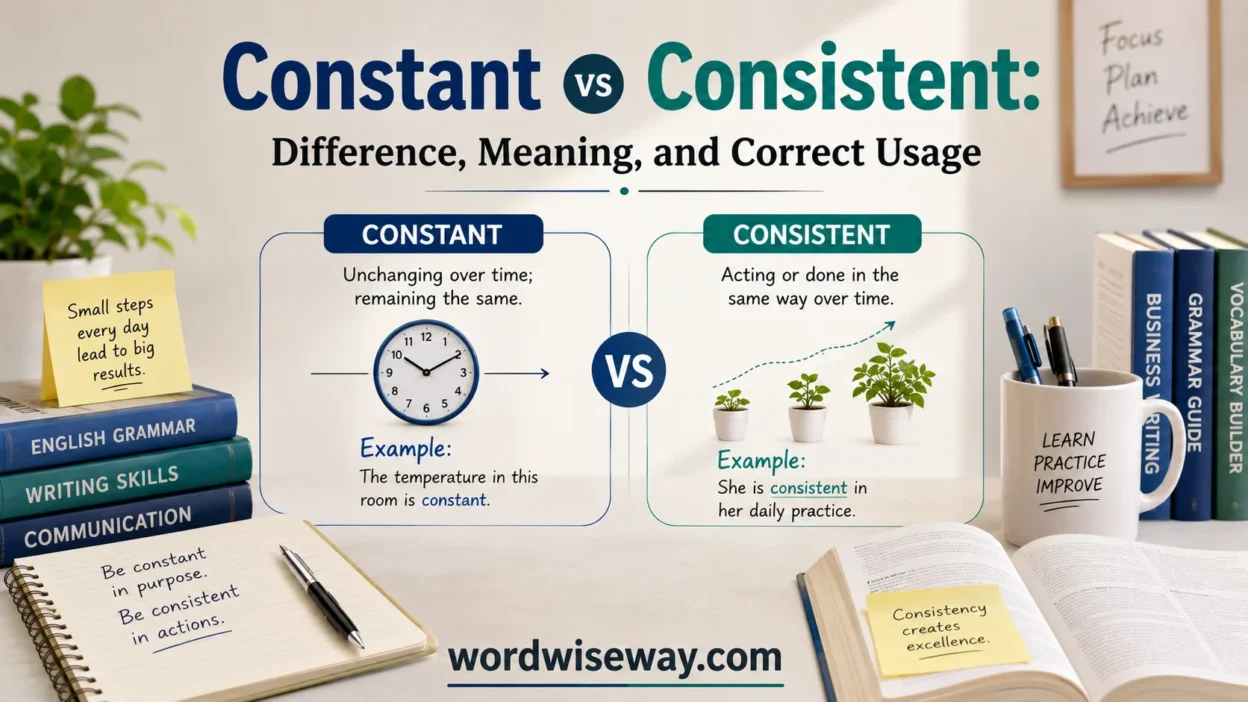
Constant vs Consistent: Difference, Meaning, and Correct Usage helps explain why these terms are often confused.
Constant means something unchanging or continuous over time, such as constant noise or problems. Consistent describes reliable, steady, and uniform actions, including effort, behavior, and habits. Their difference is important for clear communication.
In academic writing, business communication, and everyday conversation, the correct word improves clarity. This complete guide covers definitions, grammar rules, practical examples, and common mistakes. English learners and native speakers can use these usage tips to write accurately and confidently.
Quick Answer:
Constant means something that stays unchanged or continues continuously.
It does not always mean regular improvement or reliable performance.
Consistent means something that is reliable, steady, and follows a repeated pattern.
It does not mean something remains exactly the same without change.
✅ Use constant for unchanging conditions, like constant noise or constant pressure.
✅ Use consistent for habits, efforts, results, and performance.
Why Constant vs Consistent Usage Gets Confusing
At first glance, “constant” and “consistent” feel like twins. They both involve repetition or continuation. That similarity is exactly what creates the confusion.
But their core ideas are different:
- Constant means something never stops or never changes
- Consistent means something follows a stable and reliable pattern over time
Here’s a quick mental picture.
Think of a dripping faucet that never stops. That’s constant.
Now think of someone who shows up to work on time every day. That’s consistent.
Same theme of repetition. Different behavior underneath.
Many learners confuse them because both words appear in similar contexts like habits, performance, and time-based actions. However, the meaning shifts depending on whether you are describing nonstop existence or steady repetition.
Linguist Eleanor Grant once described it like this:
“Constant is about presence without pause. Consistent is about rhythm without chaos.”
That single idea already clears a lot of fog.
What Constant Means in Constant vs Consistent
Let’s dig into constant first because it is the more intense of the two.
Core Meaning of Constant
Constant describes something that:
- Does not stop
- Does not change
- Continues without interruption
It suggests a sense of persistence that feels unbroken. Sometimes it even carries a slightly annoying or overwhelming tone depending on context.
You will often see it used when something feels unavoidable.
Real-Life Examples of Constant
To understand constant vs consistent usage clearly, think in real situations:
- Constant traffic noise outside a busy road
- Constant notifications on a phone
- Constant worry before an exam
- Constant changes in weather during monsoon season
In each case, there is no pause. The action or condition keeps going like a loop that refuses to break.
Grammar Usage of Constant
In English grammar, constant is mainly used as an adjective.
It modifies nouns such as:
- Constant pressure
- Constant noise
- Constant change
- Constant reminder
Tone and Emotion in Constant Usage
One interesting detail is emotional weight. “Constant” often feels heavy. It can signal stress, irritation, or intensity.
For example:
- “He is under constant pressure at work” feels stressful
- “She hears constant noise in the city” feels exhausting
So when you use constant, you are not just describing repetition. You are often describing repetition that does not give space to breathe.
What Consistent Means in Constant vs Consistent
Now let’s move to the calmer sibling in this pair.
Core Meaning of Consistent
Consistent means:
- Something happens in a steady way
- It follows a pattern
- It remains reliable over time
Unlike constant, it does not mean nonstop. Instead, it means stable repetition.
Think of it as controlled repetition instead of endless motion.
Real-Life Examples of Consistent
Here are practical examples that show the meaning clearly:
- A student scoring similar marks in every exam
- A cricket player performing well across multiple matches
- A worker showing up on time every day
- A brand delivering similar product quality every month
Each example shows balance and stability. Nothing feels chaotic or random.
Grammar Usage of Consistent
Consistent is also an adjective. It is often used in professional, academic, and performance-related contexts.
Common phrases include:
- Consistent effort
- Consistent performance
- Consistent results
- Consistent behavior
Tone and Emotion in Consistent Usage
Unlike constant, consistent usually feels positive or neutral.
It suggests:
- Discipline
- Reliability
- Trustworthiness
For example:
- “She shows consistent improvement” sounds encouraging
- “He delivers consistent results” sounds professional
So if constant feels like a storm that never stops, consistent feels like a steady river flowing in the same direction.
Key Differences Side by Side
Now let’s put both words next to each other so the contrast becomes crystal clear.
Comparison Table
| Feature | Constant | Consistent |
| Core idea | Never stops | Repeats steadily |
| Time pattern | Continuous | Regular or stable |
| Emotional tone | Often intense or negative | Usually positive or neutral |
| Focus | Nonstop presence | Reliable pattern |
| Example | Constant noise | Consistent effort |
This table is the simplest way to lock the difference into memory.
If you ever feel stuck, just ask:
- Is it nonstop? → constant
- Is it steady repetition? → consistent
Simple Memory Trick for Constant vs Consistent
Here’s a quick trick that helps most people remember instantly.
- Constant = Can’t stop
- Consistent = Continues same pattern
Now imagine two scenes:
- A dripping tap that never closes → constant
- A morning jog at the same time every day → consistent
Your brain remembers images better than definitions. So lean into that.
Another way to think about it:
- Constant is like background noise that never turns off
- Consistent is like a drumbeat that keeps a steady rhythm
Common Mistakes in Constant vs Consistent
Even fluent speakers mess this up sometimes. Let’s fix that.
Mistake in Academic Writing
❌ “She has constant study habits”
✔ “She has consistent study habits”
Why? Because studying is not nonstop. It follows a pattern.
Mistake in Workplace Language
❌ “He delivers constant performance”
✔ “He delivers consistent performance”
Performance is measured over time, not nonstop action.
Mistake in Everyday Speech
❌ “I need constant effort to improve”
✔ “I need consistent effort to improve”
Effort works best when repeated steadily, not endlessly.
These small fixes make writing sound more natural and accurate.
How to Choose Between Constant vs Consistent
When you are unsure, use this quick decision method.
Ask These Questions
- Does it never stop at all? → use constant
- Does it repeat in a stable way? → use consistent
- Is there a sense of overload or intensity? → constant
- Is there a sense of reliability or progress? → consistent
Quick Substitution Test
Replace the word mentally:
- “Always happening” → constant fits
- “Steady over time” → consistent fits
This simple swap saves you from most mistakes.
Common Collocations in Constant vs Consistent
Words often travel in pairs. These combinations help you sound natural.
With Constant
- Constant noise
- Constant pressure
- Constant change
- Constant reminder
- Constant interruptions
With Consistent
- Consistent effort
- Consistent results
- Consistent growth
- Consistent performance
- Consistent improvement
If you memorize just these pairs, your usage improves immediately.
Advanced Insight: Subtle Meaning Differences
Now let’s go a bit deeper.
Constant Often Feels External
Constant usually describes things happening to you.
- Constant noise outside
- Constant messages from others
- Constant interruptions at work
It often feels uncontrollable.
Consistent Often Feels Internal or Controlled
Consistent usually describes behavior you manage.
- Consistent study habits
- Consistent exercise routine
- Consistent writing practice
It reflects discipline.
This difference is subtle but powerful. It helps you choose the right word in complex writing.
Case Studies: Real Usage in Context
Let’s bring this to life with practical scenarios.
Case Study: Student Performance
A student prepares for exams.
- When they study at random times, results vary
- When they study daily at the same time, they show consistent performance
Now imagine distractions:
- Loud construction outside creates constant noise
- That noise interrupts focus again and again
Same environment. Different word usage depending on behavior vs interruption.
Case Study: Workplace Productivity
An employee receives messages all day.
- Notifications create constant interruptions
- Despite that, they maintain consistent output
Here both words appear in one scenario, showing their contrast clearly.
Case Study: Fitness Routine
A person tries to get fit.
- Eating junk food constantly hurts progress
- Exercising three times a week builds consistent improvement
Again, constant drains energy while consistent builds progress.
Practice Section: Test Your Understanding
Try filling in the blanks.
- She showed ______ improvement in her studies.
- The machine makes ______ noise all night.
- He delivers ______ results every quarter.
- There is ______ pressure during exams.
Answers
- consistent
- constant
- consistent
- constant
If you got most correct, you are on the right track.
Final Checklist
Before you write, run this quick check:
- Am I describing nonstop action? → constant
- Am I describing steady repetition? → consistent
- Does it feel overwhelming? → constant
- Does it feel stable? → consistent
- Would the meaning change if I swap the word? → recheck carefully
This takes only a few seconds but improves accuracy a lot.
Read More: Weather or Whether: Difference, Meaning, and Correct Usage
FAQs
What is the main difference between Constant and Consistent?
Constant refers to something that stays unchanged or continues without stopping, while Consistent refers to something that remains reliable, steady, or follows a regular pattern.
Can Constant and Consistent be used interchangeably?
No, they cannot always be used interchangeably. Although both relate to stability, constant focuses on being unchanged, while consistent focuses on reliability and uniformity.
Is constant always a positive word?
No, constant can describe both positive and negative things. For example, constant support is positive, but constant noise can be annoying.
What does consistent mean in daily life?
Consistent means doing something regularly with dependable results, such as maintaining a consistent study routine or consistent work performance.
Which word should I use for habits, Constant or Consistent?
Consistent is usually the correct choice for habits because it shows regular action and steady behavior over time.
Can a person be described as Constant?
Yes, a person can be called constant when they remain loyal, stable, or unchanged in their actions or feelings.
Why do people confuse Constant and Consistent?
People confuse these words because both suggest continuity, regularity, and stability. However, their meanings differ based on context.
Is constant effort the same as consistent effort?
Not exactly. Constant effort suggests continuous effort without stopping, while consistent effort means regular effort maintained with reliability.
Which word is better for professional writing?
Consistent is often better for professional writing when discussing performance, results, or behavior because it shows dependability and accuracy.
How can I remember the difference between Constant and Consistent?
Remember that constant = stays the same, while consistent = stays reliable. This simple trick helps avoid confusion.
Conclusion
Understanding the difference between Constant and Consistent makes your communication clearer and more accurate. These words may look similar, but they carry different meanings. Constant highlights something unchanged, continuous, or always present, while Consistent focuses on regularity, reliability, and steady results. Using the correct word helps improve writing quality in academic, professional, and everyday situations.
Learning these small differences can prevent common mistakes and make your sentences more precise. Whether you are describing habits, performance, behavior, or situations, choosing between Constant and Consistent depends on the message you want to deliver. With practice and proper usage, you can confidently apply both words in the right context.

Emma Smith has dedicated 14 years to Princeton University’s English Department, mentoring students in textual interpretation, literary movements, and critical frameworks. Her research explores Shakespearean drama, Victorian serial fiction, postcolonial narrative theory, and manuscript studies and probing how literary forms evolve across cultures and centuries. Emma has delivered lectures at international humanities congresses and published findings in distinguished academic journals, underscoring her commitment to scholarly depth and vibrant teaching.