Aisle vs Isle: Difference, Meaning, and Correct Usage helps explain why English learners find these confusing words difficult.
Both words look alike and sound alike, but they have different meanings. These homophones are a single letter apart and often confuse native speakers when choosing the correct word. Their spelling, pronunciation, and usage create common grammar questions.
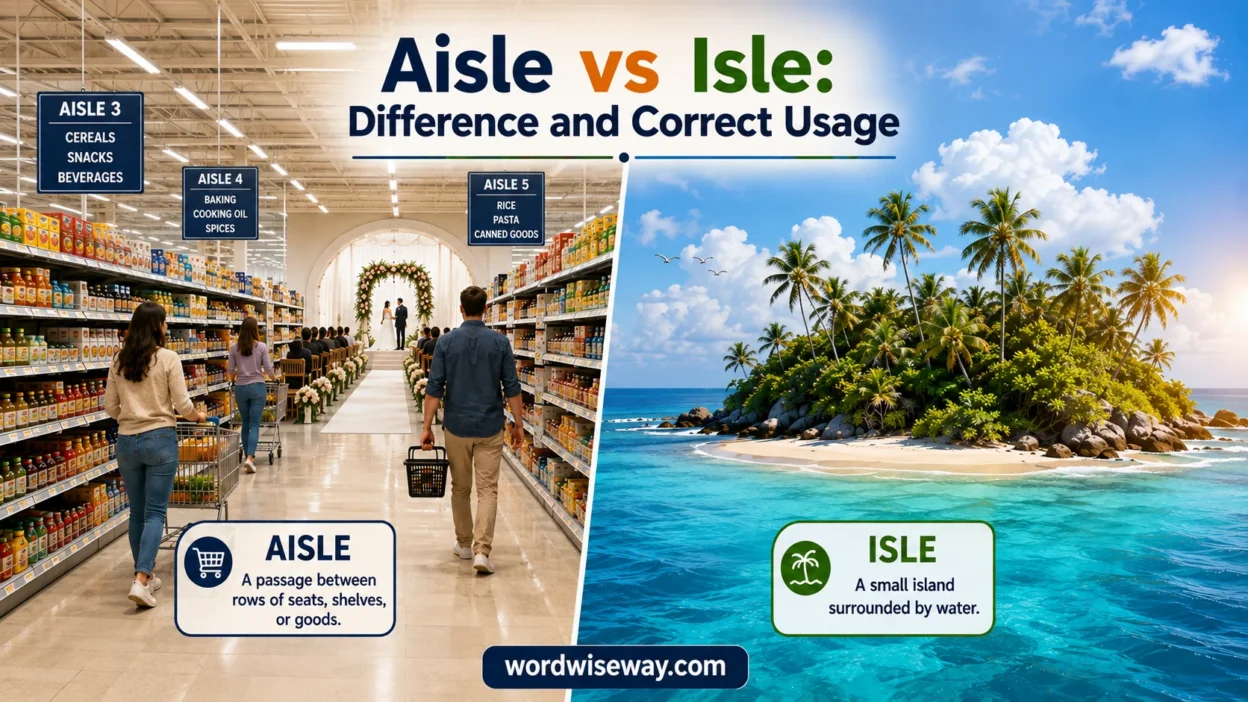
Aisle is a noun meaning a passage between rows of seats or shelves in places like a church, theater, airplane, train, or supermarket. Isle means an island. Using the wrong term can change a sentence completely, so proper grammar and vocabulary knowledge helps writers communicate clearly.
Quick Answer
✅ Aisle refers to a passage or walkway between rows of seats in places like a church, theater, airplane, or train. It can also mean the space between shelves in a supermarket where people walk while shopping.
✅ Isle refers to an island, especially a small one surrounded by water. Although aisle and isle sound the same and are homophones, their meanings are completely different.
Remember aisle with A for a area to walk through, while isle connects with island. This simple trick helps you choose the right word every tim
Aisle vs Isle Meaning Explained Simply
Let’s clear the fog right away.
- Aisle means a passage or walkway between rows of seats or shelves
- Isle means a small island or poetic version of “island”
That’s it. Two meanings. Two completely different images.
Quick mental snapshot
- Aisle → walking inside a building
- Isle → land surrounded by water
If you remember just that contrast, you already beat most spelling mistakes.
Aisle vs Isle Difference at a Glance
Here’s a clean comparison to lock it in your memory.
| Word | Meaning | Environment | Common Usage Example |
| Aisle | Walkway between rows | Stores, airplanes, theaters, weddings | “She walked down the aisle at her wedding.” |
| Isle | Small island | Geography, literature, travel writing | “The Isle of Skye is stunning.” |
Notice something important here.
One word belongs to structured indoor spaces. The other belongs to nature and geography.
Aisle Meaning in Depth (Real Usage You See Every Day)
The word aisle shows up more often than you think. You probably walk through one almost every day without noticing.
An aisle is basically a controlled walking path inside a structured space.
Where you commonly find aisles
You’ll see aisles in:
- Grocery stores
- Supermarkets
- Airplanes
- Cinemas and theaters
- Churches
- Wedding venues
Each of these places uses rows. And where there are rows, there is an aisle.
Real-life examples
- “I always choose the aisle seat on flights for extra space.”
- “The grocery aisle was packed with snacks.”
- “They walked down the aisle during the wedding ceremony.”
Why the word matters
“Aisle” helps describe direction and movement. It tells you where to walk, sit, or stand inside organized spaces.
Without aisles, everything would feel chaotic. Imagine a supermarket with no labeled pathways. You’d be lost in a maze of cereal boxes.
That’s the role of an aisle. It organizes movement.
Common confusion point
People often assume “aisle” has something to do with islands because it sounds like “isle.” But there’s no connection in meaning at all.
Isle Meaning in Depth (A Word That Feels Like an Ocean Breeze)
Now let’s shift from indoor spaces to open water.
An isle is a small island. It can be a real geographical location or a poetic way to describe one.
Where you see “isle”
- Maps and geography books
- Travel writing
- Poetry and literature
- Historical names of places
Famous examples of “isle”
- Isle of Skye (Scotland)
- Isle of Wight (England)
- Isle of Man (between Great Britain and Ireland)
Example sentences
- “The boat sailed toward a quiet isle in the distance.”
- “The isle looked untouched and peaceful.”
- “Legends say the isle was once home to ancient tribes.”
Tone difference
Here’s something interesting.
- Island is neutral and common
- Isle feels artistic, old, or romantic
Writers often use “isle” when they want imagery or mood. It adds flavor to the sentence.
Think of it like this:
- Island = everyday word
- Isle = cinematic version of island
Why Aisle vs Isle Confuses So Many People
Let’s break the confusion down logically.
Same pronunciation
Both words sound identical:
/aɪl/
That alone creates a major spelling trap.
Different spelling patterns
- Aisle → contains “ai” and silent letters
- Isle → starts with “i” and silent “s”
Both look strange in their own way.
No visual connection
Your brain cannot link them easily because:
- One relates to buildings
- The other relates to water
So your memory has no natural bridge between them.
Fast typing problem
When people type quickly, they rely on sound. And sound doesn’t help here.
That’s why mistakes happen even with good writers.
Simple Memory Tricks for Aisle vs Isle
Let’s make this stick in your brain permanently.
Trick for Aisle
Think:
Aisle = A for “Along the store”
Or visualize:
- Shopping carts
- Rows of products
- Wedding chairs
Anything with straight pathways = aisle
Trick for Isle
Think:
Isle = I for “Island”
Or imagine:
- Water all around
- A small green land patch
- Boats approaching shore
Visualization shortcut
- Aisle → “I am walking inside”
- Isle → “I am surrounded by sea”
This mental contrast is powerful.
Aisle vs Isle Side-by-Side Comparison
Let’s sharpen your understanding even more.
| Feature | Aisle | Isle |
| Environment | Indoor | Outdoor (water-based) |
| Movement | Walking through rows | Traveling by boat or map |
| Emotion | Practical, everyday | Romantic, scenic |
| Usage frequency | Very common | Less common |
| Example phrase | Aisle seat | Deserted isle |
Once you see it like this, the confusion drops fast.
Common Mistakes with Aisle vs Isle (and Fixes)
Let’s correct real errors people often make.
Mistake 1
❌ “She walked on a beautiful isle at the mall.”
✔️ “She walked down the aisle at the mall.”
Mistake 2
❌ “We visited an aisle in the ocean.”
✔️ “We visited an isle in the ocean.”
Mistake 3
❌ “I sat on the isle seat during the flight.”
✔️ “I sat in the aisle seat during the flight.”
Why these mistakes happen
People mix pronunciation with meaning. That’s the root problem.
Case Study: How One Word Changes Meaning Completely
Let’s look at a real-world writing scenario.
Scenario
A travel blogger writes:
“The wedding took place on a beautiful isle.”
Readers get confused. They imagine a beach wedding on an island.
But the writer actually meant:
“The wedding took place down a beautiful aisle.”
Now the meaning changes completely.
- First version → destination wedding on island
- Second version → ceremony inside venue
One letter changed the entire scene.
This shows why spelling accuracy matters in storytelling and communication.
Quick Practice Quiz: Aisle vs Isle
Try these.
Fill in the blanks
- She walked down the wedding ______
- The ship approached a small ______
- I prefer the ______ seat on airplanes
- The ancient ______ was covered in mist
Answers
- aisle
- isle
- aisle
- isle
If you got all correct, you’re already mastering it.
Interesting Linguistic Facts About Aisle and Isle
Here are some language facts most people don’t know.
Silent letters are historical leftovers
- “Aisle” comes from Old French influence
- “Isle” also evolved from older Latin roots
Silent letters stayed even though pronunciation changed over time.
English keeps “extra letters” for history
English often preserves spelling history even when pronunciation simplifies.
That’s why:
- Knife has a silent “k”
- Isle has a silent “s”
“Isle” is less common in modern speech
Today, writers prefer “island” unless they want tone or style.
Real-Life Usage Guide (When to Use Which Word)
Here’s a practical decision guide.
Use “aisle” when:
- You are inside a building
- You are talking about seating or rows
- You mention movement paths
Examples:
- airplane aisle
- supermarket aisle
- wedding aisle
Use “isle” when:
- You are talking about geography
- You describe islands
- You want poetic tone
Examples:
- tropical isle
- remote isle
- ancient isle
Final Takeaway: Aisle vs Isle Made Simple
Let’s lock it in one final time.
- Aisle = path between rows inside buildings
- Isle = small island surrounded by water
No overlap. No crossover. Just two separate worlds sharing one sound.
If you ever get stuck again, picture this:
- Shopping carts and seats → aisle
- Waves and sand → isle
That mental image alone solves most confusion instantly.
Read More: Brake vs Break: Difference, Meaning, and Usage Explained
FAQs
What is the easiest way to remember aisle and isle?
A simple trick is to connect aisle with a walking path and isle with an island. The letter “A” in aisle can remind you of an area where people move between seats or shelves.
Are aisle and isle pronounced the same?
Yes, aisle and isle have the same pronunciation. They are called homophones because they sound identical but have different spellings and meanings.
Can aisle and isle be used interchangeably?
No, these words cannot replace each other. Using the wrong word can completely change the meaning of a sentence.
What does aisle mean in a sentence?
Aisle means a passage or walkway between rows of seats, shelves, or other objects. For example, shoppers walk through a supermarket aisle.
What does isle mean in English?
Isle means an island, usually a small piece of land surrounded by water. It is often used in names of islands or poetic writing.
Why do people confuse aisle and isle?
People confuse them because they have similar spelling and identical pronunciation. Their close appearance makes it difficult for some writers to choose the correct term.
Are aisle and isle common grammar mistakes?
Yes, confusing these two words is a common mistake in writing. Many learners and even native speakers mix them up because they are homophones.
How can I use aisle correctly in formal writing?
Use aisle when describing a pathway in a building, vehicle, church, theater, or store. Checking the context of the sentence can help avoid errors.
How can I use isle correctly?
Use isle when you are talking about an island. It should describe land surrounded by water, not a walkway or passage.
Why is understanding aisle and isle important?
Knowing the difference improves spelling, vocabulary, and communication skills. Correct word choice helps make emails, articles, and everyday writing clearer.
Conclusion
Understanding the difference between aisle and isle makes English writing more accurate and easier to understand. Although these two words share the same pronunciation, their meanings belong to completely different contexts. One describes a passage for walking, while the other describes an island. Learning this small difference can prevent common spelling and grammar mistakes.
Using the correct word improves communication and helps writers express their ideas clearly. Whether you are writing formal documents, social media posts, or everyday sentences, knowing when to use aisle and when to use isle will make your vocabulary stronger and your writing more professional.

Emma Smith has dedicated 14 years to Princeton University’s English Department, mentoring students in textual interpretation, literary movements, and critical frameworks. Her research explores Shakespearean drama, Victorian serial fiction, postcolonial narrative theory, and manuscript studies and probing how literary forms evolve across cultures and centuries. Emma has delivered lectures at international humanities congresses and published findings in distinguished academic journals, underscoring her commitment to scholarly depth and vibrant teaching.