Kiss or slap is a phrase that gets attention because it sounds emotional, dramatic, and sometimes confusing. Its meaning depends on the context and tone. It can describe a literal choice, metaphor, or playful phrase.
You may find it in games, social media, informal settings, jokes, online trends, and storytelling. The expression can sound romantic, aggressive, or humorous, depending on how it is used. In reality, correct usage depends on the situation.
This article helps you learn where it came from and how to use it. From my experience with English writing, chatting, and posting online, this guide keeps things clear. You can use the phrase confidently when the surrounding words provide clarity and reduce confusion.
Quick Answer:
“Kiss or slap” usually presents two possible actions as alternatives.
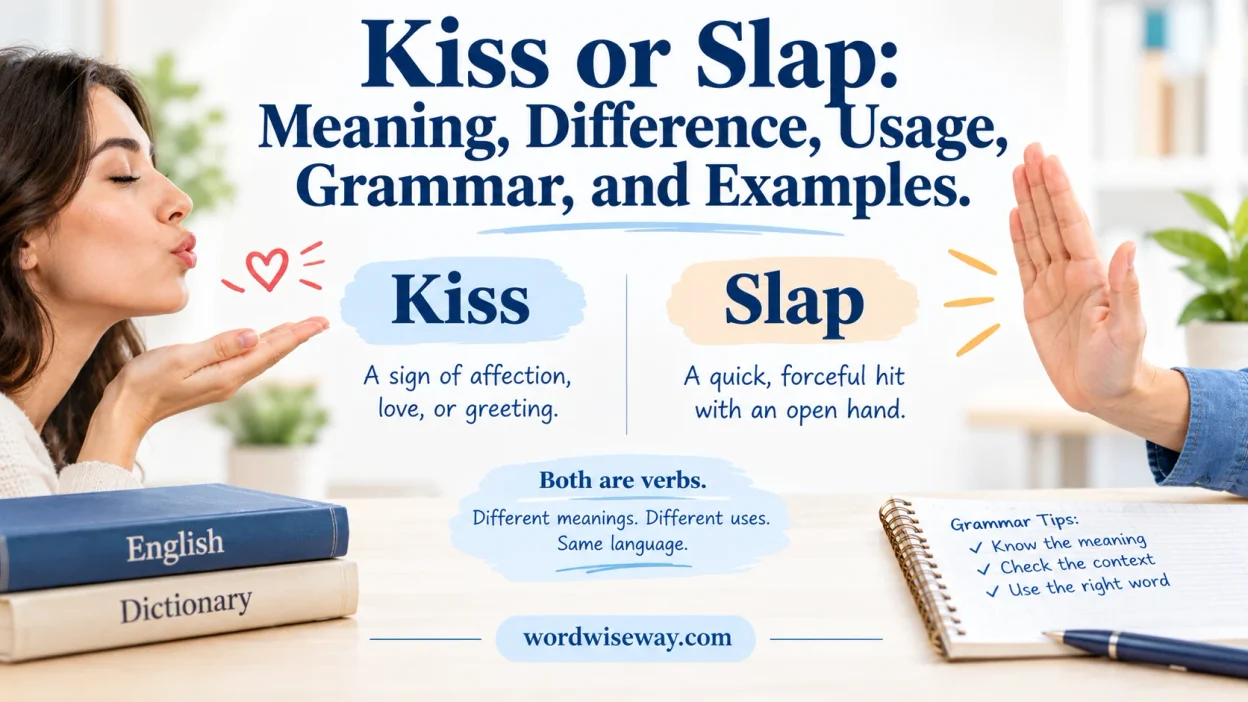
- Kiss means to touch someone with the lips as an expression of affection, greeting, or another social purpose.
- Slap means to strike someone or something with an open hand.
- Or shows that the speaker is presenting alternatives.
- “Kiss or slap?” therefore means something like “Which of these two actions would happen or would you choose?”
The exact interpretation depends on context.
For example:
“Would you choose a kiss or a slap?”
This clearly presents two alternatives.
By contrast:
“She wondered whether he would kiss or slap her.”
Here, the sentence describes two possible actions directed toward the same person.
The phrase itself doesn’t automatically establish a romantic, humorous, angry, or serious situation. The surrounding language does that work.
What Does “Kiss” Mean?
The word kiss describes an affectionate or social gesture involving the lips. Its meaning changes somewhat according to the relationship and situation.
Someone might kiss another person as a greeting, farewell, expression of affection, or part of a romantic relationship. A kiss can also appear in cultural or family settings where it carries no romantic meaning.
Kiss as a Verb
As a verb, kiss describes the action itself.
Examples:
- She kissed her mother goodbye.
- He kissed his child on the forehead.
- They kissed each other on the cheek.
The verb can take different grammatical structures. You might say “kiss someone,” “kiss someone goodbye,” or “kiss someone on the cheek.”
The surrounding words usually make the intended meaning clear.
Kiss as a Noun
As a noun, kiss refers to the gesture or act.
Examples:
- She gave her grandmother a kiss.
- He received a kiss on the cheek.
- The character avoided a goodbye kiss.
The noun often appears with words such as a, the, his, her, their, or one.
What Does “Slap” Mean?
A slap is a physical strike made with an open hand. The word can function as both a noun and a verb.
Unlike kiss, which commonly carries an affectionate meaning, slap usually describes conflict, anger, punishment, or another physical action. Context remains important because English also uses slap figuratively.
Slap as a Verb
As a verb, slap describes the action of striking with an open hand.
Examples:
- The character threatened to slap him.
- She slapped the table in frustration.
- He slapped the ball away.
Notice that slap doesn’t always describe one person striking another person. You can also slap an object or use the word figuratively.
For example, “slap the paint onto the wall” describes applying something quickly and forcefully.
Slap as a Noun
As a noun, slap names the action.
Examples:
- The character received a slap.
- A sudden slap interrupted the argument.
- He heard a slap against the table.
The noun usually needs an article, determiner, or another modifier when used in an ordinary sentence.
What’s the Difference?
Although kiss and slap can appear together in the phrase “kiss or slap,” their meanings are fundamentally different.
| Word | Basic meaning | Common role | Example |
| Kiss | A gesture involving the lips | Affection, greeting, farewell | She gave him a kiss. |
| Slap | A strike with an open hand | Conflict, anger, physical action | He threatened to slap him. |
The contrast becomes especially strong when both words appear in one question.
“Kiss or slap?”
The speaker isn’t asking about two similar actions. They’re presenting two sharply different possibilities.
What Does “Kiss or Slap?” Mean as a Question?
“Kiss or slap?” is a shortened question. English speakers often omit words when the missing information is obvious from context.
For example, someone might ask:
“Tea or coffee?”
The complete grammatical idea could be “Would you like tea or coffee?” Yet the shorter version sounds perfectly natural in conversation.
The same principle applies to “kiss or slap?”
Depending on the context, it could represent:
- A hypothetical choice
- A fictional character’s possible reaction
- A casual social prompt
- A question about what someone might do
- A humorous contrast between two possibilities
However, the phrase can become ambiguous because it doesn’t specify the subject.
Compare these sentences:
| Expression | What it clearly communicates |
| Kiss or slap? | Two possible actions, but the subject is unstated |
| Would you choose a kiss or a slap? | The listener chooses between two actions |
| Should I kiss you or slap you? | The speaker identifies themselves as the person performing the action |
| Would she kiss him or slap him? | The sentence identifies the person performing and receiving the action |
The longer versions remove ambiguity.
How to Use “Kiss or Slap” in a Sentence
The phrase works best when the context already tells the reader who is involved.
As a Direct Choice
A short question can present two alternatives:
“Kiss or slap?”
This works naturally in an informal conversation or hypothetical scenario when everyone already understands the situation.
A more explicit version would be:
“Would you choose a kiss or a slap?”
The second version provides more grammatical information.
In a Full Sentence
A complete sentence can make the relationship between the words much clearer.
Examples:
- She asked whether he wanted a kiss or a slap.
- The character had to decide whether to kiss him or slap him.
- Would you choose a kiss or a slap in that fictional scenario?
- Nobody knew whether her reaction would be a kiss or a slap.
The structure changes slightly depending on whether kiss and slap function as nouns or verbs.
In Fictional Dialogue
Writers can use the phrase to create a quick contrast between possible reactions.
For example:
“Kiss or slap?” the character asked.
The surrounding narration would then establish what the question means.
In fiction, context matters even more because dialogue often uses shortened expressions. A reader needs enough surrounding information to understand who is speaking and what the alternatives represent.
“Kiss or Slap” vs. “Kiss and Slap”
The difference between or and and is crucial.
Or presents alternatives. And connects things that occur together or belong together.
Compare:
Kiss or slap?
This presents two possible actions.
Kiss and slap?
This suggests that both actions are being considered together.
The change of one small conjunction completely alters the relationship between the words.
| Phrase | Function of conjunction | Meaning |
| Kiss or slap | Alternative | One possibility versus another |
| Kiss and slap | Combination | Both actions |
| Kiss, then slap | Sequence | One action followed by another |
This distinction becomes especially important when you’re writing dialogue or explaining a fictional situation.
“Kiss or Slap” vs. “Kiss or Be Slapped”
These expressions look similar, but their grammatical structures differ.
“Kiss or slap” doesn’t clearly identify who performs either action.
“Kiss or be slapped” establishes a different relationship. The implied subject performs the first action and receives the second.
For example:
“You can kiss him or be slapped.”
The subject you connects to both parts of the construction.
The sentence therefore has more grammatical information than the shorter phrase “kiss or slap.”
| Expression | Clarity |
| Kiss or slap? | Ambiguous without context |
| Kiss or be slapped? | Identifies different roles more clearly |
| Should I kiss or slap him? | Clearly identifies the speaker and target |
When precision matters, use the fuller construction.
Is “Kiss or Slap” Grammatically Correct?
Yes. “Kiss or slap?” can be grammatically acceptable as an informal elliptical question.
An elliptical question leaves out words that the listener can understand from context.
For example:
“Red or blue?”
This omits something such as “Do you want red or blue?”
Likewise:
“Kiss or slap?”
can omit a longer structure such as “Would you choose a kiss or a slap?”
That doesn’t make the short version incorrect. It simply makes it more dependent on context.
For formal writing, a complete sentence often works better because it removes ambiguity.
Common Contexts for “Kiss or Slap”
The phrase can appear in several types of language, although the interpretation changes with each setting.
Casual Conversation
In casual speech, people often shorten questions because the situation supplies the missing information.
“Kiss or slap?” can therefore work when both speakers already understand the hypothetical situation.
Fiction and Storytelling
Writers can use the contrast to show two dramatically different possible reactions.
The phrase can create tension without requiring a long explanation. Still, the surrounding scene should clarify the characters’ intentions.
Games and Social Prompts
The phrase may appear as a hypothetical choice in social games or online prompts.
In such cases, it usually asks someone to select between two stated possibilities rather than describing an actual event.
Memes and Online Language
Short phrases perform well in captions and memes because they’re easy to understand quickly.
“Kiss or slap?” has a built-in contrast. That makes it more attention-grabbing than a neutral question.
However, online language often strips away context. A phrase that seems harmless in one setting can sound aggressive or inappropriate in another.
Examples of “Kiss or Slap”
Here are several examples showing how the phrase and its related forms work.
Direct Questions
- “Kiss or slap?”
- “Would you choose a kiss or a slap?”
- “Which would you expect, a kiss or a slap?”
Full Sentences
- She couldn’t predict whether he would kiss her or slap her.
- The fictional scene presented a choice between a kiss and a slap.
- The character wondered whether his reaction would be a kiss or a slap.
Grammar Examples
- Kiss as a verb: She kissed her sister goodbye.
- Kiss as a noun: She gave her sister a kiss.
- Slap as a verb: The character slapped the table.
- Slap as a noun: The story described a slap.
These examples show why grammatical function matters. The same word can behave differently depending on its position.
Common Mistakes
A few mistakes can make this short expression confusing.
Treating Kiss and Slap as Similar Actions
The words belong to completely different semantic categories.
A kiss commonly communicates affection or social connection. A slap describes an open-handed strike. Their pairing creates contrast rather than similarity.
Ignoring Context
The phrase doesn’t carry one universal emotional meaning.
A fictional question might be humorous. A serious conversation could make the same words sound threatening. Context determines how readers interpret the phrase.
Confusing “Or” With “And”
This is one of the clearest grammatical mistakes.
Or presents alternatives.
And connects multiple items or actions.
Therefore, changing “kiss or slap” to “kiss and slap” changes the meaning substantially.
Leaving the Subject Unclear
The short form can leave readers wondering who will perform the action.
Compare:
“Kiss or slap?”
with:
“Should she kiss him or slap him?”
The second sentence gives the reader much more information.
Assuming One Fixed Meaning
Don’t treat “kiss or slap” as an idiom with one rigid definition.
It’s primarily a combination of ordinary English words. The meaning comes from the words themselves plus their context.
Meaning in Different Contexts
| Context | Likely interpretation |
| Casual question | A choice between two actions |
| Fictional dialogue | Two possible character reactions |
| Social prompt | A hypothetical choice |
| Meme or caption | A humorous or dramatic contrast |
| Serious conversation | A potentially confrontational statement |
| Grammar discussion | A comparison of two nouns or verbs |
The key point is simple: context supplies the missing information.
A phrase with only three words can still carry several interpretations. That’s one reason English speakers rely heavily on surrounding sentences, tone, and shared knowledge.
Synonyms and Related Words
Several related words exist, but you shouldn’t automatically substitute them.
Words Related to “Kiss”
- Peck: usually suggests a brief or light kiss.
- Embrace: means to hold someone closely rather than kiss them.
- Affection: describes a feeling rather than the physical action itself.
For example, “peck” can sometimes replace “kiss” when you specifically mean a brief kiss. However, “affection” isn’t a direct synonym.
Words Related to “Slap”
- Smack: can describe a sharp strike and may also have other meanings.
- Strike: a broader term that doesn’t specifically require an open hand.
- Hit: a general term for physical impact.
Therefore, slap is more specific than hit.
A slap is a type of hit, but not every hit is a slap.
That distinction matters when you want precise wording.
Which Word Should You Use?
Choose kiss when the intended meaning involves the specific gesture associated with the lips.
Choose slap when you specifically mean an open-handed strike.
If you’re presenting the two as alternatives, “kiss or slap” works when the context makes the participants and situation clear.
When readers could misunderstand the sentence, expand it.
Instead of:
“Kiss or slap?”
you might write:
“Would you choose a kiss or a slap?”
Or, if the action itself matters:
“Should the character kiss him or slap him?”
A few extra words can turn a foggy sentence into a crystal-clear one.
Key Grammar Facts
Keep these points in mind when writing or interpreting the phrase:
- Kiss can function as both a noun and a verb.
- Slap can function as both a noun and a verb.
- Or introduces an alternative.
- “Kiss or slap?” works as an informal elliptical question.
- The short question may omit the subject and auxiliary verb.
- Context determines who performs the action.
- A complete sentence provides greater grammatical clarity.
- “Kiss or slap” doesn’t have one fixed meaning outside context.
- “Kiss and slap” has a different meaning because and replaces or.
- Related words such as peck, smack, strike, and hit aren’t perfect substitutes.
Quick Revision:
| Point | Explanation |
| Kiss | An affectionate or social gesture involving the lips |
| Slap | A strike made with an open hand |
| Or | Connects alternatives |
| Kiss or slap? | Presents two possible actions |
| Grammar | Can work as an informal elliptical question |
| Context | Determines the exact interpretation |
| Formal writing | A complete sentence usually offers better clarity |
The easiest way to remember the phrase is to focus on the conjunction. “Or” creates the choice. The words before and after it provide the two alternatives.
Read More: Incase or In Case: Correct Spelling, Meaning, and Usage
FAQs
1. What does “kiss or slap” mean?
“Kiss or slap” presents two very different actions as a choice. Its meaning depends on the situation, speaker, and surrounding conversation.
2. Is “kiss or slap” a literal phrase?
It can be literal, but people often use it playfully or figuratively. You should check the context before deciding what the speaker means.
3. Is “kiss or slap” grammatically correct?
Yes. “Kiss or slap” is grammatically understandable because or connects two alternative actions. The exact sentence around it determines how it functions.
4. Where is “kiss or slap” commonly used?
You may encounter it in casual conversations, games, jokes, social media posts, and online trends. It usually belongs to informal communication.
5. Does “kiss or slap” have a romantic meaning?
Sometimes it can suggest a romantic situation, but that isn’t its only meaning. The tone and context can change how readers understand it.
6. Can “kiss or slap” sound aggressive?
Yes. The word “slap” can make the expression sound aggressive or confrontational. The surrounding context helps clarify the speaker’s intention.
7. Is “kiss or slap” suitable for formal writing?
Generally, it’s better suited to informal writing. In formal content, choose clearer wording when the phrase could create confusion.
8. Can I use “kiss or slap” on social media?
Yes, people may use the phrase in captions, games, jokes, and discussions. Make sure your wording makes the intended meaning clear.
9. Is “kiss or slap” a metaphor?
It can function as a metaphor when the speaker isn’t referring to the actions literally. The metaphorical meaning comes from the particular context.
10. How can I use “kiss or slap” correctly?
First, understand what you want the phrase to communicate. Then place it in a sentence where the surrounding words clearly establish the intended tone and meaning.
Conclusion
“Kiss or slap” is a short expression with more than one possible interpretation. It can describe a literal choice, a playful question, or a figurative idea. Because the two actions create very different impressions, context plays an important role.
When you use this phrase, pay attention to your audience and setting. Casual conversations, games, jokes, and social media may allow a playful tone, while formal writing usually needs more precise wording. A few surrounding words can prevent unnecessary confusion.
Understanding the phrase isn’t difficult once you focus on context, grammar, and tone. Whether you’re writing, chatting, or creating online content, choose the wording that matches your intended meaning. That small step makes your communication clearer and more natural.

Emma Smith has dedicated 14 years to Princeton University’s English Department, mentoring students in textual interpretation, literary movements, and critical frameworks. Her research explores Shakespearean drama, Victorian serial fiction, postcolonial narrative theory, and manuscript studies and probing how literary forms evolve across cultures and centuries. Emma has delivered lectures at international humanities congresses and published findings in distinguished academic journals, underscoring her commitment to scholarly depth and vibrant teaching.