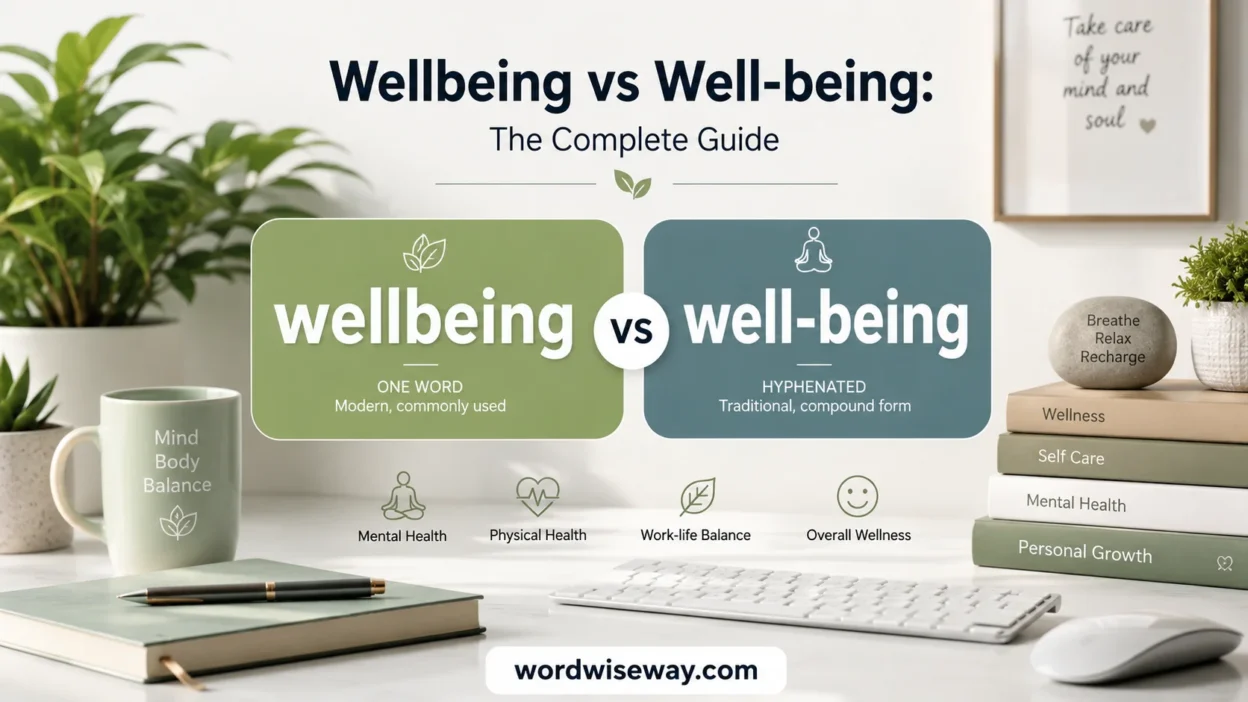
Wellbeing vs Well-being: Correct Spelling, Meaning, and Usage often appears in American English writing where people compare wellbeing and well-being.
In British English and American English, spelling differences can affect understanding. Search trends like “wellbeing or well-being uk” show how people stay confused in different contexts. The origin of spelling and style guides help writers choose the correct version. This improves understanding and supports clear writing in workplace documents.
Historically, the word comes from hundreds of years of language change and word combinations. The noun form well-being or well being has been discussed since older language constructions. Over time, one standard spelling became common despite different early spellings. Today, both forms exist, but usage depends on modern English writing rules.
Wellbeing vs Well-being Meaning: Are They Different?
Wellbeing vs Well-being definition explained simply
Here is the core truth:
👉 Both “wellbeing” and “well-being” mean the same thing.
They describe a person’s overall state of comfort, health, happiness, and life satisfaction. This includes:
- Physical health
- Mental health
- Emotional balance
- Social stability
- Financial security in some broader models
There is no semantic difference between the two forms. The distinction is purely orthographic (spelling related).
Why the hyphen exists in “well-being”
Originally, English used hyphens to connect compound concepts for clarity. “Well-being” literally breaks into:
- “well” (in good health)
- “being” (existence or state of life)
The hyphen acted like a bridge. It told readers: treat these words as one idea, not two separate ones.
This was especially useful in older English writing where compound nouns were harder to visually process.
Why “wellbeing” exists today
Over time, English simplified many hyphenated words. This process is called orthographic compression.
Examples include:
- e-mail → email
- on-line → online
- health-care → healthcare (in many modern uses)
“Wellbeing” follows the same pattern. Writers and publishers gradually dropped the hyphen for speed, simplicity, and cleaner digital formatting.
So instead of changing meaning, the language simply changed shape.
History of Wellbeing vs Well-being in English Usage
Language never stands still. The evolution of wellbeing vs well-being shows how English adapts to culture, technology, and communication habits.
Early usage: hyphen dominance
In older dictionaries and academic texts, “well-being” was the standard form. It followed traditional grammar rules that favored hyphenated compound nouns.
For decades, this was the “safe” academic choice.
Modern shift: simplification trend
As digital writing expanded, especially after the early 2000s:
- Writers preferred shorter forms
- Publishers reduced hyphen use
- Search engines started influencing spelling behavior
“Wellbeing” gained momentum in wellness blogs, corporate communications, and lifestyle writing.
Current state: both are active
Today, both forms coexist. However:
- Formal writing still leans toward “well-being”
- Modern branding and digital content often prefer “wellbeing”
English has not fully settled on one version yet.
Read More: Drier vs Dryer: Meaning, Difference, and correct usage
What Style Guides Say About Wellbeing vs Well-being
Different authorities treat this term differently. That is one reason confusion continues.
AP Style (Journalism standard in the US)
- Preferred form: well-being
- Reason: clarity and consistency in professional reporting
News organizations often stick to this rule because hyphenation reduces ambiguity during fast reading.
Chicago Manual of Style
- Preferred form: well-being
- Allows flexibility depending on publisher preference
Chicago focuses on consistency over absolute rules, especially in books and academic publishing.
Oxford and British English trends
- Increasing acceptance of wellbeing
- Still recognizes “well-being” as correct
British usage shows faster adoption of simplified forms in modern writing.
Summary Table: Style Guide Preferences
| Style Guide | Preferred Form | Notes |
| AP Style | well-being | Journalism standard |
| Chicago Manual | well-being | Flexible, context-based |
| Oxford Usage | wellbeing (modern trend) | Increasing acceptance |
| Merriam-Webster | well-being | Main entry with variant |
Regional Differences in Wellbeing vs Well-being Usage
Language behaves differently across regions. The same is true for this term.
United States usage
In the US:
- Academic and medical writing prefers well-being
- Corporate wellness branding sometimes uses wellbeing
The hyphen still signals professionalism in formal contexts.
United Kingdom usage
In the UK:
- “Wellbeing” is becoming more common in everyday and policy language
- Government health campaigns often use “wellbeing”
However, formal academic work still leans toward “well-being.”
Australia, Canada, and global usage
These regions show mixed patterns:
- Academic institutions: well-being
- Public health messaging: wellbeing
- Media outlets: both forms depending on style guide
Why Both Wellbeing and Well-being Still Exist Online
If language evolves, why hasn’t one form disappeared?
The answer lies in three forces shaping modern writing.
1. Transitional language behavior
English does not switch overnight. Instead, it drifts slowly. During transitions:
- Older form stays active
- New form gains popularity
- Both coexist for years or decades
“Well-being” and “wellbeing” are still in this overlap phase.
2. Editorial inconsistency
Different publishers follow different rules. Even within the same website:
- Old articles may use “well-being”
- New content may use “wellbeing”
This creates visible inconsistency across the web.
3. Branding decisions
Brands often choose spelling based on aesthetics.
“Wellbeing” feels:
- cleaner
- more modern
- more minimal
So wellness apps, fitness platforms, and lifestyle brands often drop the hyphen intentionally.
Wellbeing vs Well-being in Digital Writing
This is where the choice becomes practical, not just grammatical.
Search behavior reality
People search both:
- “wellbeing tips”
- “well-being tips”
Search engines understand them as closely related but still treat them as separate query variations.
Common Mistakes in Using Wellbeing vs Well-being
Even experienced writers slip up here.
Switching between forms randomly
This creates confusion and weakens credibility. Readers notice inconsistency quickly.
Over-hyphenating words
Some writers try to “correct” everything with hyphens. That leads to unnatural text like:
- well-being-focused-strategy (incorrect and cluttered)
Ignoring audience expectations
Different readers expect different standards:
- Academics expect “well-being”
- Lifestyle readers accept “wellbeing”
How to Choose Between Wellbeing and Well-being
Use this practical decision framework.
Ask these questions
- Are you writing academic, medical, or research content?
→ Use well-being - Are you writing branding, wellness, or modern lifestyle content?
→ Use wellbeing - Not sure?
→ Default to well-being
Consistency rule
Once you choose:
- Stick with it throughout the entire document
- Do not switch midway
Consistency builds trust faster than “perfect” spelling choice.
Wellbeing vs Well-being Comparison Table
| Factor | Well-being | Wellbeing |
| Structure | Hyphenated compound | Closed compound |
| Tone | Formal, academic | Modern, branding |
| Usage | Medical, journalism | Wellness, lifestyle |
| Clarity | High | High |
| Trend | Stable | Increasing |
Case Study: How Editorial Teams Handle Wellbeing vs Well-being
Let’s look at a realistic editorial workflow scenario.
A health publishing team working on wellness content faces this exact issue. Their process usually looks like this:
Step 1: Define audience
- Academic readers → well-being
- General wellness readers → wellbeing
Step 2: Set style rule
They choose one rule per content batch:
- All articles in a journal use “well-being”
- All blog content uses “wellbeing”
Step 3: Enforce consistency tools
Editors use:
- Style sheets
- Automated grammar tools
- Manual review checks
Outcome
The result is:
- Cleaner content
- Lower editing time
- Better reader trust
This shows that the choice is less about correctness and more about system design in writing workflows.
FAQs
Q1: What is the correct spelling: wellbeing or well-being?
Both wellbeing and well-being are used, but well-being is more widely accepted in formal writing and style guides.
Q2: Is wellbeing one word or two words?
It can be written as one word or two, but usage depends on region and writing style preferences.
Q3: Why is there a hyphen in well-being?
The hyphen helps improve readability and separates the parts of the word for clearer understanding.
Q4: Which spelling is used in British English?
British English often prefers well-being, especially in academic and professional writing.
Q5: Which spelling is used in American English?
American English more commonly uses wellbeing, especially in casual or modern online content.
Q6: Is wellbeing correct in academic writing?
Yes, but many academic papers still prefer well-being for consistency and formal style.
Q7: What does wellbeing mean?
It refers to happiness, health, and overall life satisfaction in daily life.
Q8: Why do people get confused between the two forms?
Because both versions are used in different contexts and across style guides.
Q9: Has the spelling changed over time?
Yes, the word evolved over hundreds of years, but both forms still exist today.
Conclusion
The difference between wellbeing and well-being is mainly about style, region, and writing preference rather than meaning. Both forms describe health, happiness, and overall life satisfaction, but writers must choose carefully depending on context and audience expectations.
In formal settings like academic papers and professional communication, well-being is often preferred, while wellbeing appears more in modern online content and casual usage. Understanding both helps improve clarity, readability, and writing accuracy across different English styles.

Evelyn Shaw has spent 14 years at Yale University’s English Department, leading students through close readings, genre studies, and interpretive methodologies. Her scholarly interests include Renaissance drama, gothic fiction, feminist literary criticism, and archival research and examining how texts generate meaning across historical periods. Evelyn has presented at major academic conferences and published essays in peer-reviewed journals, reflecting her passion for rigorous analysis and student-centered learning.