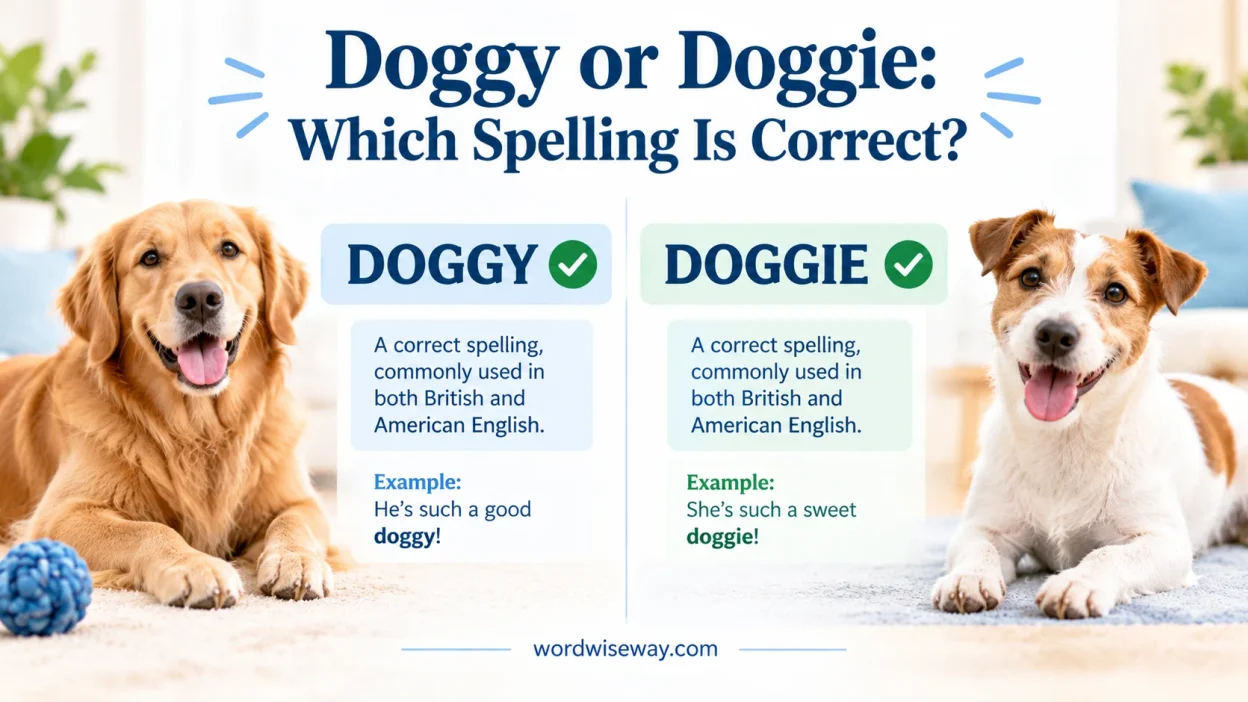
Doggy or Doggie: Which Spelling Is Correct? Both spellings describe a cute dog in friendly, informal language. If you mention your four-legged friend, favorite pet, or a dog in casual conversation, either doggy or doggie can work. These versions often appear in social media, children’s books, pet names, and everyday phrases.
The difference is mainly linked to style, tone, and personal preference. Both forms are acceptable in American English, while British English can also use either spelling. Because these are informal English forms, they do not follow strict spelling rules. Your audience and context can help you choose the most natural option.
For real writing, both spellings are correct, so neither is wrong. The usage examples, origin, and common variations show why people use both forms. Learners, writers, and pet lovers can confidently choose either version for a friendly text without confusion.
Quick Answer:
Doggy and doggie are both correct. They can both work as affectionate or child-oriented terms for a dog.
Use doggy when you want the more versatile spelling, especially when the word functions as an adjective.
Use doggie when you’re using an informal, affectionate term for a dog, particularly in speech or child-directed language.
| Word | Correct? | Main meaning | Typical use |
| Doggy | ✓ Yes | A dog; of or like a dog | Informal speech, descriptions, compounds |
| Doggie | ✓ Yes | A dog | Informal or child-oriented language |
For example:
- The little girl pointed at the doggy.
- The puppy needs a doggie toy.
- There was a doggy smell in the room.
The first two use the word as an informal reference to a dog. The third uses doggy as an adjective meaning something associated with or characteristic of a dog. Oxford specifically records this adjectival use.
Doggy vs. Doggie: The Main Difference
The biggest difference isn’t meaning. It’s form and grammatical flexibility.
Doggy is a recognized informal noun meaning a dog, especially in child-directed speech. It can also function as an adjective before a noun. For instance, you can describe something as a doggy smell or talk about doggy day care.
Doggie, meanwhile, is primarily an informal or child-oriented noun for a dog. Cambridge defines it as a child’s word for “a dog.”
The distinction becomes clearer when you place both words into sentences.
“Look at that doggy!”
Here, doggy acts as a noun.
“This room has a doggy smell.”
Here, doggy works as an adjective.
That second use gives doggy a broader grammatical range.
Doggy
Doggy is an established English word with two important uses.
As a noun, it means a dog in informal or child-oriented language. As an adjective, it means something associated with or resembling a dog. Oxford lists both meanings separately.
Examples include:
- The child wanted to pet the doggy.
- That doggy is very friendly.
- The shelter has several playful doggies.
- The room had a noticeable doggy smell.
- They opened a doggy day care center.
The word can therefore describe either the animal itself or something connected with dogs.
Doggie
Doggie carries essentially the same basic noun meaning as doggy. Cambridge defines it as a child’s word for a dog and gives the pronunciation /ˈdɔːɡi/ in its American English entry.
Examples include:
- Look at the cute doggie!
- The child wanted to see the doggie.
- She bought some doggie treats.
- The doggie was waiting by the door.
- The children enjoyed playing with the doggie.
The -ie ending can give the word a particularly affectionate or child-friendly appearance. That doesn’t make it more correct, though. It’s simply an established spelling.
Is “Doggy” a Correct Spelling?
Yes. Doggy is completely correct.
Major dictionaries recognize it as an informal word for a dog. Oxford lists doggy as an informal noun and notes doggie as an alternative. Cambridge similarly identifies doggy as a child’s word for a dog and lists doggie as another form.
When to Use Doggy
Use doggy when you want an informal term for a dog or when you’re describing something related to dogs.
For example:
- The toddler called every dog a doggy.
- That doggy looks friendly.
- We found a great doggy day care service.
- The house had a strong doggy smell.
- She bought a new doggy bed.
The spelling also appears in established compounds. Oxford lists doggy bag, for example, as an informal term for a bag used to take leftover restaurant food home.
Examples of Doggy in Sentences
Here are several natural examples:
- The child smiled when she saw the doggy.
- Our doggy loves playing in the yard.
- The shelter has a doggy adoption event this weekend.
- The blanket has a slight doggy smell.
- We found a reliable doggy day care nearby.
Notice how doggy can refer directly to a dog or describe something connected with dogs.
Is “Doggie” a Correct Spelling?
Yes. Doggie is also a correct and recognized spelling.
Cambridge lists doggie as a noun meaning a dog and describes it as a child’s word. Its dictionary examples also show the spelling in phrases such as doggie treats, doggie toys, and doggie day care.
When to Use Doggie
Use doggie when you want an informal, affectionate, or child-friendly way to refer to a dog.
For example:
- The baby pointed at the doggie.
- That doggie is adorable.
- She gave the doggie a treat.
- The children wanted to play with the doggie.
- He bought some doggie toys.
In ordinary adult writing, however, dog is usually the more neutral choice. Doggy and doggie add an informal or affectionate tone.
Examples of Doggie in Sentences
Consider these examples:
- The little boy wanted to pet the doggie.
- The doggie followed its owner into the park.
- She bought a new toy for her doggie.
- The children laughed when the doggie chased the ball.
- The doggie was waiting beside the front door.
These sentences sound informal and affectionate rather than formal or technical.
Meaning
At their core, doggy and doggie mean the same thing when they refer to a dog.
Both can serve as affectionate alternatives to the ordinary word dog. Cambridge explicitly connects the two spellings by listing doggy as a child’s word and identifying doggie as another form.
The more interesting distinction appears when doggy functions as an adjective.
What Does Doggy Mean?
As a noun, doggy means a dog, particularly in language used with children.
As an adjective, it means of or like a dog. Oxford gives a doggy smell as an example of this use.
So these two sentences have different grammatical structures:
- The doggy is sleeping.
Here, doggy is a noun. - There is a doggy smell in the room.
Here, doggy is an adjective.
That flexibility makes doggy especially useful in informal English.
What Does Doggie Mean?
Doggie primarily means a dog in child-oriented or affectionate language.
For example:
“Look at the doggie!”
Here, doggie simply replaces the more neutral word dog.
It doesn’t identify a particular breed or size. A tiny puppy and a large adult dog could both be called a doggie.
Do Doggy and Doggie Mean the Same Thing?
Usually, yes.
When both words act as informal nouns for dogs, there is no meaningful difference in their basic definition.
The difference is mainly stylistic and grammatical:
- Doggy has noun and adjective uses.
- Doggie is mainly used as an informal noun.
- Both can sound affectionate.
- Both can appear in informal compounds.
- Neither spelling is inherently wrong.
Which One Is More Common?
There isn’t a useful rule saying that one spelling is universally correct while the other is incorrect.
Dictionary evidence shows that both forms are established in English. Oxford treats doggie as an alternative spelling of doggy, while Cambridge gives separate entries and identifies the words as equivalent forms in this sense.
In practice, you’ll see doggy frequently in compounds and descriptive expressions.
Examples include:
- doggy bag
- doggy day care
- doggy smell
- doggy paddle
- doggy treats
The spelling doggie also appears in compounds such as doggie bag and doggie day care. Cambridge explicitly recognizes doggie day care alongside doggy day care.
American English Usage
American English uses both doggy and doggie.
The pronunciation remains essentially the same, while the spelling changes. American dictionary entries from Oxford recognize doggie as an alternative to doggy.
For general American writing, doggy is often the safer choice when you need the adjective form or a familiar compound.
British English Usage
British English also recognizes both spellings.
Cambridge gives doggy the British pronunciation /ˈdɒɡ.i/ and the American pronunciation /ˈdɑː.ɡi/.
The spelling difference isn’t therefore a simple British-versus-American divide. Both forms can occur in English on either side of the Atlantic.
Modern Online and Informal Usage
Online writing often favors whichever spelling feels more natural to the writer.
You’ll encounter:
- doggy
- doggie
- doggy treats
- doggie treats
- doggy day care
- doggie day care
The context usually tells you what the writer means.
Doggy or Doggie for a Pet?
When you’re talking affectionately about a pet, either spelling can work.
For example:
“My doggy loves going outside.”
or:
“My doggie loves going outside.”
Both sentences communicate the same basic idea.
The choice depends more on tone than meaning. Doggie can feel especially childlike or affectionate, while doggy can feel slightly more versatile because it also works naturally as an adjective.
If you’re writing a veterinary report, formal article, academic paper, or professional document, simply use dog unless you have a specific reason to use an informal term.
Doggy as a Noun, Adjective, and Informal Term
The word doggy has more grammatical range than its cute appearance might suggest.
Doggy as a Noun
As a noun, doggy means a dog.
Example:
The child ran toward the friendly doggy.
This use is informal and commonly associated with children.
Doggy as an Adjective
As an adjective, doggy means of or like a dog.
Example:
The room had a distinctly doggy smell.
Oxford specifically recognizes this adjectival meaning.
Common Expressions With Doggy
Several familiar expressions use doggy:
- doggy bag
- doggy day care
- doggy smell
- doggy paddle
- doggy treats
These expressions show why doggy isn’t merely a cute replacement for dog. It can also function as a productive descriptive word.
Doggie as a Noun, Adjective, and Informal Term
It is less grammatically flexible.
Doggie as a Noun
Its main role is as an informal noun for a dog.
Example:
The toddler pointed at the doggie.
Cambridge identifies this specifically as a child’s word.
Doggie as an Adjective
Although you may see doggie before another noun in informal compounds, dictionaries tend to treat doggy as the standard adjectival form.
For example, both doggy treats and doggie treats appear in real usage. Cambridge’s examples include doggie treats and doggie toys.
Still, when you’re deliberately describing something as “of or like a dog,” doggy is the clearer dictionary-backed choice.
Common Expressions With Doggie
Common examples include:
- doggie bag
- doggie day care
- doggie treats
- doggie toys
- doggie door
These phrases are informal and often appear in pet-related conversations and consumer writing.
Pronunciation
The two spellings are pronounced essentially the same in ordinary English.
Cambridge gives doggy as /ˈdɑː.ɡi/ in American English and /ˈdɒɡ.i/ in British English. Its doggie entry gives the corresponding pronunciation.
The important point is that the spelling changes, but the basic pronunciation doesn’t create a meaningful distinction between the two words.
This makes doggy and doggie a classic spelling variation rather than a pair of words with different sounds and definitions.
Spelling and Word Formation
Why do both spellings exist?
English frequently uses different endings to create affectionate or diminutive forms. The endings -y and -ie can both appear in informal nouns.
Oxford’s entry for the -y suffix notes that -y can occur in nouns to show affection and gives examples such as doggy and daddy.
That helps explain why both doggy and doggie feel natural to English speakers.
The language already contains many informal forms with similar spelling variation. The existence of two spellings doesn’t automatically mean one represents an error.
Doggy vs. Doggie in Formal and Informal Writing
Context matters more than people often realize.
In formal writing, the plain word dog is usually best. It is direct, neutral, and appropriate for academic, professional, and technical contexts.
In informal writing, either doggy or doggie can work.
| Writing situation | Best choice |
| Academic paper | dog |
| Veterinary report | dog |
| News report | Usually dog |
| Conversation with a child | doggy or doggie |
| Affectionate pet conversation | doggy or doggie |
| Informal blog | doggy or doggie |
| Describing something dog-related | doggy |
There’s no need to make informal language sound formal when the situation doesn’t demand it.
Common Mistakes
Several misconceptions can make this spelling question more confusing than it needs to be.
Treating One Spelling as Incorrect
The biggest mistake is assuming doggie must be wrong because doggy looks more familiar, or vice versa.
Both are established forms.
Confusing Doggy With Dog
Doggy isn’t simply a misspelled version of dog. It’s an informal word with its own established usage.
However, dog remains the neutral and standard choice for most formal contexts.
Using the Terms in the Wrong Context
Calling a dog doggy in a conversation with a child sounds natural.
Writing “The doggy demonstrated increased respiratory distress” in a veterinary report would sound unnecessarily childish. The word isn’t grammatically impossible, but it doesn’t suit the register.
The best word isn’t determined by spelling alone. Context controls tone.
Examples in Real Sentences
Seeing both forms side by side makes the distinction easier.
Examples With Doggy
- The child wanted to pet the doggy.
- Our doggy loves chasing tennis balls.
- The shelter hosted a doggy adoption event.
- The blanket had a doggy smell.
- They enrolled their puppy in doggy day care.
Examples With Doggie
- The toddler pointed at the doggie.
- She bought doggie treats for her puppy.
- The children wanted to play with the doggie.
- He bought a new toy for his doggie.
- The doggie waited patiently by the door.
Side-by-Side Sentence Comparison
| Doggy | Doggie |
| Look at that doggy! | Look at that doggie! |
| The doggy is friendly. | The doggie is friendly. |
| She bought doggy treats. | She bought doggie treats. |
| The room has a doggy smell. | The room has a doggie smell. |
| We found doggy day care. | We found doggie day care. |
The first three pairs demonstrate how easily the spellings can substitute for one another. The fourth pair also shows why doggy has an advantage when the word clearly functions as an adjective.
Comparison Table
| Feature | Doggy | Doggie |
| Correct spelling | ✓ Yes | ✓ Yes |
| Refers to a dog | ✓ | ✓ |
| Informal | ✓ | ✓ |
| Child-oriented | ✓ | ✓ |
| Affectionate | ✓ | ✓ |
| Used as an adjective | ✓ | Less typical |
| Used in compounds | ✓ | ✓ |
| Formal writing | Usually avoid | Usually avoid |
| Neutral alternative | Dog | Dog |
The simplest rule is this: both spellings work when you mean an informal or affectionate dog, but doggy has broader grammatical use.
Which Should You Use?
If you’re wondering which spelling to choose, doggy is the more versatile option.
Choose doggy when:
- You need an informal word for a dog.
- You want an adjective meaning related to or like a dog.
- You’re writing a familiar compound such as doggy bag.
- You want a spelling that dictionaries explicitly recognize in both noun and adjective roles.
Choose doggie when:
- You’re using an affectionate term for a dog.
- You’re writing in a child-friendly voice.
- The context naturally favors the -ie spelling.
- You want an informal alternative to doggy.
If you’re writing formally, neither is usually necessary. Dog will almost always be the cleaner choice.
Read More: Vapour or Vapor: Which Spelling Is Correct?
FAQs
Is doggy a correct spelling?
Yes. Doggy is a correct and widely used informal spelling for a dog, especially in friendly or affectionate language.
Is doggie also a correct spelling?
Yes. Doggie is also correct. It has the same basic meaning as doggy and is often used in playful or affectionate contexts.
Are doggy and doggie the same word?
They have essentially the same meaning. Both are informal terms for a dog, although individual writers may prefer one spelling over the other.
Which spelling is more common, doggy or doggie?
Both spellings are common. The choice can vary by writer, region, audience, and personal style, so there is no universal rule requiring one form.
Can I use doggy in formal writing?
Doggy is generally informal, so it may not fit formal or academic writing. In those situations, dog is usually a more neutral choice.
Is doggie suitable for children’s writing?
Yes. Doggie frequently fits children’s language because its playful sound can make writing feel warm and approachable.
Do British and American English use different spellings?
Both British English and American English can use doggy and doggie. Neither spelling belongs exclusively to one variety of English.
Why are there two spellings for doggy?
Informal and affectionate words often develop alternative spellings. Doggy and doggie reflect this kind of spelling variation in everyday English.
Should I use doggy or doggie in a social media post?
Either one can work. Consider the tone of your post and choose the spelling that sounds most natural for your audience and message.
Is doggy or doggie better for everyday writing?
Both are suitable for informal everyday writing. Your choice can depend on personal preference, context, and the tone you want to create.
Conclusion:
In everyday English, doggy and doggie are both accepted spellings for a dog. They are informal, friendly terms that often appear in conversations, pet names, children’s writing, and social media. Neither spelling is automatically wrong simply because it uses a different ending.
The choice usually comes down to style, tone, and personal preference. Doggy may feel familiar and straightforward, while doggie can have a more playful or affectionate feel. Both can communicate the same basic idea, so context matters more than searching for one universal spelling.
When writing, choose the form that fits your audience and sentence naturally. If you need a more neutral or formal word, simply use dog. For casual and friendly contexts, either doggy or doggie can be a perfectly suitable choice.

Emma Smith has dedicated 14 years to Princeton University’s English Department, mentoring students in textual interpretation, literary movements, and critical frameworks. Her research explores Shakespearean drama, Victorian serial fiction, postcolonial narrative theory, and manuscript studies and probing how literary forms evolve across cultures and centuries. Emma has delivered lectures at international humanities congresses and published findings in distinguished academic journals, underscoring her commitment to scholarly depth and vibrant teaching.