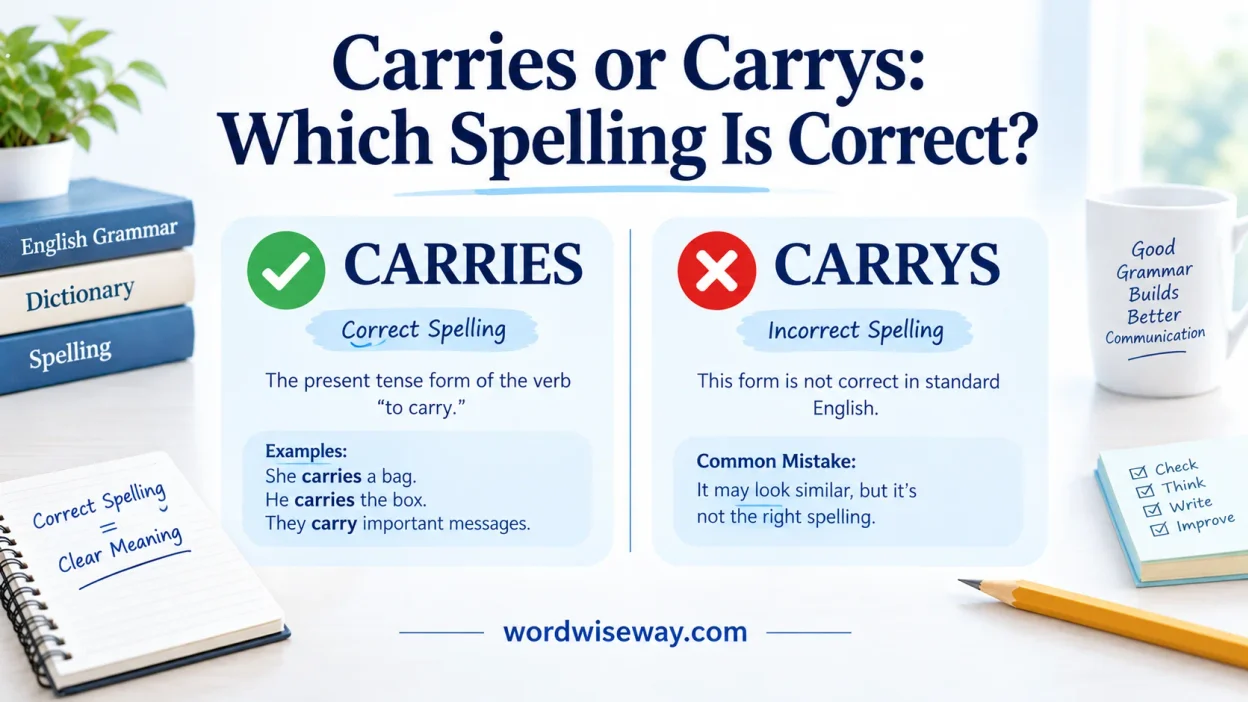
For Carries or Carrys: Correct Spelling, Meaning, and Usage, the quick answer is carries, the correct spelling, while carrys is a spelling mistake in standard English.
This guide explains the English spelling rule behind the confusion. English verbs that end in y can change when adding -s, so he, she, and it use carries rather than carrys. With carry, the correct word is carries.
English learners, students, and native speakers may find this rule confusing when they’re unsure about the correct form, but knowing its origin can remove doubt and build confidence in writing. In real life, this distinction appears when completing homework, writing an email, preparing an article, or creating online content.
The keyword carrys or carries often appears in searches because people want to avoid common mistakes in school, business emails, school assignments, social media posts, and professional content. The usage is the same in British English and American English, because the spelling rule remains consistent across varieties of English.
Real-life examples, comparisons, and clear English usage make the pattern easier to remember: carry + s becomes carries. For users, this simple rule can help prevent mistakes, support better grades, and strengthen professional communication.
Quick Answer:
Carries is the correct spelling. Carrys is incorrect in standard English.
The verb carry changes to carries when the subject is third-person singular in the simple present tense.
For example:
She carries her books to class every morning.
You wouldn’t write:
She carrys her books to class every morning. ❌
The reason is simple. When a verb ends in consonant + y, English normally changes the y to i before adding -es.
| Base Verb | Correct Third-Person Form |
| carry | carries |
| study | studies |
| try | tries |
| worry | worries |
| hurry | hurries |
| copy | copies |
Therefore, if you’re choosing between carries or carrys, choose carries.
Carries Meaning
Carries is the third-person singular present-tense form of the verb carry. Its meaning depends on the sentence, but it generally describes holding, transporting, supporting, or moving something.
For example:
- She carries a heavy backpack.
- The truck carries furniture across the country.
- The bridge carries thousands of vehicles each day.
- The store carries several popular shoe brands.
The word doesn’t always describe physically holding an object. English uses carry in several different contexts.
Carries Means Holds or Transports
The most familiar meaning involves physically holding or moving something from one place to another.
Maria carries her laptop in a protective bag.
Here, carries describes Maria transporting the laptop.
You can use the same structure for many ordinary situations:
- He carries a wallet in his pocket.
- The child carries a lunchbox to school.
- She carries groceries into the kitchen.
- The worker carries the boxes carefully.
Carries Means Transports
A vehicle, animal, machine, or other object can also carry people or goods.
The bus carries passengers between the two towns.
In this sentence, the bus isn’t physically holding the passengers in the way a person holds a box. Instead, it transports them.
Other examples include:
- The ship carries hundreds of containers.
- The airplane carries passengers across the country.
- The truck carries construction materials.
- The train carries commuters into the city.
Carries Means Supports Weight
The verb carry can also describe something that supports a load or bears weight.
This beam carries most of the roof’s weight.
Here, carries doesn’t mean physically picking something up. It describes the beam’s structural role.
You might also see this usage in engineering, architecture, and construction:
- The column carries the load above it.
- The foundation carries the weight of the structure.
- The bridge carries heavy traffic.
- The steel frame carries the building’s load.
Carries Means Offers or Stocks a Product
Retail businesses also use carry when they sell or stock a particular product.
That store carries several types of organic tea.
In this context, carries means the store offers the product for sale.
For example:
- The supermarket carries imported foods.
- This shop carries children’s clothing.
- The website carries several electronics brands.
- The pharmacy carries basic personal-care products.
Carrys Meaning
Carrys is not the correct standard spelling of the third-person singular form of carry.
The mistake happens because many English verbs simply take -s in the third-person singular:
- walk → walks
- run → runs
- read → reads
- help → helps
Someone might naturally assume that carry + s = carrys.
However, verbs ending in consonant + y follow a different spelling pattern.
The correct transformation is:
carry → carr + i + es → carries
Therefore:
He carries the bag. ✓
Not:
He carrys the bag. ❌
Why Does Carrys Look Correct?
English spelling often creates traps because several similar rules operate at once.
Consider these examples:
- play → plays
- enjoy → enjoys
- stay → stays
Now compare them with:
- carry → carries
- study → studies
- reply → replies
The difference is the letter immediately before y.
When a verb ends in a consonant + y, the y changes to i before -es.
When a verb ends in a vowel + y, the y stays in place and you simply add -s.
Why Is It Carries, Not Carrys?
The spelling of carries follows a standard English inflection rule.
The Consonant + Y Rule
When a verb ends with a consonant followed by y, change y to i and add -es when forming the third-person singular present tense.
The pattern looks like this:
consonant + y → i + es
Examples include:
| Base Verb | Third-Person Singular |
| carry | carries |
| study | studies |
| cry | cries |
| try | tries |
| fly | flies |
| reply | replies |
| identify | identifies |
Notice the letters before the final y:
- carry
- study
- try
- reply
Each word has a consonant immediately before y.
What Happens With a Vowel + Y?
The rule changes when a vowel appears before the final y.
In that case, you normally keep the y and add -s.
| Base Verb | Third-Person Singular |
| play | plays |
| stay | stays |
| enjoy | enjoys |
| obey | obeys |
| employ | employs |
This gives you a useful contrast:
She carries the bag.
She plays tennis.
Both verbs end in y, but they don’t form their third-person singular versions in the same way.
The letter before y determines the spelling pattern.
Carries vs. Carry: Understanding the Verb Forms
Carries isn’t a completely different verb from carry. It’s simply an inflected form of the same verb.
The form you use depends on the subject.
| Subject | Verb | Example |
| I | carry | I carry my bag. |
| You | carry | You carry the box. |
| We | carry | We carry the supplies. |
| They | carry | They carry the equipment. |
| He | carries | He carries the equipment. |
| She | carries | She carries the equipment. |
| It | carries | The truck carries the equipment. |
The important point is that carries belongs with a third-person singular subject in the simple present.
That includes:
- he
- she
- it
- singular nouns
- singular names
For example:
Ahmed carries his backpack.
The machine carries the material.
My sister carries an umbrella.
However, plural subjects use carry:
The students carry their books.
That’s why subject-verb agreement matters alongside spelling.
When to Use Carries in a Sentence
The word carries can appear in several types of sentences. Understanding the meaning helps you recognize the correct form naturally.
Physical Carrying
Use carries when someone holds or moves something.
She carries a water bottle everywhere.
The farmer carries a basket of vegetables.
Transportation
Use carries when a vehicle or other means of transport moves people or goods.
The train carries hundreds of passengers.
The truck carries fresh produce.
Supporting a Load
Use carries when something supports weight.
The main column carries the upper floor.
The bridge carries traffic over the river.
Stocking Products
Use carries when a business offers something for sale.
This store carries imported coffee.
The shop carries several sizes of children’s shoes.
Communicating or Containing Something
The verb carry can also have broader meanings.
For example:
The newspaper carries an article about the new policy.
Here, carries means the newspaper publishes or contains the article.
Another example:
Her voice carries across the room.
In this case, the voice travels far enough to be heard.
These different meanings show why carries is a versatile English verb rather than a word limited to physically moving objects.
Common Mistakes
Most mistakes with carries come from either incorrect spelling or incorrect subject-verb agreement.
| Incorrect | Correct |
| She carrys a bag. ❌ | She carries a bag. ✓ |
| He carrys the books. ❌ | He carries the books. ✓ |
| The truck carrys goods. ❌ | The truck carries goods. ✓ |
| They carries the boxes. ❌ | They carry the boxes. ✓ |
| We carries our equipment. ❌ | We carry our equipment. ✓ |
The fourth and fifth examples reveal an important distinction.
Carries isn’t automatically correct just because the sentence refers to carrying something. The subject determines the verb form.
A Simple Case Study
Consider these two sentences:
The delivery driver carries the packages.
The delivery drivers carry the packages.
The first sentence uses carries because driver is singular.
The second uses carry because drivers is plural.
Now look at the spelling:
The driver carrys the packages. ❌
The subject is correct for carries, but the spelling isn’t.
This small distinction can prevent many grammar errors.
Carries in Different Tenses
Carries belongs specifically to the simple present tense with third-person singular subjects. Other forms of carry use different endings.
| Tense/Form | Correct Example |
| Simple present | She carries the bag. |
| Simple past | She carried the bag. |
| Present progressive | She is carrying the bag. |
| Present perfect | She has carried the bag. |
| Infinitive | She wants to carry the bag. |
Notice that carrys doesn’t appear anywhere.
The spelling changes because English uses different grammatical endings for different forms.
The past tense is especially useful to remember:
carry → carried
So you have:
- carry
- carries
- carried
- carrying
Each form serves a different grammatical purpose.
Carries or Carrys in Questions and Negative Sentences
One of the easiest ways to make another mistake is to use carries after does or doesn’t.
When does or doesn’t acts as the auxiliary verb, use the base form carry.
Correct:
Does she carry the box?
Incorrect:
Does she carries the box? ❌
Correct:
She doesn’t carry the box.
Incorrect:
She doesn’t carries the box. ❌
Why?
The third-person marking has already moved to does. Adding it again to carry creates an incorrect double marking.
The same principle applies to other verbs:
Does he study every day? ✓
Not:
Does he studies every day? ❌
This is an important grammar distinction because carries is correct in one structure but incorrect in another.
Carries vs. Carries’ vs. Carry’s
Punctuation can create another source of confusion.
Carries
Carries is the standard third-person singular form of carry.
She carries a notebook.
Carry’s
Carry’s can represent a possessive form in an appropriate context involving something named Carry. It can also appear as a contraction in certain grammatical contexts.
It isn’t the standard spelling of the verb carries.
Carries’
Carries’ isn’t the ordinary spelling readers need when they mean the verb carries.
If the sentence means that someone or something performs the action of carrying, use:
carries
For example:
The truck carries heavy equipment. ✓
Don’t add an apostrophe.
How to Remember
The easiest memory trick is to focus on the letter before y.
If a verb ends in consonant + y, change y to i and add -es.
Think:
carry → carries
Then compare:
- study → studies
- try → tries
- hurry → hurries
- worry → worries
- copy → copies
However, if the verb ends in vowel + y, keep the y:
- play → plays
- stay → stays
- enjoy → enjoys
- obey → obeys
So the practical rule is:
Consonant + y → ies
Vowel + y → ys
It’s a small rule with a surprisingly large payoff.
Quick Comparison:
| Word | Correct? | Explanation |
| carries | ✓ | Correct third-person singular form of carry |
| carrys | ✗ | Incorrect standard spelling |
| carry | ✓ | Base form of the verb |
| carried | ✓ | Past tense and past participle |
| carrying | ✓ | Present participle and gerund |
The most important distinction is simple:
Carries is correct. Carrys is not.
Examples
Here are several examples showing how naturally carries fits into everyday English:
- She carries her keys in a small purse.
- He carries his lunch to work.
- The dog carries the toy around the house.
- The truck carries building materials.
- The bus carries passengers across town.
- The ship carries cargo between ports.
- This store carries several shoe brands.
- The bridge carries heavy traffic.
- The column carries the weight of the roof.
- The newspaper carries a detailed report.
- Her voice carries across the hall.
- The device carries electrical signals between components.
These examples also demonstrate why context matters. Carries can describe transportation, support, communication, possession, or commercial availability.
Final Answer
When you’re deciding between carries or carrys, use carries.
Carries is the correct third-person singular present form of carry. The spelling follows the standard rule for verbs ending in a consonant followed by y: change the y to i and add -es.
Remember the pattern:
carry → carries
study → studies
try → tries
By contrast, carrys doesn’t follow the standard spelling rule and should not be used in standard English.
One final detail matters: after does or doesn’t, return to the base form carry.
She carries the bag. ✓
Does she carry the bag? ✓
Once that pattern clicks, the carries vs. carrys confusion becomes much easier to avoid.
Read More: Honour or Honor: Correct Spelling, Meaning, and Usage
FAQs
Is “carries” the correct spelling?
Yes. Carries is the correct spelling in standard English. Carrys is incorrect because the verb carry changes its ending from y to ies when used with he, she, or it.
Why is “carrys” considered incorrect?
The spelling carrys doesn’t follow the standard English spelling rule for verbs ending in a consonant followed by y. You change the y to i and add -es, giving you carries.
What does “carries” mean?
Carries means to take, hold, move, or transport something from one place to another. Its exact meaning depends on the sentence and context.
What is the difference between “carry” and “carries”?
Carry is used with subjects such as I, you, we, and they. Carries is the third-person singular form used with he, she, or it. For example, “They carry the boxes,” but “She carries the boxes.”
Is “carries” used in American English?
Yes. Carries is standard in American English. The same spelling is also used in British English, so there’s no spelling difference between these varieties for this verb.
When should I use “carries” in a sentence?
Use carries when the subject is singular and refers to a third person. For example, “The truck carries heavy equipment” uses carries correctly.
Can “carrys” ever be correct?
In standard English, carrys is not the correct form of the verb carry. If you’re writing schoolwork, professional communication, or online content, use carries instead.
How do you remember the spelling of “carries”?
A simple trick is to remember the pattern consonant + y → ies when forming the third-person singular. So carry becomes carries, just as study becomes studies.
Does the spelling rule change in British English?
No. British English and American English both use carries as the third-person singular form of carry. The spelling remains the same even though some other words differ between the two varieties.
Why do people confuse “carries” and “carrys”?
The confusion usually comes from assuming that every verb forms its third-person singular simply by adding -s. Since carry follows a different spelling pattern, learners may naturally write carrys before learning the rule.
Conclusion
Choosing between carries and carrys becomes much easier once you understand the spelling pattern. Carries is the correct form in standard English, while carrys is a common mistake caused by applying the basic -s rule too broadly. The verb carry changes its ending when it becomes a third-person singular form.
You’ll use carries with he, she, and it, whether you’re writing in American English or British English. Once you recognize the consonant + y pattern, the spelling becomes predictable rather than something you have to memorize from scratch.
So, the next time you pause over carries or carrys, look at the subject and remember the simple change from y to ies. That small spelling check can make your homework, emails, articles, and everyday writing clearer and more polished.

Amelia Sanders has spent 14 years in Harvard University’s English Department, helping students navigate literary analysis, interpretive theory, and narrative techniques. Her academic pursuits center on 18th-century British prose, romantic poetry, diasporic writing, and digital editing exploring how textual choices influence cultural perspectives. Amelia has spoken at major international meetings and contributed essays to respected academic volumes, demonstrating her dedication to thoughtful scholarship and effective teaching.