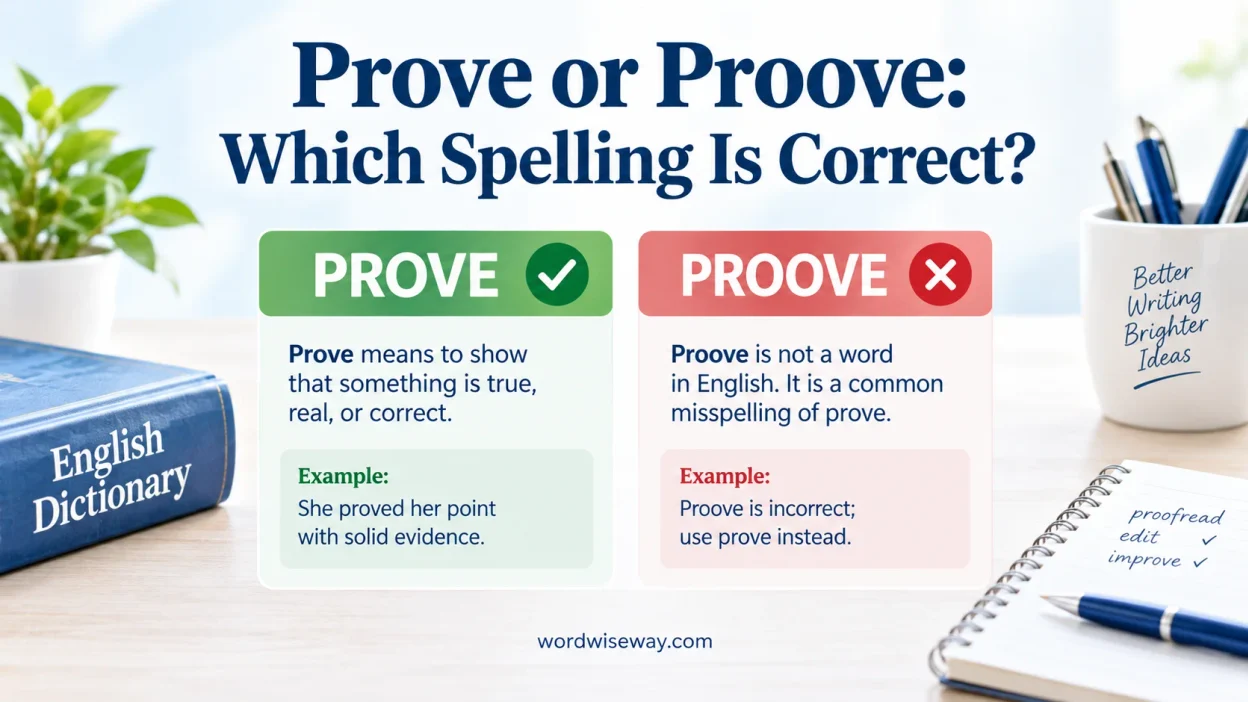
Prove or Proove: Which Spelling Is Correct? Prove is the correct spelling in standard English.
It comes from the Latin word probare and works as a verb meaning to show that something is true, correct, or valid. Although proof and prove share a similar origin, they have different grammatical roles and should not be used interchangeably.
Proove is a common spelling mistake, not a standard English word. The confusion often comes from the long vowel sound in prove, which may tempt you to add another “o.” However, English spelling patterns can be tricky, and similar words do not always follow identical forms.
When you search for proove or prove, proove meaning, or how to spell prove, remember that prove is the correct form. Use it in everyday writing, schoolwork, professional emails, and other situations where clear, accurate English matters.
Quick Answer:
Prove is the correct spelling.
Proove is an incorrect spelling in standard English.
The verb prove means to demonstrate that something is true or to show that someone or something has a particular quality. Major dictionaries, including Cambridge and Oxford Learner’s Dictionaries, list prove as the standard verb.
| Spelling | Correct? | Meaning |
| Prove | ✅ Yes | To demonstrate that something is true, correct, or valid |
| Proove | ❌ No | A misspelling of prove |
For example:
- Correct: The evidence may prove his claim.
- Incorrect: The evidence may proove his claim.
A useful rule is simple: When you mean “demonstrate or establish as true,” spell it prove.
What Does Prove Mean?
Prove is a verb used when you demonstrate that something is true, accurate, valid, or genuine. You can prove something with evidence, facts, observations, calculations, documents, or other convincing information.
Cambridge defines prove as showing that something is true. It also explains that the verb can describe something that demonstrates a particular quality or result after a period of time.
Consider these examples:
- The test results prove that the machine works.
- She collected documents to prove her identity.
- The experiment helped prove the theory.
- His actions proved that he was reliable.
- The new method proved surprisingly effective.
The word can therefore operate in more than one context. Sometimes you prove a fact directly. At other times, an event or experience proves that something has a particular quality.
Prove Means to Establish the Truth
The most familiar meaning involves evidence.
When you prove a claim, you provide enough support to establish that the claim is true or valid.
For example:
The documents helped prove that the account belonged to her.
Here, the documents provide evidence supporting the statement.
The same idea appears in mathematics. A mathematical proof uses logical reasoning to establish that a statement follows from accepted facts, definitions, or previously established results. Cambridge also lists mathematical theorem proving among the established uses of the verb.
Prove Can Mean Show a Quality or Result
Prove doesn’t always involve proving a fact with physical evidence.
You can also use it when something turns out to have a particular quality.
For example:
- The new software proved useful.
- The journey proved difficult.
- The decision proved expensive.
- The training proved to be valuable.
In these sentences, prove means that experience revealed the actual result or quality.
Oxford gives the related structure prove to be, which means that something turns out to have a particular characteristic.
What Is the Difference?
The difference is straightforward: prove is the correct word, while proove is a misspelling.
There isn’t a separate standard meaning that makes proove an alternative to prove. Adding another o doesn’t create a different modern English verb.
| Word | Status | Example |
| prove | ✅ Standard English | The results prove the theory. |
| proove | ❌ Nonstandard spelling | The results proove the theory. |
This distinction matters because a spelling mistake can change how polished your writing looks. In an academic paper or professional document, a word such as proove may immediately stand out to readers.
Why Does “Proove” Look Right?
English spelling can be an unpredictable maze.
Many words contain oo, including book, school, moon, and proof. Because prove belongs to the same broader word family as proof, writers sometimes assume that the verb should also contain two o’s.
That assumption doesn’t work here.
The standard spelling is:
p-r-o-v-e
Not:
p-r-o-o-v-e
The pronunciation doesn’t require an additional o, either. Cambridge gives the US pronunciation as /pruːv/.
The spelling therefore needs to be memorized as prove, rather than reconstructed from the spelling of another related word.
Why Is “Proove” Incorrect?
The main problem with proove is that standard English does not use it as the ordinary spelling of the verb prove.
When you want to express the idea of demonstrating something, use prove.
The Extra “O” Is Unnecessary
The incorrect version inserts an extra vowel:
prove → correct
proove → incorrect
That single letter changes the spelling without changing the intended meaning.
You might see proove in informal online writing, user-generated text, or spelling mistakes. Its appearance in those places doesn’t make it a standard alternative.
For formal writing, the choice is clear: use prove.
Prove and Proof Belong to the Same Word Family
The connection between prove and proof can contribute to the confusion.
Oxford lists prove, proof, and proven as related members of the same word family.
| Word | Part of speech | Example |
| prove | Verb | The evidence may prove the claim. |
| proof | Noun | The evidence provides proof. |
| proven | Adjective/past participle | It is a proven method. |
| proved | Past tense/past participle | The experiment proved successful. |
| proving | Present participle | The data is proving useful. |
Notice something important: proof has two o’s, but prove has only one.
English word families don’t always preserve spelling patterns perfectly. That’s one reason spelling needs to be learned from actual usage rather than from assumptions.
Is “Proove” Ever a Correct Word?
For ordinary modern English writing, proove isn’t the standard spelling of the verb meaning “to demonstrate” or “to establish as true.”
If you’re writing a sentence such as “Can you prove it?” there is no reason to use proove.
The correct sentence is:
Can you prove it?
Similarly:
- Correct: The evidence could prove his argument.
- Incorrect: The evidence could proove his argument.
Historical English contains many spellings that differ from modern conventions. However, those historical forms don’t make proove an appropriate modern substitute for prove.
For contemporary English, stick with the established dictionary form prove.
How to Use Prove in a Sentence
The easiest way to understand prove is to see how it behaves in real sentences.
Prove Something
Use prove + object when you want to say that evidence establishes something.
Examples:
- The photographs prove the location was occupied.
- The results proved the method successful.
- The records prove that the payment was made.
- The experiment proved the original prediction wrong.
This structure is especially common when the object is a claim, fact, statement, theory, or point.
Prove That Something Is True
You can use prove that before a clause.
Examples:
- The documents prove that the agreement existed.
- The results prove that the system works.
- Can you prove that your explanation is correct?
- The investigation failed to prove that the accusation was true.
The structure gives you a direct way to connect evidence with a conclusion.
Prove to Be
Another useful construction is prove to be.
Examples:
- The decision proved to be expensive.
- The new system proved to be reliable.
- The experiment proved to be successful.
- The shortcut proved to be ineffective.
Here, the verb doesn’t simply mean “provide evidence.” Instead, it describes something that turns out to have a particular quality.
Oxford specifically identifies prove to be as a standard construction.
Prove Yourself
You can also use prove yourself when someone demonstrates their ability, skill, or value.
Examples:
- She worked hard to prove herself.
- The young engineer wanted to prove himself capable.
- You don’t need to prove yourself to everyone.
Cambridge and Oxford both recognize this use, where the person demonstrates that they are capable or possess a particular quality.
Prove: Common Grammatical Forms
Understanding the different forms of prove can prevent another set of spelling mistakes.
| Form | Word | Example |
| Base form | prove | We need to prove the claim. |
| Third-person singular | proves | The evidence proves the point. |
| Past tense | proved | The test proved successful. |
| Past participle | proved / proven | The method has proved/proven effective. |
| Present participle | proving | The results are proving useful. |
Oxford lists proved as the past form and recognizes proven as a past participle, especially in North American English.
Proved vs. Proven
This distinction deserves attention because proven is often confused with proved.
Both forms are used in English, but their distribution can vary by region and grammatical context.
For example:
- The experiment proved successful.
- The method has proved reliable.
- The method has proven reliable.
- She has proven her ability.
Oxford notes that proven is especially associated with North American English as a past participle. Cambridge likewise lists proved or mainly US proven for the past participle.
So don’t confuse this legitimate variation with proove. Proved and proven are established forms. Proove isn’t the standard spelling of the verb.
Prove vs. Verify
Although prove and verify overlap, they aren’t always interchangeable.
Prove focuses on establishing that something is true or valid. Verify often focuses on checking whether information is accurate or authentic.
Compare these examples:
- The evidence proved that the claim was false.
- The employee verified the customer’s identity.
- The experiment proved the theory under the stated conditions.
- The researcher verified the measurements.
A quick way to remember the distinction is this:
Prove = establish truth or validity.
Verify = check accuracy or authenticity.
The exact choice depends on context.
Prove vs. Demonstrate
Demonstrate can be very close to prove, especially when you show something clearly.
However, prove often carries a stronger sense of establishing truth or validity.
For example:
- The experiment demonstrated how the process works.
- The evidence proved that the claim was false.
A demonstration can make an idea clear without necessarily establishing every part of a claim. The word prove usually points toward stronger evidence or a definite conclusion.
Prove vs. Confirm
Confirm also has a related meaning, but it generally means establishing that something already suspected, expected, or reported is correct.
For example:
- The test confirmed the diagnosis.
- The evidence proved the claim false.
These verbs can overlap, yet they emphasize different aspects of evidence and certainty.
Choosing the right word gives your sentence sharper meaning. If you’re establishing truth, prove may be the better choice. If you’re checking or validating existing information, confirm or verify may fit better.
Common Mistakes
Spelling prove correctly is only part of using the word well. Several other mistakes appear frequently.
Mistake: Writing Proove
This is the main spelling error.
❌ The experiment will proove the theory.
✅ The experiment will prove the theory.
Mistake: Assuming Proof and Prove Have the Same Spelling Pattern
Because proof contains oo, some writers transfer that spelling into the verb.
❌ The evidence will proove his claim.
✅ The evidence will prove his claim.
Remember that related words don’t always share identical letter patterns.
Mistake: Confusing Proved and Proven
Both forms are legitimate in modern English, so the issue isn’t that one is universally wrong.
Instead, consider the grammatical position and regional preference.
For American English, proven is especially common as a past participle. Oxford and Cambridge both document this usage.
Mistake: Using Prove When You Mean Suggest
Not every piece of evidence proves something.
Suppose a survey finds that many people prefer a particular product. That result may suggest a trend. It doesn’t automatically prove that every person prefers the product.
Good writing respects the strength of the evidence.
Prove is a powerful word. Use it when the evidence genuinely supports that level of certainty.
A Simple Way to Remember “Prove”
Here’s the easiest spelling trick:
Prove has one O before the V.
Think:
PRO + VE = PROVE
Don’t let proof pull an extra O into the verb.
You can also connect the word with familiar expressions:
- prove it
- prove a point
- prove a claim
- prove yourself
- prove to be
Seeing the correct form repeatedly makes the spelling easier to remember.
Correct and Incorrect Examples
| Incorrect | Correct |
| The results will proove the theory. | The results will prove the theory. |
| Can you proove your claim? | Can you prove your claim? |
| The evidence prooves his statement. | The evidence proves his statement. |
| She prooved her ability. | She proved her ability. |
| The method is prooving effective. | The method is proving effective. |
The pattern becomes obvious once you see the related forms together. None of the standard forms requires the extra o found in proove.
A Practical Example: Choosing the Right Spelling
Imagine you’re writing a report about a science experiment.
You want to write:
The results proove that the treatment works.
Something looks slightly unusual. The word seems related to proof, so the double o might feel reasonable.
Now check the standard verb form:
The results prove that the treatment works.
The second version is correct.
This small correction illustrates a broader lesson about English spelling: visual familiarity isn’t the same as correctness. A word can look plausible because it resembles another familiar word while still being misspelled.
Read More: Lily or Lilly: Which Spelling Is Correct?
FAQs
Is Prove the Correct Spelling?
Yes. Prove is the correct spelling in standard English. It means to show that something is true, accurate, or valid.
Is Proove a Word in English?
No. Proove is generally considered a spelling mistake rather than a standard English word.
What Does Prove Mean?
Prove means to demonstrate that something is true or correct by giving evidence, facts, or a clear reason.
Why Do People Spell Prove as Proove?
The long vowel sound in prove can make the spelling confusing. Some writers add an extra “o” because they expect the sound to match the spelling.
How Do You Pronounce Prove?
Prove is pronounced like “proov,” with a long oo sound. The pronunciation does not require an extra “o” in the written form.
What Is the Difference Between Prove and Proof?
Prove is a verb, while proof is usually a noun. You can prove something by providing proof that supports it.
Can I Use Proove in Formal Writing?
No. Avoid proove in formal writing because it is not the standard spelling. Use prove instead.
What Is the Past Tense of Prove?
The past tense is commonly proved. For example, “She proved her point with strong evidence.”
How Can I Remember the Spelling of Prove?
Remember that prove has only one “o” after the “r.” Thinking of the related word proof can also help reinforce the spelling.
Which Is Correct: Proove or Prove?
Prove is correct. Proove is an incorrect spelling, so choose prove when you want to use the standard English form.
Conclusion
The correct spelling is prove, not proove. Prove is a standard English verb used when you want to show that something is true, accurate, or valid. Although the spelling may seem confusing because of its long vowel sound, adding an extra “o” makes the word incorrect.
Understanding the difference between Prove or Proove can help you avoid a simple spelling mistake in everyday writing. Whether you’re writing an assignment, email, article, or professional document, use prove when expressing the idea of demonstrating something with evidence or reasoning.
So, whenever you hesitate between proove and prove, remember the simple rule: prove has only one “o” after the “r.” Keeping this spelling in mind can make your writing clearer, more accurate, and easier for readers to understand.

Emma Smith has dedicated 14 years to Princeton University’s English Department, mentoring students in textual interpretation, literary movements, and critical frameworks. Her research explores Shakespearean drama, Victorian serial fiction, postcolonial narrative theory, and manuscript studies and probing how literary forms evolve across cultures and centuries. Emma has delivered lectures at international humanities congresses and published findings in distinguished academic journals, underscoring her commitment to scholarly depth and vibrant teaching.