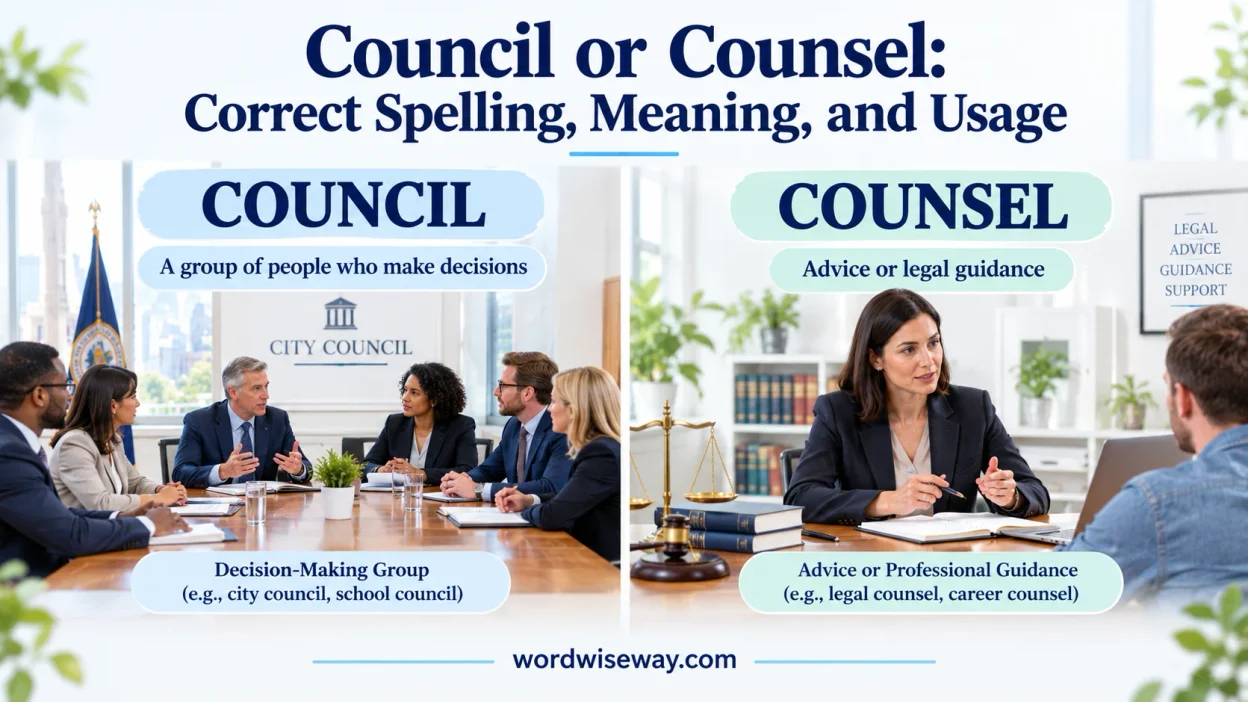
Council or Counsel: Correct Spelling, Meaning, and Usage can help you understand these commonly confused words in American English.
They look and sound similar, but their meanings and spellings are different. A council is a group of people who meet for consultation and make decisions, while counsel means advice or instruction.
A city council may include politicians who are gathered to discuss government topics and community matters. Legal counsel can mean a lawyer or legal advice, while legal council is incorrect in this context. Understanding this difference helps you choose the right word in professional and formal situations.
This simple guide can prevent a mix up in emails, legal writing, school work, social media posts, and everyday communication. When someone provides guidance, use counsel. When a decision-making group gathers to act, use council. This approach makes the usage easier to remember and helps you feel confident.
Quick Answer:
Use council when you mean an organized group of people who make decisions, govern an area, represent a group, or provide advice.
Use counsel when you mean advice, guidance, a lawyer or legal representative, or the act of advising someone.
| Word | Main Meaning | Part of Speech | Example |
| Council | An organized group that makes decisions or provides advice | Noun | The city council approved the proposal. |
| Counsel | Advice or guidance | Noun | She offered valuable counsel. |
| Counsel | A lawyer or legal representative | Noun | The defendant spoke with counsel. |
| Counsel | To advise or guide someone | Verb | The teacher counseled the student. |
A simple rule works in most situations:
Group = council. Advice or lawyer = counsel.
The words sound alike enough to cause confusion, but their meanings give you a reliable way to tell them apart.
Council: Meaning and Definition
What Does Council Mean?
Council is a noun for a group of people who meet to make decisions, govern a particular area, represent others, or advise an organization.
A council can have different responsibilities depending on its purpose. A city council, for instance, handles local government matters. A student council represents students and may organize activities or discuss student concerns.
The central idea behind council is a group acting together.
You can see this meaning in phrases such as:
- city council
- town council
- student council
- local council
- council member
- council meeting
- council committee
For example:
The city council approved the new transportation plan.
The word council refers to the governing group rather than an individual member.
Council as a Noun
Council functions as a noun and refers to the body itself.
Consider these examples:
- The council voted on the proposal.
- The council held a public meeting.
- Several council members supported the plan.
- The student council organized the event.
- The town council discussed the issue.
Each sentence involves a group or something directly connected with that group.
That gives you an important clue. When a sentence involves members, meetings, voting, governing, committees, or official decisions, council is often the correct choice.
Common Phrases With Council
Some expressions appear regularly in everyday American English.
- city council
- town council
- local council
- student council
- council member
- council meeting
- council chamber
- council vote
- council decision
- council committee
For example, a council member belongs to a council. A council meeting brings council members together to discuss matters within their authority.
These common combinations make the meaning easier to recognize.
Counsel: Meaning and Definition
What Does Counsel Mean?
Counsel has several related meanings. It can mean advice or guidance, a lawyer or legal representative, or the act of advising someone.
Unlike council, it doesn’t refer to an organized governing group.
For example:
She sought counsel before making an important decision.
Here, counsel means advice.
In another sentence:
The defendant spoke with legal counsel.
Here, counsel refers to a lawyer or legal representative.
The context tells you which meaning applies.
Counsel as a Noun
When counsel means advice, it often has a formal tone.
Examples include:
- She valued her mentor’s counsel.
- His counsel helped the company avoid a serious mistake.
- They ignored the expert’s counsel.
- The leader offered wise counsel during the discussion.
In each sentence, counsel means advice or guidance.
The word also has an important legal meaning. In legal contexts, counsel can refer to a lawyer or lawyers involved in a case.
For example:
- The defendant spoke with counsel.
- Defense counsel presented the argument.
- The judge addressed counsel in court.
- The company hired legal counsel.
This meaning appears frequently in legal and business writing.
Counsel as a Verb
Counsel can also work as a verb. In this form, it means to advise, guide, or recommend a course of action.
Examples:
- The teacher counseled the student about the decision.
- The advisor counseled the team before the meeting.
- The lawyer counseled the client about the agreement.
- The manager counseled the employee about workplace expectations.
The verb commonly appears with a person receiving the advice.
You may see structures such as counsel someone about something or counsel someone on something.
American English uses counseled and counseling. These forms are worth remembering because the spelling can look unusual if you’re more familiar with the noun.
Key Differences
The easiest way to understand council vs. counsel is to identify what the word represents.
Council represents a group. Counsel represents advice, legal representation, or advising.
| Feature | Council | Counsel |
| Refers to a group | ✓ | ✗ |
| Means advice | ✗ | ✓ |
| Can mean a lawyer | ✗ | ✓ |
| Can function as a verb | ✗ | ✓ |
| Common in government | ✓ | Sometimes |
| Common in legal writing | Sometimes | ✓ |
| Means guidance | ✗ | ✓ |
| Refers to decision-making members | ✓ | ✗ |
Consider two different situations.
Several elected officials meet to discuss a proposed local law. They form a council.
A lawyer reviews that proposed law and explains its legal implications. That lawyer provides counsel.
The pronunciation doesn’t distinguish the words. Context does.
How to Use Each Word
When to Use Council
Use council when you’re referring to an organized group.
Ask yourself:
Am I talking about a group of people or an official body?
If yes, council is likely correct.
Examples:
- The city council approved the budget.
- The student council planned the school event.
- The town council met on Tuesday.
- Several council members supported the proposal.
- The council rejected the request.
Notice the common thread. Every sentence involves a group, its members, or something the group does.
When to Use Counsel
Use counsel when you mean advice, guidance, or legal representation.
Ask yourself:
Am I talking about advice or someone providing professional advice?
If so, choose counsel.
Examples:
- She asked for counsel before making the decision.
- His counsel proved valuable during the negotiations.
- The company hired legal counsel.
- The attorney served as counsel for the defendant.
- The advisor counseled the employees about the new policy.
This simple meaning test solves most council-versus-counsel mistakes.
Examples
Examples With Council
Here are several examples that show how council works in context:
- The city council approved funding for the new library.
- The student council met after school.
- The town council discussed the parking proposal.
- The council meeting began at six o’clock.
- Several council members supported the resolution.
- The environmental council released its recommendations.
In every case, the word describes a group or something belonging to that group.
Examples With Counsel
Now compare those examples with counsel:
- She asked her mentor for counsel.
- The company sought legal counsel before signing the contract.
- His parents offered counsel during the difficult situation.
- The attorney acted as counsel for the client.
- The advisor counseled the team about the problem.
- The teacher counseled the student about the academic decision.
Here, the meaning centers on advice, guidance, or legal representation.
Council and Counsel in Legal Contexts
Legal writing creates some of the most noticeable mistakes between these two words.
What Does Legal Counsel Mean?
Legal counsel means legal advice or a lawyer who provides legal advice and representation.
For example:
The company consulted its legal counsel before signing the agreement.
Here, counsel refers to the lawyer or legal advisers.
You’ll also encounter expressions such as:
- legal counsel
- defense counsel
- general counsel
- co-counsel
- counsel for the defense
- counsel for the prosecution
The phrase general counsel commonly refers to a company’s chief legal adviser or principal lawyer.
For example:
The company’s general counsel reviewed the contract.
The word counsel can therefore describe both legal advice and the professional providing it.
Why Council Is Different in Legal and Government Writing
Council can appear in legal documents because government bodies often operate through councils.
For example:
The city council passed the ordinance.
The sentence refers to a governing body.
Compare it with:
The city hired legal counsel to review the ordinance.
Now the sentence refers to lawyers providing legal advice.
The distinction becomes obvious when you identify the role:
Council makes or discusses decisions. Counsel provides advice or legal representation.
Common Mistakes
Council for Advice
One common error occurs when someone uses council to mean advice.
Incorrect:
She asked her teacher for council.
Correct:
She asked her teacher for counsel.
The correct sentence means that she asked her teacher for guidance.
Counsel for a Government Group
The opposite mistake also happens.
Incorrect:
The city counsel approved the proposal.
Correct:
The city council approved the proposal.
A city council is the governing body. A city may also employ legal counsel, but the two terms identify different things.
Confusing Counsel and Council in Legal Writing
Legal contexts require particular care because both words can appear in related sentences.
Compare:
The council discussed the proposed regulation.
The attorney served as counsel in the case.
The first sentence concerns a group. The second concerns legal representation.
A useful proofreading trick involves checking nearby words. Terms such as member, meeting, vote, committee, city, and government often suggest council.
Words such as lawyer, attorney, legal, client, advice, and case often suggest counsel.
Context isn’t merely helpful here. It’s the deciding factor.
Easy Memory Trick
A good memory trick can turn this spelling problem into a quick decision.
Think of these three words:
Group → Council
Advice → Counsel
Lawyer → Counsel
You can also use the substitution test.
Take this sentence:
The council voted on the proposal.
Mentally replace council with group. The basic idea still works.
Now try:
She sought counsel.
Replace counsel with group. The sentence no longer makes sense.
That tells you the word must refer to advice.
The legal test works just as well:
The defendant met with counsel.
If counsel means a lawyer or legal representative, it fits naturally.
Remembering the meaning is much more reliable than trying to remember the spelling alone.
Grammar Guide
Is Council Singular or Plural?
Council is a singular countable noun when you refer to one council.
For example:
The council is meeting tonight.
Its plural form is councils.
Several councils are reviewing the proposal.
When a council acts as one organization, American English normally treats it as singular.
Is Counsel Singular or Plural?
Counsel behaves differently depending on its meaning.
When it means advice, it generally works as an uncountable noun.
Her counsel was helpful.
You normally don’t use “two counsels” to mean two pieces of advice.
When counsel refers to lawyers in a legal case, it can work as a collective term.
Counsel was present in court.
The word can also refer to an individual lawyer depending on the legal context.
As a verb, counsel follows ordinary verb forms:
- counsel
- counsels
- counseled
- counseling
Council and Counsel in Different Sentence Structures
Council functions as a noun.
The council approved the measure.
Counsel can function as either a noun or a verb.
The lawyer offered counsel.
The lawyer counseled the client.
This difference gives you another useful clue. If you’re using the word as an action meaning advise, counsel is the correct choice.
Side-by-Side Comparison
| Meaning or Use | Correct Word | Example |
| Government group | Council | The city council voted today. |
| Student governing group | Council | The student council planned the event. |
| Advice | Counsel | She offered wise counsel. |
| Legal advice | Counsel | They sought legal counsel. |
| Lawyer in a case | Counsel | Defense counsel addressed the court. |
| Giving advice | Counsel | The advisor counseled the employee. |
| Council member | Council | A council member proposed the change. |
| Company chief lawyer | Counsel | The general counsel reviewed the agreement. |
This comparison captures the most useful distinction: council identifies a group, while counsel centers on advice or legal representation.
A Practical Case Study: Council or Counsel?
Imagine a city considering a new public transportation policy.
The city council holds a meeting to discuss the proposal. Its members examine the costs, hear arguments, and eventually vote.
Before the vote, city officials consult their legal counsel. The lawyers review the proposal and explain potential legal concerns.
In this situation, both words are correct because they describe different roles.
- The council discusses and makes official decisions.
- The counsel provides legal advice.
- The lawyers can also be called counsel.
- The advice itself can also be called counsel.
This example shows why replacing one word with the other doesn’t work. The terms aren’t interchangeable even though they sound alike.
Which One Should You Use?
Choose council when you mean a group, governing body, committee, or official assembly.
Choose counsel when you mean advice, guidance, a lawyer, or the act of advising someone.
The quickest decision guide is:
| If you mean… | Use |
| A group | Council |
| A governing body | Council |
| A city government body | Council |
| Advice | Counsel |
| Guidance | Counsel |
| A lawyer | Counsel |
| Legal representation | Counsel |
| To advise someone | Counsel |
When you’re uncertain, don’t focus on how the word sounds. Focus on what the sentence actually means.
Read More: Dwarfs or Dwarves: Correct Spelling, Meaning, and Usage
FAQs
What is the main difference between council and counsel?
Council refers to a group that meets to discuss matters or make decisions. Counsel usually means advice, guidance, or a lawyer who provides legal help.
Is legal council or legal counsel correct?
Legal counsel is the correct phrase when you mean a lawyer or legal advice. Legal council usually refers to a legal governing group, so it has a different meaning.
Does council mean a group of people?
Yes. Council commonly describes a group of people chosen or organized to discuss issues, provide consultation, or make decisions.
Can counsel refer to a person?
Yes. Counsel can refer to someone who gives professional advice. In legal writing, it often describes a lawyer representing or advising someone.
Are council and counsel pronounced the same?
In most varieties of American English, council and counsel are pronounced the same. Their meanings and spellings, however, are different.
How can I remember which word to use?
Think of council as a group that comes together, while counsel connects with advice or guidance. This distinction makes the correct choice easier to remember.
Is city council the correct spelling?
Yes. City council is the standard expression for a local government group responsible for discussing community matters and making decisions.
Can counsel mean advice?
Yes. Counsel can mean advice, especially when someone offers thoughtful guidance about a personal, professional, or legal matter.
Why do people confuse council and counsel?
People often confuse them because they sound the same and have very similar spellings. Their different meanings become clearer when you consider the context of the sentence.
Which word should I use in professional writing?
Choose council for a group involved in discussion or decision-making. Choose counsel for advice, guidance, or a legal adviser. Checking the sentence context will usually reveal the right choice.
Conclusion
Understanding council and counsel becomes much easier once you focus on what each word represents. Council refers to a group of people who gather to discuss issues, offer consultation, or make decisions. You might see it in phrases such as city council or government council. Counsel, on the other hand, relates to advice, guidance, or legal assistance.
A lawyer may serve as legal counsel, while someone can also give counsel when offering thoughtful advice. Although these words share the same pronunciation in American English, their meanings and uses are clearly different.The best way to avoid this common spelling mistake is to pause and consider the role of the word in your sentence. If you are talking about people gathering together to discuss or decide something, council is usually the word you need.
If the sentence involves advice, guidance, or a lawyer, choose counsel. This small mental check can save you from errors in emails, school assignments, professional writing, legal discussions, and everyday communication. Context acts like a useful signpost, pointing you toward the correct spelling.Once you recognize the distinction, choosing between council or counsel no longer needs to feel confusing. Remember the simple connection: council is associated with a group, while counsel is connected with advice or an adviser.
Keeping that difference in mind will help you write more accurately and confidently. Whether you are preparing formal documents, discussing government matters, or simply writing a quick message, using the correct term makes your meaning clearer. A little attention to context can turn these commonly confused words into two easy choices.

Evelyn Shaw has spent 14 years at Yale University’s English Department, leading students through close readings, genre studies, and interpretive methodologies. Her scholarly interests include Renaissance drama, gothic fiction, feminist literary criticism, and archival research and examining how texts generate meaning across historical periods. Evelyn has presented at major academic conferences and published essays in peer-reviewed journals, reflecting her passion for rigorous analysis and student-centered learning.