After high school, choosing your path and planning your next steps can feel confusing or daunting.
If you search for a college or university, you may wonder if they’re the same thing or have different levels of education. College or University: What’s the Difference? becomes clearer when you understand the key differences.
In the US, UK, and Canada, these terms can mean different things. A college may be a smaller institution, while a university can have a big, expansive university campus, specialized colleges, and broader education options. This matters for international students planning to study abroad.
When students, parents, or professionals compare schools, consider the best fit, smaller class sizes, programs, and course details. Understanding the difference between college or university can also help with admissions, forms, emails, and applications.
Quick Answer
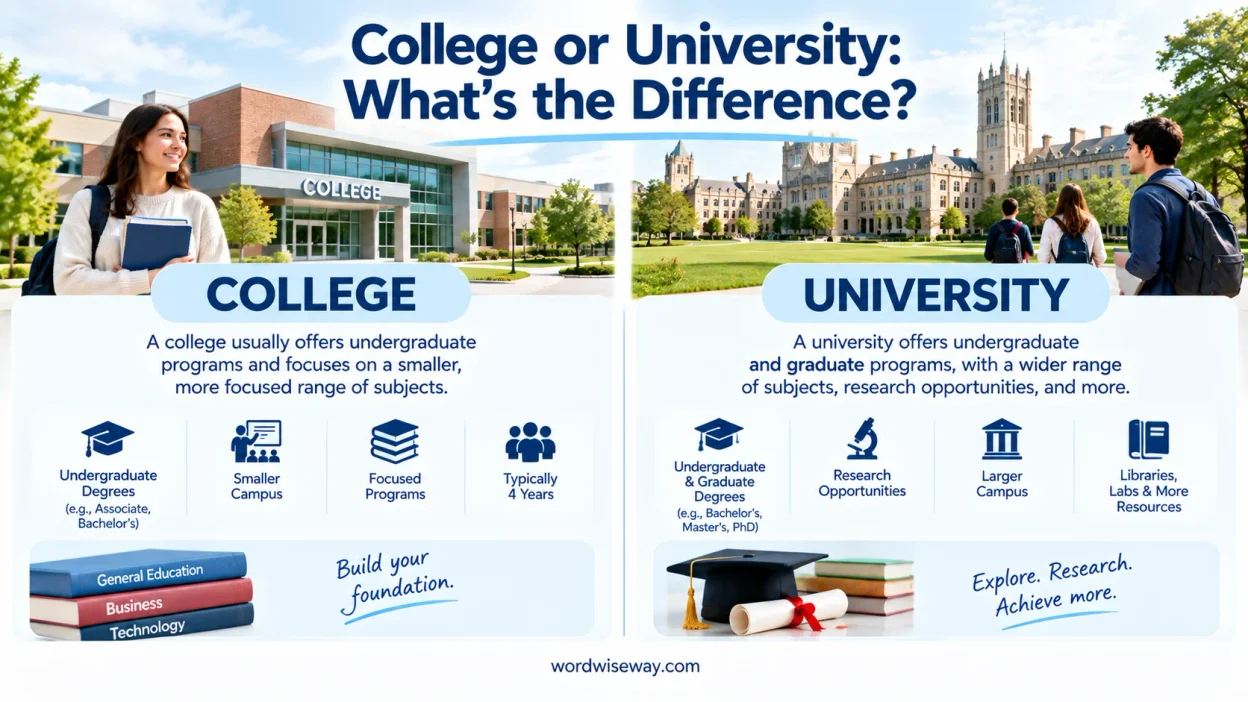
A college is generally a higher-education institution that may offer undergraduate degrees, associate degrees, diplomas, certificates, or specialized programs. Some colleges also offer graduate degrees.
A university is generally a broader higher-education institution that offers multiple fields of study and commonly provides undergraduate, master’s, and doctoral programs. Universities also tend to have larger research operations.
However, these definitions aren’t universal.
For example, the UK government states that higher-education courses are commonly taught at universities, colleges, and specialist institutions, showing that a college can provide higher education without being a university.
In Pakistan, the distinction can be even more important because colleges may operate through university affiliations. The Higher Education Commission maintains separate information about recognized universities, degree-awarding institutions, campuses, and recognized affiliated colleges.
So, the simplest rule is this:
College and university don’t have one worldwide definition. The education system determines how the terms work.
What Is a College?
A college is an institution that provides education after secondary school. Its size, programs, and degree authority can vary dramatically.
Some colleges focus on undergraduate education. Others specialize in technical training, professional education, or particular academic disciplines. Community colleges in the United States, for instance, commonly provide two-year programs and pathways into bachelor’s degrees.
The word can also describe a smaller academic unit inside a university. That’s where the terminology gets slippery.
A university might contain several colleges, such as a college of engineering, college of business, or college of arts and sciences. In that situation, the college isn’t a separate university. It’s part of the larger institution.
What Degrees Can You Earn at a College?
The answer depends on the college.
Depending on the institution and country, a college may offer:
- Certificates
- Diplomas
- Associate degrees
- Bachelor’s degrees
- Professional qualifications
- Master’s degrees in some cases
A two-year college doesn’t normally offer the same range of programs as a large research university. Yet calling every college a two-year institution would also be inaccurate.
That’s why you should check the actual program and credential, rather than relying only on the word appearing in the institution’s name.
Types of Colleges
Colleges come in several forms.
Community colleges commonly provide shorter programs, career-focused education, and transfer pathways.
Liberal arts colleges generally emphasize undergraduate education across subjects such as humanities, social sciences, natural sciences, and arts.
Technical colleges focus more heavily on practical and occupational fields.
Specialized colleges may concentrate on areas such as art, agriculture, education, nursing, or technology.
University colleges can operate as constituent units within larger universities.
These categories overlap in some education systems, so the institution’s official status matters more than its title.
What Is a University?
A university is generally a larger and more academically diverse higher-education institution.
Universities commonly offer bachelor’s degrees alongside postgraduate qualifications such as master’s and doctoral degrees. Many also operate research centers, laboratories, professional schools, libraries, and specialized institutes.
That broader structure creates a larger academic ecosystem.
A student might study computer science in one department, while another student conducts graduate research in physics and a third studies medicine through a professional school.
What Degrees Can You Earn at a University?
Universities commonly offer a progression such as:
- Bachelor’s degrees
- Master’s degrees
- Doctoral degrees
- Professional degrees
- Graduate certificates
- Specialized postgraduate qualifications
The exact structure varies by country.
For example, the UK government lists diplomas, bachelor’s degrees, foundation degrees, and postgraduate degrees among higher-education qualifications.
The important point is that a university isn’t defined solely by offering a bachelor’s degree. Many colleges can award bachelor’s degrees too.
How Universities Are Organized
A university can resemble a small academic city.
Its structure may include:
- Faculties
- Schools
- Colleges
- Departments
- Research institutes
- Laboratories
- Libraries
- Graduate schools
- Professional schools
- Student services
For example, a university could have a School of Engineering containing departments such as electrical engineering, mechanical engineering, and computer engineering.
This layered structure allows universities to support many disciplines under one institution.
University Research and Graduate Education
Research forms an important part of many universities.
Faculty members may conduct scientific experiments, publish academic papers, supervise graduate researchers, develop new technologies, or work with government and industry.
Universities also commonly supervise master’s and doctoral research.
That doesn’t mean every university conducts the same amount of research. Nor does it mean colleges never conduct research. The difference is usually one of institutional scope and emphasis, not an absolute rule.
College vs. University: Key Differences
The following table shows common patterns rather than rules that apply to every country.
| Feature | College | University |
| Typical size | Often smaller | Often larger |
| Program range | Usually narrower | Usually broader |
| Bachelor’s degrees | Common at many colleges | Common |
| Master’s degrees | Offered by some colleges | Common |
| Doctoral degrees | Less common | Common |
| Research | Varies | Often substantial |
| Academic structure | Often simpler or specialized | Often includes multiple schools, faculties, or departments |
| Student population | Often smaller | Often larger |
| Career-focused programs | Common at some colleges | Also available |
| Graduate education | Depends on institution | Common |
The word often matters here.
A small university can have fewer students than a large college. A college can offer a bachelor’s degree. Some universities focus heavily on teaching while others emphasize research.
The label gives you a clue. It doesn’t tell the whole story.
College vs. University in the United States
American usage creates much of the confusion surrounding college or university.
In everyday conversation, Americans frequently use college as a broad term for postsecondary education. Someone might say, “I’m in college,” even though the institution’s official name contains the word university.
Institutionally, however, the terms can describe different types of schools.
A community college commonly offers two-year programs. Students may earn an associate degree or complete coursework before transferring to a four-year institution.
A four-year college can award bachelor’s degrees and may focus primarily on undergraduate education.
A university typically contains a wider collection of undergraduate and graduate programs. Many universities also conduct extensive research.
Consider this example:
Student A attends a four-year liberal arts college and earns a bachelor’s degree.
Student B attends a university and earns a bachelor’s degree in the same broad field.
Both students can receive bachelor’s degrees. The institutional structure, program selection, research opportunities, and campus environment may differ.
So, in the United States, college doesn’t automatically mean lower education than university.
College vs. University in the United Kingdom
The British system adds another layer to the terminology.
The UK government explains that higher-education courses are taught at universities, colleges, and specialist institutions.
A college can therefore provide higher education without functioning as a university.
The word can also appear inside university names or describe constituent colleges. At collegiate universities, students may belong to an individual college while studying for a university degree.
This creates an important distinction:
A college can be an independent educational institution or part of a university, depending on the context.
Because of that, American assumptions about the word college don’t always work in Britain.
College vs. University in Pakistan and South Asia
In Pakistan, the distinction between a college and university can affect how a student’s education is structured.
Some colleges operate through affiliation with a university or another recognized higher-education institution. In such cases, the relationship between the college, university, program, and degree matters.
The Higher Education Commission maintains information on recognized campuses and degree-awarding institutions. It also publishes a list of recognized affiliated colleges connected with public-sector higher-education institutions.
That makes recognition and affiliation especially important when comparing institutions.
For example, a student shouldn’t choose a college simply because its name sounds impressive. The student should verify:
- Which institution recognizes the program
- Who awards the degree
- Whether the campus is recognized
- Whether the specific qualification is recognized
- Whether the program has any relevant professional accreditation
- Whether the institution appears in official recognition records
Pakistan’s HEC also maintains a Pakistan Qualification Register containing recognized qualifications and providers. HEC states that qualifications not listed in the register aren’t recognized by the commission.
That check can save you from a very expensive academic headache later.
Which One Should You Choose?
There isn’t one correct answer for every student.
Instead, start with the program you actually want.
A student interested in a two-year career pathway may find a community college appropriate. Someone planning to complete a doctorate may need a university offering the required graduate and research programs.
Choose a College If You Want…
A college may suit you when you prefer:
- A smaller academic environment
- A focused range of subjects
- Undergraduate-centered education
- Technical or career-oriented training
- A shorter qualification
- A transfer pathway to another institution
- Specialized education in a particular field
However, don’t assume every college provides all these features. Check the institution’s actual programs.
Choose a University If You Want…
A university may fit your plans when you need:
- A broad selection of majors
- Multiple academic departments
- Master’s-level study
- Doctoral education
- Research opportunities
- Specialized graduate facilities
- Several related disciplines under one institution
Again, the specific university matters more than the word university.
Questions to Ask Before Choosing
Before applying, investigate these points:
- Does the institution offer the exact degree you need?
- Who awards the degree?
- Is the institution officially recognized?
- Is the specific program accredited where required?
- What are the total tuition and fees?
- What other costs will you pay?
- What admission requirements apply?
- What scholarships or financial aid are available?
- Can you transfer credits if necessary?
- What postgraduate opportunities exist?
- What career services does the institution provide?
The institution’s name should be near the bottom of your checklist, not the top.
College vs. University: Cost Differences
It’s tempting to assume that university always costs more than college.
That shortcut doesn’t work.
Tuition depends on many factors, including:
- Public or private status
- Country
- State or province
- Degree program
- Residency status
- Institution
- Course load
- Financial aid
- Housing
- Transportation
- Living expenses
A public university can cost less than a private college. A community college can cost less than many four-year institutions. A specialized college can also have substantial fees.
Look beyond advertised tuition.
Your total cost of attendance can include tuition, admission fees, books, equipment, accommodation, food, transportation, and other expenses.
The number that matters to your budget is the amount you actually need to pay after available financial assistance.
College vs. University: Admission Requirements
Admission requirements vary considerably.
A college may require academic transcripts, entrance examinations, application forms, and proof of eligibility. A university can require similar documents while adding program-specific requirements.
Some competitive programs may request:
- Entrance tests
- Interviews
- Portfolios
- Personal statements
- Recommendation letters
- Subject prerequisites
- Language-proficiency evidence
Graduate admissions can involve additional requirements such as previous degrees, research proposals, academic references, or standardized tests.
The safest approach is simple: read the official admission requirements for the exact program, not just the institution’s general admissions page.
College vs. University: Student Life
Student life doesn’t follow a neat college-versus-university formula.
A large college can have a busy campus. A small university can feel intimate and close-knit.
When comparing institutions, look at:
- Class sizes
- Student organizations
- Clubs
- Sports
- Housing
- Libraries
- Laboratories
- Career services
- Counseling and academic support
- Internships
- Research opportunities
- Campus facilities
Two universities can have completely different student experiences.
The same applies to colleges.
In other words, institutional culture matters more than the label on the entrance gate.
College vs. University: Academic Degrees
Understanding degree levels makes the comparison easier.
| Qualification | Common purpose | Where it may be offered |
| Certificate | Short, focused study | Colleges, universities, specialist institutions |
| Diploma | Practical or academic qualification | Colleges and universities, depending on country |
| Associate degree | Usually two years of undergraduate study | Commonly colleges |
| Bachelor’s degree | Undergraduate degree | Colleges and universities |
| Master’s degree | Advanced postgraduate study | Universities and some colleges |
| Doctoral degree | Advanced research qualification | Primarily universities |
This table describes common patterns, not a universal international system.
Different countries organize qualifications differently. That’s why the level and official recognition of the qualification matter more than the institution’s title alone.
College vs. University vs. Institute
The word institute creates another common misunderstanding.
An institute is not automatically below a university.
Institutes may specialize in areas such as:
- Technology
- Engineering
- Management
- Research
- Medicine
- Agriculture
- Design
- Professional education
The name doesn’t tell you exactly what qualification the institution can award.
A better question is:
What is the institution officially authorized to teach and award?
That question cuts through a surprising amount of educational terminology fog.
College vs. University vs. School
The word school can mean something different in higher education.
A university may contain a:
- School of Business
- School of Engineering
- School of Medicine
- School of Law
- Graduate School
Here, school doesn’t necessarily mean a separate institution.
It can describe an academic division within a larger university.
For example, a School of Engineering might contain several departments. Students belong to the larger university while studying through that academic unit.
Which Word Should You Use?
The correct word depends on what you’re describing.
When to Say “College”
Use college when you’re referring to an institution officially called a college or when the context specifically uses the term for higher education.
In American English, college can also work as a broad everyday term for postsecondary education.
For example:
She plans to attend college after high school.
That sentence doesn’t necessarily mean the institution’s official name contains College.
When to Say “University”
Use university when referring to an institution officially identified as a university.
For example:
He studies computer science at a university.
If you’re naming an institution, follow its official name rather than replacing university with college.
College or University in a Sentence
Compare these examples:
- She attends a college in California.
- She attends a university in California.
- She plans to go to college after high school.
- The university offers doctoral programs.
- The college is affiliated with a university.
Each sentence can be correct. The intended meaning determines the best term.
Common Mistakes
Several assumptions cause unnecessary confusion.
Assuming Every College Is Smaller
Many colleges are smaller than universities, but size doesn’t define every college.
Assuming Every University Offers Every Degree
Universities have broad academic offerings, yet individual universities can have limited programs. A university might not offer the exact degree you need.
Assuming University Automatically Means Better
The label doesn’t establish quality.
A specialized college may provide stronger preparation for a particular field than a university with a broader academic portfolio.
Ignoring Accreditation and Recognition
This mistake can have serious consequences.
Before enrolling, verify the institution and program through the appropriate official authority.
In Pakistan, HEC provides recognition information for universities, degree-awarding institutions, campuses, and affiliated colleges.
Choosing Based Only on the Name
A grand-sounding name doesn’t guarantee a useful qualification.
Look at the actual degree, curriculum, faculty, facilities, recognition, costs, and career pathway.
How to Check Whether a College or University Is Legitimate
Before paying an application fee or enrolling, perform a basic verification.
Check Official Recognition
Start with the relevant government or accreditation authority.
In Pakistan, HEC provides official recognition resources and maintains information about recognized institutions and campuses.
HEC also maintains a list of institutions that it identifies as fake, illegal, unlawful, or unrecognized.
Check the Exact Program
Institutional recognition doesn’t mean every possible program automatically has every professional approval.
If you’re studying medicine, engineering, law, nursing, or another regulated field, check the relevant professional body as well.
Check Who Awards the Degree
This is particularly important when a college operates under affiliation.
Ask:
Will the college award the qualification, or will the affiliated university award it?
The answer can tell you much more about the educational structure than the college’s name.
Check the Qualification
Pakistan’s Pakistan Qualification Register provides information about recognized qualifications and their providers.
For other countries, use the relevant national recognition or accreditation system.
A Practical Case Study: Choosing Between a College and University
Imagine a student who wants to study computer science.
She finds two options.
Option A is a college offering a focused undergraduate computer science program.
Option B is a university offering computer science alongside artificial intelligence, software engineering, mathematics, data science, graduate programs, and research laboratories.
Neither label alone determines which option fits her.
If she wants a focused undergraduate environment and the college has strong teaching resources, Option A may match her needs.
If she wants to explore several computing disciplines and later pursue graduate research, Option B may offer a broader pathway.
The sensible decision comes from comparing program structure, recognition, cost, teaching, facilities, career opportunities, and future plans.
The word on the building is only one piece of the puzzle.
Read More: Trust or Will: Difference and Which Word Should You Use?
FAQs
Is a college the same as a university?
Not always. The meaning of college and university depends on the country and its education system. In some places, a college can be part of a university, while in others, it can operate as a separate institution.
What is the main difference between a college and a university?
A university usually offers a wider range of programs and may include multiple colleges, schools, or departments. A college may be smaller and focus on a more limited range of subjects.
Is a university bigger than a college?
Often, yes, especially in the US. Universities commonly have larger campuses, more students, and more academic programs. However, size isn’t a universal rule, so you should check the specific institution.
Can you get a degree from a college?
Yes. Many colleges offer degrees, including associate, bachelor’s, and sometimes advanced degrees. The available qualifications depend on the institution and country.
Which is better for international students, college or university?
Neither is automatically better. International students should compare programs, tuition, location, class sizes, admission requirements, and career opportunities before choosing a school.
Does college mean university in the US?
The word college can sometimes refer broadly to higher education in the US. People may say they’re “going to college” even when they actually attend a university.
Why do the terms college and university differ by country?
Education systems developed differently around the world. As a result, college and university can have different meanings in the US, UK, Canada, and other countries.
Can a university have colleges inside it?
Yes. Some universities are organized into separate colleges or schools that focus on particular academic areas. These might include colleges of engineering, business, arts, or medicine.
What should I check before applying to a college or university?
Look at the program, degree offered, admission requirements, tuition, location, campus environment, class sizes, and available resources. The institution’s name alone doesn’t tell you everything.
How can I avoid confusion when choosing a college or university?
Start by checking the institution’s official website and academic information. Then compare the program details, application requirements, and qualifications it offers with your own study goals.
Conclusion
The difference between a college and university isn’t always as simple as their names suggest. Their meanings can change depending on the country, education system, and type of institution. A college may be smaller or more specialized, while a university often provides a broader range of programs and academic options.
If you’re choosing where to study, look beyond the label. Check the programs, degree options, class sizes, campus environment, admission requirements, costs, and resources available to students. These details will give you a clearer picture of whether an institution matches your goals.
For international students, understanding these terms becomes especially useful when comparing schools abroad. Once you know how college and university are used in your target country, applications, academic documents, and school research become much easier to navigate.

Emma Smith has dedicated 14 years to Princeton University’s English Department, mentoring students in textual interpretation, literary movements, and critical frameworks. Her research explores Shakespearean drama, Victorian serial fiction, postcolonial narrative theory, and manuscript studies and probing how literary forms evolve across cultures and centuries. Emma has delivered lectures at international humanities congresses and published findings in distinguished academic journals, underscoring her commitment to scholarly depth and vibrant teaching.