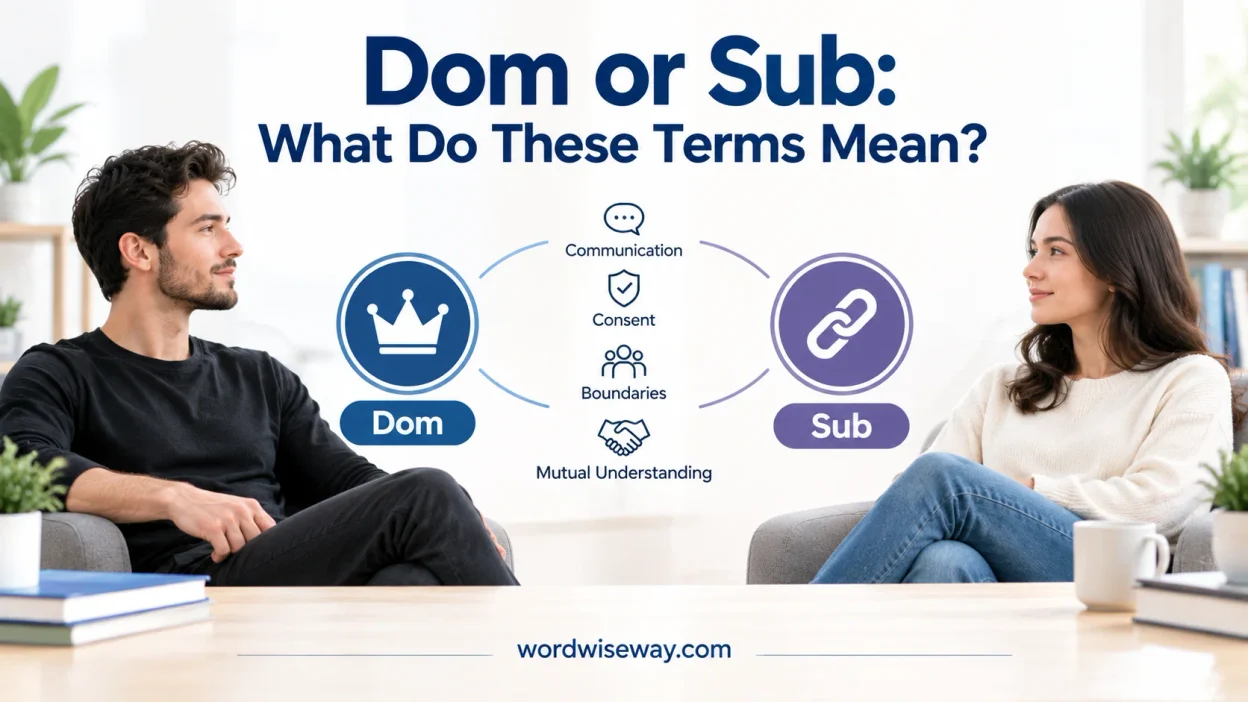
Dom or Sub: What Do These Terms Mean? These terms appear in online conversations, relationship discussions, and pop culture.
Sometimes used as slang, they have a specific meaning in adult relationships and consensual relationship dynamics. Dom means dominant, while sub means submissive, describing different roles.
These terms may appear in discussions of psychology, but they don’t automatically describe someone’s personality, behavior, or lifestyle. Growing social media exposure has increased curiosity about them, while misunderstanding and misconceptions can also spread through casual conversations and changing modern relationship language.
From an educational perspective, these labels describe particular structured dynamics, rather than someone’s complete identity. Discussions can involve control, trust, and emotional balance, but these ideas depend on mutual agreement and should not be confused with pressure or coercion..
Quick Answer:
Dom means dominant, while Sub means submissive.
A Dom generally takes the more directive or controlling role within an agreed-upon dynamic. A Sub voluntarily accepts a more yielding role within that same dynamic. The important word is voluntarily. Without genuine agreement, the dynamic isn’t consensual.
The terms don’t automatically describe someone’s entire personality. A person who identifies as dominant in one context might be quiet or reserved in everyday life. Likewise, someone who takes a submissive role doesn’t automatically lack confidence or independence.
Some people also use the term Switch for someone who is comfortable taking either role depending on the situation or their preferences.
The simplest distinction looks like this:
| Term | Basic meaning | What it describes |
| Dom | Short for dominant | A person who takes a more directive role |
| Sub | Short for submissive | A person who voluntarily takes a more yielding role |
| Switch | Someone who may take either role | A flexible role preference |
Consent, communication, and boundaries remain essential regardless of the label.
What Does Dom Mean?
Dom is short for dominant. In the context of consensual relationship dynamics, it generally describes someone who takes a leadership or directive role that the other person has agreed to.
The key point is that dominance exists within an agreed framework. It doesn’t give someone unlimited authority over another person.
For example, two people might agree that one person will take the lead when making certain decisions within their relationship dynamic. That arrangement doesn’t mean the dominant person automatically controls the other person’s friendships, education, finances, or personal choices.
That’s where the difference between dominance and control becomes important.
A healthy consensual dynamic involves clearly understood limits. A controlling relationship can involve pressure, intimidation, manipulation, or disregard for someone’s wishes. Those are fundamentally different concepts.
What Does Being a Dom Actually Involve?
The exact meaning varies from person to person because there isn’t one universal definition of the role.
Depending on the agreed dynamic, a Dom may take responsibility for:
- Leading certain agreed activities
- Setting mutually accepted expectations
- Communicating clearly
- Checking whether boundaries remain respected
- Listening to the other person’s concerns
- Respecting a person’s decision to stop or change the arrangement
The label itself doesn’t tell you everything about someone’s behavior. Context matters.
Someone can identify as a Dom without being dominant in every part of life. A workplace manager, for example, may make decisions professionally while having an entirely different personality outside work. Relationship roles work in a similarly context-dependent way.
What Does Sub Mean?
Sub is short for submissive. It generally refers to someone who voluntarily takes a more yielding or receptive role within an agreed dynamic.
Submission doesn’t mean that a person has no opinions. It doesn’t automatically mean they lack confidence either.
In fact, the ability to communicate personal boundaries remains important regardless of which role someone takes. A person can agree to a particular dynamic while still maintaining clear personal limits.
This distinction helps separate consensual submission from forced obedience.
If someone pressures another person into accepting a role they don’t want, the situation no longer represents genuine voluntary agreement. A label cannot transform coercion into consent.
Does Being a Sub Mean Someone Is Weak?
No.
Submission describes a role, not a measure of strength, intelligence, confidence, or personal value.
A person can be highly independent in everyday life and still choose a submissive role in a particular consensual dynamic. Likewise, someone who appears very confident socially may prefer a submissive role in another context.
Personality and relationship roles aren’t interchangeable categories.
Think of the difference between a job role and a person’s complete identity. A person might lead a team at work without needing to lead every social situation in life. In the same way, a relationship role doesn’t necessarily describe every aspect of someone’s character.
What’s the Difference?
The central difference involves the role each person voluntarily takes within the agreed dynamic.
A Dom generally takes the more directive position. A Sub generally takes the more yielding position.
However, the distinction isn’t simply “one person has power and the other has none.” Healthy consensual dynamics require both people to communicate their preferences and boundaries.
| Feature | Dom | Sub |
| Full term | Dominant | Submissive |
| General role | More directive | More yielding |
| Agreement | Required | Required |
| Boundaries | Must respect them | Communicates and maintains them |
| Ability to stop | Must respect the other person’s decision | Can withdraw consent |
| Personality | Doesn’t define the whole personality | Doesn’t define the whole personality |
| Everyday behavior | May be completely unrelated to the role | May be completely unrelated to the role |
The table shows why reducing the terms to “powerful” and “powerless” misses an important part of the picture.
Dom or Sub Doesn’t Automatically Define Personality
One of the most common misunderstandings about Dom or Sub terminology is assuming that the label reveals someone’s entire personality.
It doesn’t.
People are complicated collections of traits, experiences, preferences, responsibilities, and circumstances. A single relationship label can’t capture all of that.
A person who takes a dominant role may still be shy in unfamiliar social situations. A person who takes a submissive role may be assertive at school, work, or in everyday decision-making.
This is why statements such as “all Doms are naturally controlling” or “all Subs are naturally passive” are misleading.
Role and Personality Are Different
A role describes how someone participates in a particular dynamic.
A personality trait describes a relatively consistent characteristic of how someone tends to think, feel, or behave.
Those categories can overlap, but they aren’t identical.
For example, someone might naturally enjoy organizing group projects while still preferring a different role in a personal relationship. Another person might be very outspoken in everyday conversations but prefer a more yielding role in a particular consensual setting.
Context changes behavior.
Is Dom or Sub Always One or the Other?
Not necessarily.
Some people strongly prefer one role. Others don’t identify with either label. Some people use Switch to describe a preference for taking different roles at different times or with different partners.
There is no requirement that everyone choose a label.
The terminology functions as a way for people to communicate preferences. It shouldn’t become a rigid personality test.
Someone might also use different terminology depending on the community or context. Online language evolves quickly, and people don’t always use labels in precisely the same way.
That’s why asking what someone means by a particular term can be more useful than making assumptions from the label alone.
What Is a Switch?
A Switch is generally someone who may take either a dominant or submissive role depending on their preferences, circumstances, or relationship dynamic.
This doesn’t necessarily mean the person changes roles randomly. Different people use the term differently.
For one person, switching might depend on the situation. For another, it might depend on the person they’re interacting with. Someone else might simply prefer not to have a fixed role.
The important point is that Dom, Sub, and Switch aren’t a universal three-category personality system. They’re terms people may use to communicate particular preferences.
Consent and Boundaries in Dom or Sub Dynamics
Consent is one of the most important concepts for understanding Dom or Sub terminology.
A consensual arrangement requires genuine agreement. That agreement should not come from threats, pressure, manipulation, or fear.
Consent also isn’t necessarily permanent. Someone can change their mind.
For that reason, healthy communication involves more than asking for agreement once. People need to remain able to communicate their comfort level and boundaries throughout the relationship.
What Makes Consent Meaningful?
Meaningful consent should be:
- Voluntary: A person agrees without coercion or intimidation.
- Informed: The person understands what they’re agreeing to.
- Specific: Agreement to one thing doesn’t automatically mean agreement to everything.
- Ongoing: A person can change their mind.
- Respected: A boundary should be taken seriously.
These principles apply far beyond Dom or Sub terminology. They’re fundamental parts of respectful relationships generally.
Boundaries Are Not the Same as Rules
A useful distinction exists between a personal boundary and a demand imposed on someone else.
A boundary communicates what a person is comfortable with and what they will do if that boundary isn’t respected.
For example, someone can say that they aren’t comfortable with a particular situation. Respecting that statement means accepting their boundary rather than trying to pressure them into changing it.
Communication becomes especially important when two people have different preferences. Disagreement doesn’t automatically mean someone is wrong. It means the people involved need to understand where their limits differ.
Dom vs. Sub vs. Switch
The three terms can be summarized without treating them as rigid personality categories.
| Term | General role | Important distinction |
| Dom | Takes a dominant or directive role | Dominance doesn’t automatically mean controlling someone’s entire life |
| Sub | Takes a submissive or yielding role | Submission doesn’t automatically mean weakness or lack of independence |
| Switch | May take either role | Switching doesn’t require a person to use both roles equally |
These definitions are intentionally broad because individual interpretations can differ.
Common Misconceptions
“A Dom Is Always Controlling”
This confuses consensual dominance with controlling behavior.
A dominant role exists within boundaries that participants have agreed upon. Someone who ignores another person’s limits isn’t demonstrating a healthy version of consensual dominance simply because they call themselves a Dom.
The label doesn’t excuse disrespect.
“A Sub Is Weak”
This misconception treats a relationship role as a measurement of personal strength.
A submissive role doesn’t determine someone’s intelligence, confidence, independence, or ability to make decisions. People can be assertive in one part of life and prefer a different role in another.
“Dom and Sub Describe Someone’s Entire Personality”
They don’t.
These terms generally describe a particular role or preference. They don’t explain someone’s complete character.
Using one label to make assumptions about someone’s entire behavior can lead to inaccurate conclusions.
“Everyone Has to Pick One”
Not everyone wants a label.
Some people identify strongly with a particular role. Others don’t use these terms at all. Some use different terminology, while others may describe their preferences without adopting a specific label.
Labels can help communication, but they’re optional.
How Dom or Sub Terms Are Used Online
Online communities often use Dom or Sub as shorthand because the terms are brief and recognizable.
However, online usage can become inconsistent. A person might use “Dom” casually to describe confidence or leadership even when the traditional meaning involves a specific consensual dynamic.
Context therefore matters.
If you encounter the terms online, don’t automatically assume that everyone using them means exactly the same thing. Internet slang frequently stretches beyond its original definition.
This is particularly important when reading profiles, comments, or discussions where the person hasn’t explained what they mean.
A Simple Example of How the Terms Work
Consider a fictional adult couple who have discussed their preferred relationship roles.
They agree that one person will take a more directive role in a particular part of their relationship. The other person agrees to take a more yielding role. Beforehand, they discuss boundaries and agree that either person can stop the arrangement.
In this simplified example, the first person could describe their role as Dom, while the second could describe theirs as Sub.
The important details aren’t merely the labels. The important details are agreement, communication, boundaries, and respect.
Now imagine that one person doesn’t actually agree but feels pressured into accepting the arrangement. The situation changes fundamentally. Calling one person a Dom and the other a Sub doesn’t make pressure or coercion acceptable.
That distinction is essential.
Why Communication Matters So Much
Clear communication prevents assumptions.
People sometimes assume that using the same label means having identical preferences. It doesn’t. Two people who both identify as Doms may have very different boundaries. Two people who identify as Subs may also have completely different preferences.
A label provides a starting point for conversation, not a complete instruction manual.
Good communication can include discussing:
- Personal boundaries
- Expectations
- Comfort levels
- What each person means by a particular label
- Situations that are unacceptable
- How either person can communicate discomfort
- Whether preferences have changed over time
The details matter because vague assumptions can create misunderstandings.
Important Facts to Remember
Several points help keep the terminology in perspective:
- Dom is commonly short for dominant.
- Sub is commonly short for submissive.
- A Dom generally takes a more directive role.
- A Sub generally takes a more yielding role.
- The roles should be based on voluntary agreement.
- A Dom isn’t automatically controlling in every part of life.
- A Sub isn’t automatically weak or passive.
- Neither label defines someone’s entire personality.
- Some people identify as Switches.
- Some people don’t use any of these labels.
- Consent can be withdrawn.
- Personal boundaries deserve respect regardless of someone’s role.
Read More: Wings or Image: Difference and When Should You Use Each?
FAQs
What does dom or sub mean?
“Dom” is short for dominant, while “sub” is short for submissive. The terms describe roles within certain consensual adult relationship dynamics.
Are dom and sub slang terms?
They can be used casually as slang online, but they also have specific meanings in discussions about consensual relationship dynamics.
What does dominant mean in this context?
Dominant generally refers to a person who takes a leading or controlling role within an agreed relationship dynamic.
What does submissive mean in this context?
Submissive generally refers to a person who agrees to take a less controlling role within an agreed dynamic.
Are dom and sub personality types?
Not necessarily. These terms describe particular roles or preferences and don’t automatically define someone’s entire personality, behavior, or lifestyle.
Where do people commonly see these terms?
You may encounter them in online conversations, relationship discussions, social media, and pop culture.
Why do people search for dom or sub?
People may search for these terms because of curiosity, social media exposure, or confusion about modern relationship language.
Are dom and sub related to psychology?
The terms can appear in psychological or relationship discussions, but they shouldn’t be treated as psychological diagnoses or complete descriptions of a person.
What role does trust play in these dynamics?
Trust and clear communication can be important because consensual relationship dynamics depend on people understanding and agreeing to the roles involved.
Why are dom or sub terms sometimes misunderstood?
Online slang, pop culture, incomplete explanations, and changing relationship language can create misconceptions about what these terms actually mean.
Conclusion
Understanding dom or sub starts with knowing that these terms describe specific roles within consensual adult relationship dynamics. Dom refers to dominant, while sub refers to submissive. They aren’t automatic labels for someone’s complete personality, behavior, or lifestyle.
Because these terms appear frequently in social media, online conversations, and pop culture, it’s easy to encounter incomplete explanations or misconceptions. Looking at their meaning in context can help separate the actual terminology from casual slang and assumptions.
The most important point is that these roles involve mutual understanding, communication, trust, and agreement. Learning the basic meaning of the terms can make discussions about modern relationship language clearer without assuming that one label defines an entire person.

Evelyn Shaw has spent 14 years at Yale University’s English Department, leading students through close readings, genre studies, and interpretive methodologies. Her scholarly interests include Renaissance drama, gothic fiction, feminist literary criticism, and archival research and examining how texts generate meaning across historical periods. Evelyn has presented at major academic conferences and published essays in peer-reviewed journals, reflecting her passion for rigorous analysis and student-centered learning.