Sub or Dub: Difference and Which Should You Choose? helps viewers understand the difference between subtitles and dubbed audio.
If you watch anime, foreign movies, or an international series, you’ll often see these terms. In simple terms, sub uses reading subtitles, while dub uses voice acting in your own language.
The sub or dub debate can leave people confused about which option to choose. Anime fans, streaming users, and language learners may have different needs. Your choice can change the viewing experience, emotions, and understanding of culture while enjoying a show.
This article explains useful comparisons to make the phrase sub or dub easier to understand. Some viewers may find one option better, while others may prefer another. The right choice depends on the content and what suits you.
Quick Answer:
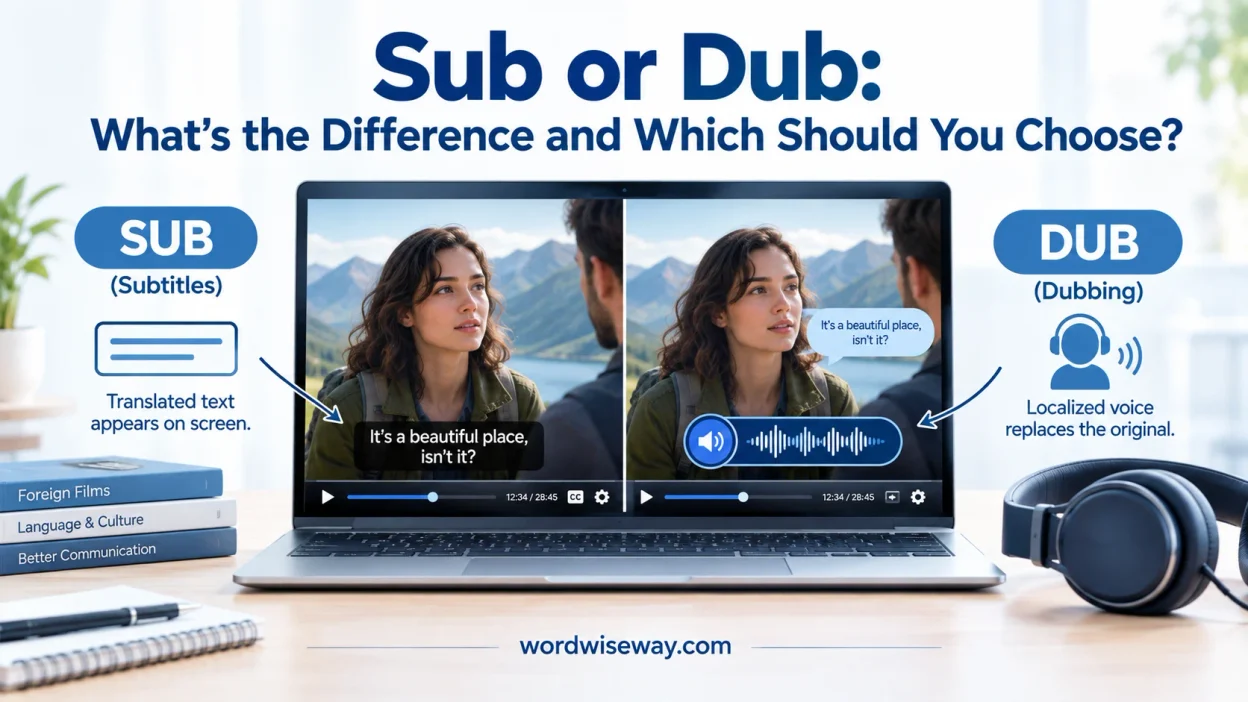
Sub means subtitled. The original audio stays intact while translated dialogue appears as text on the screen.
Dub means dubbed. The original spoken dialogue gets replaced or supplemented by newly recorded dialogue in another language.
For example, imagine you’re watching a Japanese anime with English subtitles. You’ll hear the original Japanese voice actors while reading English translations. With an English dub, you’ll hear English-speaking voice actors performing the characters’ dialogue.
| Feature | Sub | Dub |
| Original voices | ✅ Yes | ❌ Usually replaced |
| Translated dialogue | ✅ Written | ✅ Spoken |
| Reading required | ✅ Yes | ❌ Usually no |
| Original vocal performance | ✅ Preserved | ❌ Replaced |
| Focus on visuals | Requires more attention | Usually easier |
| Source-language exposure | High | Lower |
| Familiar-language listening | Depends on source | ✅ Yes |
| Translation adaptation | Subtitle script | Dub script |
The practical choice depends on what you want from the viewing experience. If you care most about the original performances, subtitles may suit you. If you want to watch without reading, dubbing may be more convenient.
What Does Sub Mean?
Sub is short for subtitle or subtitled content. In a subtitled movie or show, the original audio remains unchanged while translated text appears on the screen.
Suppose a character speaks Japanese. A subtitled English version keeps the Japanese performance but displays an English translation. You can therefore hear the original actor while understanding the dialogue through text.
Subtitles aren’t simply a transcript pasted underneath a video. Professional subtitle creation involves translation, timing, segmentation, readability, and adaptation. A translator has to fit the translated message into the available screen time without making the viewer read excessively long lines.
How Subtitles Work
A subtitle needs to appear at roughly the right moment and disappear when that piece of dialogue finishes. Timing matters because even an accurate translation becomes difficult to follow if it appears too early, too late, or disappears too quickly.
Professional subtitle work also considers:
- Dialogue timing
- Reading speed
- Line length
- Scene changes
- Speaker changes
- Cultural references
- Idioms and slang
- On-screen text
- Character relationships
This is why a subtitle translation doesn’t always match every spoken word exactly. Translators often need to communicate the same meaning in a shorter, natural form.
What Are Different Types of Subtitles?
Not every text track serves the same purpose.
Translated subtitles usually focus on rendering spoken dialogue into another language. They may also translate important signs or written information.
Closed captions can provide additional information about the soundtrack. Depending on the captioning system, they can identify speakers and describe relevant sounds, music, laughter, or other non-dialogue audio.
The distinction matters for accessibility. The FCC notes that subtitles generally display dialogue as text but may not identify speakers or background sounds in the same way as closed captions or SDH.
For example, a subtitle might translate what a character says. Accessibility-oriented captions may also indicate that music is playing, a door slams, or another character laughs.
What Does Dub Mean?
Dub is short for dubbing. Instead of displaying translated dialogue for you to read, a production records new spoken dialogue in another language.
The original video remains, but the dialogue track changes. New voice actors perform the translated lines while the production team mixes their voices with music, effects, and other audio.
Dubbing involves much more than translating a script. The translated dialogue needs to sound natural when spoken and fit the timing of the scene.
How Dubbing Works
A typical dubbing process can involve several stages:
- Translating the original dialogue
- Adapting the translation for natural speech
- Casting voice actors
- Recording performances
- Matching dialogue to the scene
- Mixing voices with music and sound effects
- Reviewing the finished version
The translator may have to change sentence structure because spoken dialogue needs to fit the character’s timing.
A joke is an easy example. A joke that works perfectly in Japanese may become meaningless when translated word for word into English. The adaptation team may need to find an English expression that creates a similar effect while still fitting the scene.
Why Can Dubbed Dialogue Differ From the Original?
A dubbed line doesn’t always represent a word-for-word translation.
The production team may need to consider:
- Lip movement
- Timing
- Natural speech
- Character personality
- Cultural references
- Humor
- Local expressions
- Voice performance
This creates a balancing act. The dub needs to communicate the original idea while sounding natural in the target language.
The Main Differences
The biggest difference between sub and dub is where the translation appears.
With subtitles, the translation appears as written text while the original dialogue continues in the background. With dubbing, the translation becomes part of the spoken soundtrack.
That distinction affects nearly everything else.
Original Voice Acting
Subtitles preserve the original voice performance. You hear the actors chosen for the original production, including their vocal tone, rhythm, accent, pauses, and emotional delivery.
Dubbing introduces a new performance. A skilled dub actor can create an excellent interpretation of the character, but it’s still a different performance from the original.
Reading
Subtitles require you to read while watching. This isn’t necessarily difficult, but it adds another task to the viewing process.
Dubbing removes most of that reading requirement. You can listen to the dialogue while giving more attention to movement, scenery, facial expressions, and visual details.
Translation
Both formats require translation or adaptation, but their constraints differ.
Subtitle translators have to work within limits involving screen space and reading time. Dub translators must also consider spoken timing and synchronization.
As a result, the subtitle and dub scripts for the same production may not be identical.
Which One Should You Choose?
There isn’t one universal answer to the sub or dub question. Your preference can change depending on the production and what you want from it.
Instead of asking which format is automatically better, consider what matters most during your viewing experience.
Choose Sub If You Want the Original Performance
Subtitles allow you to hear the original voice actors.
This can matter when voice performance plays a major role in character development. A particular voice, accent, speech pattern, or emotional delivery may carry information that isn’t fully reproduced by another performer.
Subtitles can also help if you’re interested in the original language and culture.
Choose Dub If You Don’t Want to Read
Dubbing removes the need to constantly shift your attention between the image and text.
That can be useful during visually complex scenes. Action sequences, detailed animation, and fast camera movements can demand a lot of visual attention. Listening to dialogue instead of reading it may make those scenes easier to follow.
Choose Sub for Original-Language Exposure
If you’re learning the language used in the original production, subtitles can provide useful exposure to authentic speech.
You can hear pronunciation, rhythm, intonation, and common expressions while connecting those sounds with written translations.
However, simply watching subtitled entertainment doesn’t automatically make someone fluent. Active language practice still matters.
Choose Dub for Familiar-Language Listening
A dub can make a foreign-language production feel more immediately accessible.
If you understand English more comfortably than the original language, an English dub lets you concentrate on the story without constantly translating text mentally.
Anime
The sub or dub debate appears particularly often among anime viewers because Japanese animation has developed a large international audience.
Anime can contain rapid dialogue, cultural references, wordplay, honorifics, dialects, and character-specific speech patterns. Translating these elements requires choices.
Academic discussion of Japanese media translation has noted that subtitled and dubbed versions can produce different audience experiences. One analysis reports research in which viewers watching subtitled anime showed greater understanding of certain cultural learning than viewers in comparison groups watching dubbed or untranslated material.
That doesn’t mean every subtitled anime automatically teaches culture better. The result depends on the particular production, translation, viewer, and viewing conditions.
Subbed Anime
Subbed anime preserves the original Japanese voice performances.
This can be valuable when you want to hear the original character voices or experience dialogue in its source language. Subtitles may also allow translators more room to retain certain expressions that would be difficult to fit naturally into spoken dubbing.
However, subtitles require continuous reading. Fast conversations can also become demanding when several characters speak rapidly.
Dubbed Anime
Dubbed anime uses voice actors who perform the dialogue in another language.
A good dub can make a series easier to follow, especially when you prefer listening to reading. It can also make dialogue-heavy episodes more relaxed to watch.
The tradeoff is that you aren’t hearing the original voice performances. Localization may also change certain expressions so they sound natural to the target audience.
Sub or Dub for Movies and TV Shows
The same principles apply outside anime.
International movies and television programs frequently use subtitles or dubbing to reach audiences who don’t speak the original language. Your choice may depend heavily on the production itself.
For a dialogue-heavy drama, you might care about the original performances. For a fast-moving adventure film, you might prefer not to divide your attention between subtitles and action.
There is also a practical factor: availability.
A particular movie might offer subtitles in several languages but only one or two dubbed versions. Another production may provide an extensive selection of audio tracks.
So before choosing between sub and dub, check what versions the specific title actually offers.
Language Learning
Watching foreign-language entertainment can support language exposure, but subtitles and dubs provide different kinds of input.
With subtitles, you can hear the original language while reading a translation. This gives you access to the sounds of the source language even when you don’t understand every word.
With a dub, the spoken language changes. If you’re learning English and watch an English dub, for example, you can hear English dialogue while following a story you already understand.
For more focused learning, you can also use subtitles in the same language as the audio when available. That can connect pronunciation, spelling, and meaning more directly.
A useful approach is to pay attention to short expressions rather than trying to understand every sentence.
For example, you might notice how characters greet one another, ask questions, disagree, apologize, or express surprise. Those repeated patterns often provide more practical language exposure than memorizing isolated vocabulary.
Subtitles vs. Dubbing for Children
For children, the choice can depend on reading ability, language familiarity, and accessibility needs.
Younger viewers who aren’t comfortable reading quickly may find dubbing easier because they can follow the story through audio.
Older children who read confidently may benefit from subtitles when they want to hear the original language.
There isn’t a single format that works equally well for every child. The content itself matters too. A complicated story with rapid dialogue may create a different experience from a simple animated program.
The Role of Voice Acting in Sub and Dub
Voice acting is one of the most noticeable differences between the two formats.
With subtitles, the original actors remain part of the experience. Their timing, pitch, pauses, pronunciation, and emotional choices stay connected to the characters.
With dubbing, new actors interpret those characters.
That doesn’t automatically make a dub inferior. A dub actor can deliver a compelling performance that works extremely well in the target language. However, the performance represents an adaptation rather than the original recording.
This distinction becomes especially noticeable when a character has an unusual speaking style or relies heavily on wordplay.
Translation vs. Localization in Sub and Dub
Translation and localization aren’t quite the same thing.
Translation focuses on transferring meaning from one language to another.
Localization adapts that meaning for a particular audience and cultural context.
Consider an idiom. A literal translation might preserve the individual words but produce an expression that sounds strange in English. A localized version may use an English idiom that communicates the same idea more naturally.
Dubbing often has stronger timing constraints because actors have to deliver the line within a specific part of the scene.
Subtitles have their own constraints because viewers need enough time to read the translated text.
Neither process is simply a matter of replacing one word with another.
Why Subtitles and Dubs Don’t Always Match
You may notice something surprising when switching between subtitle and dub tracks: the dialogue doesn’t always match.
That’s normal.
The subtitle track might translate the original dialogue for written reading. The dub script might adapt the same dialogue for spoken delivery.
A single sentence can therefore have different wording while expressing essentially the same idea.
Several factors can cause these differences:
- Different translation teams
- Different adaptation goals
- Lip synchronization
- Reading-time limitations
- Character voice
- Regional expressions
- Cultural references
- Spoken-language rhythm
The goal isn’t necessarily identical wording. The goal is to communicate the scene effectively within the technical limits of the chosen format.
Common Myths
“Sub Is Always More Accurate”
Subtitles aren’t automatically more accurate simply because they preserve the original audio.
Subtitle quality depends on the translation, timing, context, and adaptation choices. A poorly translated subtitle can still distort meaning.
Likewise, a carefully produced dub can communicate the original scene effectively.
“Dub Is Always Poorly Translated”
This is another broad assumption.
Dubbing quality varies between productions. Voice casting, translation, adaptation, direction, recording, and mixing all influence the finished result.
Some dubs receive extensive production work and use experienced voice performers.
“Sub Is Always Better for Language Learning”
Subtitles can provide valuable language exposure, but watching them passively isn’t the same as studying a language.
If the subtitles appear in English while the audio uses Japanese, for example, you’re still primarily reading English while hearing Japanese.
For language learning, your goal determines which setup makes the most sense.
“Dubs Always Change the Story”
A change in wording doesn’t necessarily mean the story changed.
Translation often requires adaptation. An English sentence may use completely different words from the original while preserving the same basic meaning.
The important distinction is between linguistic adaptation and an actual change to the narrative.
Accessibility and the Difference Between Subtitles and Captions
Subtitles and captions overlap, but they aren’t always identical.
The FCC explains that closed captions can provide access to spoken audio and may include information such as speaker identification, sound effects, music, and laughter.
That makes captions particularly important for viewers who cannot rely fully on the audio track.
Captions also need to be readable and synchronized with the corresponding speech or sounds. The FCC has specifically addressed accuracy, synchronization, speaker identification, and nonverbal information in its captioning requirements.
Accessibility needs vary from person to person. Some viewers may benefit from captions, while others may find dubbing easier because they don’t need to rely on written text.
How to Decide Between Sub or Dub
If you’re still stuck between sub or dub, ask yourself a few practical questions:
- Do you want to hear the original voice actors?
- Are you comfortable reading while watching?
- Do you want exposure to the original language?
- Would reading distract you from visual details?
- Is the available dub well produced?
- Are you watching casually or studying the dialogue?
- Do you need captions or another accessibility feature?
- Which version is available in your preferred language?
Your answers will usually point toward the format that fits your situation.
A Simple Sub or Dub Decision Guide
| Your Main Priority | Format to Consider |
| Hear original voice acting | Sub |
| Avoid reading | Dub |
| Experience the original language | Sub |
| Focus heavily on visuals | Dub |
| Read translated dialogue | Sub |
| Listen in a familiar language | Dub |
| Explore original vocal delivery | Sub |
| Reduce the need for reading | Dub |
| Use captions for accessibility | Sub/captions |
| Compare translation choices | Try both |
Can You Switch Between Sub and Dub?
Absolutely. You don’t have to pick one format and stick with it forever.
You might prefer subtitles for one series because you enjoy the original performances. Then you might switch to a dub for another show because the dialogue is easier to follow that way.
You can even compare both versions of the same scene. This can reveal how translators adapt jokes, idioms, character personalities, and cultural references.
For language learners, switching formats can also provide different types of exposure. You might watch with a familiar-language dub first to understand the story, then revisit selected scenes with the original audio and subtitles.
Read More: Dom or Sub: What Do These Terms Mean?
FAQs
What does “sub” mean in anime and movies?
“Sub” is short for subtitles. It means you hear the original dialogue while reading translated text on the screen.
What does “dub” mean when watching a show?
“Dub” means dubbed audio. The original dialogue is replaced with recorded voices in another language, so you can watch without reading subtitles.
Does watching sub help with language learning?
It can. Language learners may use subtitles to hear the original voice acting, notice common expressions, and connect spoken words with their written meaning.
Why do some viewers prefer dubbed content?
Some viewers prefer dubbed audio because they can focus on the action, facial expressions, and story without constantly reading subtitles.
Is sub or dub better for anime?
There isn’t one choice that works for everyone. Anime fans may choose based on voice acting, language, comfort, and the type of viewing experience they want.
Can subtitles change the meaning of dialogue?
Yes, translations can sometimes differ from the original wording. A subtitle may prioritize natural language or limited screen space rather than translating every word directly.
Does dubbing change the original voice acting?
Yes. A dub uses new performers to deliver the dialogue in another language. This can create a different interpretation of a character’s tone and emotions.
Which option is easier for children?
Dubbed audio can be easier for children who are still developing reading skills because they can follow the story without relying heavily on subtitles.
Can watching sub help you understand another culture?
It can provide more exposure to the original dialogue, expressions, humor, and cultural references. However, translations may still require context to fully understand certain references.
How should you choose between sub and dub?
Consider your needs, preferred language, reading comfort, and interest in original voice acting. You can also try both options with the same show and see which viewing style feels more natural.
Conclusion
The sub or dub choice ultimately depends on how you like to experience a story. Subtitles let you hear the original performances and follow the dialogue through text, while dubbed audio lets you focus more freely on the visuals and story in your preferred language. Both options can create a different viewing experience.
If you enjoy original voice acting, cultural details, or reading along with dialogue, subtitles may fit your viewing style. If you prefer listening in your own language or find reading distracting, a dub may feel more natural. Your choice can also change depending on the anime, movie, or series you’re watching.
There’s no need to stick with only one option. Try a few episodes with subtitles and then switch to the dub if it’s available. After experiencing both, you’ll have a clearer idea of which style matches your preferences, comfort, and viewing needs.

Emma Smith has dedicated 14 years to Princeton University’s English Department, mentoring students in textual interpretation, literary movements, and critical frameworks. Her research explores Shakespearean drama, Victorian serial fiction, postcolonial narrative theory, and manuscript studies and probing how literary forms evolve across cultures and centuries. Emma has delivered lectures at international humanities congresses and published findings in distinguished academic journals, underscoring her commitment to scholarly depth and vibrant teaching.