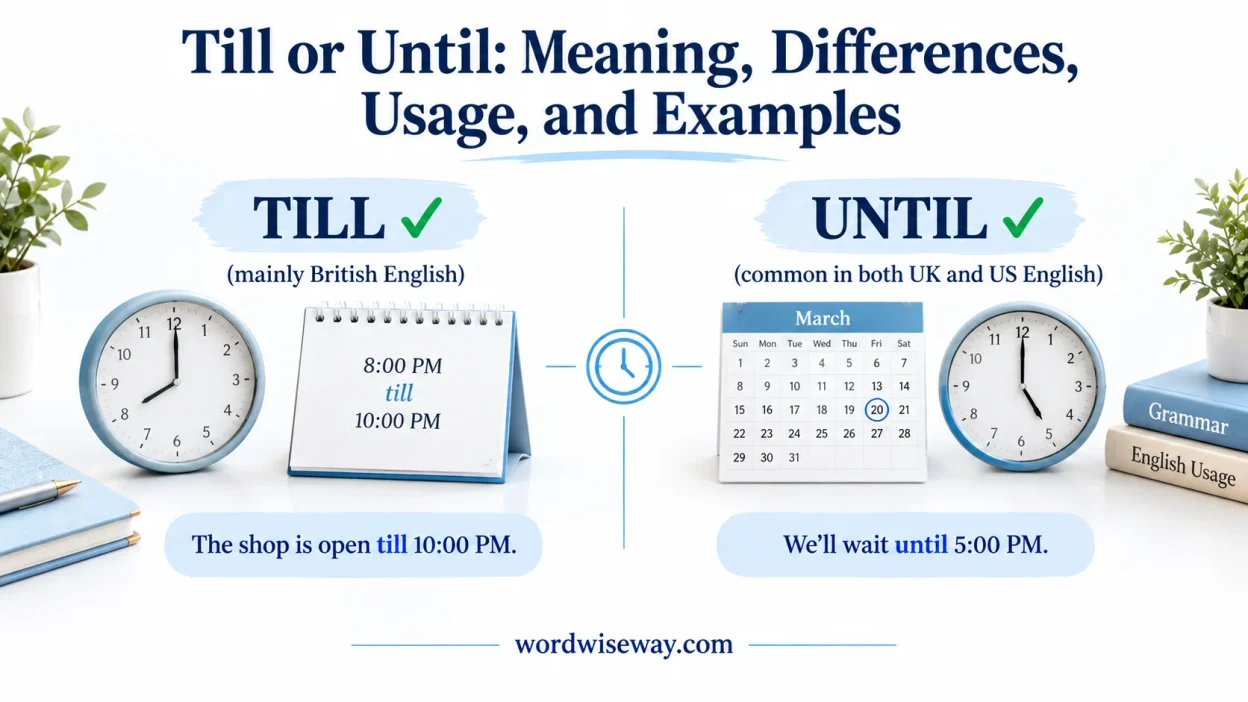
Till or Until: Meaning, Differences, Usage, and Examples can help English learners and native speakers understand the meaning and differences between these words. Both refer to a point in time when something continues and then stops, but their usage, tone, style, and context may vary.
In everyday writing, “Wait till tomorrow” and “Wait until tomorrow” are both correct English and sound natural. However, Wait until tomorrow may work better in formal writing. Knowing their origins can also reduce confusion and make these forms easier to recognize.
Understanding usage differences helps with choosing the right word in each situation. Till suits everyday conversations, while until often appears in emails, essays, and business communication. Practical examples, common mistakes, FAQs, and practical advice can help you write more clearly and confidently.
Till or Until?
Till and until are generally interchangeable when they indicate a time endpoint. Both can mean “up to the time when something happens.”
For example:
- I waited till midnight.
- I waited until midnight.
Both sentences mean that the waiting continued up to midnight.
You can also use either word before a clause:
- Stay here till I return.
- Stay here until I return.
The main practical difference is register. Until often sounds more neutral and works comfortably in formal writing. Till is also standard English, but it frequently feels more conversational.
| Word | Basic meaning | Typical tone | Standard English? |
| till | up to a particular time | Conversational, familiar | ✓ Yes |
| until | up to a particular time | Neutral, sometimes more formal | ✓ Yes |
| ’til | informal shortened form | Casual | Limited |
| til | informal spelling | Casual and often nonstandard | Avoid in formal writing |
One important point deserves emphasis: till isn’t an incorrect abbreviation of until. It has a long history as an independent English word.
What Does “Till” Mean?
Till commonly means “up to the time that” something happens or “up to” a specified point in time.
You can use it before a noun phrase, time expression, or clause.
Consider these examples:
- We stayed there till Friday.
- She worked till midnight.
- Wait till tomorrow.
- Don’t leave till I call you.
In each case, till identifies an endpoint. The action continues until that point arrives.
Till as a Preposition
A preposition connects a word or phrase to the rest of a sentence. When till functions this way, it commonly comes before a time expression.
Examples include:
- The store stays open till 9 p.m.
- I’ll be here till Monday.
- They talked till sunrise.
- The road remains closed till noon.
The basic pattern is simple:
subject + verb + till + time
For example:
We waited till sunset.
The sentence doesn’t merely mention sunset. It establishes sunset as the endpoint of the waiting period.
Till as a Conjunction
Till can also introduce a clause containing another action or event.
For example:
- Wait till I get home.
- Stay here till the rain stops.
- She didn’t speak till everyone left.
Here, till connects one part of the sentence to a clause. The second event determines when the first action ends or begins.
That distinction matters because the word following till isn’t always a simple time expression.
Compare:
- We stayed till midnight.
- We stayed till the guests left.
The first sentence uses a specific time. The second uses an event as the endpoint.
Is “Till” Correct English?
Yes. Till is a standard English word.
There’s no grammatical rule requiring you to replace every occurrence of till with until. In everyday speech, phrases such as “wait till tomorrow” and “stay till the end” sound perfectly natural.
The belief that till is simply a lazy shortening of until causes much of the confusion. In reality, till has its own established history and usage.
The unrelated noun till, meaning a cash register or the drawer containing money, comes from a different context. The temporal word and the cash-register meaning shouldn’t be confused.
What Does “Until” Mean?
Until marks the point in time when something stops, changes, or reaches a particular stage.
Examples include:
- I’ll wait until noon.
- She stayed until Friday.
- Don’t open it until tomorrow.
- We won’t know until the results arrive.
Like till, until can introduce either a time expression or a clause.
Until as a Preposition
When until comes before a noun or time expression, it works as a preposition.
Examples:
- until Monday
- until midnight
- until next week
- until the end of the year
In sentences:
- The office is closed until Monday.
- He studied until midnight.
- The project won’t finish until next month.
Until as a Conjunction
When until introduces a clause, it functions as a conjunction.
Examples:
- Wait until I arrive.
- Don’t start until everyone is ready.
- She stayed until the meeting ended.
The clause after until tells you what event establishes the endpoint.
Key Differences
The biggest surprise is that there isn’t a huge meaning gap between these words.
Their core temporal meaning overlaps almost completely. The differences become more noticeable when you consider tone, frequency, sentence style, and context.
Meaning
When both words refer to time, they generally mean “up to the time when.”
Compare:
- I worked till 6 p.m.
- I worked until 6 p.m.
The essential meaning remains the same.
Likewise:
- Don’t leave till I return.
- Don’t leave until I return.
Again, the time relationship doesn’t fundamentally change.
Formality and Tone
Until often feels more neutral or formal. That doesn’t make till informal in every situation, however.
Consider these sentences:
- Please remain seated until the announcement ends.
- Wait till I tell you what happened.
The first sounds suited to an official instruction. The second feels more conversational.
This distinction is about register, not correctness.
Frequency and Style
Writers often choose until when they want a more polished or neutral tone. Speakers frequently use till in ordinary conversation.
That pattern isn’t absolute.
A sentence such as “The museum is open till 5 p.m.” can still appear in ordinary written English. Meanwhile, “Wait till I finish” sounds completely natural in speech.
The best choice depends on your audience and the tone you want.
When Should You Use Each?
Choosing between the two doesn’t need to become a grammar maze.
Use “Until” for a Neutral or Formal Tone
If you’re writing a formal notice, academic sentence, professional document, or polished article, until is often the safest stylistic choice.
Examples:
- The application window remains open until Friday.
- Please keep the receipt until your order arrives.
- The policy remains effective until further notice.
These sentences sound straightforward and neutral.
Use “Till” in Everyday Language
Till fits naturally into casual conversations and familiar expressions.
Examples:
- Wait till I get back.
- I won’t know till tomorrow.
- Stay here till dinner.
- We talked till midnight.
There’s no grammatical problem with these sentences.
Choose One for Consistency
If you have no reason to switch between them, consistency can make your writing smoother.
For example, if a formal article repeatedly uses until, there’s little reason to insert till randomly. Likewise, conversational writing can comfortably use till throughout.
Think of it as choosing a shirt for the occasion. Both shirts work. The setting determines which one looks more natural.
Common Uses
Talking About Time
Both words commonly appear with:
- Clock times
- Days
- Dates
- Months
- Seasons
- Events
- Deadlines
- Other time expressions
Examples:
- until 8 p.m.
- till Monday
- until next summer
- till sunrise
- until the ceremony ends
Describing Continued Actions
Both words can describe an action that continues up to an endpoint.
For example:
She practiced until the competition began.
The practicing continues through the period leading to the competition.
You can replace until with till:
She practiced till the competition began.
The core meaning remains intact.
Describing a Change or Condition
Sometimes the endpoint isn’t simply a clock time. Instead, an event changes the situation.
Examples:
- Wait until the light turns green.
- Don’t open the door till someone knocks.
- Stay inside until the storm passes.
In each sentence, the second event establishes the boundary.
Till vs. Until in Negative Sentences
Negative sentences deserve special attention because not until can create a meaning that learners sometimes misread.
Consider:
I didn’t leave until noon.
This means the person left at noon or sometime after the waiting period ended, with noon serving as the earliest stated point.
Now compare:
I left until noon.
That sentence usually doesn’t communicate the same idea and may sound incomplete or unnatural depending on context.
The construction not … until is therefore important.
Examples of “Not Until”
- She didn’t call until evening.
- We didn’t understand the problem until later.
- He didn’t arrive until midnight.
- They won’t announce the decision until Friday.
A useful pattern is:
not + action + until + endpoint
This construction often emphasizes that something happened later than expected or not before a particular point.
Till vs. Until at the Beginning of a Sentence
Both words can appear at the beginning of a sentence when they introduce a dependent clause.
Examples:
Until the rain stops, we’ll stay inside.
Till the rain stops, we’ll stay inside.
Both are grammatically possible. However, until generally sounds more natural in formal or polished prose.
Another example:
Until everyone arrives, the meeting can’t begin.
This construction clearly establishes the condition that must be met before the main action can occur.
Till vs. Until in Questions
Both words work naturally in questions involving time.
Examples:
- How long will you stay until Friday?
- Will you be here till noon?
- Do I have until tomorrow?
- Do I have till tomorrow?
Some constructions sound more natural than others depending on the intended meaning.
For example, “How long will you stay?” already asks about duration. Adding until requires a clear endpoint:
How long will you stay until Friday?
This may sound awkward if the speaker simply means “Will you stay through Friday?”
Clearer alternatives include:
Will you stay until Friday?
or
How long will you stay?
Good writing isn’t just about grammatical possibility. Natural phrasing matters too.
Till vs. Until in Different Tenses
The choice between till and until doesn’t determine the tense. You can use both with past, present, and future contexts.
Present
- I wait until she arrives.
- I stay till the store closes.
Past
- We waited until the bus arrived.
- They stayed till the rain stopped.
Future
- I’ll wait until you return.
- We’ll stay till Friday.
A common point of confusion involves future time clauses.
In standard English, a future main clause often takes a present tense verb after until.
For example:
I’ll wait until she arrives.
Not:
I’ll wait until she will arrive.
The first version is the natural standard construction.
The same principle applies with till:
I’ll wait till she arrives.
The choice between the two words doesn’t change this tense pattern.
Till vs. Until With “From”
You can use from … until … to express a period that begins at one point and ends at another.
Examples:
- The office is open from Monday until Friday.
- She worked from 9 a.m. until 5 p.m.
- The exhibition runs from June until August.
You can also encounter from … till …:
- The office is open from Monday till Friday.
- She worked from 9 a.m. till 5 p.m.
Both constructions can communicate the same time range.
However, from … until … often feels more neutral and polished. It’s especially useful in formal schedules, notices, and professional writing.
Till vs. Until With “To”
English uses several different ways to express time ranges, including from … to ….
For example:
The store is open from 9 a.m. to 5 p.m.
You don’t need until simply because the sentence describes an ending time.
Compare:
The store is open from 9 a.m. to 5 p.m.
with:
The store is open until 5 p.m.
Both can work, but they organize the information differently.
From … to … emphasizes the complete range. Until emphasizes the endpoint.
That’s a small distinction, but it makes writing more precise.
Is “Till” the Same as “’Til”?
Not exactly.
Till
Till is a complete standard word.
Example:
I’ll stay till Monday.
’Til
’Til is an informal shortened form commonly associated with until.
You may see it in casual writing, song titles, advertising, dialogue, or creative contexts.
However, it isn’t the best choice when you’re aiming for formal standard prose.
For professional or academic writing, till or until is usually cleaner.
Til
The spelling til without an apostrophe appears in informal writing. It can also represent other words in particular contexts.
For standard English writing, don’t casually replace till or until with til.
A simple rule works well:
Use “until” or “till” in standard writing. Use “’til” only when the informal style is intentional.
Is “Until” the Same as “Up To”?
Sometimes, but not always.
When discussing time, until and up to can overlap.
For example:
You can stay until Friday.
This can communicate that Friday marks the endpoint.
However, up to has broader uses.
It can refer to quantity:
The hall can hold up to 500 people.
Here, until cannot replace up to.
You can also use up to for limits or maximum amounts:
- up to 20 pages
- up to $100
- up to three attempts
- up to 50 students
Therefore, remember this distinction:
Until primarily marks a temporal endpoint. Up to can describe time, quantity, degree, or a maximum limit.
Common Mistakes
Treating “Till” as Incorrect
This is one of the most persistent misconceptions.
Till is grammatically correct. You don’t need to replace every till with until.
Using “’Til” in Formal Writing
The informal shortened form can make formal prose look unnecessarily casual.
Use:
until tomorrow
or:
till tomorrow
rather than:
’til tomorrow
when you want conventional formal writing.
Confusing Duration With a Deadline
Until often describes how long something continues.
We stayed until midnight.
A deadline, however, can describe the latest acceptable time.
Submit the form by midnight.
Until and by can therefore express different ideas.
“Until midnight” describes continuation up to a point. “By midnight” usually means the action should be completed no later than that point.
Misplacing “Not”
Compare:
I didn’t call until Monday.
with:
I called until Monday.
The first says the call didn’t happen before Monday. The second suggests an action continuing through a period, though the exact meaning depends on context.
That tiny word not can completely reshape the sentence.
Using the Wrong Tense After Until
A frequent error is:
I’ll call you until I will arrive.
Standard English normally uses:
I’ll call you until I arrive.
The future meaning comes from the main clause. The time clause uses the present form.
Example Sentences
Here are practical examples showing how both words behave.
| With till | With until |
| Wait till I return. | Wait until I return. |
| We stayed till midnight. | We stayed until midnight. |
| Don’t leave till Friday. | Don’t leave until Friday. |
| She worked till sunset. | She worked until sunset. |
| Stay here till the rain stops. | Stay here until the rain stops. |
| I’ll wait till tomorrow. | I’ll wait until tomorrow. |
| He didn’t arrive till noon. | He didn’t arrive until noon. |
| They talked till everyone left. | They talked until everyone left. |
The paired sentences demonstrate the central point: the meaning usually remains essentially unchanged.
A Practical Case Study: Choosing the Right Word
Imagine you’re writing a workplace notice:
The office will remain closed till Monday.
This sentence is grammatically correct. However, you might prefer:
The office will remain closed until Monday.
Why? The second version has a slightly more neutral, official tone.
Now imagine you’re writing dialogue:
Wait till you hear this!
Replacing till with until is grammatically possible:
Wait until you hear this!
Yet the first version can feel more conversational and spontaneous.
The lesson isn’t “always use until.” The lesson is match the word to the voice of the writing.
Comparison Table
| Feature | Till | Until |
| Core meaning | Up to a particular time | Up to a particular time |
| Refers to time | ✓ | ✓ |
| Can introduce a clause | ✓ | ✓ |
| Standard English | ✓ | ✓ |
| Common in conversation | ✓ | ✓ |
| Neutral formal tone | Possible | Very common |
| Informal feel | Common | Less noticeable |
| Works with “not” | ✓ | ✓ |
| Works in future time clauses | ✓ | ✓ |
| Common in time ranges | ✓ | ✓ |
| Informal shortened form | ’til | ’til is associated with until |
Till or Until: Which One Should You Use?
If you’re still deciding between them, use this simple framework:
- Choose “until” for formal, academic, professional, or neutral writing.
- Choose “till” when you want a natural conversational tone.
- Use either one when the sentence simply describes an endpoint in time.
- Avoid “til” in polished standard writing.
- Use “’til” cautiously when an intentionally informal style calls for it.
- Don’t assume till is incorrect. It is a standard English word.
The best choice often depends less on grammar than on voice. A formal announcement and a casual conversation don’t always need to sound alike.
Read More: Dinner or Supper: Meaning, Difference and Correct Usage
FAQs
Is till the same as until?
Yes. Till and until generally have the same meaning when they show how long something continues before a specific time or event. The main difference is usually style rather than meaning.
Is until more formal than till?
Generally, yes. Until often sounds more neutral or formal, while till is common in casual speech and everyday writing. Both are grammatically correct.
Can I use till in formal writing?
You can, because till is a standard English word. However, until may sound more polished in formal documents, academic essays, and professional communication.
Is till an abbreviation of until?
No. Till is not simply a shortened form of until. It has its own history in English and has been used as a word in its own right for centuries.
Which is correct: wait till tomorrow or wait until tomorrow?
Both are correct. Wait till tomorrow sounds conversational, while wait until tomorrow can feel slightly more formal or neutral.
Can till and until begin a sentence?
Yes. Both can begin a sentence when they introduce a time-related clause. For example, you can say that you will wait until someone arrives or stay till the work ends.
Do till and until work with specific times?
Yes. You can use either word with a specific time, date, or event. The choice depends mainly on the tone and style you want rather than a difference in basic meaning.
Is till common in everyday English?
Yes. Till appears frequently in conversations, informal messages, and casual writing. It can sound completely natural when the surrounding sentence has an informal tone.
Are there common mistakes with till and until?
A common mistake is assuming that one is always correct and the other is always wrong. In many sentences, either works, so you should consider the context, intended meaning, and level of formality.
How can I choose between till and until?
Think about your audience and the setting. Choose till when you want a natural conversational tone, and consider until when you want a more neutral or formal style.
Conclusion
Choosing between till and until becomes much easier once you understand that both usually express the same basic idea: something continues up to a particular time or event. The real distinction often comes from tone, context, and personal style rather than a major difference in meaning. That’s why both forms can be correct in many everyday sentences.
For casual conversations, till can sound relaxed and natural, while until often feels more neutral and works especially well in formal writing. When you’re writing an email, essay, or professional message, until can be a safe choice. In ordinary speech, however, till fits comfortably without sounding incorrect.
The best approach is to consider your audience, sentence, and purpose before choosing. Don’t treat till as wrong or until as automatically better. Once you recognize their shared meaning and subtle stylistic differences, you can use both confidently and make your writing sound clear, natural, and polished.

Evelyn Shaw has spent 14 years at Yale University’s English Department, leading students through close readings, genre studies, and interpretive methodologies. Her scholarly interests include Renaissance drama, gothic fiction, feminist literary criticism, and archival research and examining how texts generate meaning across historical periods. Evelyn has presented at major academic conferences and published essays in peer-reviewed journals, reflecting her passion for rigorous analysis and student-centered learning.