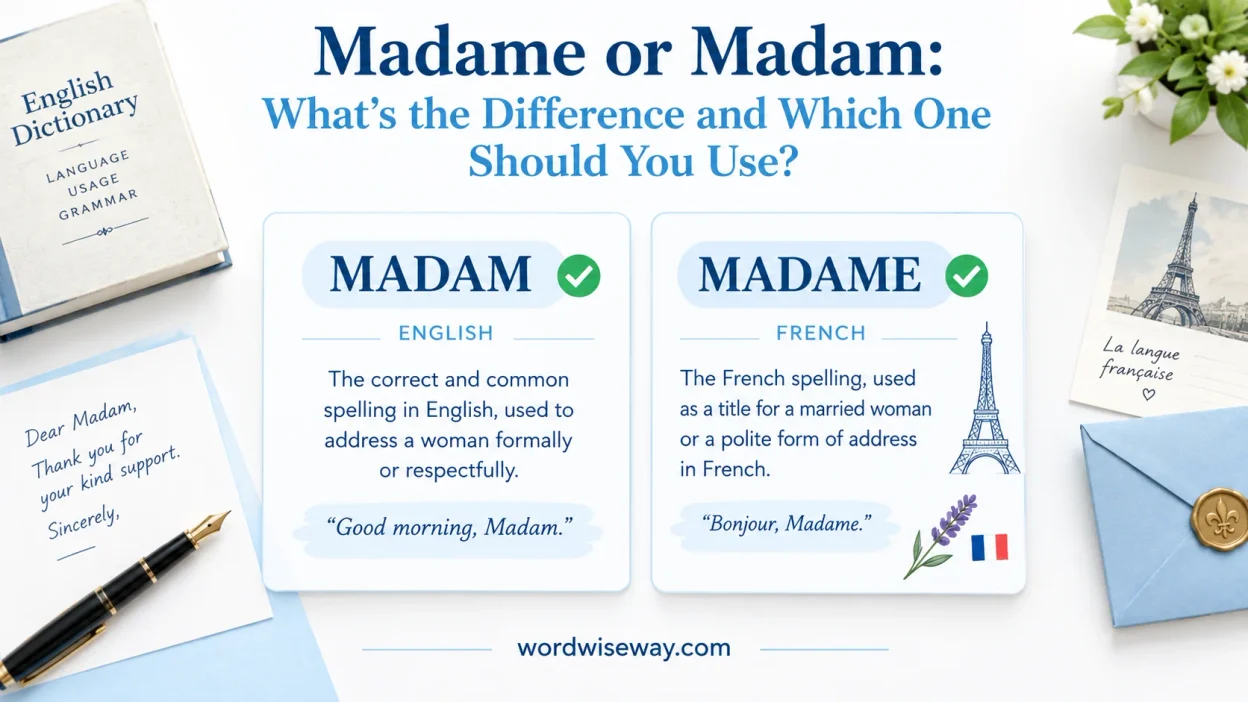
Madame or Madam: Meaning, Difference and Correct Usage explains why Madam and Madame can cause confusion in business emails, formal letters, customer service messages, and everyday conversations.
Both words look similar, and some people think they are interchangeable, but each has a different purpose in American English. Madam is the usual formal English form of address for an unnamed woman or someone with an official position.
Madame usually reflects French or foreign-style usage and can appear before a title and surname, as in Madame Dupont. A hotel employee may address a guest as “madam,” while an English writer may mention a French woman as Madame Laurent. This structural difference reflects their historical connection and modern English usage.
Understanding the meaning, history, spelling differences, usage rules, and common mistakes helps you choose correctly. Whether writing to a government official, addressing a customer, or learning English grammar, knowing the right word helps you write more professionally, avoid mistakes, and understand which word to choose and why.
Quick Answer
Madam is the standard English form used as a polite or formal way to address a woman. You might use it in a business letter, formal conversation, customer service setting, or official title.
Madame is the French form of the word and is commonly used in French. English also uses madame, but usually in French-related contexts, established names, titles, or situations where the French flavor is intentional.
| Word | Main use | Example |
| Madam | Formal English address | “Yes, Madam.” |
| Madam | Formal titles | “Madam President” |
| Madam | Formal letters | “Dear Madam,” |
| Madame | French form of address | “Madame Dupont” |
| Madame | French-related English contexts | “Madame Curie” |
| Madame | Established English usage | “Madame Tussaud” |
A useful rule is simple: choose “madam” for ordinary formal English and “madame” when French usage or a specific established name calls for it.
What Does Madam Mean?
Madam Definition
Madam is a formal term used to address a woman respectfully. It can stand alone or appear alongside an official position or title.
For example:
- “Excuse me, Madam.”
- “Yes, Madam.”
- “Madam Chair, may I respond?”
- “Madam President addressed the assembly.”
- “Dear Madam, thank you for your letter.”
The word often sounds more formal than simply using a woman’s name. In everyday American conversation, you may hear it less often than ma’am, which functions as a shortened spoken form of madam.
Although madam can convey respect, its tone depends heavily on the situation. A hotel employee might say, “Certainly, Madam,” as a polite service phrase. Someone could also use “Madam” sarcastically in a heated conversation. The word itself doesn’t determine the attitude.
How to Use Madam in a Sentence
Use madam when you directly address a woman in a formal or respectful way.
Consider these examples:
- “Madam, your appointment is ready.”
- “Thank you, Madam.”
- “Madam Chair opened the meeting.”
- “Dear Madam, we have received your application.”
- “May I help you, Madam?”
Notice that madam functions as a form of address rather than simply describing a woman.
When it appears as a direct form of address, capitalization depends on its position and style. At the beginning of a sentence, it naturally begins with a capital letter. In formal titles such as Madam President, it is also commonly capitalized when used as part of the title.
Common Expressions With Madam
Several English expressions use madam naturally.
Dear Madam is a traditional formal letter opening when the recipient’s name isn’t known.
Madam President addresses a female president by office.
Madam Chair addresses a female chairperson.
Yes, Madam provides a formal response.
Excuse me, Madam politely gets a woman’s attention.
These expressions aren’t interchangeable with madame simply because both words refer to women.
What Does Madame Mean?
Madame Definition
Madame is the French equivalent of a formal title for a woman. In French, it can be used before a woman’s surname or as a respectful form of direct address.
For example, a French speaker might use Madame in a situation where an English speaker would use Mrs., Ms., or ma’am, depending on the context.
English borrowed the word from French, so madame has a legitimate place in English vocabulary. However, its use follows different conventions.
In English, the word often signals a French connection or a particular formal style. That’s why Madame Curie is familiar to English readers, while Madame Smith would sound unusual in ordinary American English.
How to Use Madame in a Sentence
English can use madame when referring to a woman by a French title or in a French cultural setting.
Examples include:
- “Madame Curie changed the history of modern science.”
- “The painting depicts Madame de Pompadour.”
- “Madame Tussaud became associated with the famous wax museum.”
- “The French speaker addressed her as Madame.”
The context makes the word feel natural.
If you’re writing an ordinary American business email to a woman whose name you don’t know, Dear Madam usually fits better than Dear Madame.
Common English Uses of Madame
You’ll encounter madame in several recognizable situations:
- French names and titles
- French-language writing
- Historical references involving French women
- French cultural discussions
- Established names and institutions
- Certain formal or theatrical uses
- English references that intentionally preserve French terminology
One important detail deserves attention: madame can also have specialized English meanings. In some contexts, especially older or formal English, it can refer to a woman who manages a house of prostitution. Because of that secondary meaning, context matters even more.
Key Differences
The easiest way to understand madame vs. madam is to compare their roles rather than their spellings.
| Feature | Madam | Madame |
| Primary language | English | French |
| Common US English use | Yes | Limited |
| French usage | Not standard | Yes |
| Formal English address | Common | Uncommon |
| French title | No | Yes |
| Formal letters in English | Common | Usually not |
| Common official title | “Madam President” | Usually not |
| French-related names | Sometimes translated | Often retained |
| Common abbreviation | No widely standard equivalent | Mme. |
| Typical plural | madams | mesdames in French |
The spelling difference isn’t merely decorative. It tells the reader something about the linguistic context.
Madam Is Usually the English Choice
If you’re writing ordinary US English, madam should usually be your first choice.
For instance:
“Dear Madam, I am writing regarding your recent request.”
That’s a conventional English expression.
Changing it to:
“Dear Madame, I am writing regarding your recent request.”
doesn’t automatically make the sentence more sophisticated. Instead, it introduces a French form that may feel unnecessary.
Madame Signals French or Specialized Context
Madame makes more sense when the French form itself matters.
For example:
“Madame Curie received international recognition for her scientific work.”
Here, the French title has become part of the familiar English name.
Similarly, if you’re writing in French, madame is the natural choice rather than madam.
Which One Is Correct?
Both words are correct. The real question is which word fits the language and context.
Use Madam in Standard English
Choose madam when you’re writing formal US English and directly addressing a woman.
Common situations include:
- Business correspondence
- Customer service
- Formal conversation
- Official speeches
- Government titles
- Courtroom language
- Traditional formal letters
For example:
“Madam Chair, the committee is ready to proceed.”
Here, madam works naturally because the sentence follows an English formal-title convention.
Use Madame in French or French-Related Contexts
Choose madame when you’re writing French or preserving a French title.
For example:
“Madame Dupont will meet with the committee.”
If the surrounding text is French, madame is expected.
It can also remain appropriate when referring to a well-known person whose established name traditionally uses the French form.
Can You Use Madame in English?
Yes. Madame appears in English dictionaries and English-language writing. However, that doesn’t mean it replaces madam everywhere.
Think of it as a borrowed word with a specialized wardrobe. Sometimes it fits perfectly. In ordinary formal English, however, madam usually fits the occasion better.
Madam or Madame in Formal Letters and Emails
Formal correspondence is one of the areas where this distinction becomes especially useful.
Dear Madam vs. Dear Madame
For a standard English letter, use:
Dear Madam,
This form works when you know the recipient is a woman but don’t know her name.
For example:
“Dear Madam, I am writing to request further information about the application.”
Using Dear Madame may suggest French usage or a deliberate French influence.
When you know the person’s name, however, using their name is generally clearer and more natural.
Instead of:
“Dear Madam,”
you might write:
“Dear Ms. Johnson,”
when the person’s preferred title is known.
That approach feels more personal and avoids unnecessary formality.
Madam in Official Titles
English frequently uses Madam before an official position.
Examples include:
- Madam President
- Madam Chair
- Madam Speaker
- Madam Ambassador
- Madam Justice
These constructions work because madam functions as part of a formal English title.
The title often replaces the person’s name in direct address.
For example:
“Madam Speaker, the bill requires further discussion.”
The same pattern doesn’t automatically transfer to madame.
Madam or Madame in French
French uses madame as a standard title and form of address.
Its abbreviation is commonly written as Mme. in English-influenced contexts and Mme in French typography.
The word has a much broader everyday role in French than madame usually has in American English.
For example, a French-language sentence might address a woman as:
“Madame, pouvez-vous m’aider ?”
In English, the equivalent situation would normally use ma’am or madam, depending on the level of formality.
Madame, Monsieur, and Mademoiselle
French has traditionally used:
- Madame for an adult woman
- Monsieur for a man
- Mademoiselle historically for an unmarried or young woman
Modern French usage generally favors Madame for adult women regardless of marital status in many formal settings.
This matters because English and French don’t map perfectly word for word. A translation that mechanically substitutes one title for another can sound unnatural.
Pronunciation
Spelling isn’t the only difference. Pronunciation also changes between the two forms.
How to Pronounce Madam
In standard American English, madam is pronounced with two syllables.
The first syllable carries the main stress, while the second syllable has a reduced vowel sound in ordinary speech.
The spoken form is closely related to the familiar word ma’am, although madam sounds more formal.
How to Pronounce Madame
English pronunciation of madame generally reflects its French origin while adapting it to English speech.
French pronunciation differs from typical English pronunciation. If you’re speaking French, using the French pronunciation is appropriate. If you’re using the word within an English sentence, English speakers may use an anglicized pronunciation.
The key point is that madam and madame aren’t simply two spellings of one identical spoken word.
Abbreviation
The most familiar abbreviation associated with madame is Mme.
For example:
- Madame Dupont → Mme. Dupont
- Madame Laurent → Mme. Laurent
French typography may omit the period in Mme, while English writing often uses Mme.
There isn’t an equally standard everyday abbreviation for madam in US English.
That’s an important distinction. Mme. shouldn’t automatically be treated as an abbreviation for English madam.
Plural Forms of Madam and Madame
Plural of Madam
The ordinary English plural is:
madams
For example:
“Several madams attended the formal reception.”
However, the plural can sound unusual when you’re talking about forms of address because people generally address each woman individually.
Plural of Madame
French uses:
mesdames
This is the plural form of madame.
For example, Mesdames et Messieurs means Ladies and Gentlemen.
In English writing, mesdames can also appear when the French form is intentionally retained.
Don’t confuse mesdames with a spelling error. It follows French plural formation.
Common Mistakes to Avoid
Even experienced writers can stumble over these two words because their meanings overlap.
Here are the most common errors:
- Using madame in every formal English situation: French spelling doesn’t automatically mean greater respect.
- Writing “Dear Madame” in ordinary US correspondence: Use Dear Madam unless French usage is intended.
- Assuming madam and madame have identical meanings: Their uses overlap, but their linguistic roles differ.
- Using Mme. as the English abbreviation for madam: Mme. represents the French title madame.
- Mixing French and English conventions: Keep titles consistent with the language of the surrounding text.
- Ignoring context: A historical French name may require Madame, while an English formal title may require Madam.
- Treating capitalization as fixed: Capitalization depends on whether the word functions as a title, direct address, or ordinary noun.
A quick context check can prevent nearly all of these mistakes.
Examples
Examples make the distinction much easier to remember.
| Situation | Correct choice | Example |
| Formal English letter | Madam | “Dear Madam, thank you for your response.” |
| English official title | Madam | “Madam President entered the chamber.” |
| Direct formal address | Madam | “Madam, your table is ready.” |
| French title | Madame | “Madame Dupont arrived early.” |
| French-language writing | Madame | “Madame, veuillez patienter.” |
| Established French name | Madame | “Madame Curie made major scientific discoveries.” |
| French abbreviation | Mme. | “Mme. Dupont” |
| French plural | Mesdames | “Mesdames et Messieurs” |
Example: Formal Business Letter
Correct:
Dear Madam,
Thank you for contacting our office.
The English form works because the letter follows standard English conventions.
Example: Official Address
Correct:
Madam Chair, may I ask a question?
Here, madam works as part of an English formal title.
Example: French Context
Correct:
Madame Dupont will meet with the delegation.
The French title is appropriate because the context preserves French naming conventions.
Example: Historical Reference
Correct:
Madame Curie remains one of the most recognized scientists associated with radioactivity research.
The established form is widely recognized in English.
Madam or Madame in American English
American English strongly favors madam for ordinary formal address.
You may encounter it in:
- Formal customer service
- Government settings
- Business correspondence
- Ceremonial speech
- Legal contexts
- Political and institutional titles
- Traditional etiquette
However, everyday American speech often uses ma’am instead.
For example:
“Yes, ma’am.”
This is generally more conversational than:
“Yes, madam.”
The latter can sound especially formal, old-fashioned, theatrical, or deliberately ceremonious depending on the situation.
Madame still appears in American English, but its use tends to be more specialized.
You might see it in historical names, French contexts, cultural writing, or particular established expressions.
Madam or Madame in British English
British English also uses madam, particularly in formal address and service situations.
The basic distinction remains similar: madam belongs naturally to English, while madame often carries French associations.
Regional style can affect how formal or old-fashioned madam sounds. However, the core spelling distinction doesn’t disappear between American and British English.
For practical US English writing, the safest default remains straightforward:
Use madam for ordinary formal English. Use madame when French context or an established name calls for it.
Is Madam Rude or Polite?
Madam is fundamentally a respectful form of address, but tone can change how it feels.
Imagine a hotel employee saying:
“Certainly, Madam. I’ll take care of that.”
The word sounds courteous and professional.
Now imagine someone saying:
“Whatever you say, Madam.”
The same word could sound sarcastic.
That difference comes from context, delivery, and surrounding language. Words don’t live in a vacuum. Tone supplies the weather.
In some modern American settings, madam can also sound unusually formal because people more commonly use a person’s name, Ms., or ma’am.
Is Madame More Formal Than Madam?
Not necessarily.
Many English speakers perceive madame as more elegant, refined, or distinctly French. However, that perception doesn’t make it the correct choice for every formal situation.
Formal doesn’t mean French.
If you’re writing a standard American business letter, madam is usually more appropriate than madame.
On the other hand, using madame can be entirely appropriate when French culture, language, history, or a recognized name is central to the context.
The distinction is therefore about usage rather than social rank.
A Simple Memory Trick
Use this quick rule:
Madam = standard English.
Madame = French or French-related context.
When you’re unsure, ask yourself what language the surrounding sentence follows.
If you’re writing:
“Dear Madam, thank you for your inquiry.”
you’re using standard English.
If you’re writing:
“Madame Dupont est arrivée.”
you’re using French.
The spelling becomes much easier once you stop treating the words as competing versions and start treating them as context-specific forms.
Read More: Preterite or Imperfect: How to Choose the Right Spanish Tense
FAQs
Is Madam or Madame correct in English?
Both Madam and Madame are correct, but they aren’t normally used in the same way. Madam is the standard English form of respectful address, while Madame is commonly associated with French or French-style usage.
When should you use Madam?
Use Madam when directly addressing a woman respectfully, especially when you don’t know her name. It’s common in formal conversations, letters, customer service, and official communication.
When should you use Madame?
Use Madame when referring to a French woman or using a French-style title before a surname. For example, Madame Dupont follows the French naming convention.
Is Madam more common in American English?
Yes. Madam is the more familiar choice in standard American English when you need a formal term of address. You’ll often see it in professional or official settings.
Can Madam and Madame be used interchangeably?
Not always. Although they share a historical connection and similar meaning, replacing one with the other can make a sentence sound unnatural or change its cultural context.
Should you capitalize Madam in a sentence?
Capitalize Madam when you use it as a direct form of address or as part of a specific title. Lowercase usage may appear when the word functions as a general noun rather than a formal address.
Should you write Madam before a woman’s surname?
Usually, no. In English, Madam generally stands alone when used as a respectful form of address. A French-style expression such as Madame Laurent uses Madame before the surname.
Is Madame only used for married women?
No. Madame isn’t simply an indicator of marital status. In French usage, it functions as a standard title for an adult woman, while English speakers may use it to preserve a French or foreign-style context.
Which word should you use in a formal email?
In most American English business emails, Madam is the safer choice when you need a respectful form of address and don’t know the woman’s name. However, a specific professional title or the recipient’s name may be more natural when available.
Why do Madam and Madame look so similar?
The two words have a shared historical connection, which explains their similar spelling and meaning. Over time, English and French developed different conventions, giving each form its own role in modern usage.
Conclusion
Choosing between Madam and Madame becomes much easier once you look at the context rather than the spelling alone. Both words are correct, respectful terms, but Madam fits standard English usage, especially in formal communication, while Madame carries a French or foreign-style flavor. That small difference can make your writing sound either natural or slightly out of place.
For everyday American English, Madam is generally the better choice when you need to address an unnamed woman politely. You might see it in a formal letter, business exchange, customer service setting, or official conversation. Madame, on the other hand, works naturally when you’re using a French title or referring to someone with a French name, such as Madame Laurent.
Once you understand this distinction, you won’t need to second-guess every formal greeting. Consider who you’re addressing, the language and setting you’re writing in, and whether the word stands alone or comes before a surname. With those simple clues in mind, choosing the right form becomes a straightforward part of polished communication.

Emma Smith has dedicated 14 years to Princeton University’s English Department, mentoring students in textual interpretation, literary movements, and critical frameworks. Her research explores Shakespearean drama, Victorian serial fiction, postcolonial narrative theory, and manuscript studies and probing how literary forms evolve across cultures and centuries. Emma has delivered lectures at international humanities congresses and published findings in distinguished academic journals, underscoring her commitment to scholarly depth and vibrant teaching.