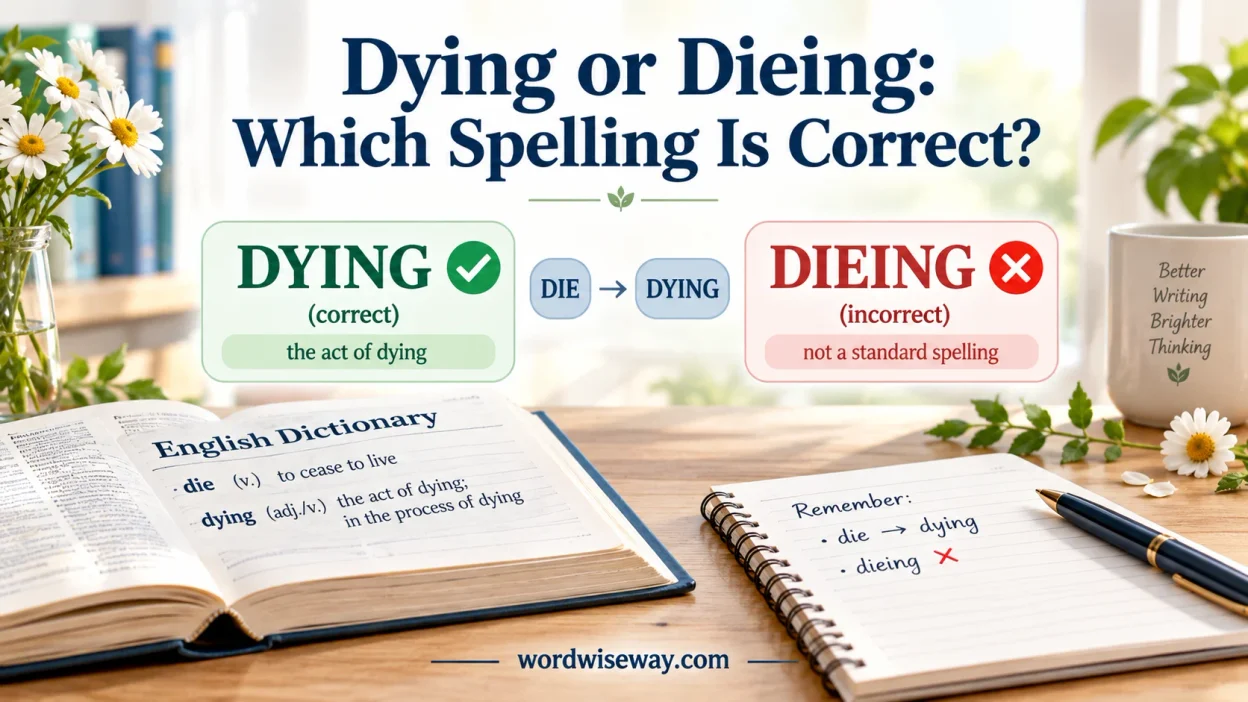
Dying or Dieing: Correct Spelling, Meaning, and Usage can clear the confusion surrounding the verb die and its unusual spelling.
Dying is the present participle form of die, referring to death, ceasing life, or the ending of life. Dieing is a rare and uncommon term linked to metal cutting, die-casting, die-cast machines, and a shaping process.
The difference becomes clearer when you check the context and meaning. Dyeing has a separate use related to changing color. I often notice this common error in an email, essay, news article, social media post, or academic writing. A spell checker may catch the wrong form, while a sharp-eyed reader can notice an extra letter.
When you write, choose the correct form according to the sentence and usage. Understanding these rules helps learners, writers, and native speakers avoid trouble and write with confidence. It also makes real-life writing more accurate and professional.
Quick Answer:
Dying is the correct spelling when you mean the -ing form of the verb die.
- Dying ✓ Standard spelling
- Dieing ✗ Usually incorrect when you mean “approaching death” or “ceasing to live”
For example:
The old tree is dying because it hasn’t received enough water.
Here, dying describes an action or process that is happening now.
The spelling changes from die to dying rather than simply adding -ing to create dieing. The ie changes to y before -ing.
| Word | Correct? | Example |
| Dying | ✓ | The plant is dying. |
| Dieing | ✗ In ordinary use | The plant is dieing. |
| Die | ✓ | Some plants die without water. |
| Died | ✓ | The plant died yesterday. |
| Dies | ✓ | The plant dies without enough water. |
So, if you’re talking about the ordinary verb die, remember this simple form:
die → dying
What Does Dying Mean?
Dying is the present participle and gerund form of die. Its most direct meaning relates to the process of approaching death or losing the ability to remain alive.
For example:
- The injured bird is dying.
- The patient is dying.
- The flowers are dying.
- The fish are dying because the water is polluted.
However, English uses dying in several broader ways. Something doesn’t have to be literally alive for the word to make sense.
You can describe a tradition, language, industry, business, or trend as dying when it is gradually disappearing or losing strength.
For example:
- The village’s old tradition is dying.
- The industry is slowly dying.
- That custom is dying out among younger generations.
- The old technology is dying as newer systems replace it.
The central idea remains the same: something is gradually coming to an end, losing vitality, or disappearing.
Why Is It “Dying” Instead of “Dieing”?
The spelling of dying can seem strange because the base verb is die. If you simply attach -ing, you might expect:
die + ing = dieing
English doesn’t form the word that way.
Instead, the spelling changes:
die → dying
The ie becomes y before the -ing ending.
This pattern also appears in other common verbs ending in -ie.
| Base Verb | -ing Form |
| die | dying |
| lie | lying |
| tie | tying |
| vie | vying |
This is why dying isn’t an arbitrary spelling. It follows an established English spelling pattern.
The “ie” to “y” Pattern
When you learn die → dying, it helps to connect it with lie → lying and tie → tying.
For example:
- She is lying on the sofa.
- He is tying his shoes.
- The flowers are dying.
- The athletes are vying for first place.
Notice that English doesn’t preserve the original ie sequence in these forms.
That makes dieing look logical at first glance, but standard spelling uses dying.
Is “Dieing” Ever a Word?
This question needs a little more care.
In ordinary English, dieing is not the standard spelling of the -ing form of the verb “die.” If you mean that a person, animal, plant, or other living thing is approaching death, use dying.
However, dieing can occur in specialized technical contexts related to die as a manufacturing tool or process. In manufacturing, a die can refer to a tool used to shape, cut, form, or stamp material.
That technical meaning is completely different from the everyday verb die, meaning to cease living.
This distinction matters because context determines the word’s meaning.
Ordinary Meaning
The flowers are dying.
Here, dying means the flowers are losing their ability to live.
Technical Meaning
A manufacturing text may use terminology derived from die as a tool. In that specialized setting, forms such as dieing can appear.
For general writing, however, don’t use dieing as an alternative spelling of dying.
If your sentence means “approaching death,” dying is the form you want.
The Key Difference
The easiest way to understand the difference is to focus on the meaning you intend.
| Spelling | Ordinary meaning | Standard everyday use |
| Dying | Approaching death, declining, or gradually ending | ✓ Yes |
| Dieing | Specialized technical usage in certain contexts | Rare |
| Dying | Wanting something intensely in expressions such as “dying to know” | ✓ Yes |
For most everyday writing, dying is the only form you need.
If you write an email, essay, article, school assignment, story, or social post about something approaching death, use dying.
Why Do People Spell It “Dieing”?
The mistake usually comes from a perfectly understandable assumption.
A writer sees:
die + ing
and naturally produces:
dieing
That reasoning works with some English verbs. For example:
- read + ing = reading
- jump + ing = jumping
- play + ing = playing
English spelling becomes less predictable with verbs that end in certain letter combinations. Die belongs to one of those groups.
The correct transformation is:
die → dying
The same kind of spelling adjustment appears in:
lie → lying
and
tie → tying
So, although dieing looks as though it should work, standard English uses dying.
Dying as a Verb Form
To use dying accurately, it helps to understand how it relates to the other forms of die.
| Verb Form | Function | Example |
| Die | Base form | Plants can die without water. |
| Dies | Present tense with he, she, it, or singular nouns | The flower dies without water. |
| Died | Past tense | The flower died last week. |
| Dying | Present participle or gerund | The flower is dying. |
These forms describe different grammatical situations.
Die
Use die as the base form after modal verbs and certain other structures.
- Plants can die without water.
- Some animals die naturally.
- Trees may die during severe droughts.
Dies
Use dies with a singular third-person subject in the simple present.
- The flower dies without sunlight.
- A battery dies when it loses all its charge.
- The tradition slowly dies over time.
Died
Use died for a completed event in the past.
- The plant died during the winter.
- The battery died yesterday.
- The old tradition died out decades ago.
Dying
Use dying when the process is happening or continuing.
- The plant is dying.
- The battery is dying.
- The tradition is dying out.
The distinction becomes much easier when you focus on time and action rather than memorizing isolated words.
Dying vs. Died
Dying and died often confuse learners because both relate to death. Their grammatical meanings differ.
Dying describes an ongoing process.
The tree is dying.
This tells you that the tree is currently in the process of losing its life.
Died describes a completed event.
The tree died last winter.
This tells you that the death occurred in the past.
Think of it as a process versus a finished event.
| Sentence | Meaning |
| The plant is dying. | The process is happening now. |
| The plant died. | The death happened in the past. |
| The plant dies every summer. | The event happens repeatedly or generally. |
Dying vs. Dies
The difference between dying and dies also depends on grammar.
Consider these two sentences:
The battery dies quickly.
This sentence makes a general statement about the battery.
Now compare it with:
The battery is dying.
This sentence describes the battery’s current condition.
The same distinction appears in many contexts.
- The flowers die without water.
This states a general fact. - The flowers are dying without water.
This describes an ongoing situation.
The ending changes because the grammatical structure changes.
Common Meanings of Dying
Although death is the core meaning, dying has several useful applications in everyday English.
Dying Literally
The most direct meaning describes the process of approaching death.
Examples include:
- The animal is dying.
- The tree is dying.
- The patient is dying.
The word can apply to living organisms, including people, animals, and plants.
Dying as Declining
English also uses dying to describe something that is gradually losing strength or popularity.
For example:
- The industry is dying.
- The tradition is dying.
- The language is dying.
- The village is slowly dying.
Here, dying doesn’t necessarily mean literal biological death. Instead, it signals decline.
Dying Out
The phrase dying out means gradually disappearing until something no longer exists or occurs.
Examples:
- The old custom is dying out.
- Some traditional skills are dying out.
- The species is at risk of dying out.
The word out adds the idea of disappearance.
“Dying For” and “Dying To”
The word dying also appears in common idiomatic expressions.
Dying For Something
Dying for can express an extremely strong desire for something.
For example:
I’m dying for a cold glass of water.
The speaker usually isn’t making a literal statement about death. The expression emphasizes intense desire.
You might also hear:
- I’m dying for a vacation.
- She’s dying for some good news.
- We’re dying for a break.
Dying to Do Something
Dying to can express strong eagerness to do something.
Examples:
- I’m dying to see the new movie.
- She’s dying to tell you the news.
- They’re dying to visit the new restaurant.
Again, context matters. These expressions use dying figuratively.
Practical Case Studies:
Looking at realistic sentences makes the spelling rule easier to remember.
Case Study: A Plant
Suppose someone forgets to water a houseplant for several weeks.
Correct:
The plant is dying because it hasn’t received enough water.
Incorrect:
The plant is dieing because it hasn’t received enough water.
The intended verb is die, so its -ing form is dying.
Case Study: A Phone Battery
Imagine your phone shows a very low battery percentage.
You might say:
My phone is dying.
Here, dying is used informally to mean that the battery is almost empty.
You wouldn’t normally write:
My phone is dieing.
The standard spelling remains dying.
Case Study: A Declining Tradition
Consider a traditional practice that fewer people follow each year.
You could write:
The tradition is slowly dying out.
The phrase describes gradual disappearance rather than literal biological death.
Again, dying is correct.
Case Study: A Past Event
Suppose a plant already died yesterday.
You would write:
The plant died yesterday.
You wouldn’t use dying because the sentence describes a completed past event.
This example also shows why choosing the correct spelling isn’t enough. You must select the correct verb form for the sentence.
Common Mistakes
Writing “Dieing” Instead of “Dying”
This is the most common spelling mistake.
❌ The flowers are dieing.
✓ The flowers are dying.
Remember:
die → dying
Using “Dying” When You Need “Died”
❌ The tree dying last year.
✓ The tree died last year.
The word last year signals a completed past event, so died fits the sentence.
Using “Dying” When You Need “Dies”
❌ A plant dying without water.
✓ A plant dies without water.
The second sentence expresses a general fact. It needs the simple present form dies.
Assuming Every -ing Form Simply Adds “ing”
English spelling doesn’t always work like a mathematical equation.
You can’t always take the base word and attach -ing without changing anything.
Compare:
- make → making
- write → writing
- lie → lying
- tie → tying
- die → dying
The spelling behavior depends on the ending and the established spelling pattern.
A Simple Way to Remember Dying
If dieing keeps sneaking into your writing, use a three-word memory chain:
die → dying
Then connect it with:
lie → lying
tie → tying
These words help reinforce the ie → y pattern.
A useful reminder is:
When “die” takes “-ing,” the spelling becomes “dying.”
That’s short enough to remember when you’re writing quickly.
Dying in American English
In standard American English, dying is the normal spelling for the -ing form of die.
There isn’t an American-English spelling variation that changes ordinary dying to dieing.
This matters when you’re proofreading articles, essays, school assignments, websites, or professional writing. If the intended meaning is the ordinary verb die, use dying.
The pronunciation also doesn’t make the spelling change obvious. English contains many words whose spelling can’t be predicted perfectly from their sound. That’s one reason visual patterns and word families can help more than pronunciation alone.
: Quick Revision
Here’s the entire lesson in compact form:
- Dying is the standard spelling for the -ing form of die.
- Dieing is generally incorrect when you mean approaching death.
- The standard spelling changes die → dying.
- Died is the past tense of die.
- Dies is the third-person singular present form.
- Dying describes an ongoing process or can function as a gerund.
- Dying out means gradually disappearing.
- Dying for can express intense desire.
- Dying to can express strong eagerness.
- Dieing may appear in specialized technical contexts involving a manufacturing die, but it isn’t the ordinary spelling of dying.
Practice:
Choose the correct form in each sentence.
- The flowers are ______ because nobody watered them.
- The old tradition is slowly ______ out.
- My phone is ______.
- The leaves started ______ during the heat wave.
- The plant ______ last winter.
- She is ______ to hear the results.
- Some languages are ______ out.
- The battery usually ______ after several hours.
- The animal was ______ when help arrived.
- I’m ______ for a cup of coffee.
Answers
- dying
- dying
- dying
- dying
- died
- dying
- dying
- dies
- dying
- dying
The exercise highlights an important point: not every sentence needs dying. You must consider both spelling and grammar.
Read More: Preformed or Performed: Correct Spelling, Meaning, and Usage
FAQs
Is dying the correct spelling?
Yes, dying is the standard and correct spelling when you mean the present participle of die. It describes the process of approaching death, ending, or declining. For example, you might describe a plant as dying or a tradition as dying out.
Why is dieing usually considered incorrect?
Dieing looks logical if you simply add -ing to die, but English spelling rules change the word. The standard form is dying. Using dieing in ordinary writing can make your sentence appear misspelled.
Is dieing ever a real English word?
Yes, but it has a very limited technical use. Dieing can refer to processes involving a die, especially certain manufacturing or metalworking operations. This specialized meaning is very different from the ordinary verb die.
What does dying mean in a sentence?
Dying can describe the process of losing life. It can also describe something declining or gradually disappearing. For instance, writers may use it when discussing a dying industry, language, custom, or trend.
What is the difference between dying and dyeing?
Dying comes from die and relates to death or decline. Dyeing comes from dye and means changing the color of something. Although the words look and sound similar, their meanings and uses are completely different.
Why does die change to dying?
The spelling changes because English does not always form continuous words by simply attaching -ing. With die, the final ie changes to y before -ing is added, producing dying.
Can I use dying for things that are not alive?
Yes. Dying can describe something that is losing strength, popularity, activity, or importance. Expressions such as a dying tradition or dying trend use the word in a figurative sense rather than referring directly to physical death.
Will a spell checker accept dieing?
Most modern spell checkers will flag dieing when you intend the ordinary form of die. However, a dictionary or specialized writing system may recognize it because it has a rare technical meaning.
Which word should I use in everyday writing?
Use dying when you mean the present participle of die. Use dyeing when you mean coloring something. Reserve dieing for the specific technical contexts where that specialized term is appropriate.
How can I remember whether to write dying or dieing?
A useful memory trick is to connect dying with die and dyeing with dye. When your sentence concerns death, decline, or something fading away, dying is normally the form you need.
Conclusion
Understanding Dying or Dieing becomes much easier when you remember how the verb die changes in its continuous form. Dying is the standard and correct spelling in everyday English when you mean ceasing to live or ending. Although dieing may look logical, it is rarely used and usually does not fit normal sentences. Keeping this difference in mind can help you avoid a common spelling mistake.
Context also plays an important role when choosing the right word. Dying can describe death, decline, or something gradually losing strength, while dyeing relates to changing the color of something. Dieing has a rare technical meaning connected with manufacturing and cutting tools. These distinct meanings show why checking the sentence before choosing a spelling matters.
The easiest way to remember the correct form is simple: when die takes -ing, the final e changes, giving you dying, not dieing. Once you understand this spelling rule, you can use the word confidently in emails, essays, articles, social media posts, and everyday writing. A small spelling detail can make your writing clearer, more accurate, and more professional.

Emma Smith has dedicated 14 years to Princeton University’s English Department, mentoring students in textual interpretation, literary movements, and critical frameworks. Her research explores Shakespearean drama, Victorian serial fiction, postcolonial narrative theory, and manuscript studies and probing how literary forms evolve across cultures and centuries. Emma has delivered lectures at international humanities congresses and published findings in distinguished academic journals, underscoring her commitment to scholarly depth and vibrant teaching.