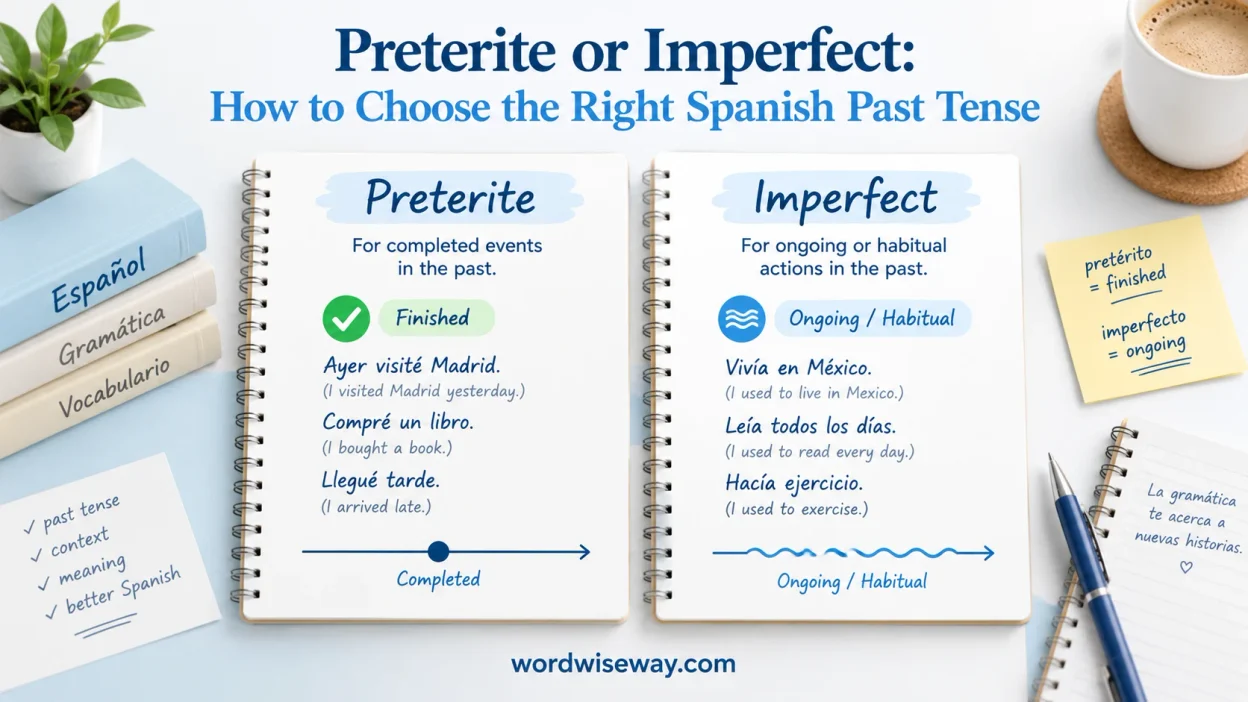
Preterite or Imperfect: How to Choose the Right Spanish Tense helps you understand how context shapes Spanish past-tense choices in real use. In Spanish grammar, two simple past tenses, the preterite and imperfect, describe the past from different angles.
The preterite tense can show a single event that happened at a specific point of time or had a specific duration, while the imperfect tense describes ongoing events, habits, and background information without a specific time period.
These tenses can refer to past events, but their difference can change the meaning of a sentence, so you need to understand the distinction before you use them confidently.For learners, this grammar topic often creates confusion and struggle, especially when choosing the correct tense for conversations, writing, exams, and language-learning apps.
Completed actions contrast with ongoing events, while native speakers rely on context rather than memorized rules. Real-world examples make tense selection easier to understand because context guides the choice. Learning the origins, usage trends, common mistakes, and practical advice can help you avoid mistakes, choose the right form, and build greater confidence when using Spanish past tenses.
Quick Answer
The simplest way to remember the difference is this:
| Preterite | Imperfect |
| Completed past events | Ongoing past actions |
| One-time events | Repeated or habitual actions |
| A sequence of completed events | Background information |
| Actions viewed as bounded | Actions without a stated endpoint |
| Events that move a story forward | Descriptions and circumstances |
| What happened | What was happening or what things were like |
Consider these examples:
- Ayer comí pizza. = I ate pizza yesterday. The eating is presented as completed.
- Cuando era niño, comía pizza todos los viernes. = When I was a child, I ate pizza every Friday. The sentence describes a repeated habit.
The important point is that the preterite doesn’t simply mean “short” and the imperfect doesn’t simply mean “long.” Spanish cares about perspective.
What Is the Spanish Preterite?
The Spanish preterite, also called the preterite perfect or pretérito indefinido, commonly describes actions that the speaker views as completed in the past.
A completed action can happen quickly or take hours. Duration alone doesn’t determine the tense. What matters is whether the speaker presents the event as a finished whole.
For example:
- Terminé el trabajo. = I finished the work.
- Ayer fui al mercado. = I went to the market yesterday.
- Compramos una casa en 2020. = We bought a house in 2020.
Each action has a clear boundary in the speaker’s presentation.
When to Use the Preterite
The preterite works particularly well for completed events.
If you can picture an action as an event that began and reached a relevant endpoint, the preterite may be appropriate.
For example:
María abrió la puerta, entró en la habitación y se sentó.
Maria opened the door, entered the room, and sat down.
The three verbs form a sequence. Each event advances the story, which makes the preterite a natural choice.
The preterite also commonly describes:
- A single completed action
- A specific event
- A series of completed events
- A change or development viewed as completed
- An action that interrupts an ongoing situation
- A completed action within a defined period
Consider the difference between these ideas:
Estudié toda la noche.
The speaker presents the studying as a completed activity.
Estudiaba toda la noche.
This can describe a habitual or ongoing pattern rather than one completed night.
The words may look nearly identical, yet the viewpoint changes the meaning.
Common Preterite Signal Words
Certain expressions frequently appear with the preterite because they point toward completed events.
Common examples include:
- ayer = yesterday
- anoche = last night
- anteayer = the day before yesterday
- el año pasado = last year
- la semana pasada = last week
- una vez = once
- de repente = suddenly
- entonces = then
- hace dos días = two days ago
- en 2024 = in 2024
However, these expressions aren’t magic switches. A time expression can suggest a particular tense, but context still controls the choice.
For instance, el año pasado can appear in a sentence describing a completed event or a repeated situation. Always examine what the speaker wants to emphasize.
Preterite Examples in Context
Here are several useful examples:
- Ayer compré un libro.
I bought a book yesterday. - Llegamos a Madrid el lunes.
We arrived in Madrid on Monday. - Ella terminó el proyecto anoche.
She finished the project last night. - Primero cenamos y después vimos una película.
First we had dinner and then we watched a movie.
The last example shows one of the preterite’s most important storytelling functions. The actions occur as completed events in a sequence.
What Is the Spanish Imperfect?
The Spanish imperfect, or pretérito imperfecto, describes past situations from a different angle. Instead of presenting an event as a completed whole, it often places you inside the situation.
The imperfect commonly describes:
- Ongoing actions
- Repeated actions
- Habits
- Background circumstances
- Past descriptions
- Age
- Time
- Weather
- Physical or emotional states
Think of the imperfect as the part of a story that answers questions such as What was happening? What was it like? What usually happened?
For example:
Hacía frío.
It was cold.
The sentence doesn’t tell you when the cold began or when it ended. It simply establishes the weather as part of the background.
When to Use the Imperfect
The imperfect commonly describes ongoing or habitual situations in the past.
Consider:
Cuando vivía en México, caminaba al trabajo todos los días.
When I lived in Mexico, I walked to work every day.
The sentence doesn’t focus on one particular walk. Instead, it describes a repeated habit during a period of the speaker’s life.
The imperfect also handles background descriptions:
- La casa era grande. = The house was large.
- Hacía calor. = It was hot.
- Eran las ocho. = It was eight o’clock.
- Yo tenía diez años. = I was ten years old.
- Ella estaba cansada. = She was tired.
These statements establish circumstances rather than pushing a sequence of completed events forward.
Common Imperfect Signal Words
Several expressions frequently accompany the imperfect:
- siempre = always
- a menudo = often
- normalmente = normally
- generalmente = generally
- cada día = every day
- todos los días = every day
- de niño/de niña = as a child
- mientras = while
- cada verano = every summer
- muchas veces = many times
Again, treat these as clues rather than automatic rules.
For example, siempre often introduces a habitual action, but context can change how a speaker frames an event. The verb’s meaning and the surrounding sentence matter.
Imperfect Examples in Context
- Cuando era pequeño, jugaba afuera.
When I was little, I used to play outside. - Todos los domingos visitábamos a nuestros abuelos.
Every Sunday, we used to visit our grandparents. - La ciudad era tranquila.
The city was quiet. - Mientras estudiaba, escuchaba música.
While I was studying, I listened to music.
Notice how these sentences create a past landscape. They describe what life was like, what normally happened, or what was in progress.
The Main Differences
The difference becomes much easier when you compare the two tenses in pairs.
Completed Action vs. Ongoing Action
Compare:
Leí el libro.
I read the book.
Leía el libro.
I was reading the book.
The preterite presents the reading as completed. The imperfect puts the listener inside the activity without emphasizing its completion.
This distinction becomes especially useful in narratives:
Leía el libro cuando sonó el teléfono.
I was reading the book when the phone rang.
Here, leía establishes the ongoing background action. Sonó introduces the completed event that interrupts it.
One-Time Event vs. Habitual Action
Compare:
Fui al gimnasio ayer.
I went to the gym yesterday.
Iba al gimnasio todos los días.
I used to go to the gym every day.
The first sentence identifies a completed visit. The second describes a repeated habit.
This is one of the clearest practical distinctions between the two tenses.
Main Event vs. Background Information
Spanish storytelling often uses the two tenses like different cinematic layers.
The imperfect sets the scene:
It was raining. The street was empty. People were walking slowly.
Then the preterite moves the action forward:
A car arrived. The driver opened the door. A man stepped out.
In Spanish, the same principle often appears through imperfect and preterite forms.
The imperfect supplies the backdrop. The preterite supplies the events.
Specific Duration vs. Ongoing Duration
Duration can confuse learners because both tenses can describe long activities.
For example:
Estudié durante tres horas.
I studied for three hours.
The speaker presents the three-hour activity as completed.
But:
Estudiaba durante horas.
I used to study for hours.
This can describe a recurring or habitual situation.
So don’t use the simplistic rule that “long action = imperfect.” Length doesn’t decide the tense. Perspective does.
What Happened vs. What Was Happening
A useful mental shortcut is:
- Preterite: What happened?
- Imperfect: What was happening? What was it like? What used to happen?
This isn’t a perfect formula for every sentence, but it provides a strong starting point.
Preterite and Imperfect Together
Many learners treat the preterite and imperfect as rivals. In real Spanish, they’re often teammates.
A sentence can naturally require both.
When One Action Interrupts Another
This is one of the most important patterns to learn.
The ongoing action normally takes the imperfect, while the completed interruption normally takes the preterite.
For example:
Yo caminaba por el parque cuando empezó a llover.
I was walking through the park when it started to rain.
Here:
- caminaba describes the ongoing activity.
- empezó identifies the completed event.
Another example:
Mientras cocinaba, sonó el teléfono.
While I was cooking, the phone rang.
The cooking provides the background. The ringing becomes the event.
Two Actions Happening at the Same Time
Two ongoing actions can both use the imperfect.
Mientras estudiaba, escuchaba música.
While I was studying, I listened to music.
Neither action needs to appear as a completed event. The sentence describes what was happening simultaneously.
Another example:
Mi hermano jugaba videojuegos mientras yo hacía la tarea.
My brother was playing video games while I was doing homework.
Both actions form part of the background.
Background + Main Event
Consider this short scenario:
Era de noche, hacía frío y la calle estaba vacía. De repente, apareció un perro.
It was nighttime, it was cold, and the street was empty. Suddenly, a dog appeared.
The first three descriptions use the imperfect because they establish the scene. Apareció uses the preterite because the dog’s appearance becomes a distinct event.
That’s the storytelling power of the two tenses.
How Meaning Changes With Preterite vs. Imperfect
Some verbs reveal the distinction particularly well because changing the tense can change the meaning substantially.
Conocí vs. Conocía
Conocía a Ana.
I knew Ana.
Conocí a Ana.
I met Ana.
The imperfect describes an existing state of familiarity. The preterite presents the event of meeting someone.
This distinction shows why translating each tense word-for-word doesn’t work.
Supe vs. Sabía
Sabía la respuesta.
I knew the answer.
Supe la respuesta.
I found out the answer.
With saber, the preterite can describe the point when someone found out or learned something, while the imperfect describes knowledge that already existed.
Pude vs. Podía
Podía nadar.
I could swim.
This can describe an ability or possibility that existed.
Pude nadar.
I managed to swim / I was able to swim.
The preterite can present the ability as something successfully achieved in a particular situation.
Context remains essential because these forms can support different interpretations.
Quise vs. Quería
Quería comprar el car.
I wanted to buy the car.
The imperfect describes an ongoing desire or intention.
Quise comprar el car.
I wanted to buy the car / I tried or intended to buy the car.
The preterite can frame the desire as a specific event or intention. With querer, context often determines the exact English interpretation.
No Quise vs. No Quería
This contrast can become especially important.
No quería ir.
I didn’t want to go.
This describes a state of unwillingness or lack of desire.
No quise ir.
I refused to go / I didn’t want to go.
The preterite can present the refusal as a specific decision or response.
The difference isn’t merely grammatical decoration. Changing the tense can change what happened in the story.
Common Spanish Verbs
Some high-frequency verbs deserve special attention because learners encounter them constantly.
Ser
The imperfect frequently describes identity, characteristics, age, time, and general background:
- Era joven. = I was young.
- La casa era grande. = The house was large.
- Eran las seis. = It was six o’clock.
The preterite can present a bounded state or event:
- Fue un día difícil. = It was a difficult day.
- La reunión fue larga. = The meeting was long.
The context determines whether the speaker describes an ongoing characteristic or a completed situation.
Estar
The imperfect can describe an ongoing state:
Estaba cansado.
I was tired.
The preterite can present a state as bounded or connected to a particular completed situation:
Estuve enfermo durante una semana.
I was sick for a week.
The sentence frames the illness as a completed period.
Tener
Tenía veinte años.
I was twenty years old.
The imperfect describes age as a background circumstance.
Tuve una idea.
I had an idea.
The preterite presents the thought as an event that occurred.
Saber
This verb is especially useful for understanding viewpoint:
- Sabía la verdad. = I knew the truth.
- Supe la verdad. = I found out the truth.
The imperfect describes knowledge already present. The preterite can mark the moment of discovery.
Conocer
- Conocía a Pedro. = I knew Pedro.
- Conocí a Pedro. = I met Pedro.
The imperfect describes familiarity. The preterite describes the encounter that established it.
Querer
- Quería ayudarte. = I wanted to help you.
- Quise ayudarte. = I wanted/tried to help you.
The imperfect often presents the desire as an ongoing intention. The preterite frames it as a specific intention or attempt.
Preterite or Imperfect in Spanish Storytelling
Stories provide one of the clearest places to understand this contrast.
Setting the Scene With the Imperfect
The imperfect often handles details that create the atmosphere:
- Weather
- Time
- Age
- Appearance
- Feelings
- Surroundings
- Ongoing activities
- Repeated behavior
For example:
Era una tarde tranquila. Hacía calor y las calles estaban casi vacías.
It was a quiet afternoon. It was hot and the streets were almost empty.
Nothing dramatic needs to happen yet. The imperfect simply prepares the scene.
Advancing the Story With the Preterite
Once the story starts moving, completed events often appear in the preterite:
Un hombre llegó, abrió la puerta y entró.
A man arrived, opened the door, and entered.
Each verb contributes a new event. The sequence has momentum.
Example Story Using Both Tenses
Consider this short example:
Era sábado y hacía buen tiempo. María caminaba por el centro mientras escuchaba música. Las tiendas estaban llenas de gente. De repente, vio a una amiga que no había visto durante años. Se saludaron y hablaron durante varios minutos.
The tense choices create two layers.
| Spanish form | Tense | Function |
| era | Imperfect | Background time |
| hacía | Imperfect | Weather |
| caminaba | Imperfect | Ongoing action |
| escuchaba | Imperfect | Ongoing action |
| estaban | Imperfect | Background condition |
| vio | Preterite | Completed event |
| había visto | Past perfect | Earlier past event |
| saludaron | Preterite | Completed event |
| hablaron | Preterite | Completed event |
Notice how the story begins with circumstances and then moves into specific events.
Decision Guide
When you’re unsure, don’t immediately search for a signal word. Instead, ask what the sentence is doing.
Ask These Questions Before Choosing
- Is the action presented as completed?
Consider the preterite. - Is the action ongoing in the background?
Consider the imperfect. - Did the action happen repeatedly or habitually?
The imperfect is often appropriate. - Does the sentence describe a person, place, time, weather, or condition?
The imperfect often fits. - Does the action form part of a completed sequence?
Consider the preterite. - Did one event interrupt another ongoing action?
The ongoing action usually takes the imperfect while the interruption takes the preterite. - Does the verb have a different meaning in each tense?
Pay close attention to verbs such as saber, conocer, querer, and poder.
A Simple Preterite vs. Imperfect Decision Tree
Past action → What are you emphasizing?
- A completed event → Preterite
- A specific event in a sequence → Preterite
- An ongoing background action → Imperfect
- A repeated or habitual action → Imperfect
- A description or past condition → Imperfect
- An ongoing action interrupted by another event → Imperfect + Preterite
The decision becomes easier with practice because you’re learning to recognize perspective rather than memorizing isolated rules.
Common Mistakes
Choosing Based Only on Signal Words
Words such as ayer, siempre, and mientras can provide useful clues. However, they don’t replace context.
Treat signal words like road signs. They point you in a direction, but they don’t drive the car.
Assuming “Was” Always Means Imperfect
English translations can mislead you.
The English word “was” can correspond to different Spanish forms depending on context. For example:
Estaba cansado.
I was tired.
But:
Estuve cansado durante tres días.
I was tired for three days.
The English translation doesn’t reveal the entire Spanish distinction.
Using the Imperfect for Every Ongoing-Looking Action
An action can last a long time and still take the preterite if the speaker presents it as completed.
Trabajé durante ocho horas.
I worked for eight hours.
The action lasted a substantial period, but the sentence presents those eight hours as a completed block.
Using the Preterite for Every Finished Activity
A past activity may have finished in reality without requiring the preterite.
If you’re describing a habitual pattern, the imperfect may still be appropriate:
Cuando vivía allí, trabajaba los sábados.
When I lived there, I used to work Saturdays.
The individual workdays ended, but the speaker describes the habit, not one completed Saturday.
Treating the Two Tenses as Direct English Equivalents
This is perhaps the biggest trap.
Spanish divides past meaning according to viewpoint. English often leaves that distinction to context or uses other structures.
Instead of asking, “Which Spanish tense translates this English verb?” ask:
“How does the Spanish sentence present this past situation?”
That question usually leads you toward the correct choice.
Conjugation Basics
Understanding the endings helps you recognize the forms once you’ve chosen the tense.
Regular Preterite Endings
For regular -AR verbs, such as hablar:
| Person | Ending | Example |
| yo | -é | hablé |
| tú | -aste | hablaste |
| él/ella/usted | -ó | habló |
| nosotros | -amos | hablamos |
| vosotros | -asteis | hablasteis |
| ellos/ustedes | -aron | hablaron |
For regular -ER and -IR verbs, the endings follow another pattern:
| Person | -ER example | -IR example |
| yo | comí | viví |
| tú | comiste | viviste |
| él/ella/usted | comió | vivió |
| nosotros | comimos | vivimos |
| vosotros | comisteis | vivisteis |
| ellos/ustedes | comieron | vivieron |
Regular Imperfect Endings
-AR verbs use forms such as:
- hablaba
- hablabas
- hablaba
- hablábamos
- hablabais
- hablaban
-ER and -IR verbs share the same imperfect endings:
- comía
- comías
- comía
- comíamos
- comíais
- comían
And:
- vivía
- vivías
- vivía
- vivíamos
- vivíais
- vivían
The imperfect has only three commonly taught irregular verbs: ser, ir, and ver.
Their forms are:
| Verb | Imperfect forms |
| ser | era, eras, era, éramos, erais, eran |
| ir | iba, ibas, iba, íbamos, ibais, iban |
| ver | veía, veías, veía, veíamos, veíais, veían |
The preterite has a much larger group of irregular forms, including common verbs such as tener, estar, poder, poner, saber, querer, venir, decir, hacer, and traer. These forms require focused practice because their stems or endings don’t follow the standard regular pattern.
Practice
The best way to master the difference is to practice complete contexts, not isolated verb charts.
Fill-in-the-Blank Practice
Choose the correct form:
- Cuando era niño, yo ___ al parque todos los días.
(ir) - Ayer ___ al parque con mi hermano.
(ir) - Mientras ella ___, sonó el teléfono.
(estudiar) - María ___ la puerta y entró.
(abrir) - Cuando vivíamos allí, ___ mucho los fines de semana.
(viajar) - Anoche ___ una película.
(ver)
The answers are:
- iba
- fui
- estudiaba
- abrió
- viajábamos
- vimos
The crucial step isn’t memorizing those answers. Identify the reason behind each choice.
Choose the Correct Form
Compare these pairs:
Cuando era joven, trabajé / trabajaba en una tienda.
The imperfect trabajaba fits a habitual or ongoing period of life.
Ayer trabajé / trabajaba durante ocho horas.
The preterite trabajé presents the eight-hour work period as completed.
Now consider:
Mientras cociné / cocinaba, mi hermano llegó.
The natural contrast is:
Mientras cocinaba, mi hermano llegó.
The cooking forms the background. The arrival is the completed event.
Read More: Till or Until: Meaning, Differences, Usage, and Examples
FAQs
What Is the Main Difference Between the Preterite and Imperfect?
The preterite usually describes completed actions or events in the past, while the imperfect describes ongoing actions, repeated habits, or background details.
How Do I Know When to Use the Preterite?
Use the preterite when you want to show that an action happened and ended. It often works with events tied to a specific moment, duration, or completed sequence.
When Should I Use the Imperfect in Spanish?
Use the imperfect for actions that were ongoing, repeated, habitual, or descriptive in the past. It often provides background information rather than focusing on an action’s completion.
Can the Preterite and Imperfect Describe the Same Event?
Yes. Both tenses can describe the same past situation, but they can change the perspective and meaning. The preterite focuses on what happened, while the imperfect emphasizes the ongoing setting or circumstances.
Do Time Expressions Help Me Choose the Correct Past Tense?
Yes. Words and phrases that indicate a specific completed time can often point toward the preterite. Expressions describing repeated, habitual, or unspecified past periods often work with the imperfect.
How Does Context Affect the Choice Between Preterite and Imperfect?
Context can determine which tense makes the most sense. Instead of relying on one keyword, consider whether the action was completed, ongoing, repeated, or part of the background.
Which Spanish Past Tense Is Used for Habits?
The imperfect is normally used for habits and repeated actions in the past. It shows that something happened regularly without emphasizing a single completed occurrence.
Can One Spanish Sentence Use Both the Preterite and Imperfect?
Yes. Spanish speakers often combine both tenses when telling stories. The imperfect can establish the background or an ongoing action, while the preterite can introduce a completed event.
Why Do Spanish Learners Confuse the Preterite and Imperfect?
Learners often confuse them because English doesn’t always mark the same distinction clearly. The best approach is to focus on the role of the action in context rather than translating word for word.
What Is the Easiest Way to Practice Preterite and Imperfect?
Start with short real-world examples and ask whether each action was completed, ongoing, habitual, or descriptive. Then practice sentences where both tenses appear together, because that shows how Spanish uses them in natural context.
Conclusion
competing rules and start looking at what you want the listener to notice. The preterite puts the spotlight on a completed event, while the imperfect gives you the surrounding action, habit, or background. That simple shift in perspective can make Spanish past-tense choices feel far less confusing.
When you practice, pay attention to the story behind each sentence rather than searching for one magic word that tells you which tense to use. Ask yourself whether the action ended, continued, happened repeatedly, or simply set the scene. Reading short stories, listening to native speakers, and creating your own examples can help you recognize these patterns naturally. Over time, the distinction becomes less of a grammar puzzle and more of an instinctive choice.
The goal isn’t to memorize every rule overnight. Build your understanding through real examples, notice how context changes meaning, and revisit mistakes instead of simply moving past them. With steady practice, you’ll become more comfortable choosing the preterite or imperfect in everyday Spanish, whether you’re speaking, writing, studying for an exam, or simply trying to tell a story clearly.

Amelia Sanders has spent 14 years in Harvard University’s English Department, helping students navigate literary analysis, interpretive theory, and narrative techniques. Her academic pursuits center on 18th-century British prose, romantic poetry, diasporic writing, and digital editing exploring how textual choices influence cultural perspectives. Amelia has spoken at major international meetings and contributed essays to respected academic volumes, demonstrating her dedication to thoughtful scholarship and effective teaching.