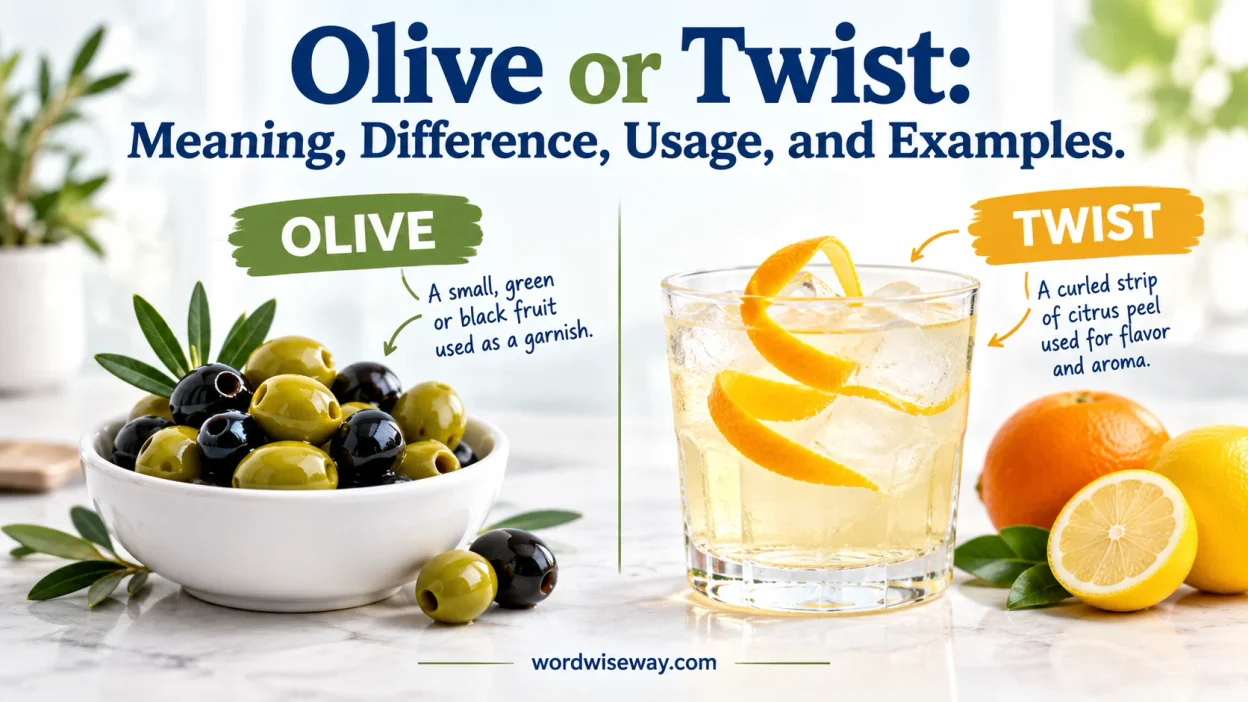
The olive and twist choice has a familiar place in cocktail culture. The phrase describes how a drink is finished, usually with an olive or citrus twist.
The meaning is simple, while the difference depends on the garnish, usage, and context. For examples, a bartender may ask which option you prefer when preparing certain drinks. The correct choice depends on the cocktail, not just the English words.
The phrase can sound alike with Oliver Twist, the famous novel by Charles Dickens, creating a mix-up or confusion. These expressions have different origins, although they seem closely related.
When people search for the phrase, they may be wondering whether it relates to food, drinks, or literature. This article clears up the meanings, common mistakes, and proper use in a simple way, helping you know when to say it and when not to say it.
Quick Answer:
Olive or twist is a phrase used to ask whether someone wants an olive or a citrus-peel garnish with a cocktail, particularly a martini.
In this expression:
- Olive means an olive added as a garnish.
- Twist means a twisted strip of citrus peel, usually lemon.
- Olive or twist? means “Which garnish would you prefer?”
- The phrase uses or because it presents two alternatives.
For example:
“Olive or twist?”
This doesn’t mean someone is asking whether you want to twist an olive. It refers to two different garnish choices.
The phrase is also sometimes used humorously outside cocktail contexts when someone wants to frame an ordinary decision as a playful two-way choice.
Olive or Twist Meaning Explained
The easiest way to understand olive or twist is to look at the special meaning of twist.
In ordinary English, twist can mean to turn something around, bend something, or change the direction of something. In cocktail terminology, however, it can function as a noun for a strip of citrus peel used as a garnish.
A bartender can twist a strip of lemon peel over a drink. That action releases aromatic oils from the peel. The resulting garnish is then called a twist.
An olive works differently. It provides a small savory element and can remain in the glass as an edible garnish.
So the phrase compresses a longer question into just three words:
Olive or twist?
In other words:
“Would you prefer an olive or a citrus-peel garnish?”
That compact wording explains why the phrase can confuse people who haven’t encountered cocktail terminology before.
What Does Olive Mean in “Olive or Twist”?
In this phrase, olive has its literal food-related meaning.
An olive is the fruit of the olive tree. When used as a cocktail garnish, it is typically added whole to the finished drink. In the context of the phrase, though, you don’t need to interpret olive as a general reference to olive oil, olive trees, or the color olive.
The surrounding context narrows the meaning.
For example:
- “She chose an olive.” means the olive garnish was selected.
- “He prefers an olive.” means he prefers that garnish option.
- “Olive or twist?” asks which garnish the person wants.
This distinction matters because olive has several meanings in English. Context acts like a linguistic signpost.
What Does Twist Mean in “Olive or Twist”?
The word twist has a more specialized meaning in this phrase.
A twist usually refers to a thin strip of citrus peel used as a garnish. Lemon is especially associated with the term, although other citrus fruits can also be used in cocktail garnishing.
The name comes from preparation. The peel is twisted over the drink, which helps release fragrant citrus oils onto the surface.
That means twist describes both the garnish and the preparation technique behind it.
It doesn’t mean:
- twisting the glass
- twisting the entire drink
- changing the recipe
- physically twisting an olive
This specialized meaning is what makes olive or twist interesting from a vocabulary perspective. A familiar word takes on a narrower meaning within a particular context.
Difference at a Glance
| Feature | Olive | Twist |
| Basic meaning in the phrase | Olive garnish | Citrus-peel garnish |
| Typical example | Green olive | Lemon peel |
| Grammatical role here | Noun | Noun |
| Main association | Savory flavor | Citrus aroma |
| Why it has this name | The fruit itself | The peel is twisted |
| Common context | Martini and cocktail terminology | Martini and cocktail terminology |
The key difference is simple: an olive is the garnish itself, while a twist refers to citrus peel prepared as a garnish.
Neither word is a spelling alternative for the other. They name two different things.
Why Does “Twist” Mean Citrus Peel?
The answer lies in how citrus peel is handled.
When a narrow piece of citrus peel is held over a drink and twisted, pressure helps express aromatic oils from the outer surface. Those oils contribute a noticeable citrus fragrance.
That aromatic effect is important because smell strongly influences how you perceive flavor. A citrus garnish can therefore contribute more than visual decoration.
The International Bartenders Association’s Dry Martini specification describes squeezing oil from lemon peel over the drink or using green olives as a garnish.
This explains why twist became a useful shorthand. Instead of describing the entire garnish and preparation process, cocktail terminology reduces it to one memorable word.
Olive or Twist in a Martini Context
The phrase is strongly associated with the martini.
The International Bartenders Association’s Dry Martini uses gin and dry vermouth and identifies lemon peel or green olives as garnish options.
This doesn’t mean every martini follows one universal formula. Martini recipes and serving traditions vary considerably. Still, the olive-versus-citrus choice is a well-established part of martini vocabulary.
A simple example makes the meaning clear:
Bartender: “Olive or twist?”
Customer: “Twist.”
The first speaker is asking about the garnish. The second speaker is selecting the citrus-peel option.
The important point is linguistic rather than procedural: twist is functioning as a noun with a specialized cocktail meaning.
Olive or Twist vs. Olive and Twist
The tiny word or carries a lot of meaning here.
Olive or twist presents two alternatives.
Olive and twist indicates that both options are being included.
Compare these sentences:
| Phrase | Meaning |
| Olive or twist? | Choose between the two garnish options. |
| Olive and twist. | Both garnishes are being mentioned or requested. |
| With an olive. | The olive garnish is selected. |
| With a twist. | The citrus-peel garnish is selected. |
This is a useful example of how a small conjunction can change the relationship between words.
Or creates a choice. And combines items.
Is “Olive or Twist” a Spelling Choice?
No. This is one of the most important points to understand.
Olive or twist isn’t asking you to choose between two spellings.
Both words are correctly spelled:
- olive
- twist
There isn’t a British spelling of olive or twist and a different American spelling of the phrase.
The expression remains written the same way in both varieties of English.
What changes is not spelling. Context changes the meaning.
For example, twist can mean a physical turning movement in one sentence and a citrus garnish in another.
Compare These Uses of “Twist”
Physical movement:
“She gave the handle a quick twist.”
Unexpected development:
“The story took an unexpected twist.”
Cocktail terminology:
“The drink was served with a twist.”
The spelling stays exactly the same. The context changes the interpretation.
Examples
Examples are the quickest way to see how the phrase works naturally.
Example 1: Direct Question
“Olive or twist?”
The speaker is asking which garnish the other person prefers.
Example 2: Olive
“She chose the olive.”
Here, olive refers to the selected garnish.
Example 3: Twist
“He ordered it with a twist.”
Here, twist refers to citrus peel used as a garnish.
Example 4: Clear Explanation
“The bartender explained that a twist meant citrus peel.”
This sentence removes the ambiguity surrounding the word twist.
Example 5: Informal Usage
“Olive or twist? That’s the question.”
This can be used playfully when referring to the familiar choice.
Example 6: Explanatory Writing
“The phrase olive or twist refers to two common garnish choices associated with martinis.”
This version works well in educational or reference content.
Common Mistakes
Because the phrase combines ordinary words with specialized terminology, several misunderstandings are possible.
Mistaking Twist for a Verb
A reader may initially assume that twist tells someone to perform an action.
In olive or twist, however, twist functions as a noun.
It identifies a type of garnish.
Thinking Olive and Twist Are Synonyms
They aren’t synonyms.
An olive is a fruit. A twist, in this context, is a citrus-peel garnish.
They represent different options.
Assuming Twist Means Any Citrus Fruit
A twist commonly refers to citrus peel, with lemon being especially associated with the term. However, the exact citrus can vary by drink and context.
So it’s better to interpret twist as citrus-peel garnish rather than automatically defining it as one specific fruit in every situation.
Treating the Phrase as a Spelling Question
Olive or twist isn’t a spelling comparison.
If someone asks, “Which is correct, olive or twist?” the answer depends on what they mean. The two words don’t perform the same grammatical or semantic job.
Confusing “Or” With “And”
The original phrase presents alternatives.
Replacing or with and changes the relationship between the two terms.
Olive or Twist in Everyday English
Although the phrase has a specific cocktail origin and association, language doesn’t always stay inside its original box.
People sometimes borrow familiar expressions for humorous or metaphorical purposes.
For example:
“Olive or twist? Apparently, this is today’s biggest decision.”
The sentence doesn’t necessarily need a literal cocktail context. Instead, it borrows the recognizable structure of the phrase to create a playful choice.
Still, context matters.
If a reader sees olive or twist without any surrounding explanation, the cocktail meaning is the safest interpretation.
If the phrase appears in a joke, headline, business name, or creative piece, the writer may be deliberately playing with that familiar association.
Why Context Matters
Words rarely live alone. Context determines which meaning becomes active.
Consider the word twist:
- A twist in a novel is an unexpected development.
- A twist in a wire is a physical turn.
- A twist in a story changes expectations.
- A twist in cocktail terminology refers to citrus peel used as a garnish.
The dictionary word remains the same. The surrounding words act as the decoder.
In olive or twist, the presence of olive strongly points toward the garnish meaning because both terms belong to the same cocktail vocabulary.
This is why reading the complete phrase is more useful than defining twist in isolation.
Olive or Twist vs. Lemon Twist
These expressions are related, but they’re not identical.
Olive or twist is a choice between two garnish options.
Lemon twist names one particular garnish.
For example:
- Olive or twist? = Which garnish?
- Lemon twist = A specific citrus-peel garnish.
- With an olive = The olive option.
- With a twist = The citrus-peel option.
The phrase lemon twist can therefore clarify what twist means when a reader is unfamiliar with cocktail terminology.
Is “Olive or Twist” Correct English?
Yes. Olive or twist is a legitimate English phrase when used in the appropriate context.
It is especially associated with cocktail terminology and the garnish choice commonly discussed with martinis. The phrase is concise because it leaves the larger context unstated.
Instead of saying:
“Would you like an olive or a strip of citrus peel as the garnish?”
someone familiar with the terminology can simply say:
“Olive or twist?”
That kind of compression appears throughout specialized language. Once a community understands the terminology, a short phrase can replace a much longer explanation.
The Easy Way to Remember It
Use this simple memory trick:
Olive = the fruit.
Twist = the citrus peel.
Then remember the phrase:
Olive or twist = two garnish choices.
If you see the word twist next to olive in a cocktail-related sentence, don’t automatically use the everyday meaning of twist. The context is signaling the specialized meaning.
A useful mental picture is enough: one option is an olive, while the other is a curled strip of citrus peel.
Read More: Text or Die: How to Play, Answers, Strategies, and Tips
FAQs
What does “olive or twist” mean?
“Olive or twist” refers to a cocktail garnish choice. It usually means choosing an olive or a twist of citrus peel for your drink.
Is “olive or twist” related to Oliver Twist?
No. “Olive or twist” refers to drinks, while Oliver Twist is the title of a famous novel by Charles Dickens.
Why do people confuse olive or twist with Oliver Twist?
The two phrases sound very similar when spoken. This similarity can cause confusion, especially when someone hears the expression without seeing it written.
Is olive or twist a common cocktail phrase?
Yes, it can be used when discussing how certain cocktails should be garnished. A bartender may ask whether you’d prefer an olive or a citrus twist.
What is the difference between an olive and a twist?
An olive is a whole fruit used as a garnish, while a twist usually means a strip of citrus peel added to a drink for aroma and flavor.
What does “twist” mean in a drink?
In cocktail terminology, a twist generally means a piece of citrus peel. It may be expressed over the drink to release its aromatic oils before serving.
Is “olive or twist” connected to food?
Yes, but mainly through drinks and cocktail garnishes. The phrase isn’t a reference to a particular food dish or literary character.
Who wrote Oliver Twist?
Charles Dickens wrote Oliver Twist. The novel is a work of literature and has no connection to the cocktail phrase “olive or twist.”
When should you use “olive or twist”?
Use it when discussing a cocktail garnish choice. For example, you might hear it when someone asks how you’d like a particular drink prepared.
How can you remember the difference?
Think of olive or twist as a drink-related choice and Oliver Twist as a literary name. Keeping the cocktail and novel contexts separate makes the distinction easier to remember.
Conclusion
The phrase olive or twist belongs to the world of cocktails, where it describes a choice of garnish. An olive gives the drink a different touch, while a citrus twist adds a fresh aroma and flavor. The exact choice depends on the drink and personal preference.
The confusion usually comes from its similarity to Oliver Twist, the well-known novel by Charles Dickens. Although the two expressions sound alike, they refer to completely different things. One relates to drinks, while the other belongs to literature.
Once you connect each phrase with its proper context, the difference becomes much easier to remember. So, when you hear olive or twist in a bar or cocktail conversation, think garnish, not Dickens.

Evelyn Shaw has spent 14 years at Yale University’s English Department, leading students through close readings, genre studies, and interpretive methodologies. Her scholarly interests include Renaissance drama, gothic fiction, feminist literary criticism, and archival research and examining how texts generate meaning across historical periods. Evelyn has presented at major academic conferences and published essays in peer-reviewed journals, reflecting her passion for rigorous analysis and student-centered learning.