Trunk or Treats: Ideas, Tips, Themes, and How to Plan the Event helps you understand this popular Halloween activity.
Schools, churches, neighborhoods, and communities use it to celebrate Halloween. Instead of going house to house, kids walk car to car in a parking lot, where cars park and trunks open for a fun setup.
Each car trunk can be decorated, while people give candy and sweets to children. The space is easier to supervise than a neighborhood street. This activity is growing fast, so planning a simple plan helps when organizing the whole event. You can add theme ideas, themes, games, and decorating tasks.
Trunk or treats, trunk-or-treat, and trunk or treat often create spelling confusion. The keyword helps explain the meaning, origin, and spelling differences. This American event differs from traditional Halloween trick or treat and may appear in other countries. A clear guide with examples, rules, real-life examples, and correct usage can help you learn the different ideas behind these events.
Quick Answer:
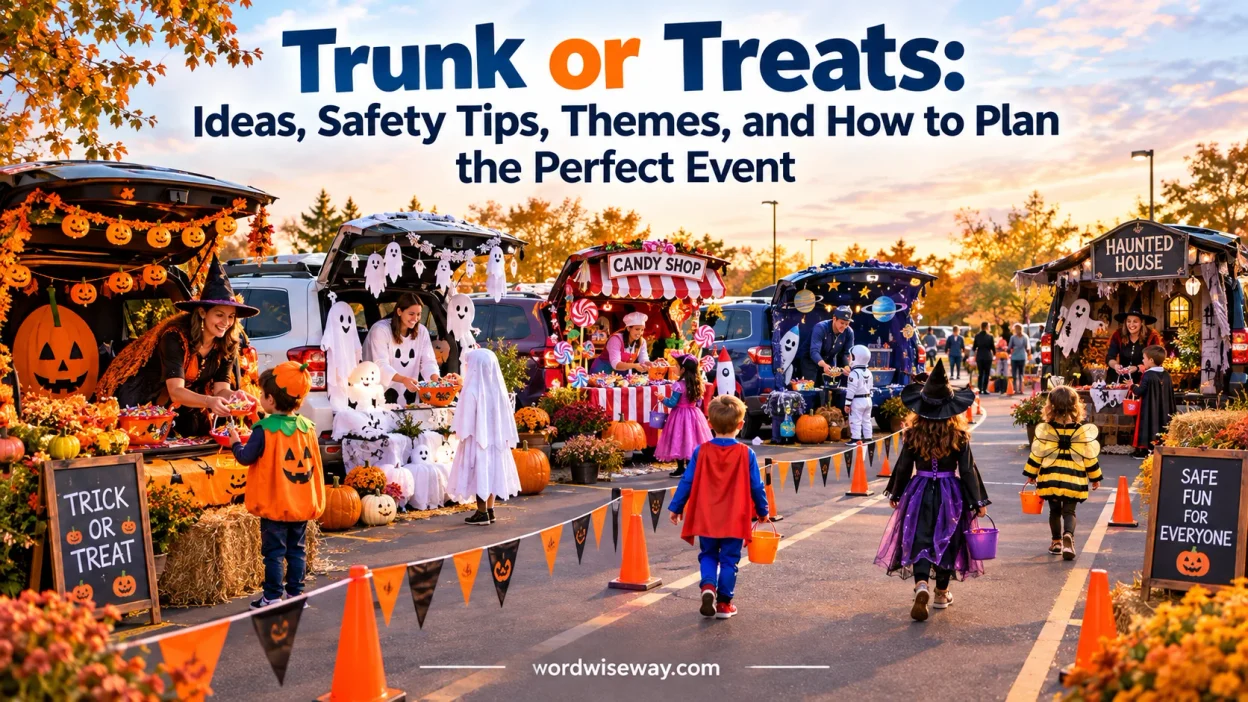
Trunk or Treats are organized Halloween events where children collect candy from decorated vehicle trunks instead of visiting individual homes. Participants park their vehicles in a designated area, decorate the rear of their cars around a chosen theme, and hand out treats to children who walk from vehicle to vehicle.
A typical event takes place in a parking lot, school property, church grounds, community center, or another suitable space. Organizers usually arrange vehicles in rows and create pedestrian areas between them.
The format combines the excitement of traditional trick-or-treating with a centralized community gathering. Children still dress in costumes and collect treats, but the activity happens within a planned area.
Traditional trick-or-treating involves going from home to home to collect candy. Trunk or treat moves that same basic activity into a shared location.
How Does Trunk or Treat Work?
The beauty of a trunk or treat event lies in its straightforward format. Families decorate their vehicles, children arrive in costumes, and everyone follows a planned route through the parking area.
Choose a Suitable Location
Start with a location that can accommodate vehicles and pedestrians without creating unnecessary traffic conflicts.
Common choices include:
- School parking lots
- Church parking areas
- Community centers
- Neighborhood gathering spaces
- Large private parking areas with permission
- Recreation facilities
The venue should have enough room for vehicles, walking paths, activities, entrances, exits, and emergency access.
Set Up the Vehicles
Participating vehicles usually park in rows with enough space between them for children and adults to move comfortably.
Decorators can open their trunks and transform them into small themed displays. Some setups remain simple, while others become elaborate miniature scenes.
A pumpkin-themed trunk might use orange decorations, artificial leaves, pumpkins, and Halloween signs. A space-themed trunk could feature planets, stars, rockets, and a dark-blue backdrop.
The decoration doesn’t need to cost a fortune. Clever design often matters more than expensive materials.
Hand Out Treats
Once the event begins, children walk along the designated route and collect treats from each participating vehicle.
Hosts can place candy in a bowl, basket, or accessible container. If young children or visitors with mobility limitations attend, keeping the treat station easy to reach makes the event more inclusive.
Add Activities
Candy doesn’t have to carry the entire event.
Organizers can add:
- Costume contests
- Trunk decoration contests
- Halloween bingo
- Simple carnival-style games
- Photo areas
- Pumpkin activities
- Music
- Community food stations
- Craft tables
The best activities match the audience and available space rather than simply adding more things.
Trunk or Treat vs. Traditional Trick-or-Treating
Both activities revolve around costumes and treats, but their formats differ considerably.
| Feature | Trunk or Treat | Traditional Trick-or-Treating |
| Main location | Centralized event area | Neighborhood streets |
| Treat source | Decorated vehicle trunks | Homes and businesses |
| Organization | Usually scheduled and planned | Usually informal |
| Walking area | Concentrated | Spread across neighborhoods |
| Decorations | Cars and trunks | Homes, yards, and porches |
| Activities | Games and contests can be included | Usually focused on collecting treats |
| Community interaction | Centralized | Spread across individual homes |
Neither format has to completely replace the other. A family can attend a trunk or treat event and still participate in other Halloween traditions when appropriate.
Why Do People Have Trunk or Treat Events?
A well-organized trunk or treat creates a shared Halloween experience instead of scattering families across different streets.
Community Connection
A centralized event gives neighbors, parents, children, teachers, volunteers, and community members a chance to interact in the same place.
For schools and community organizations, that social element can become one of the event’s biggest strengths.
Convenient Setup
Families can visit multiple decorated vehicles without traveling from one house to another.
That makes the format particularly useful for organized groups that want to create a defined Halloween activity in one location.
Creative Displays
Vehicle trunks provide a surprisingly small but versatile canvas.
A single parking space can become a pirate ship, enchanted forest, pumpkin patch, outer-space station, farm, or colorful candy shop.
Organized Environment
Organizers can establish specific arrival times, parking arrangements, activity areas, and pedestrian routes.
That structure doesn’t automatically make an event safe, though. Vehicle movement, pedestrian flow, lighting, and supervision still require careful planning.
Safety Tips
Safety should shape the event layout from the beginning rather than become an afterthought.
Halloween creates additional pedestrian risks because children often travel after dark while wearing costumes that can affect visibility or movement. Safe Kids Worldwide recommends reflective materials, flashlights or glow sticks, properly fitted costumes, and extra caution around vehicles.
Keep Vehicles Stationary
Once children enter the pedestrian area, vehicles should remain stationary.
Organizers should establish a clear time for vehicle arrival and parking before opening the event to children. If vehicles need to leave early, volunteers should manage the situation carefully and keep pedestrians away from the moving vehicle.
Create Clear Walking Paths
A parking lot can become confusing quickly when dozens of families arrive at once.
Use a simple layout that separates:
- Vehicle parking
- Pedestrian movement
- Entrance
- Exit
- Activity areas
- Food areas
- Emergency access
Don’t allow decorations, tables, cords, boxes, or other objects to spill into walking routes.
Keep Emergency Access Clear
Emergency routes should never become part of the decoration zone.
Before the event begins, organizers should identify access points that must remain unobstructed. Volunteers should also know where those routes are.
Improve Visibility
Good lighting matters after sunset.
Families can use flashlights or glow sticks, while organizers can illuminate walking paths and important entrances. Safe Kids specifically recommends reflective tape, reflective stickers, light-colored clothing, and portable lights to improve visibility.
Choose Safe Decorations
Decorations should look interesting without creating hazards.
Avoid displays that contain:
- Sharp exposed edges
- Unsecured heavy objects
- Loose electrical cords across walking paths
- Unstable structures
- Open flames
- Easily accessible hazardous materials
The CDC has also recommended keeping costumes visible, ensuring masks don’t interfere with sight or hearing, and reducing trip hazards from oversized clothing or shoes.
Check Treats Before Eating
Children should bring collected treats home for an adult to inspect before eating them. This long-standing Halloween safety recommendation also appears in CDC guidance.
For organized events, individually packaged treats can make distribution easier and cleaner.
Best Ideas
A theme gives your trunk a visual identity. It also makes decorating much easier because every prop has a job.
Classic Halloween Themes
Classic themes remain popular because you can build them with inexpensive supplies.
Consider:
- Haunted house
- Graveyard
- Pumpkin patch
- Witch’s cottage
- Spooky forest
- Ghost house
- Monster laboratory
For a younger audience, keep spooky displays playful rather than frightening.
Family-Friendly Themes
If toddlers and younger children will attend, friendly themes work particularly well.
Try:
- Farm
- Candy shop
- Under the sea
- Outer space
- Jungle
- Storybook world
- Fall harvest
These themes give you plenty of decoration options without relying on intense horror elements.
Movie and Character Themes
Popular fictional worlds can turn a plain trunk into an instantly recognizable scene.
Possible directions include:
- Superheroes
- Animated adventures
- Fantasy worlds
- Classic fictional characters
- Space adventures
- Magical kingdoms
When using recognizable characters or franchises, remember that public events and commercial uses can involve intellectual-property considerations. A homemade family display is different from commercially promoting a copyrighted brand.
Easy Decorations
You don’t need professional event equipment to create an impressive display.
Use a Backdrop
A sheet, fabric panel, poster board, or cardboard scene can transform the inside of a trunk.
Choose one dominant background instead of covering every surface with decorations.
Add Simple Props
Cardboard boxes can become buildings, tombstones, rockets, treasure chests, or storefronts.
Paper bats, pumpkins, artificial leaves, signs, and spiderweb decorations can fill smaller gaps.
Use Battery-Powered Lighting
Battery-powered LED lights can add atmosphere without running cords across pedestrian routes.
Lighting also serves a practical purpose when it helps people see where they’re walking.
Create a Theme Sign
A large sign tells visitors what your display represents.
For example:
WELCOME TO THE PUMPKIN PATCH
or
MISSION: CANDY FROM SPACE
A readable sign often has more visual impact than dozens of tiny decorations.
Creative Trunk or Treat Themes With Candy Ideas
| Theme | Decoration Direction | Treat Direction |
| Haunted House | Cobwebs, ghosts, signs | Assorted packaged candy |
| Outer Space | Stars, planets, rocket shapes | Star-themed treats |
| Farm | Pumpkins, fall colors, farm signs | Packaged seasonal treats |
| Under the Sea | Blue backdrop, fish shapes | Blue-wrapped candy |
| Superhero | Comic-inspired signs and props | Individually wrapped treats |
| Candy Shop | Bright signs and oversized candy props | Mixed candy selection |
Games and Activities
A few carefully selected activities can make the event feel more like a community celebration.
Costume Contest
Keep categories simple.
You might recognize:
- Most creative costume
- Funniest costume
- Best family costume
- Best homemade costume
- Best themed costume
For younger children, avoid making the competition overly serious. Participation should remain the main attraction.
Trunk Decoration Contest
This works especially well when many adults participate.
Possible categories include:
- Best overall theme
- Most creative trunk
- Best family-friendly design
- Best DIY display
- Best use of recycled materials
Halloween Bingo
Create cards featuring simple Halloween objects such as pumpkins, ghosts, bats, cats, and candy.
Children can play while waiting for other activities.
Photo Area
A themed backdrop creates an easy photo opportunity.
You can use cardboard props, signs, pumpkins, or a decorated vehicle. Keep the area away from vehicle traffic so people aren’t stopping in the middle of a parking lane.
Trunk or Treat Food and Refreshments
Food can extend the event beyond candy, but organizers should keep distribution simple.
Useful options include:
- Individually packaged snacks
- Bottled water
- Pre-portioned refreshments
- Seasonal snacks
- Clearly labeled allergy-conscious alternatives
If an event serves prepared food, organizers should follow applicable local food-safety requirements.
The CDC’s inclusive Halloween guidance also recommends accessible treat stations placed on safe, level surfaces and free from obstacles.
How to Organize a Trunk or Treat Event
Successful trunk or treat events usually start with logistics rather than decorations.
Set the Date and Time
Choose a time that works for the intended audience.
For younger children, an earlier event may work better than a late-night gathering. Whatever schedule you choose, publish the start and end times clearly.
Select the Venue
Confirm that you have permission to use the property.
Then inspect the area for:
- Parking capacity
- Lighting
- Walking surfaces
- Accessible routes
- Restrooms
- Emergency access
- Entrance and exit points
Recruit Vehicle Hosts
Create a simple sign-up system so you know how many vehicles will participate.
Ask hosts to provide their:
- Name
- Contact information
- Vehicle type
- Theme
- Estimated candy supply
- Special requirements
Establish Event Rules
Keep the rules short enough that people will actually read them.
Important rules can include:
- Park before the event opens.
- Keep vehicles stationary during the event.
- Keep walking paths clear.
- Don’t block emergency access.
- Secure decorations.
- Follow the event’s treat guidelines.
- Clean the assigned area afterward.
Plan the Layout
A basic site plan can prevent many headaches.
Think of the event as several zones:
Entrance → Vehicle Rows → Activities → Food → Exit
Don’t force every visitor through the same narrow point. Give pedestrians room to move and provide clear visual signs.
Recruit Volunteers
Volunteers can handle:
- Check-in
- Parking assistance
- Pedestrian guidance
- Games
- Prize distribution
- First-aid coordination
- Cleanup
- General questions
A few clearly assigned responsibilities work better than telling everyone to “help wherever needed.”
Trunk or Treat Rules for Participants
Every vehicle host should understand the basic expectations before arriving.
A practical participant checklist includes:
- Arrive before children enter the event area.
- Park in the assigned location.
- Keep the vehicle stationary.
- Secure decorations.
- Keep cords and props away from walking paths.
- Bring enough treats for the expected crowd.
- Avoid displays unsuitable for young children.
- Keep emergency routes clear.
- Remove trash and decorations before leaving.
These rules turn a collection of decorated cars into a coordinated event.
What Should You Bring to a Trunk or Treat?
For Vehicle Hosts
Bring:
- Candy or approved treats
- Decorations
- Theme sign
- Battery-powered lights
- Tape or fasteners
- Trash bags
- Extra supplies
- Folding table if permitted
A small emergency decoration kit can save the day when tape comes loose or a sign refuses to cooperate.
For Families
Children and parents may want:
- Costumes
- Treat bags
- Comfortable shoes
- Weather-appropriate clothing
- Flashlights or glow sticks
- Water
- Any necessary personal items
Safe Kids recommends that children wear properly fitted costumes and use lights or reflective materials to improve visibility.
Trunk or Treat Ideas for Different Groups
Church Trunk or Treat
Church events often emphasize family activities and community connection.
A successful setup might combine decorated vehicles with games, food, music, and a clearly marked children’s area.
School Trunk or Treat
Schools can involve families, teachers, staff, and parent organizations.
A grade-level or classroom theme can make participation easier because each group has a defined concept.
Neighborhood Trunk or Treat
Neighborhood groups can keep things informal.
Residents can sign up for parking spaces, choose themes, bring treats, and share responsibility for cleanup.
Community Organization Events
Larger organizations may need more structured registration, volunteer assignments, signage, crowd management, and venue planning.
The larger the event becomes, the more important the site plan becomes.
Trunk or Treat for Different Age Groups
Toddlers and Preschoolers
Young children generally benefit from:
- Shorter walking routes
- Simple decorations
- Bright displays
- Earlier event times
- Easy-to-reach treats
- Fewer frightening elements
Elementary-Age Children
Older children may enjoy:
- Interactive themes
- Games
- Costume contests
- Decoration contests
- Photo areas
Tweens
Tweens may prefer more elaborate themes, challenges, creative contests, and interactive displays rather than a simple candy walk.
How Much Does a Trunk or Treat Cost?
There isn’t one fixed price for a trunk or treat because costs depend on the event’s size and what participants already own.
A small family display might require little more than candy and household decorations. A larger community event can involve additional expenses for:
- Candy
- Prizes
- Signs
- Lighting
- Tables
- Food
- Printing
- Decorations
- Venue-related expenses
The easiest way to control costs is to separate essential expenses from optional upgrades.
Candy, safety supplies, signage, and basic event logistics come first. Elaborate decorations can come later.
How to Make a Trunk or Treat More Sustainable
Halloween decorations don’t have to become single-use clutter.
You can:
- Reuse cardboard.
- Store decorations for next year.
- Repurpose fabric.
- Choose durable decorations.
- Avoid unnecessary disposable props.
- Use rechargeable lighting when practical.
- Provide clearly marked waste containers.
A cardboard box that becomes a haunted-house wall this year can become a rocket next year. Halloween creativity has a surprisingly long shelf life.
Common Mistakes
Even a fun event can stumble when basic logistics get ignored.
Starting Setup Too Late
Decorating vehicles takes longer than expected. Give participants enough setup time before children arrive.
Creating Narrow Walking Routes
Crowded paths make movement frustrating and can increase the chance of trips or collisions.
Allowing Vehicle Movement
Vehicle movement and child pedestrian traffic should not overlap unnecessarily.
Blocking Emergency Access
Decorations and parked vehicles should never prevent emergency access.
Running Out of Candy
Estimate attendance conservatively and keep backup treats available when possible.
Forgetting Weather
Outdoor Halloween events need a contingency plan for rain, wind, temperature changes, or other local conditions.
Overloading the Event
More activities don’t always create a better event.
A well-run event with six useful activities can work better than a chaotic event with fifteen poorly organized ones.
Planning Checklist
Use this checklist when preparing your own event:
- ☐ Choose the location
- ☐ Confirm permission
- ☐ Set the date and time
- ☐ Estimate attendance
- ☐ Recruit vehicle hosts
- ☐ Create the parking layout
- ☐ Establish safety rules
- ☐ Arrange pedestrian routes
- ☐ Plan emergency access
- ☐ Organize candy and treats
- ☐ Choose decorations
- ☐ Arrange lighting
- ☐ Recruit volunteers
- ☐ Plan games and contests
- ☐ Prepare signs
- ☐ Create a weather backup plan
- ☐ Arrange trash collection
- ☐ Inspect the site before opening
- ☐ Clean the area after the event
A Practical Trunk or Treat Case Study
Imagine a school expecting roughly 150 children.
Instead of allowing vehicles to arrive randomly, organizers divide the parking lot into three vehicle rows. Each row has a separate walking lane, while one side remains clear for emergency access.
Twenty-five participating vehicles each choose a simple theme. The school adds a small costume contest, a photo station, and two children’s games.
The event starts with vehicle setup. Once all cars are parked, volunteers close the vehicle area to moving traffic. Children then enter through one marked entrance and follow the walking route through the decorated rows.
This setup works because the organizers solve the movement problem first. Decorations come second.
That principle scales well. Whether the event has ten vehicles or dozens, people need to know where to park, where to walk, where to play, and where to leave.
Read More: Olive or Twist: Meaning, Difference, Usage, and Examples
FAQs
What does trunk or treat mean?
Trunk or treat is a Halloween event where people decorate their car trunks and hand out candy to children in a parking lot. It offers a different setup from traditional trick-or-treating.
Is trunk or treat the same as trick or treat?
They share the same Halloween tradition of collecting candy, but the setting differs. Trunk or treat usually takes place in one organized area, while trick-or-treating typically involves visiting individual homes.
Why do people organize trunk or treat events?
Schools, churches, neighborhoods, and communities may organize these events to create a shared Halloween celebration. Keeping everyone in one space can also make supervision easier.
What are some popular trunk or treat themes?
Common themes include superheroes, movies, fairy tales, animals, spooky scenes, and seasonal designs. You can also create a simple theme using decorations you already have.
What should you put in a trunk or treat?
You can use decorations, themed props, lights, signs, and small games. Keep enough space for children to approach the trunk safely and collect their candy.
How do you plan a trunk or treat event?
Start by choosing a location, date, and basic rules. Then invite participants, plan decorations and games, arrange candy, and decide how you’ll manage parking and supervision.
Where can a trunk or treat event be held?
A school parking lot, church property, community area, or other suitable private space can work. Choose a location with enough room for parked cars and safe movement between them.
How can you make a trunk or treat fun for children?
Add colorful decorations, simple games, themed activities, and friendly interactions. Giving each car its own creative theme can also make the event more interesting.
What is the correct spelling: trunk or treat or trunk-or-treat?
You’ll see several forms, including “trunk or treat,” “trunk-or-treat,” and “trunk or treats.” Trunk or treat is commonly used when referring to the event as a phrase.
Is trunk or treat only an American event?
Trunk or treat is strongly associated with Halloween celebrations in the United States. Similar organized events can also be held elsewhere, although the name and traditions may vary.
Conclusion
Trunk or treat brings a fresh twist to the familiar Halloween tradition. Instead of moving from house to house, children visit decorated cars in one shared space. Schools, churches, neighborhoods, and communities can use this setup to create a lively event where candy, games, themes, and creative trunks become part of the celebration.
Planning doesn’t have to feel complicated. Choose a suitable parking lot, decide on simple rules, prepare decorations, arrange candy, and think about how you’ll supervise children. Even a small gathering can feel special when each car has a thoughtful theme and participants know what to expect.
Whether you call it trunk or treat, trunk-or-treat, or trunk or treats, the basic idea remains easy to understand. With a clear plan and a little creativity, you can turn a group of parked cars into an engaging Halloween experience that gives children plenty to explore.

Emma Smith has dedicated 14 years to Princeton University’s English Department, mentoring students in textual interpretation, literary movements, and critical frameworks. Her research explores Shakespearean drama, Victorian serial fiction, postcolonial narrative theory, and manuscript studies and probing how literary forms evolve across cultures and centuries. Emma has delivered lectures at international humanities congresses and published findings in distinguished academic journals, underscoring her commitment to scholarly depth and vibrant teaching.