Congratulations or Congradulations: Correct Spelling, and Usage can leave writers confused about the right spelling. Congratulations is the correct version in standard English, while congradulations is a common typo. This spelling mistake often appears when typing on phones and writing quick messages, emails, or social media posts.
The pronunciation can cause confusion because the “t” sound may seem soft, making some people hear a “d” sound. Autocorrect can sometimes make the problem worse, while seeing the incorrect form online may make it seem acceptable. Following basic English rules helps you recognize the correct spelling and avoid common mistakes.
In real-life writing, congratulations works in formal and informal situations. Its origin, grammar rules, and proper usage become clearer through usage examples. Global spelling preferences do not change the standard form. Once you understand the difference, you can write with greater confidence.
Quick Answer:
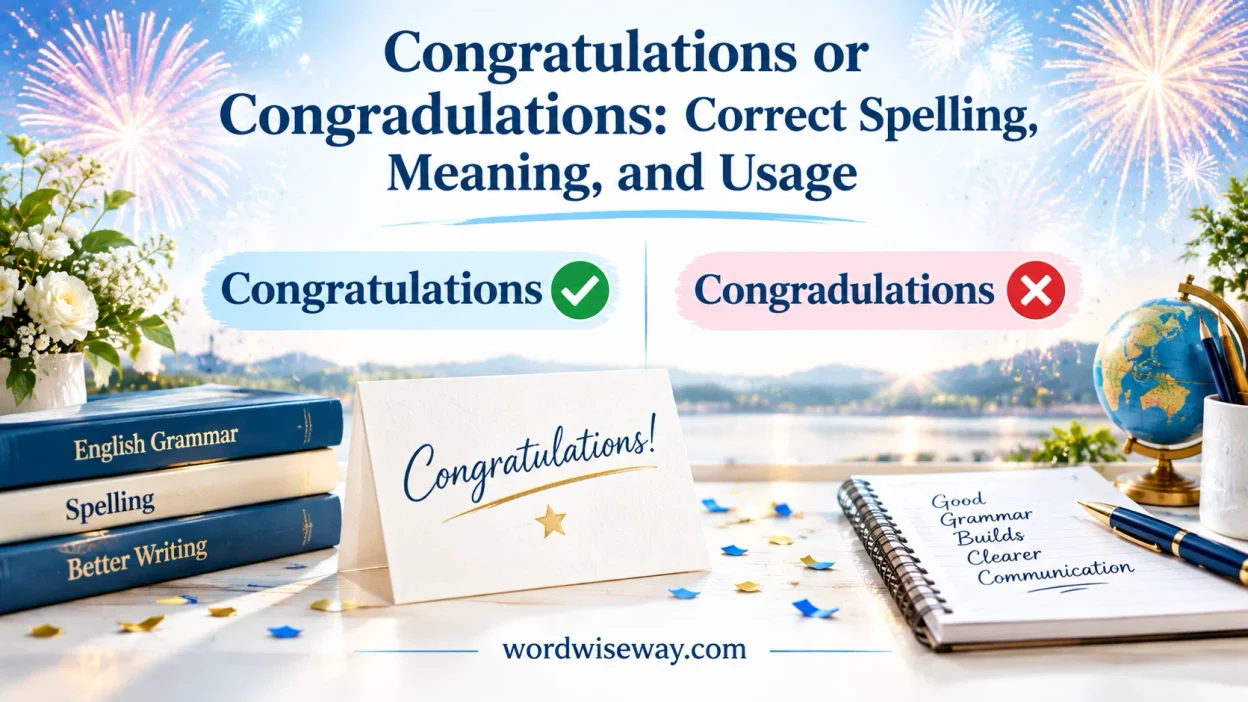
Congratulations is the correct spelling.
Congradulations is a misspelling and should not be used in standard English writing.
The correct word contains -grat-, not -grad-:
| Spelling | Correct? | Explanation |
| Congratulations | ✅ Yes | Standard English spelling |
| Congradulations | ❌ No | Common misspelling |
A useful way to remember it is to focus on the middle of the word: con-grat-u-la-tions. The important spelling is grat, not grad.
For example:
- Congratulations on your graduation! ✅
- Congradulations on your graduation! ❌
The second sentence clearly communicates the intended meaning, but the spelling remains incorrect.
Congratulations: Meaning and Definition
What Does Congratulations Mean?
Congratulations is an expression used to show pleasure, approval, praise, or good wishes when someone achieves something or experiences an important event.
You might say it after a friend passes an exam, after a colleague receives a promotion, or after someone wins a competition.
For example:
- Congratulations on passing your exam.
- Congratulations on your new job.
- Congratulations on winning the competition.
- Congratulations on your graduation.
The word often appears with on when you identify the achievement or event.
The expression doesn’t necessarily require a huge accomplishment. Even a small personal milestone can deserve congratulations if the achievement matters to the person involved.
When Should You Say Congratulations?
You can use congratulations in many situations where someone has achieved something positive or reached a significant milestone.
Common examples include:
- Graduation
- Passing an exam
- Getting a new job
- Receiving a promotion
- Winning a competition
- Getting an award
- Getting engaged
- Getting married
- Completing a difficult project
- Reaching a personal milestone
- Publishing important work
- Achieving a professional goal
The key idea is recognition. You’re acknowledging something positive that happened to another person.
Congradulations: Why Is It Incorrect?
Is Congradulations a Word?
Congradulations is not the standard spelling of the English word. It is a common misspelling of congratulations.
Someone who writes congradulations usually understands exactly what the word means. The problem lies only in the spelling. Adding d changes the written form from the standard version.
This mistake often appears because graduation is closely associated with congratulations. A person might unconsciously blend the spelling patterns of graduation and congratulations.
Consider the difference:
- graduation
- congratulations
Both words relate naturally to academic achievement, which can make the middle letters easier to mix up.
For instance, someone might think about saying “congratulations on your graduation” and accidentally transfer the d from graduation into congratulations.
Why Do People Spell It Congradulations?
Pronunciation plays a major role in many spelling mistakes. English spelling doesn’t always provide a perfect letter-by-letter representation of how words sound in everyday speech.
When people pronounce congratulations quickly, some sounds become less distinct. The word also contains several syllables, which makes it more difficult to spell from sound alone.
Another factor is familiarity. People often see graduation, graduate, and grad together. Since these words contain d, the brain can sometimes associate that sound or spelling with congratulations.
This creates a simple mental trap:
graduation → grad → congradulations
The correct spelling follows a different pattern:
congratulations → grat
That distinction is worth remembering whenever you’re writing the word.
Congratulations Spelling Breakdown
How to Spell Congratulations Correctly
The word can look intimidating because it’s fairly long. Instead of trying to memorize every letter at once, divide it into smaller parts:
con + grat + u + la + tions
The most important section for avoiding the common mistake is grat.
Think:
con-GRAT-u-la-tions
Not:
con-GRAD-u-la-tions
A practical memory trick is to connect congratulations with congratulate:
- congratulate
- congratulated
- congratulating
- congratulations
All of these words keep the grat spelling.
If you remember congratulate, the spelling of congratulations becomes much easier.
Common Misspellings of Congratulations
Because the word contains several syllables, people make different spelling mistakes. Some common incorrect forms include:
- Congradulations
- Congratualtions
- Congradualtions
- Congradulations
- Congradualtions
Among these, congradulations is especially understandable because of its connection with graduation and graduate.
Still, none of these alternatives replaces the standard spelling.
Congratulations vs. Congradulations: Key Difference
The difference is straightforward once you isolate the troublesome letters.
| Word | Correct? | Meaning | Standard Usage |
| Congratulations | ✅ Yes | Praise or good wishes for an achievement or happy event | Use it in all standard writing |
| Congradulations | ❌ No | Intended to mean congratulations | Avoid it |
There isn’t a difference in meaning between the two forms because congradulations isn’t a separate standard word. It is simply a misspelled version of congratulations.
That makes this a spelling issue rather than a vocabulary-choice issue.
How to Use Congratulations in a Sentence
Everyday Examples
In everyday conversation, congratulations can stand alone.
“Congratulations!”
That’s enough when everyone already knows what happened.
You can also add the achievement:
- Congratulations on passing your test!
- Congratulations on your new job!
- Congratulations on winning first place!
- Congratulations on finishing the project!
The expression works because it directly recognizes someone’s success.
Formal Examples
In professional or formal situations, you can make the message more specific.
- Congratulations on your well-deserved promotion.
- Congratulations on completing your degree.
- Congratulations on this important professional achievement.
- Congratulations on receiving the award.
A formal congratulatory message usually sounds better when it identifies the achievement instead of stopping at a generic phrase.
For example, “Congratulations on your promotion” gives the reader more context than simply “Congratulations.”
Casual Examples
Casual writing often uses shorter expressions.
- Congrats!
- Congratulations!
- Congrats on the win!
- Congratulations on your new job!
Congrats is a common informal shortening of congratulations. It works well in texts and casual conversations, while congratulations remains the full standard form.
Congratulations as a Singular or Plural Form
Why Is Congratulations Usually Plural?
One interesting feature of congratulations is that it normally appears in the plural.
You generally say:
“Congratulations!”
rather than:
“Congratulation!”
The plural form has become the established expression for offering praise or good wishes.
The singular noun congratulation does exist, but it isn’t normally used as the everyday expression you give someone after an achievement.
For example:
“Congratulations on your graduation.” sounds natural.
“Congratulation on your graduation.” sounds unnatural in ordinary modern English.
The plural form is therefore the one you’ll want in most real-world situations.
Congratulations On vs. Congratulations For
When to Use “Congratulations On”
Congratulations on is the standard and natural construction when you mention the achievement or event.
Examples include:
- Congratulations on your graduation.
- Congratulations on passing the exam.
- Congratulations on getting the job.
- Congratulations on your promotion.
- Congratulations on winning the championship.
The word on connects the expression to the achievement being recognized.
This makes it a useful pattern to remember:
Congratulations on + achievement/event
Is “Congratulations For” Correct?
Congratulations for can appear in English, but it isn’t usually the first choice when you’re directly congratulating someone on an achievement.
In many everyday situations, congratulations on sounds more natural.
For example:
Congratulations on your promotion.
is a straightforward and familiar construction.
If you’re unsure which preposition to use, on is generally the better choice for this common congratulatory structure.
Congratulations in Different Situations
Congratulations on Graduation
Graduation is one of the most common occasions for saying congratulations.
Examples:
- Congratulations on your graduation!
- Congratulations on completing your degree!
- Congratulations on reaching this important milestone!
Notice that graduation contains a d, while congratulations does not contain d in the corresponding middle section. Keeping the two spellings separate can prevent the classic congradulations mistake.
Congratulations on a New Job
Starting a new job is another natural occasion for congratulations.
You could write:
“Congratulations on your new job! Wishing you success in your new role.”
For a professional message, you can make the wording more specific:
“Congratulations on your new position. Your achievement is certainly worth celebrating.”
The word remains the same regardless of whether the situation is casual or formal.
Congratulations on Getting Married
Marriage and engagement announcements commonly receive congratulatory messages.
Examples include:
- Congratulations on your marriage!
- Congratulations to you both!
- Congratulations on your engagement!
These expressions recognize an important personal event rather than an academic or professional achievement.
Congratulations on Winning
When someone wins a competition, award, match, or contest, congratulations fits naturally.
Examples:
- Congratulations on winning the competition!
- Congratulations on taking first place!
- Congratulations on your award!
- Congratulations on the victory!
The phrase works across many fields, from sports and academics to creative competitions.
Congratulations on an Achievement
Not every achievement needs a special category. You can simply identify what the person accomplished.
For example:
- Congratulations on completing your project.
- Congratulations on reaching your goal.
- Congratulations on publishing your first book.
- Congratulations on finishing the course.
This flexibility makes congratulations one of the most useful expressions for recognizing positive accomplishments.
A Simple Case Study: Why the Spelling Gets Confused
Imagine someone receives a graduation announcement from a friend.
They want to reply:
“Congratulations on your graduation!”
They know the meaning perfectly. However, because the message contains graduation, their brain may connect the two words and produce:
“Congradulations on your graduation!”
This illustrates why the error happens. The person isn’t confusing the meaning. They’re transferring the familiar grad spelling from graduation into another word.
The solution is simple: remember that the two words have different internal patterns.
| Word | Important Spelling |
| Congratulations | grat |
| Graduation | grad |
| Graduate | grad |
This small distinction can prevent a surprisingly persistent spelling error.
Read More: Edgewater or Deserters: Which Should You Choose?
FAQs
Is “Congratulations” spelled with a T or a D?
The correct spelling is congratulations, with a t. Congradulations is a common spelling error caused partly by the way the word sounds when spoken.
Is “Congradulations” an accepted spelling?
No. Congradulations is not the standard spelling in English. It is generally treated as a misspelling of congratulations.
Why do people spell “Congratulations” as “Congradulations”?
The mistake often comes from pronunciation. The t in the middle of the word can sound less distinct in normal speech, so some people mistakenly hear a d sound and reproduce it in writing.
Can I use “Congratulations” in a formal email?
Yes. Congratulations is appropriate in formal emails when you are acknowledging an achievement, promotion, graduation, award, or another positive event.
Is “Congratulations” suitable for social media posts?
Yes. The word is commonly used in social media posts, comments, captions, and messages to celebrate someone’s achievement or good news.
Does autocorrect fix “Congradulations”?
It may, depending on the keyboard or software you use. However, autocorrect is not always consistent, so it is better to recognize the correct spelling yourself.
Is “Congratulations” singular or plural?
Congratulations is normally used in its plural form when expressing praise or good wishes. You would usually write “Congratulations!” rather than using a singular form.
When should you say “Congratulations”?
You can say congratulations when someone achieves something worth celebrating, such as graduating, getting a new job, receiving an award, winning a competition, or reaching an important goal.
Is “Congratulations” the same in British and American English?
Yes. Congratulations has the same standard spelling in both British and American English. Regional differences do not change the spelling of this word.
How can I remember the correct spelling of “Congratulations”?
A useful way to remember it is to focus on the t in congratulations rather than the d sound you may hear while speaking. Checking the spelling before sending an important message can also prevent the mistake.
Conclusion
Knowing the difference between congratulations and congradulations can save you from a small but noticeable spelling mistake. Congratulations is the correct form in standard English, while congradulations is an incorrect spelling that often comes from confusing pronunciation with written form.
Whether you are writing a formal email, sending a quick message, or posting on social media, using the correct spelling makes your writing clearer. The word works naturally in many real-life situations, from celebrating a graduation to recognizing someone’s achievement or success.
Once you remember the t in congratulations, the correct form becomes much easier to recognize. A little attention while typing can prevent this common error and help you write congratulations with confidence whenever you want to celebrate someone’s good news.

Emma Smith has dedicated 14 years to Princeton University’s English Department, mentoring students in textual interpretation, literary movements, and critical frameworks. Her research explores Shakespearean drama, Victorian serial fiction, postcolonial narrative theory, and manuscript studies and probing how literary forms evolve across cultures and centuries. Emma has delivered lectures at international humanities congresses and published findings in distinguished academic journals, underscoring her commitment to scholarly depth and vibrant teaching.