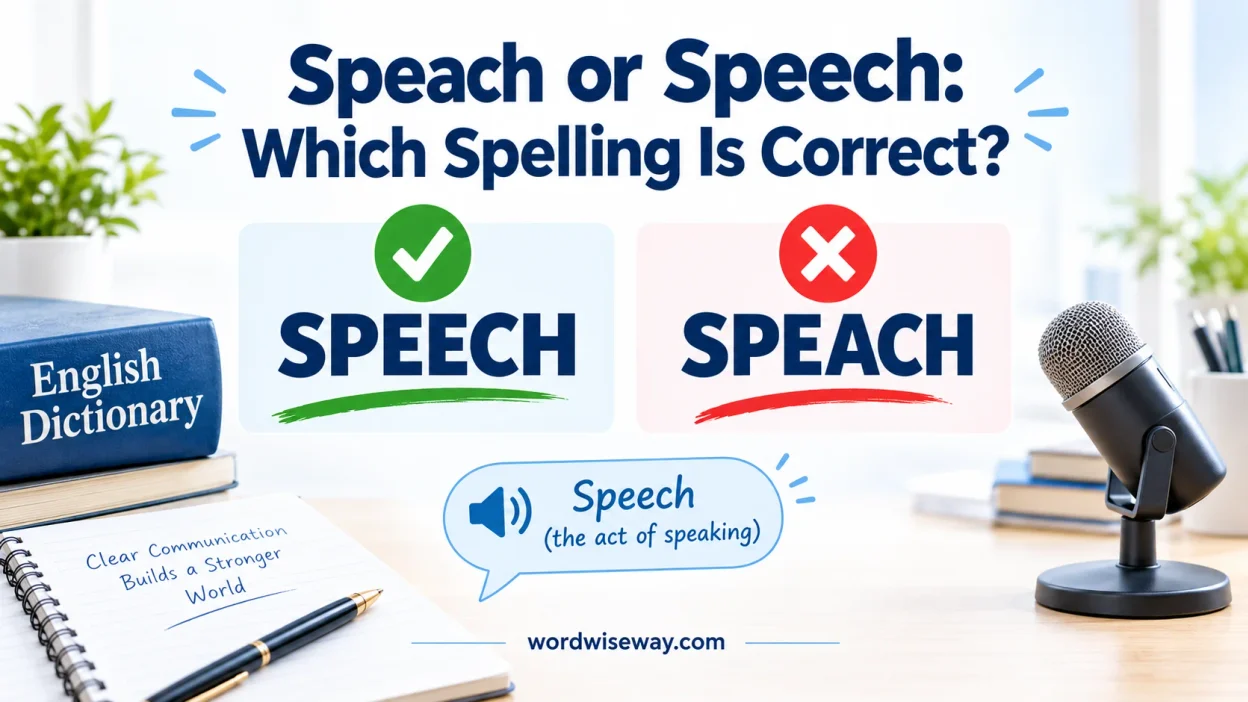
Speach or Speech: Which Spelling Is Correct? This guide explains why speech is the correct spelling in standard English. The word origin, phonetic rules, and familiar sound can cause learners to assume that ea belongs in the word, creating the common error speach.
Many students, writers, and professionals encounter this spelling mistake in emails, essays, school assignments, speeches, and online posts. This confusion often leads people to search online for the correct answer. Learning the right form improves writing accuracy, English accuracy, and confidence.
Using simple examples makes the difference easier to remember. Understanding English spelling patterns and checking your words during daily use can strengthen your writing skills. Even experienced writers make mistakes, so careful written communication helps prevent unpolished writing.
Quick Answer:
Speech is the correct spelling. Speach is incorrect in standard English.
| Spelling | Correct? | Meaning | Example |
| Speech | ✅ Yes | Spoken communication or a formal talk | She gave a short speech. |
| Speach | ❌ No | Common misspelling of speech | She gave a short speach. |
The word speech appears in standard dictionaries with meanings related to talking, a person’s manner of speaking, spoken language, and formal public talks.
So, if you’re wondering “Is it speach or speech?”, remember the simple answer:
Speech is correct. Speach is incorrect.
Speech: Definition and Meaning
The word speech has more than one meaning, although its meanings all connect to spoken communication.
What Does Speech Mean?
First, speech can mean the ability to talk or the activity of talking. For example, someone might discuss a child’s speech development or a person’s loss of speech.
You can also use the word to describe how someone talks. A person’s speech might sound fast, slow, clear, hesitant, formal, informal, or difficult to understand.
For example:
- Her speech was clear and easy to understand.
- The child’s speech developed quickly.
- His speech became slower after the illness.
- Some expressions occur more often in speech than in writing.
Cambridge Dictionary recognizes these uses of speech, including the ability to talk, the activity of talking, a person’s way of talking, and language used in spoken communication.
Speech as a Formal Talk
Speech can also mean a prepared or formal talk delivered to an audience.
You might give a speech at a graduation ceremony, wedding, school event, meeting, award ceremony, or other special occasion.
For example:
- Maya gave a speech at her graduation.
- The principal delivered a short speech.
- He prepared a speech for the ceremony.
- She became nervous before giving her speech.
This meaning is especially common when someone prepares specific ideas and presents them to a group. Cambridge lists a formal talk given to a group of people as another standard meaning of speech.
Why Is “Speach” Incorrect?
The spelling speach looks reasonable because English contains many words with similar letter patterns. However, standard English spells this word speech.
The problem isn’t that speach has a different meaning. It simply isn’t the standard spelling of the noun you’re looking for.
Consider these sentences:
- ❌ She prepared a speach for the ceremony.
- ✅ She prepared a speech for the ceremony.
The second sentence uses the established English spelling.
Why Do People Write “Speach”?
Pronunciation can play a role in the mistake. Speech is pronounced /spiːtʃ/ in American English and British English. The pronunciation contains a long ee vowel followed by the ch sound.
Because English spelling doesn’t always map neatly onto pronunciation, learners sometimes choose letters that seem logical from the sound alone.
Another factor is the relationship between speech and speak. These words are closely connected, yet their spellings aren’t identical.
| Word | Part of speech | Example |
| speak | Verb | I speak English. |
| spoke | Past tense of speak | She spoke clearly. |
| spoken | Past participle | He has spoken to them. |
| speech | Noun | Her speech was inspiring. |
The spelling speech isn’t an arbitrary modern invention. Its history reaches back through Middle English speche to Old English forms associated with speaking and language.
Speech Pronunciation
In American English, speech is pronounced /spiːtʃ/. British English uses the same basic pronunciation.
You can break the sound into four main parts:
- /s/ as in say
- /p/ as in pen
- /iː/ as in sheep
- /tʃ/ as in cheese
The spelling contains seven letters, but the pronunciation works as a single syllable.
That matters because learners sometimes try to spell a word exactly as it sounds. English doesn’t always cooperate with that strategy. In this case, the ee sound appears through the spelling ee, while the final ch represents the /tʃ/ sound.
Speech vs. Speak
One reason speach or speech can become confusing is the connection between speech and speak. They belong to the same word family, but they serve different grammatical roles.
Speech
Speech is a noun.
It can refer to spoken communication, someone’s manner of speaking, or a formal talk.
Examples:
- Her speech was easy to follow.
- We practiced our speech before the ceremony.
- The doctor examined his speech.
- Freedom of speech is a widely used expression.
Speak
Speak is primarily a verb. It describes the act of using your voice to communicate.
Examples:
- I speak English.
- Please speak slowly.
- She can speak three languages.
- We need to speak about the problem.
The difference becomes clearer when you place both words in one sentence:
She speaks clearly because her speech is carefully organized.
Here, speaks describes an action, while speech functions as a noun.
Spoken
Spoken is another form of the verb speak. It often appears with helping verbs or as an adjective.
Examples include:
- We have spoken about this before.
- English is widely spoken around the world.
- The course focuses on spoken English.
These forms connect to the same linguistic family, but you shouldn’t substitute them for one another.
Speech in Different Contexts
The word speech becomes more useful when you understand how its meaning changes slightly with context.
Speech in Everyday Communication
In ordinary conversation, speech often refers to someone’s ability or manner of talking.
For example, you might describe someone as having clear speech. You could also talk about fast speech, informal speech, or children’s speech development.
These uses focus on spoken communication itself, rather than a prepared presentation.
Speech in Public Speaking
When someone prepares remarks for an audience, speech often means a formal talk.
A student might write a speech for a school event. A guest might give a speech at a wedding. An award recipient might deliver an acceptance speech.
The size of the audience doesn’t determine whether something qualifies as a speech. Context and purpose matter more.
Speech in Language and Linguistics
In linguistics, speech can refer to spoken language and the sounds people produce when communicating.
You may encounter terms such as:
- speech sounds
- speech patterns
- speech development
- speech recognition
- speech production
- speech perception
These expressions show how broadly the word can function in language-related discussions.
Speech in Social and Legal Contexts
The word also appears in established expressions involving communication and expression.
One familiar example is freedom of speech. Other expressions include free speech and hate speech.
These phrases have specific meanings depending on their legal, social, or academic context. They shouldn’t be treated as interchangeable simply because they contain the same word.
Common Phrases
Learning common combinations can make the correct spelling easier to remember.
Freedom of Speech
Freedom of speech refers broadly to the ability or right to express ideas and opinions. The exact legal meaning depends on the applicable law and jurisdiction.
Example:
The article discusses freedom of speech.
Speechless
Speechless describes someone who is temporarily unable or unwilling to speak because of strong emotion, surprise, shock, or amazement.
Example:
The unexpected announcement left her speechless.
Speech Impediment
A speech impediment is a difficulty that affects someone’s ability to produce speech clearly or fluently.
Example:
The child received support for a speech difficulty.
Speech Therapy
Speech therapy is professional support designed to address certain communication or speech difficulties.
Example:
The child attends speech therapy sessions.
Part of Speech
A part of speech identifies a grammatical category such as a noun, verb, adjective, or adverb.
For example, speech itself is a noun.
Example:
In this sentence, “speech” functions as a noun.
Direct Speech
Direct speech reports someone’s exact words.
Example:
Maria said, “I need more time.”
The quoted words represent what Maria actually said.
Indirect Speech
Indirect speech reports the meaning of someone’s words without reproducing them as a direct quotation.
Example:
Maria said that she needed more time.
Both forms appear frequently in English grammar.
Figure of Speech
A figure of speech is an expression that uses language in a nonliteral or distinctive way.
For example, metaphors and similes are common figures of speech.
The phrase has nothing to do with giving a public speech. Context does the heavy lifting here.
Speech in a Sentence
Seeing the correct spelling in different situations helps reinforce it.
Examples About Talking
- Her speech was calm and measured.
- The child’s speech improved over time.
- His speech became difficult to understand.
- Clear speech helps listeners follow an explanation.
About Public Speaking
- She gave a speech at the graduation ceremony.
- He wrote a short speech for the wedding.
- The student practiced his speech several times.
- Everyone listened quietly during the speech.
Examples About Language
- Some words sound different in everyday speech.
- The study examines children’s speech patterns.
- Written language can differ from ordinary speech.
- The recording contains examples of natural speech.
Notice how the same spelling works across all these contexts. The meaning changes according to the sentence, but the spelling doesn’t.
Common Mistake
The easiest way to identify the mistake is to compare the two forms side by side.
| Incorrect | Correct |
| ❌ speach | ✅ speech |
| ❌ speaches | ✅ speeches |
| ❌ speachless | ✅ speechless |
| ❌ speach therapy | ✅ speech therapy |
| ❌ public speach | ✅ public speech |
The error can become especially noticeable in longer words derived from speech. Once you know the base spelling, related expressions become easier to write correctly.
Incorrect and Correct Examples
❌ She prepared a speach for her class.
✅ She prepared a speech for her class.
❌ His speach was difficult to understand.
✅ His speech was difficult to understand.
❌ The teacher discussed speach development.
✅ The teacher discussed speech development.
❌ She gave two speaches during the event.
✅ She gave two speeches during the event.
The key point remains simple: speach doesn’t become correct because the surrounding sentence is correct. The spelling itself needs to change.
How to Remember the Correct Spelling
A useful memory trick is to connect speech with speak.
Think:
speak → speech
Both words begin with spe- and belong to the same word family.
You can also remember the middle of the word as ee:
sp + ee + ch = speech
That small visual pattern can prevent the common mistake of inserting ea.
Another practical strategy involves proofreading. If you type speach, pause when your spell checker marks it. Don’t simply accept the suggestion without looking at the word. Train yourself to recognize the correct form visually.
A Simple Memory Rule
Speech has “ee” in the middle.
This isn’t a general spelling rule for every English word. It’s simply a useful memory cue for this particular word.
Speech or Speach: What Should You Use?
Use speech whenever you’re referring to spoken communication, someone’s way of talking, or a formal talk.
Use these forms:
- speech
- speeches
- speechless
- speechwriter
- speechwriting
- speech therapy
- speech pattern
- speech development
Avoid speach in standard English writing.
If a spelling checker underlines speach, replace it with speech. In formal writing, schoolwork, professional communication, and published content, the standard spelling matters.
Read More: Buisness or Business: Which Spelling Is Correct?
FAQs
Is “speach” a correct spelling?
No. Speach is a common spelling mistake. The correct spelling is speech, which refers to spoken words or a formal talk.
Why do people spell speech as “speach”?
The mistake usually happens because of pronunciation. The vowel sound can make speach seem logical, even though standard English uses speech.
What is the correct spelling, speech or speach?
Speech is the correct spelling. You should use it in schoolwork, professional writing, emails, and everyday English.
What does the word speech mean?
Speech can mean the ability to communicate through spoken language. It can also describe a formal talk given to an audience.
Is “speach” a common spelling mistake?
Yes. People often write speach because English spelling doesn’t always match pronunciation. This makes the error easy to repeat.
How can I remember the spelling of speech?
Try remembering the word as speech, with ee after the sp. Writing the word several times in real sentences can also reinforce the correct spelling.
Is speech used as a noun or a verb?
Speech is mainly used as a noun. It can refer to spoken communication, a person’s way of speaking, or a formal address.
Can I use “speech” in formal writing?
Yes. Speech is completely appropriate in formal writing, including essays, reports, school assignments, professional documents, and presentations.
Does speech have anything to do with speaking?
Yes. Speech is closely connected with speaking because it refers to spoken communication and the way people express thoughts through language.
How do I avoid writing “speach” by mistake?
Build the correct spelling into your everyday writing. When proofreading, pay special attention to speech and other words whose pronunciation might make their spelling confusing.
Conclusion
The confusion between speach or speech usually comes from the way the word sounds. While speach may look reasonable at first glance, it is not the standard spelling. Speech is the correct form, whether you’re talking about spoken communication, a formal address, or someone’s ability to communicate through language.
Remembering this spelling becomes easier when you connect it with real writing. Use speech in your emails, essays, assignments, articles, and everyday sentences. If you often pause when writing the word, take a moment to check it rather than trusting the sound alone. English has plenty of spelling patterns that don’t behave exactly as they sound.
A small spelling habit can make your writing clearer and more polished. Once speech becomes familiar, you’ll be less likely to type speach by accident. Keep practicing the correct form, notice it when you read, and let repetition turn this once-confusing word into an easy one.

Evelyn Shaw has spent 14 years at Yale University’s English Department, leading students through close readings, genre studies, and interpretive methodologies. Her scholarly interests include Renaissance drama, gothic fiction, feminist literary criticism, and archival research and examining how texts generate meaning across historical periods. Evelyn has presented at major academic conferences and published essays in peer-reviewed journals, reflecting her passion for rigorous analysis and student-centered learning.