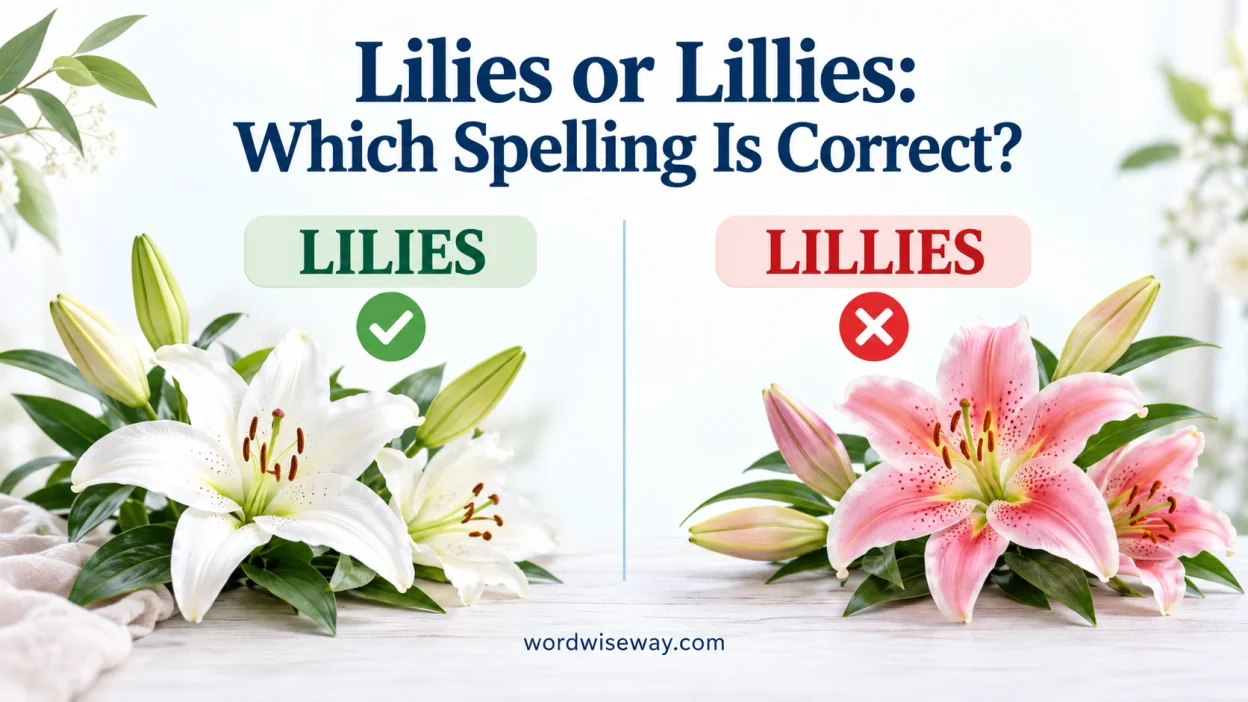
Lilies vs Lillies creates a common spelling confusion, but lilies is the correct plural of lily. If you wonder, Lilies or Lillies: Which Spelling Is Correct?, remember the simple spelling rule: change y to ie and add s. Therefore, lily becomes lilies, not lillies. This easy trick helps writers avoid a common misspelling.
The rule is useful in everyday writing, academic work, and professional communication. You may need lilies in a message, formal email, academic essay, social media caption, card, menu, or shop sign. A flower shop might display “Fresh Lilies,” while “Fresh Lillies” contains an error. Learning the pattern improves spelling confidence and writing accuracy.
The English spelling pattern changes the ending because lily is a singular noun. Your brain may expect regular plural nouns to simply add s, creating an easy trap. Once you understand this rule, you can remember the correct form, avoid common spelling mistakes, and write about flowers, gardens, and nature with greater confidence.
Quick Answer:
Lilies is the correct spelling.
Lillies is a common misspelling. If you’re writing about more than one lily, use lilies.
| Word | Correct? | Use |
| lily | ✅ | Singular |
| lilies | ✅ | Plural |
| lillies | ❌ | Common misspelling |
| lilys | ❌ | Incorrect plural |
| lilyes | ❌ | Incorrect plural |
For example:
The garden was filled with beautiful lilies.
You can remember the main transformation as:
lily → remove y → add ies → lilies
The spelling doesn’t become lillies because the plural rule doesn’t call for a second l.
Why Is “Lilies” the Correct Spelling?
The spelling lilies follows a standard English plural pattern. When a singular noun ends in a consonant + y, English commonly changes the final y to ies.
The word lily ends in ly. The letter immediately before y is l, which is a consonant. Therefore, the usual plural transformation applies:
lily → lilies
You can see the same pattern in several familiar words:
- baby → babies
- city → cities
- family → families
- party → parties
- story → stories
- lady → ladies
- country → countries
- library → libraries
The important point is that the spelling changes at the end of the word. The original l doesn’t get doubled.
So this:
lily + plural ending
becomes:
lil + ies = lilies
It does not become:
lill + ies = lillies
That extra l has no grammatical job to perform.
Cambridge’s dictionary entry confirms the standard plural directly: lily, plural lilies.
Singular and Plural Forms
The difference between lily and lilies is simply the difference between one and more than one.
Use lily when you’re talking about one flower or plant.
She planted a lily near the window.
Use lilies when you’re talking about two or more.
She planted several lilies near the window.
Here’s the distinction at a glance:
| Number | Correct form | Example |
| One | lily | A white lily bloomed today. |
| More than one | lilies | White lilies bloomed today. |
This distinction matters because the noun changes its spelling as well as its grammatical number.
You wouldn’t write two lily in standard English. You’d write two lilies.
Likewise, one lilies is incorrect because the plural form doesn’t match a singular quantity.
What Does “Lily” Mean?
A lily is a flowering plant or flower. The word can refer to various plants commonly described as lilies, including familiar names such as tiger lily, Easter lily, and water lily. Cambridge lists numerous lily-related terms, including calla lily, day lily, Easter lily, tiger lily, and water lily.
When you refer to multiple examples, the plural is lilies.
The florist arranged roses and lilies together.
The same spelling applies whether you’re discussing flowers in a garden, plants in a botanical context, or lilies in a bouquet.
Why “Lillies” Is Incorrect
The spelling lillies looks believable because the word already contains a repeated l sound. However, pronunciation doesn’t determine the spelling here.
The singular word is spelled:
lily
When you pluralize it, you don’t double the first consonant. Instead, you change the final y to ies.
That produces:
lily → lilies
The incorrect form lillies introduces an extra l that isn’t present in the singular spelling.
This mistake often happens because English contains many words that do double consonants in certain forms. For example, some words double a consonant when adding a suffix. That pattern can make lillies look plausible at first glance.
However, pluralizing lily doesn’t work that way.
Why Do People Write “Lillies”?
The error is understandable because lillies visually seems to preserve the beginning of lily while adding the familiar -ies ending.
There is another subtle trap, too. The pronunciation of lily contains repeated l sounds across its syllables. That can make writers unconsciously expect an additional l in the spelling.
English spelling often refuses to cooperate with what your ears expect.
The safest approach is to remember the written pattern rather than trying to spell the word from pronunciation:
lily → lilies
Once you memorize that transformation, lillies becomes much easier to spot as an error.
The Spelling Rule Behind “Lily → Lilies”
The y → ies pattern is one of the most useful pluralization rules to know.
When a singular noun ends in a consonant + y, the usual plural form changes y to ies.
For example:
| Singular | Plural |
| baby | babies |
| city | cities |
| country | countries |
| family | families |
| party | parties |
| story | stories |
| lady | ladies |
| lily | lilies |
The same basic pattern explains every example in the table.
What Happens With Vowel + Y?
Here’s where English throws in a useful twist.
If a word ends in a vowel + y, you generally keep the y and add s.
Consider these examples:
| Singular | Plural |
| boy | boys |
| toy | toys |
| day | days |
| key | keys |
| journey | journeys |
| monkey | monkeys |
The difference becomes clearer when you compare the letters immediately before y.
Consonant + y:
- lily → lilies
- city → cities
- baby → babies
Vowel + y:
- boy → boys
- toy → toys
- key → keys
This distinction is the key to understanding why lilies looks different from boys or toys.
Why “Lily” Takes “-ies”
Look at the final two letters:
lily
The l comes directly before y. Because l is a consonant, the standard plural pattern changes the ending:
-y → -ies
Therefore:
lily → lilies
There’s no need to double the l.
How to Use “Lilies” in a Sentence
Correct spelling becomes much easier to remember when you see the word working naturally in sentences.
Here are several examples:
- The garden was filled with fragrant lilies.
- She bought white lilies for the vase.
- Several lilies opened after the warm weather arrived.
- The florist arranged roses and lilies in separate bouquets.
- Bright orange lilies stood out against the green leaves.
- The gardener planted several lilies along the walkway.
- These lilies bloom during the warmer months.
- The painting showed a vase surrounded by lilies.
Notice that lilies works the same way as other regular plural nouns in a sentence. It can function as the subject or object of a sentence.
Lilies grow throughout the garden.
Here, lilies is the subject.
She watered the lilies every morning.
Here, lilies is the object.
A Simple Before-and-After Example
Imagine you have one flower:
The lily is blooming.
Now imagine you have five:
The lilies are blooming.
The sentence changes from singular to plural. The noun changes from lily to lilies.
That’s the entire spelling transformation in action.
Common Mistakes
Several incorrect spellings appear because writers try to apply the wrong plural pattern.
The most common mistake is lillies, but it isn’t the only one.
| Incorrect spelling | Why it’s wrong | Correct spelling |
| lillies | Adds an unnecessary l | lilies |
| lilys | Keeps the y instead of changing it | lilies |
| lilyes | Adds an incorrect plural ending | lilies |
| lillys | Doubles l and keeps y | lilies |
| lillyes | Uses both incorrect changes | lilies |
“Lillies”
This is the most common-looking error. It adds an extra l before the plural ending.
❌ The garden contains beautiful lillies.
✅ The garden contains beautiful lilies.
“Lilys”
This version treats lily like a noun that simply takes -s.
That doesn’t follow the standard consonant + y rule.
❌ She planted three lilys.
✅ She planted three lilies.
“Lilyes”
This spelling keeps the y and adds -es. English doesn’t form the plural of lily this way.
❌ The vase contains pink lilyes.
✅ The vase contains pink lilies.
These errors may look minor, but they can make otherwise polished writing appear careless.
Is “Lilies” Always the Plural of “Lily”?
Yes. In standard English, lilies is the plural form of lily.
Dictionaries consistently identify lilies as the plural. Cambridge’s English dictionary gives the word’s plural directly and provides examples using lilies in natural sentences.
The noun can refer to a variety of flowering plants that people commonly call lilies. Specific names can make the meaning more precise.
For example:
- a lily
- two lilies
- a tiger lily
- several tiger lilies
- a water lily
- several water lilies
- an Easter lily
- several Easter lilies
The plural transformation still follows the same basic pattern.
What About Compound Names?
Compound expressions containing lily generally preserve the plural spelling when you need more than one.
For example:
water lily → water lilies
tiger lily → tiger lilies
Easter lily → Easter lilies
The word lily changes to lilies because it remains the noun being pluralized.
The pond was covered with water lilies.
Several tiger lilies grew along the trail.
This gives you another practical memory clue: if you’re pluralizing lily, the ending changes to -ies regardless of the descriptive word in front.
Lilies or Lillies in Different Types of Writing
The correct spelling doesn’t change depending on where you write it.
Whether you’re preparing a school assignment, writing a blog post, sending a message, or describing a garden, use lilies.
In Formal Writing
Use lilies in essays, reports, articles, and other formal material.
The study examined the growth patterns of several lily species.
When you’re discussing multiple flowers, lilies is the appropriate plural.
In Everyday Writing
The same spelling applies to casual communication.
I bought some lilies for the table.
There’s no informal plural spelling that makes lillies correct.
In School Assignments
If you’re writing about plants, gardens, literature, or symbolism, use lilies whenever you mean more than one lily.
The poem describes white lilies growing beside the river.
Correct spelling helps keep your work polished and easy to read.
In Online Content
Blog posts, social media captions, product descriptions, and websites should also use lilies.
Search engines don’t turn an incorrect spelling into a correct one. More importantly, readers expect standard English in polished content.
If your heading asks “Lilies or Lillies?”, the answer should consistently use lilies throughout the article.
An Easy Trick to Remember
The simplest memory trick is to focus on the ending.
Don’t think:
lily + s
Instead, think:
lily → change y to ies
That gives you:
lilies
You can also remember the phrase:
One lily, many lilies.
The first form ends in y. The second ends in ies.
Another useful trick is to group lily with familiar words such as baby, city, and story.
- baby → babies
- city → cities
- story → stories
- lily → lilies
Once you recognize the pattern, the spelling becomes predictable.
A Quick Memory Formula
Consonant + y → change y to ies
So:
l + y → l + ies
Therefore:
lily → lilies
Don’t insert another l.
Quick Comparison
When you’re choosing between the two spellings, the answer is straightforward.
| Feature | Lilies | Lillies |
| Standard English spelling | ✅ Yes | ❌No |
| Plural of lily | ✅ Yes | ❌No |
| Follows the consonant + y rule | ✅ Yes | ❌No |
| Suitable for formal writing | ✅ Yes | ❌ No |
| Contains an unnecessary extra l | ❌No | ✅Yes |
| Example | Three lilies bloomed. | Three lillies bloomed. |
The correct form is lilies in every standard writing context.
A Practical Spelling Check for “Lilies”
If you’re proofreading a sentence and aren’t sure about the spelling, use this three-step check:
Step 1: Find the singular form.
The singular is lily.
Step 2: Check the letter before y.
The letter before y is l, a consonant.
Step 3: Change y to ies.
lily → lilies
That’s all you need.
This method is more reliable than trying to remember whether the word needs another consonant. It connects the spelling directly to a standard English rule.
Read More: Acknowledgement or Acknowledgment: Which Spelling Is Correct?
FAQs
Is Lilies the Correct Spelling?
Yes, lilies is the correct spelling. It is the plural form of lily.
Is Lillies Ever Correct?
No. Lillies is a common misspelling in standard English. The correct form is lilies.
Why Does Lily Become Lilies?
When lily changes from singular to plural, the y changes to ie before adding s. This creates lilies.
What Is the Singular Form of Lilies?
The singular form is lily. For example, you can say, “I planted one lily,” but “I planted several lilies.”
Why Do People Spell Lilies as Lillies?
The mistake often happens because lily already contains two l letters. Writers may accidentally keep the double l when forming the plural.
How Can I Remember the Spelling Lilies?
Think of the pattern y → ies. Remembering lily → lilies makes the correct spelling easier to recall.
Is Lilies Used for More Than One Flower?
Yes. Lilies refers to two or more flowers called lily. The word can describe different types of lilies found in gardens and nature.
Can I Use Lilies in Formal Writing?
Yes. Lilies is appropriate for formal and informal writing, including academic work, professional communication, articles, and emails.
Is Lilies Common in Gardening Writing?
Yes. Gardeners and writers frequently use lilies when discussing flowers, planting, gardens, care, and different lily varieties.
What Is an Easy Example of Lilies?
A simple example is: “The garden is filled with beautiful lilies.” Here, lilies correctly refers to multiple lily flowers.
Conclusion
The correct spelling is lilies, not lillies. The word lilies is the plural form of lily, and it follows the familiar y → ies spelling pattern. Although lillies may look natural at first glance, it is a common spelling error in standard English.
Remembering lily → lilies can make this small spelling rule much easier. Whether you are writing about flowers, gardens, or nature, using lilies keeps your writing accurate. This simple pattern can also help you avoid similar mistakes with other words that change y to ies.
Once you understand the difference between lilies and lillies, there is little reason to second-guess the plural form. Keep lilies in mind whenever you write about more than one lily, and your spelling will stay clear and correct.