If you’ve ever paused over whilst or while, you’re not alone. These two words often appear in Whilst or While: What’s the Difference? becomes easier when you understand their meaning, usage, and function. Both while and whilst are conjunctions that can show contrast, concession, or overlap in time. However, while is more common, while whilst often sounds more formal.
In British English, while remains more commonly used. The British National Corpus (BNC) shows an 8 to 1 ratio, with while clearly outnumbering whilst. In American English, whilst is far less common. Your region, audience, and context can therefore influence your choice.
While also works as a noun and verb, unlike whilst. It can describe a period of time, while whiled away means to spend time pleasantly. Understanding this difference helps writers, students, and bloggers improve clarity, avoid mistakes, and use correct English with greater confidence.
Quick Answer:
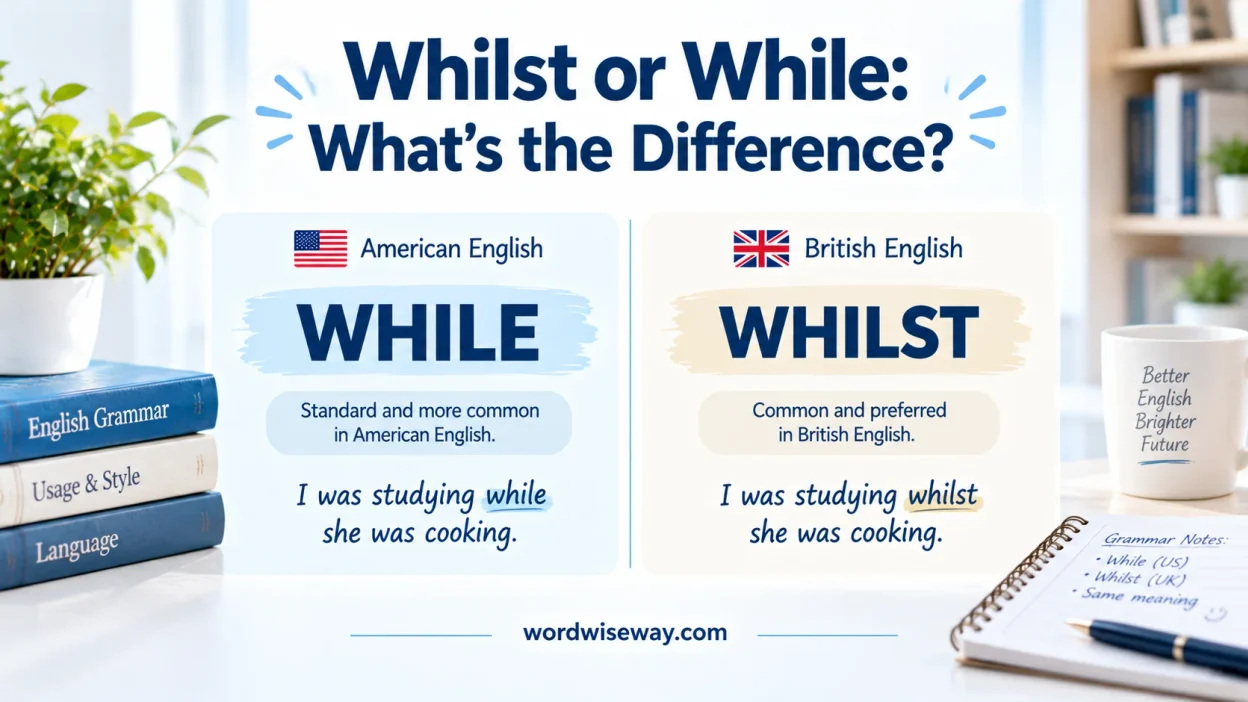
While and whilst can both mean “during the time that” or introduce a contrast between two ideas. The biggest difference is regional preference and tone.
For American English, while is the standard choice. It sounds natural in conversation, professional writing, academic work, journalism, and everyday communication.
Whilst is especially associated with British English. It remains grammatically valid, but it can sound more formal, literary, or distinctly British to American readers.
| Feature | While | Whilst |
| Meaning | Time or contrast | Time or contrast |
| Conjunction | Yes | Yes |
| Noun use | Yes | Generally no |
| American English | Very common | Uncommon |
| British English | Very common | Common |
| Everyday conversation | Natural | Less common |
| Formal writing | Natural | Often more formal |
| Literary tone | Possible | More noticeable |
| Means “during the time that” | Yes | Yes |
| Can express contrast | Yes | Yes |
| Best default for US English | Yes | No |
So, if you’re writing for an American audience and aren’t following a British style guide, choose while.
What Does “While” Mean?
While has several grammatical functions, which explains why you see it everywhere. Its most common roles involve time and contrast.
While as a Conjunction for Time
When while expresses time, it means something like “during the time that.” It connects two actions or situations that overlap.
For example:
While I was studying, my sister watched television.
The two activities happened during the same period.
You can use this structure with different tenses:
- While I was cooking, the phone rang.
- While she works, he handles the customers.
- While you’re visiting New York, try the local food.
- While they were traveling, they took hundreds of photographs.
Notice that while doesn’t necessarily mean both actions lasted for exactly the same amount of time. It establishes a time relationship between them.
While as a Conjunction for Contrast
While can also introduce a contrasting statement.
Consider:
While Sarah enjoys city life, her brother prefers the countryside.
Here, while doesn’t describe two simultaneous activities. Instead, it highlights a difference between Sarah’s preference and her brother’s preference.
In this sense, while can sometimes be close in meaning to whereas or although, depending on the sentence.
For example:
While the first plan is cheaper, the second offers more flexibility.
The sentence compares two characteristics.
However, context matters. A sentence beginning with while can sometimes create temporary ambiguity because readers initially expect a time-related meaning.
While as a Noun
One important feature separates while from whilst.
While can function as a noun in expressions such as:
- for a while
- after a while
- in a while
- a little while
- quite a while
For example:
I’ll stay here for a while.
Here, while isn’t connecting two clauses. It refers to a period of time.
That makes while considerably more versatile than whilst.
Common Expressions With While
The word while appears in several familiar expressions.
For a while means for a period of time.
We talked for a while before leaving.
In a while refers to a period from now.
I’ll call you in a while.
Once in a while means occasionally.
I still eat dessert once in a while.
All the while means throughout the period being discussed.
She smiled all the while she was telling the story.
Worth your while means worthwhile or beneficial enough to justify your time or effort.
It may be worth your while to compare the prices first.
These expressions show why you can’t simply replace every occurrence of while with whilst.
What Does “Whilst” Mean?
Whilst is an established English conjunction with meanings that overlap heavily with while.
It can introduce both time and contrast.
Whilst for Time
When whilst expresses time, it means approximately “during the time that.”
For example:
Whilst I was preparing dinner, the children finished their homework.
This has essentially the same meaning as:
While I was preparing dinner, the children finished their homework.
The difference isn’t the basic relationship between the two actions. Instead, whilst gives the sentence a different regional and stylistic flavor.
Whilst for Contrast
Whilst can also introduce contrast.
Whilst the first option costs less, the second provides additional features.
Here, whilst works much like while or whereas.
Another example:
Whilst some students prefer online classes, others learn better in person.
The sentence contrasts two groups and their preferences.
This use appears more naturally in British English than in everyday American English.
Is “Whilst” Formal?
Often, yes. However, formal isn’t the whole story.
A British writer may use whilst naturally because it belongs to their normal variety of English. An American writer might use the same word deliberately to create a formal, literary, or British-sounding tone.
That’s an important distinction.
Calling whilst simply “formal English” can be misleading. Its frequency is strongly connected to regional English usage.
A word can sound formal in one variety while sounding perfectly ordinary in another.
Key Differences
The easiest way to understand whilst vs. while is to separate grammar from style.
Grammatically, the two words overlap considerably. Stylistically, they aren’t equally common everywhere.
American English vs. British English
While is the normal choice in American English.
You’d naturally write:
While I was working, I listened to music.
An American reader would understand whilst, but the word may stand out:
Whilst I was working, I listened to music.
The second sentence isn’t inherently grammatically wrong. It simply has a stronger British or formal flavor.
British English uses both forms. While remains common, while whilst continues to appear in formal writing, edited prose, and other contexts.
Therefore, the safest rule for US English is straightforward:
Use while unless you have a specific reason to use whilst.
Formality and Tone
The difference becomes especially noticeable when you consider tone.
| Context | While | Whilst |
| Casual conversation | Very natural | Less natural |
| American business writing | Natural | Unusual |
| American academic writing | Natural | Possible but marked |
| British conversation | Natural | Possible |
| British formal writing | Natural | Common enough |
| Literary writing | Natural | Can create a formal tone |
| General international writing | Broadly understood | More regionally marked |
If your goal is clarity for a broad American audience, while usually creates less friction.
When Should You Use “While”?
Choose while when you want a neutral, widely understood option.
It works particularly well when:
- You’re writing in American English.
- You’re speaking casually.
- You’re writing for a general audience.
- You’re creating website content for US readers.
- You’re writing an email or business document.
- You’re writing academic material in American English.
- You want a simple alternative to a more formal-sounding conjunction.
- You need the noun while in expressions such as for a while.
For example:
While the software is easy to use, its advanced features require practice.
There’s no need to dress up the sentence. While communicates the relationship cleanly.
When Should You Use “Whilst”?
Use whilst when it fits the English variety or stylistic context you’re intentionally following.
It can make sense when:
- You’re writing in British English.
- A British style guide or editorial convention calls for it.
- You want to maintain consistency with surrounding British vocabulary.
- You’re deliberately using a more formal or literary register.
- The intended audience regularly uses whilst.
For example:
Whilst the proposal has potential, several details require further consideration.
For a British audience, this can sound perfectly natural. For a general American audience, while would usually feel more straightforward.
Common Grammar Patterns
Both words can introduce dependent clauses.
While + Subject + Verb
A common pattern is:
while + subject + verb
For example:
While I was studying, my friend called me.
The clause beginning with while cannot normally stand alone as a complete sentence.
Incorrect:
While I was studying.
Correct:
While I was studying, my friend called me.
The same basic structure works with whilst:
Whilst I was studying, my friend called me.
Main Clause + While-Clause
You can also place the while clause after the main clause.
My friend called me while I was studying.
This construction often feels especially smooth because the main idea comes first.
The same pattern works with whilst:
My friend called me whilst I was studying.
While at the Beginning of a Sentence
When a dependent while clause comes first, a comma commonly separates it from the main clause.
While the rain continued, we stayed indoors.
The same punctuation pattern applies to whilst:
Whilst the rain continued, we stayed indoors.
The comma belongs to the sentence structure. It isn’t there because one word is more formal than the other.
While + -ing Form
English often shortens clauses when the subject is clear from context.
For example:
While studying, Maya listened to classical music.
This is a shortened form of a construction such as:
While Maya was studying, she listened to classical music.
You can also see:
- While driving, keep your attention on the road.
- While working, he prefers complete silence.
- While traveling, they kept a detailed journal.
The shortened construction should remain logically clear. Avoid attaching a while + -ing phrase to the wrong subject.
Punctuation
Punctuation depends primarily on the sentence structure.
When an introductory dependent clause comes first, a comma commonly follows it:
While the store was closed, customers waited outside.
When the dependent clause follows the main clause, a comma often isn’t needed:
Customers waited outside while the store was closed.
The same principle applies to whilst:
Whilst the store was closed, customers waited outside.
Customers waited outside whilst the store was closed.
Don’t add commas simply because while or whilst appears in the sentence.
Common Mistakes
Treating “Whilst” as More Correct
A common misconception says whilst represents “proper” or more sophisticated English.
That’s not how English works.
Whilst is a legitimate conjunction. However, its usage varies by region and style. While is not an inferior version.
For American English, while is the ordinary standard choice.
Using “Whilst” in American Writing Without a Purpose
Using whilst in US English isn’t automatically a grammar error.
Still, it can sound noticeably British or unusually formal.
If you’re writing a US-focused article, choosing while usually creates a more natural voice.
Confusing “While” With “Whereas”
These words overlap when they introduce contrast, but they aren’t identical in every context.
Compare:
While Anna prefers tea, James prefers coffee.
Whereas Anna prefers tea, James prefers coffee.
Both sentences contrast preferences. However, whereas has a more clearly contrastive function.
By contrast:
While Anna was making tea, James washed the dishes.
Here, while clearly expresses time.
Confusing “While” With “Awhile”
This is one of the most common problems involving while.
Compare:
Stay while I finish this.
Here, while introduces a clause.
Now consider:
Stay awhile.
Here, awhile is an adverb meaning for a short time.
You can also say:
Stay for a while.
The forms look similar, but their grammatical roles differ.
Misplacing the While-Clause
A poorly positioned while clause can make the intended meaning unclear.
For example:
While reading the report, the lights suddenly went out.
This sentence can create a logical problem because the lights appear grammatically connected to the act of reading.
A clearer version is:
While I was reading the report, the lights suddenly went out.
Adding the subject removes the ambiguity.
While vs. Awhile
The distinction between while and awhile deserves special attention.
Awhile functions as an adverb.
Let’s rest awhile.
A while contains the noun while, usually referring to a period of time.
Let’s rest for a while.
A useful test is to look at what comes before the expression.
With for, use the noun phrase:
for a while
Not:
for awhile
In standard edited American English, for a while is the conventional form.
| Expression | Function | Example |
| while | Conjunction or noun | Wait while I finish. |
| a while | Noun phrase | I haven’t seen her for a while. |
| awhile | Adverb | Sit awhile. |
| for a while | Prepositional phrase | We talked for a while. |
While vs. Whereas
While can express contrast, but it has an additional time-related meaning.
Whereas focuses specifically on contrast.
Compare:
While the blue car is cheaper, the red car has better fuel economy.
Whereas the blue car is cheaper, the red car has better fuel economy.
Both establish a comparison.
Now change the sentence:
While the mechanic inspected the car, I waited outside.
Replacing while with whereas would destroy the intended time relationship.
That’s the key distinction. While is flexible. Whereas is primarily contrastive.
While vs. Although
While can sometimes introduce a concession similar to although.
For example:
While the apartment is small, it has an excellent location.
This can be understood as:
Although the apartment is small, it has an excellent location.
However, while can also describe time:
While the apartment was being renovated, we stayed elsewhere.
The context determines the meaning.
If a sentence could be interpreted as either temporal or contrastive, although may make the intended concession clearer.
While vs. During
While and during both relate to time, but their grammar differs.
While normally introduces a clause containing a verb:
While I was working, she prepared dinner.
During generally precedes a noun phrase:
During my work session, she prepared dinner.
A useful pattern is:
while + clause
during + noun phrase
Compare:
| Correct Structure | Example |
| while + clause | While I was sleeping, the phone rang. |
| during + noun phrase | During the night, the phone rang. |
| while + subject + verb | While she was studying, I cooked. |
| during + noun | During her studies, I worked. |
This difference helps prevent many grammar errors.
Is “Whilst” Grammatically Correct?
Yes. Whilst is a genuine English conjunction.
It isn’t simply a misspelling of while, and it isn’t an obsolete word that modern English has abandoned.
Its main distinction involves usage and register.
British English continues to use whilst, while American English strongly favors while. Therefore, whether it sounds natural depends heavily on the variety of English you’re writing.
The better question isn’t “Is whilst correct?”
It’s:
Does whilst fit the variety, audience, and tone of this writing?
For US English, while will usually be the more natural answer.
Is “Whilst” Outdated?
Not exactly.
Calling whilst outdated can create the wrong impression because the word remains in active use, particularly in British English.
However, it can sound old-fashioned or overly formal in some contexts, especially to American readers.
That’s a matter of register and regional perception, not proof that the word has disappeared.
Think of it as a word with a narrower stylistic footprint rather than a dead word.
Examples of Whilst and While in Sentences
Examples Showing Time
- While I was cooking, my brother cleaned the kitchen.
- Whilst I was cooking, my brother cleaned the kitchen.
- She listened to music while she worked.
- She listened to music whilst she worked.
- While they were traveling, they kept a journal.
- Whilst they were traveling, they kept a journal.
In these pairs, the basic meaning remains essentially unchanged.
Examples Showing Contrast
- While the first option is cheaper, the second is faster.
- Whilst the first option is cheaper, the second is faster.
- While some people prefer coffee, others prefer tea.
- Whilst some people prefer coffee, others prefer tea.
Again, the primary difference is style and regional preference.
Examples in American English
Natural American usage strongly favors while:
While the project took longer than expected, the final result met our goals.
Call me while you’re on your way home.
I’ve been waiting here for a while.
Replacing each instance with whilst wouldn’t produce the same level of naturalness.
Examples in British English
Both forms can appear:
While the project took longer than expected, the final result met our goals.
Whilst the project took longer than expected, the final result met our goals.
The second version may sound more formal or distinctly British depending on the speaker and context.
Real-World Usage and Style Considerations
Word choice should match your audience.
If your website targets American readers, while keeps your prose aligned with standard US usage. If you’re writing for British readers, whilst may fit naturally in some contexts.
Consistency matters, too.
A document that otherwise follows American conventions can sound stylistically uneven if it suddenly uses strongly British vocabulary. The same principle works in reverse.
For example, if you’re consistently writing in British English and using British spelling such as colour, favour, and organise, whilst may fit the overall style.
If you’re using American spellings such as color, favor, and organize, while will generally fit better.
A Practical Style Comparison
| Writing Situation | Natural Choice |
| US blog article | while |
| US business email | while |
| US academic paper | while |
| Casual American conversation | while |
| British conversation | while / whilst |
| British formal writing | while / whilst |
| Deliberately literary style | whilst may fit |
| Broad international audience | while |
Quick Decision Guide:
Choosing between them doesn’t need to become a grammar maze.
Are you writing for American readers?
Choose while.
Are you writing in British English?
Both can work, depending on context and style.
Do you need an expression such as “for a ___”?
Use while.
Do you want the most neutral option?
Choose while.
Are you intentionally following a British or literary style?
Whilst may be appropriate.
Are you unsure which one your audience expects?
While is usually the safer choice for broad English-language communication.
Whilst or While: Which Should You Use?
The answer depends less on grammar than many people expect.
While is the standard, versatile choice in American English. It can express time, contrast, and several common expressions involving periods of time.
Whilst shares the main conjunction uses of while, but it has a stronger association with British English. It can also sound more formal or literary, especially to American readers.
The simplest rule is easy to remember:
For American English, use “while” as your default.
If you’re writing British English, whilst remains a valid option. Just make sure it matches the tone and style of the surrounding text.
Read More: Ambience or Ambiance: Which Spelling Is Correct?
FAQs
Is while or whilst more common?
While is much more common in everyday English. It works naturally in both British and American English, making it a familiar choice for most readers.
Is whilst correct English?
Yes, whilst is correct English. It has the same basic meaning and grammatical function as while, although it is less common and often sounds more formal.
Is whilst more formal than while?
Generally, yes. Whilst can give writing a more formal or traditional tone, while while usually feels more natural, direct, and accessible.
Do while and whilst have the same meaning?
In most situations, yes. Both words can express contrast, concession, or an overlap in time, depending on how you use them in a sentence.
Is whilst mainly used in British English?
Whilst is strongly associated with British English, but it isn’t actually the most common choice there. While is still used much more frequently.
Do Americans use the word whilst?
Americans understand whilst, but they rarely use it in ordinary writing or conversation. It may sound unusually formal or old-fashioned to many American readers.
Can while be a noun?
Yes. While can function as a noun when it means a period of time. For example, you can say that something happened after a while.
Can while be a verb?
Yes. While can also work as a verb meaning to spend time pleasantly. The expression whiled away commonly describes passing time doing something enjoyable.
Which word should I use in professional writing?
While is usually a straightforward choice for professional writing because it sounds clear and accessible. Whilst can also be appropriate when a more formal British style fits the context.
Is whilst or while better for American English?
While is the more natural choice for American English. It is widely understood and commonly used, whereas whilst can feel unusually formal or unfamiliar.
Conclusion
While and whilst share the same basic meaning and grammatical function, their style and frequency can differ. While is the more common choice in everyday English, whereas whilst often carries a more formal or traditional tone. Both can describe contrast, concession, and an overlap in time, so the intended meaning usually remains clear.
Your audience, region, and writing context can guide your choice. While works naturally in both British and American English, while whilst is more closely associated with British usage. In American English, it can sound unusually formal or old-fashioned, so while often feels more natural for general communication.
If you’re writing for a broad audience, while is a simple and versatile option. However, whilst isn’t incorrect, and there are contexts where its formal tone may fit well. Once you understand this distinction, you can choose the word that suits your style, audience, and purpose without getting caught in the spelling confusion.

Amelia Sanders has spent 14 years in Harvard University’s English Department, helping students navigate literary analysis, interpretive theory, and narrative techniques. Her academic pursuits center on 18th-century British prose, romantic poetry, diasporic writing, and digital editing exploring how textual choices influence cultural perspectives. Amelia has spoken at major international meetings and contributed essays to respected academic volumes, demonstrating her dedication to thoughtful scholarship and effective teaching.