When you’re writing in English, Lily or Lilly: Which Spelling Is Correct? is a common question about the standard spelling of the flower.
A lily in the garden uses the standard form, while the extra “l” in lilly can make writers second-guess themselves. This common spelling mix-up often appears when naming a baby name, creating a caption for social media, or preparing emails, school assignments, and blog posts.
The answer becomes easier when you understand how each form is used. Lily is the usual word for the flower, while Lilly can be a name or another version used in certain contexts. Both may appear online, in books, and among names of people and companies, which can create confusion about the difference.
Search engines receive thousands of queries about “lily or lilly” every month, as users seek a quick, reliable answer. This article clears up the issue without treating lilly as a mistake. The distinction isn’t like American spelling and British spelling, such as color and colour or center and centre.
Quick Answer:
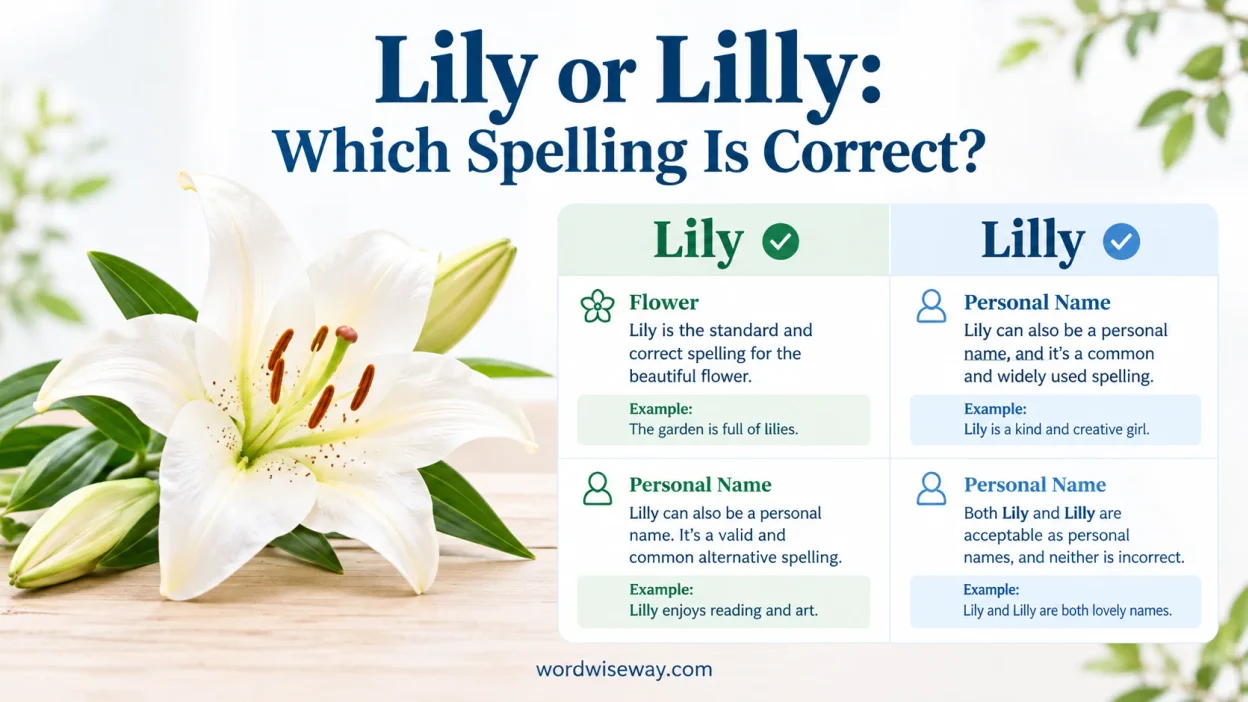
Lily is the standard English spelling for the flower. Lily is also a common personal name. Lilly is a legitimate alternative spelling used as a given name and surname.
Here’s the simplest rule:
- Lily = the standard spelling of the flower.
- Lily = a common spelling of the personal name.
- Lilly = an established alternative spelling of a personal name.
- Lilly = can also occur as a surname.
- Lily and Lilly are usually pronounced the same when used as names.
So, if you’re asking about the flower, choose lily. If you’re referring to a person named Lilly, don’t “correct” the name to Lily.
Lily vs. Lilly: At a Glance
| Feature | Lily | Lilly |
| Standard flower spelling | ✅ Yes | ❌ No |
| Given name | ✅Yes | ✅ Yes |
| Surname | ✅Yes | ✅ Yes |
| Alternative personal-name spelling | ✅ Yes | ✅ Yes |
| Usually pronounced the same as the other form | ✅Yes | ✅ Yes |
| Appropriate for the flower in standard English | ✅ Yes | ❌ No |
| Appropriate for a person named Lilly | ❌ Not if their name is Lilly | ✅Yes |
The most important distinction involves common nouns versus proper names. English dictionaries establish the ordinary spelling of words such as lily. Personal names, however, don’t have to follow the standard spelling of the related dictionary word.
Is Lily or Lilly the Correct Spelling?
The answer depends on what you’re referring to.
If you mean the flower, lily is the correct standard spelling. If you mean a person’s name, both Lily and Lilly can be correct.
That distinction prevents a surprisingly common mistake. Someone might write, “She gave me a beautiful Lilly,” intending to describe the flower. In standard English, that should be “She gave me a beautiful lily.”
However, if the sentence says, “Lilly gave me a flower,” the spelling depends on the person’s actual name. If her name is officially Lilly, changing it to Lily would simply make her name wrong.
Lily Is the Standard English Word for the Flower
The word lily refers to flowering plants commonly associated with the genus Lilium. Lilies belong to the lily family, Liliaceae, although common names can sometimes use “lily” for plants that aren’t true lilies.
The spelling lily is well established in standard English.
For example:
- The white lily bloomed in the garden.
- She planted several lilies beside the walkway.
- The lily has become a popular flower in gardens and floral arrangements.
The plural form is lilies, not lillys. This follows the familiar English spelling pattern in which a consonant plus y changes to ies when forming the plural.
Lily Is Also a Common Given Name
Lily became a personal name through the flower’s symbolism and long-standing use as a feminine given name.
Flower names have a notable place in English naming traditions. Rose, Violet, Daisy, Iris, and Lily are all familiar examples.
As a name, Lily doesn’t need to be lowercase because proper names begin with capital letters:
Lily is meeting us after school.
The capitalization tells you that Lily is a person’s name rather than the flower itself.
Lilly Is a Valid Personal Name
Lilly isn’t automatically a spelling mistake.
Some people are genuinely named Lilly, and that spelling can appear on official records, in published works, and in everyday communication. A person’s proper name doesn’t become incorrect simply because another spelling is more closely associated with the flower.
Consider these two sentences:
- Lily joined the science club.
- Lilly joined the science club.
Both sentences can be grammatically correct. The correct choice depends on the person’s actual name.
This is one reason spelling names requires more care than checking a dictionary. A dictionary can tell you how to spell the common noun lily. It can’t decide how a particular person spells their given name.
Lily vs. Lilly in Names
The difference becomes clearer when you separate name spelling from word spelling.
Lily as a Given Name
Lily is a well-established given name derived from the name of the flower. Its appeal comes partly from the flower’s long cultural association with ideas such as purity and beauty.
The name has also remained recognizable across different English-speaking communities.
When you encounter someone named Lily, the standard spelling is straightforward:
Lily
Don’t add an extra l simply because you think the name looks more distinctive. Names belong to the people who carry them.
Lilly as a Given Name
Lilly represents a spelling variation of the name. The doubled l gives the name a slightly different visual form while usually leaving its pronunciation unchanged.
You may encounter both forms in the same school, workplace, family, or community.
For example:
- Lily Brown
- Lilly Brown
These aren’t necessarily two spellings of the same person. They can represent two different people with independently chosen or established names.
That’s why accuracy matters when you’re writing invitations, certificates, assignments, contact lists, or other documents.
Lily and Lilly as Surnames
Both Lily and Lilly can also appear as surnames.
Surnames follow the same basic principle as given names: use the family’s established spelling.
If a person’s surname is Lilly, writing Lily changes the surname. Even though the difference looks tiny, official names aren’t interchangeable.
This matters particularly in formal contexts such as:
- Legal documents
- School records
- Employment records
- Certificates
- Travel documents
- Published credits
- Email correspondence
- Databases and directories
A doubled letter isn’t decorative when it forms part of someone’s legal name.
Pronunciation
In common English usage, Lily and Lilly are generally pronounced alike when they function as given names.
The pronunciation has two syllables, with the stress falling on the first syllable.
The spelling difference therefore usually doesn’t create a meaningful difference in everyday pronunciation.
This makes Lily vs. Lilly a spelling distinction rather than a major pronunciation distinction.
However, names can develop individual or regional pronunciations. If you’re introducing someone whose name is unfamiliar, their own pronunciation takes priority over assumptions based on spelling.
Why Does Lilly Have Two L’s?
The extra l in Lilly primarily reflects a spelling variation used in personal names. It doesn’t mean that the ordinary English flower word requires two l’s.
English contains many names whose spelling differs from a related common word. Personal naming traditions can preserve, modify, or create spellings that don’t follow ordinary dictionary conventions.
Think about the difference between a dictionary word and a proper name. The dictionary word has a standardized spelling. A person’s name can have a personalized spelling that becomes the correct form for that individual.
Therefore:
lily is the standard flower word.
Lily and Lilly can both function as personal names.
There isn’t a general English spelling rule saying that Lilly must be wrong simply because lily is the standard noun.
Lily or Lilly in a Sentence
Context makes the difference easy to see.
Examples With Lily
When lily refers to the flower, keep it lowercase unless another rule requires capitalization.
- The lily opened in the morning sunlight.
- We planted a pink lily near the fence.
- Several lilies grew beside the pond.
When Lily refers to a person, capitalize it.
- Lily finished her homework early.
- Lily brought a book to class.
- I spoke with Lily after the meeting.
Notice how the same sequence of letters can represent either a flower or a person’s name. Capitalization and context reveal which meaning you intend.
Examples With Lilly
Use Lilly when that is the person’s established name.
- Lilly won the school art competition.
- I sent the invitation to Lilly yesterday.
- Lilly and her sister visited the garden.
You shouldn’t change these examples to Lily unless the person’s name is actually Lily.
Common Mistakes
The most frequent errors happen when writers treat names and ordinary words as though they follow exactly the same rules.
Using Lilly for the Flower
If you’re talking about the flower, lily is the standard spelling.
Incorrect:
The garden has several lillys.
Correct:
The garden has several lilies.
The plural spelling deserves special attention because lillys doesn’t follow the standard plural form of lily.
“Correcting” Someone’s Name
If someone introduces herself as Lilly, don’t change her name to Lily in your writing.
For example, if a classmate writes her name as Lilly, preserve that spelling in your notes or assignment.
A name isn’t a spelling exercise.
Assuming Lilly Is Always Wrong
Calling Lilly an outright misspelling ignores its established use as a personal name and surname.
The right question isn’t simply, “Which spelling looks correct?”
Instead, ask:
What are you trying to name or describe?
If it’s a flower, choose lily. If it’s a person, use their actual spelling.
Mixing the Spellings
Consistency matters when you’re referring to the same person.
If someone’s name is Lilly, don’t alternate between Lilly and Lily throughout an article or document.
That kind of inconsistency can create confusion, especially in formal writing.
Which One Should You Use?
Choosing between Lily and Lilly becomes simple once you identify the context.
Use lily when you’re talking about the flower.
Use Lily when someone’s given name is Lily.
Use Lilly when someone’s given name is Lilly.
Use Lily or Lilly as a surname according to the family’s established spelling.
Here’s a practical decision guide:
| What are you writing? | Correct choice |
| The flower | lily |
| More than one flower | lilies |
| A person named Lily | Lily |
| A person named Lilly | Lilly |
| A family with the surname Lily | Lily |
| A family with the surname Lilly | Lilly |
When you’re unsure about someone’s name, check the person’s own spelling rather than guessing.
A Simple Memory Trick
There’s an easy way to remember the difference.
One L in the middle for the flower: lily.
Two L’s can belong to a person’s chosen name: Lilly.
Imagine the extra letter as part of the person’s identity rather than part of the English flower word. That mental distinction can help you avoid “correcting” a legitimate name variation.
The trick isn’t a formal grammar rule. It’s simply a useful way to remember the central distinction.
Related Spelling Variations
You may encounter different forms of Lily-related names in historical records, family names, and modern naming practices.
However, not every variation should be treated as an ordinary English spelling of the flower.
For standard writing, the core distinction remains clear:
- lily is the standard common noun.
- Lily is an established given name.
- Lilly is an established alternative personal-name spelling.
- Lily and Lilly can both occur as surnames.
The context determines which form belongs on the page.
Read More: Lilies or Lillies: Which Spelling Is Correct?
FAQs
Is Lily the Correct Spelling for the Flower?
Yes. Lily is the standard spelling when you mean the flowering plant. It is the form you’ll normally use in general English writing.
Is Lilly Also a Correct Word?
Lilly can be correct when it is used as a personal or business name. However, it is not the usual spelling for the flower itself.
Why Do People Spell Lily as Lilly?
People often add an extra l because Lilly appears as a name and is familiar in everyday use. This can make the two forms easy to confuse.
Should I Write Lily or Lilly in a Sentence?
Use lily when you are talking about the flower. For example, you could write about planting a lily in your garden.
Is Lilly a Common Baby Name?
Yes, Lilly is used as a given name. Its use as a name is separate from the standard spelling of the flower.
Is Lily Used as a Person’s Name?
Yes. Lily is also widely used as a personal name, so its meaning depends on the context in which you see it.
Is Lily an American or British Spelling?
Lily is not mainly an American-versus-British spelling difference. It is the standard spelling of the flower in both varieties of English.
Is Lilly a Misspelling of Lily?
Not necessarily. When lilly refers to a person, company, or other proper name, it may be intentional. It would be unusual as the standard spelling of the flower.
How Can I Remember the Correct Flower Spelling?
A simple way to remember it is to associate the flower with lily, using one l in the middle. Save Lilly for contexts where that spelling is specifically intended.
Which Spelling Should I Use in Formal Writing?
For the flower, use lily in formal writing, school assignments, articles, and general communication. Use Lilly when you are reproducing an established name or proper noun.
Conclusion
The confusion between lily and lilly is easy to understand because both forms appear in everyday use. However, when you mean the flower, lily is the standard spelling. The single l keeps your writing clear and avoids an unnecessary spelling mix-up.
Lilly still has a place when it appears as a personal name, company name, or another established proper name. That means you shouldn’t automatically treat it as a mistake when you see it. Context matters, especially when the spelling belongs to a specific person or organization.
For everyday writing, choose lily when talking about the flower. Whether you’re writing a school assignment, social media caption, email, or blog post, this simple distinction can help you write with confidence and avoid second-guessing your spelling.

Evelyn Shaw has spent 14 years at Yale University’s English Department, leading students through close readings, genre studies, and interpretive methodologies. Her scholarly interests include Renaissance drama, gothic fiction, feminist literary criticism, and archival research and examining how texts generate meaning across historical periods. Evelyn has presented at major academic conferences and published essays in peer-reviewed journals, reflecting her passion for rigorous analysis and student-centered learning.