For years as an English teacher and language specialist, I’ve noticed that small spelling differences often create bigger writing problems than people expect. One question that regularly comes up in classrooms, editing sessions, and professional writing is whether connector or connecter is the correct spelling. Since both forms appear online, it’s easy to assume they’re interchangeable. In reality, modern English clearly favors one spelling over the other. In this guide, I’ll explain the meaning, spelling difference, real-world usage, and the simple rule that helps you choose the correct word with confidence in academic, professional, and everyday writing.
Quick Answer:
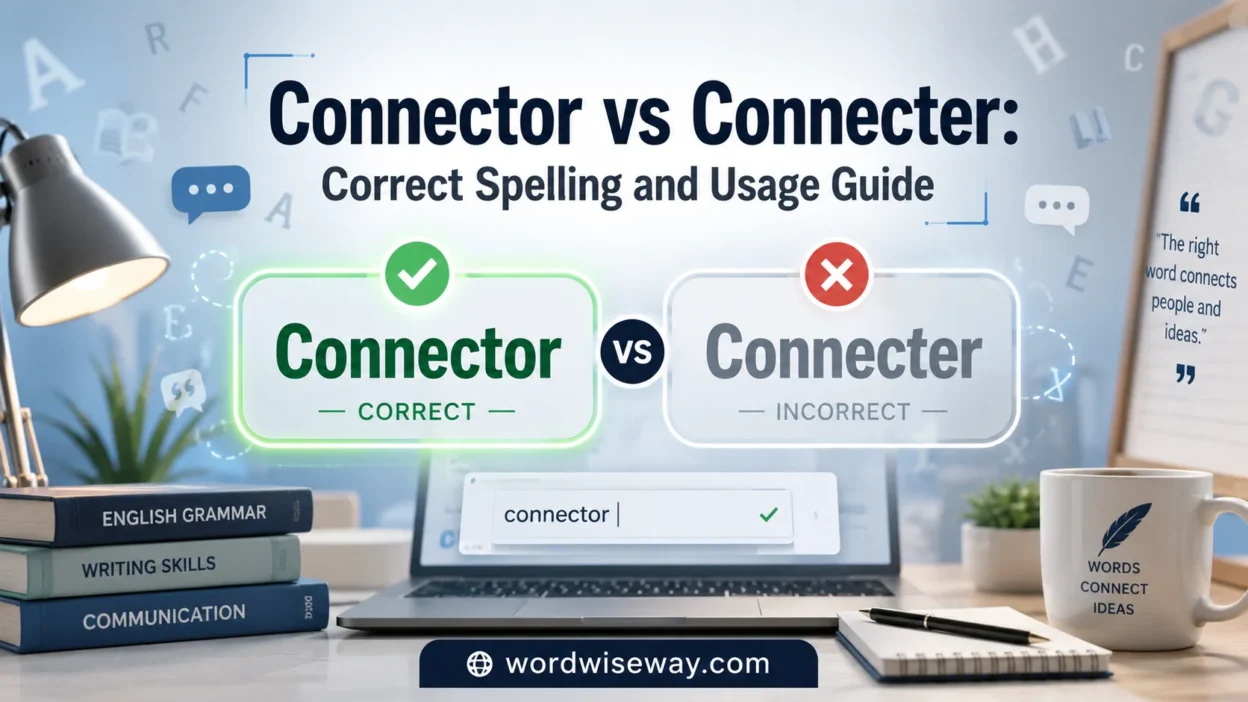
Connector is the correct and standard spelling in modern English. It refers to something that links or joins two things together, such as an electrical device, a sentence linking word, or a networking connection. Connecter is an outdated and rarely used variant that is generally avoided in academic, professional, and everyday writing. To write clearly and confidently, always use connector.
Correct Spelling and Usage Guide Explained Simply
Let’s start with the most important truth.
In modern English, “connector” is the correct and standard spelling.
The word “connecter” exists, but it is rare and widely considered outdated or non-standard in most writing contexts.
If you are writing emails, academic papers, technical documents, or content online, “connector” is the only safe and accepted choice.
That’s the short answer. Now let’s understand why.
What “Connector” Means in Everyday English
The word connector refers to something that joins, links, or brings two things together.
It can describe both physical objects and abstract roles.
Common meanings of “connector” include:
- A device that joins electrical or mechanical parts
- A cable or port used in technology
- A person who introduces people to each other
- A word or phrase that links ideas in writing
- A route that connects transportation systems
Real-world examples:
- A USB connector links your phone to a charger or computer
- An HDMI connector transfers video and audio signals
- A social connector is someone who introduces people in networking situations
- Words like however, therefore, and because act as sentence connectors
So at its core, a connector is anything that builds a bridge between two points.
Simple idea. Powerful word.
Why “Connecter” Confuses So Many People
At first glance, “connecter” looks reasonable. It follows a familiar English pattern where verbs turn into nouns with “-er.”
For example:
- teach → teacher
- bake → baker
- write → writer
So naturally, people assume:
- connect → connecter
But English doesn’t always follow a single rule. It often borrows spelling patterns from Latin-based structures, especially for technical or formal nouns.
That’s where connector breaks the pattern and chooses “-or” instead of “-er.”
Read More: Laid vs Laid Out Meaning, Difference, and Correct Usage
What About “Connecter”? Does It Actually Exist?
Yes, but barely.
The spelling “connecter” appears in older texts, rare dialect usage, or inconsistent writing systems.
However, in modern usage, it is:
- Not preferred in academic writing
- Not used in technical documentation
- Not standard in dictionaries for professional contexts
- Often flagged as incorrect in grammar tools
Important clarity:
If you use “connecter” in a resume, article, or professional document, it may look like a spelling mistake rather than a valid variant.
That’s the key issue.
Why “Connector” Became the Standard Spelling
Language standardization is not random. It follows patterns shaped by history, science, and consistency.
The dominance of “connector” comes from several influences.
Latin-style noun formation
Many English words ending in “-or” come from Latin roots or Latin-style adaptations:
- actor
- editor
- creator
- director
So “connector” fits naturally into that family.
Technical language consistency
Engineering, computing, and science communities prefer standardization.
In those fields, clarity matters more than style variation.
So terms like:
- electrical connector
- network connector
- interface connector
became fixed in technical language with the “-or” form.
Dictionary and publishing standards
Modern dictionaries, publishing houses, and academic style guides consistently favor connector.
Once major references agree, the spelling becomes globally standardized.
Clear Comparison Table
| Word | Status | Usage Today | Context Suitability | Recommendation |
| Connector | Standard English | Very common | Technical, formal, informal | Always use |
| Connecter | Non-standard/rare | Extremely rare | Historical or inconsistent texts | Avoid |
This table makes it simple.
If you want clarity and credibility, stick with connector every time.
Where You See “Connector” in Real Life
The word shows up everywhere once you start noticing it.
Technology and electronics
This is the most common area.
- USB connector
- HDMI connector
- Ethernet connector
- Power connector
These parts physically link devices together.
Transportation systems
In travel and logistics, connectors play a big role.
- Flight connectors (connecting flights)
- Bus connectors between routes
- Train line connectors between cities
They keep movement flowing smoothly.
Communication and writing
In language, connectors help ideas flow.
- however
- therefore
- because
- although
These are called sentence connectors, and they guide logic in writing.
Social and professional life
Some people naturally act as connectors.
They:
- introduce friends
- build professional networks
- link opportunities between groups
A strong connector can change someone’s career path with a single introduction.
Common Mistakes People Make With Connector vs Connecter
Even confident writers slip here.
Mistake 1: Trusting instinct over standard usage
People assume English always follows “-er” endings. It doesn’t.
Mistake 2: Relying on autocorrect
Some tools don’t always correct rare spellings like “connecter.”
That creates false confidence.
Mistake 3: Mixing informal and formal writing rules
You might see “connecter” in casual online posts. That doesn’t make it correct.
Mistake 4: Confusing verb and noun forms
- connect (verb)
- connector (noun)
“Connecter” incorrectly tries to fill the noun role.
Simple Memory Tricks to Remember the Right Spelling
You don’t need grammar books to remember this. Just a few mental shortcuts.
Trick 1: Think of “actor”
If you can say actor, you can say connector.
Both describe something that performs an action or function.
Trick 2: Visual association
Picture a plug connecting two cables.
What does the label usually say? Connector.
That image sticks.
Trick 3: The OR rule
Many technical and formal nouns use “-or.”
- motor
- sensor
- connector
If it sounds technical, “-or” often wins.
Case Study: Why Spelling Matters in Real Communication
Let’s look at a real-world style scenario.
Scenario: A freelance designer applying for a job
The designer writes:
“I specialize in building UI connecter components for web applications.”
Two recruiters read the resume.
One notices the spelling. The other doesn’t.
But the one who notices assumes something important:
- attention to detail is weak
- technical accuracy may be unreliable
Even if the skill is strong, perception shifts.
Now compare:
“I specialize in building UI connector components for web applications.”
Same skill. Different impression. Much cleaner result.
That tiny spelling choice influences trust.
Quick Reference Guide: When to Use Connector
Use connector in every modern context:
Technical writing
- engineering documents
- software documentation
- hardware descriptions
Academic writing
- essays
- research papers
- reports
Professional communication
- resumes
- emails
- business proposals
Everyday usage
- casual writing
- social posts
- explanations
If you’re unsure, default to connector. It will always be accepted.
My Personal Experience:
As an English teacher and language specialist, I’ve noticed that many learners assume connecter is correct because it matches words like teacher and writer. While reviewing essays, emails, and online content, I regularly help students understand that connector is the standard spelling. After learning this difference, they write with greater confidence and accuracy.
Frequently Asked Questions
Q1: What is Connector vs Connecter: Correct Spelling, Meaning and Usage?
It refers to the difference between two spellings, where connector is modern and connecter is outdated.
Q2: Which spelling is correct, connector or connecter?
Connector is the correct and widely accepted spelling in modern English.
Q3: Is connecter still used today?
It is very rarely used and mostly seen in older texts.
Q4: What does a connector mean?
A connector is something that links or joins two parts together.
Q5: Why do people get confused between both words?
Because both forms appear similar and can be found in older writing.
Q6: Is connecter wrong?
Not exactly wrong, but it is outdated and not preferred in modern usage.
Q7: Where is the word connector used?
It is used in technology, engineering, grammar, and general writing.
Q8: Can using the wrong spelling affect writing?
Yes, it can make writing appear incorrect or less professional.
Q9: What does connector come from?
It comes from the verb connect.
Q10: How can I remember the correct spelling?
Just remember that modern English always prefers connector.
Conclusion
Understanding Connector vs Connecter: Correct Spelling, Meaning and Usage is not just about spelling, but about writing with accuracy and confidence. In modern English, connector is the standard form used across academic, technical, and professional spaces, while connecter remains a historical variant rarely seen today.
Choosing the correct spelling helps avoid confusion, reduces mistakes, and improves clarity in communication. Whether you are writing emails, reports, or technical documents, using connector ensures your work stays aligned with accepted grammar and professional usage standards.

Amelia Sanders has spent 14 years in Harvard University’s English Department, helping students navigate literary analysis, interpretive theory, and narrative techniques. Her academic pursuits center on 18th-century British prose, romantic poetry, diasporic writing, and digital editing exploring how textual choices influence cultural perspectives. Amelia has spoken at major international meetings and contributed essays to respected academic volumes, demonstrating her dedication to thoughtful scholarship and effective teaching.