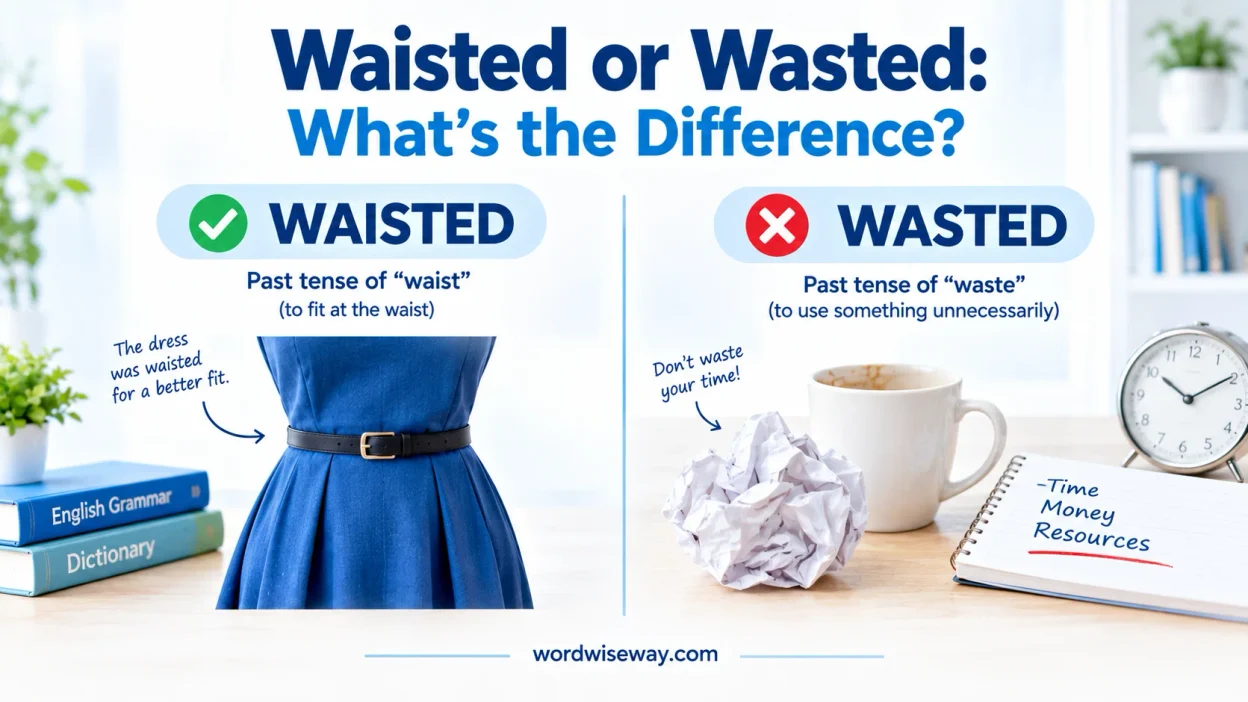
Waisted or Wasted: What’s the Difference? often causes confusion for English learners and native speakers because these commonly confused words have similar pronunciation. Their meanings, however, are completely different, and a small spelling difference can change a sentence.
Waisted relates to the waist and describes something shaped or designed around it, such as high-waisted jeans. Wasted means used, spent, or consumed carelessly without a useful result. Writing “I feel waisted after work” or “high-wasted jeans” can create mistakes and misunderstandings.
Understanding the correct meaning, spelling, usage rules, and examples helps a student or writer improve academic writing, professional writing, and clear communication. These distinctions also support precise communication and stronger communication skills.
Quick Answer:
Use waisted when you mean something related to the waist or something shaped around a waist. It commonly appears in compounds such as high-waisted, low-waisted, narrow-waisted, and long-waisted. Cambridge Dictionary defines waisted as describing something that has a particular type of waist or is narrower around the waist or middle.
| Word | Connected word | Main meaning | Example |
| Waisted | waist | Related to or shaped around the waist | She wore high-waisted jeans. |
| Wasted | waste | Used poorly, lost, or spent unnecessarily | He wasted his afternoon. |
Use wasted when you mean something that was used unnecessarily, lost, or not used effectively. It comes from the verb waste. You can waste time, money, food, effort, energy, resources, or opportunities.
The easiest rule is simple: waist → waisted and waste → wasted.
What Does “Waisted” Mean?
Waisted is an adjective related to the noun waist. It describes a person, garment, or object according to the shape, position, or structure of its waist or middle.
The word appears most naturally in combinations. High-waisted and low-waisted are especially common when people describe clothing. You may also encounter terms such as narrow-waisted, long-waisted, short-waisted, and thick-waisted.
The underlying noun, waist, refers to the part of the body above and slightly narrower than the hips. The word can also describe the corresponding part of clothing that covers or surrounds that area.
That relationship gives you a useful spelling clue. If your sentence refers to a waist, the form with -i-, waisted, is likely the one you need.
How “Waisted” Works in English
Unlike wasted, which frequently functions as an ordinary past-tense verb or adjective, waisted usually works as an adjective.
Consider these examples:
- She bought a high-waisted skirt.
- The designer created a low-waisted jacket.
- The garment has a narrow-waisted shape.
- The character wore a long-waisted coat.
- The vase has a waisted middle.
In each case, the word points back to waist.
The meaning can extend beyond the human body. A physical object can have a narrower middle or a shape resembling a waist. Collins Dictionary, for example, includes waisted for objects that have a waistlike structure or concave sides.
Examples of “Waisted” in Sentences
Here are several natural examples:
- She chose a high-waisted pair of jeans.
- The costume included a low-waisted skirt.
- The tailor designed a narrow-waisted jacket.
- The dress has a clearly defined waist.
- The antique vase has a waisted middle.
- That style of coat is long-waisted.
Notice the common thread. None of these examples involves losing, misusing, or squandering something.
What Does “Wasted” Mean?
Wasted comes from the verb waste. It can describe something that someone used without good reason, failed to use effectively, or allowed to be lost.
For example, if you spend three hours on something that produces no useful result, you might describe those hours as wasted time. If you buy food and let it spoil without eating it, you could describe the food as wasted.
Cambridge Dictionary explains wasted in the sense of resources such as time and money not being used effectively. The dictionary also records other meanings, including describing someone or something as extremely thin or weak and a slang use meaning very drunk or affected by drugs.
For ordinary spelling questions, however, the most important meaning is used badly or unnecessarily.
Examples of “Wasted” in Sentences
- I wasted two hours scrolling through old messages.
- She wasted her money on something she didn’t need.
- Don’t let good food go wasted.
- The team wasted several opportunities.
- We wasted valuable time waiting for the wrong bus.
- His effort shouldn’t go wasted.
- They found a way to use the leftover materials instead of letting them go wasted.
The base word is always waste.
That gives you another quick test. If you can replace the word with a form of waste, then wasted is probably correct.
Key Differences
The spelling difference looks tiny, but the semantic gap is enormous.
| Feature | Waisted | Wasted |
| Base word | Waist | Waste |
| Main role | Adjective | Verb form and adjective |
| Main idea | Related to a waist or middle | Used poorly, lost, or squandered |
| Common phrases | High-waisted, low-waisted | Wasted time, wasted money |
| Common topic | Clothing, shape, design | Time, money, effort, resources |
| Example | A high-waisted dress | A wasted opportunity |
Think of the i as a signpost.
In waisted, the i keeps you connected to waist. In wasted, there is no i because the base word is waste.
Meaning in Context
Context usually solves this spelling puzzle faster than pronunciation does.
Suppose you read:
She bought a ___ skirt.
The sentence doesn’t immediately tell you which spelling belongs there. But if the intended meaning concerns the position of the skirt around the body, high-waisted could be correct.
Now consider:
She ___ three hours on the project.
Here, the word needs to function as the past tense of waste. Therefore, wasted is correct.
The surrounding words act like a small grammatical compass. They point toward the intended base word.
Compare These Sentences
Waisted:
- She bought high-waisted jeans.
- The costume has a low-waisted design.
- The jacket is narrow-waisted.
- The vase has a waisted shape.
Wasted:
- She wasted her afternoon.
- He wasted his money.
- They wasted a valuable opportunity.
- We wasted too much food.
The difference becomes obvious once you focus on meaning rather than spelling.
Is “Waisted” a Correct Word?
Yes. Waisted is a legitimate English word.
It may look unusual because English speakers encounter wasted much more often in everyday writing. However, frequency doesn’t determine whether a word is correct. Waisted has an established use as an adjective connected with the waist. Cambridge Dictionary lists it as an adjective and gives examples involving high-waisted and low-waisted clothing.
Collins also records waisted as an adjective. Its entries include both descriptions involving a particular kind of waist and descriptions of objects with a waistlike shape.
So don’t automatically treat waisted as a typo.
If you’re describing a garment’s position or a structure’s shape, it can be exactly the word you need.
Why “Waisted” Often Appears With a Hyphen
When waisted combines with another adjective to form a compound modifier, a hyphen often appears before a noun.
Common examples include:
- high-waisted jeans
- low-waisted pants
- narrow-waisted dress
- long-waisted coat
- short-waisted jacket
The hyphen helps readers recognize the words as one descriptive unit.
For example, high-waisted jeans clearly tells you that high and waisted work together to describe the jeans.
Is “Wasted” a Correct Word?
Yes. Wasted is a standard and highly common English word.
It is the past tense and past participle of waste. The verb waste means to use something without care or without getting a useful result from it. Cambridge Dictionary gives examples involving time, money, water, opportunities, and other resources.
For example:
- I waste time.
- I wasted time yesterday.
- I have wasted enough time.
The spelling follows the regular waste → wasted pattern.
As an adjective, wasted can describe something that wasn’t used effectively:
- wasted time
- wasted money
- wasted effort
- wasted resources
- wasted opportunity
The meaning remains connected to the idea of waste.
Common Phrases With “Waisted”
Because waisted describes a type or shape of waist, it frequently appears in clothing and physical descriptions.
High-Waisted
High-waisted describes clothing whose waistline sits relatively high on the body.
Examples include:
- high-waisted jeans
- high-waisted pants
- high-waisted skirts
- high-waisted shorts
- high-waisted trousers
Low-Waisted
Low-waisted describes clothing with a lower waistline.
For example:
The store sells both high-waisted and low-waisted styles.
Narrow-Waisted
Narrow-waisted describes someone or something with a relatively narrow waist.
For example:
The costume was designed with a narrow-waisted silhouette.
Waisted Objects
The word can also describe objects with a narrowed middle.
For example:
The antique vase has a waisted shape.
This broader use matters because waisted isn’t exclusively a fashion term.
Common Phrases With “Wasted”
It appears in a much wider range of everyday expressions.
Wasted Time
Wasted time refers to time that wasn’t used productively or effectively.
The unnecessary delay resulted in several hours of wasted time.
Wasted Money
Wasted money refers to money spent without worthwhile benefit.
Buying equipment you never use can become wasted money.
Wasted Food
Wasted food refers to food that gets discarded or otherwise isn’t used.
Better meal planning can reduce wasted food.
Wasted Effort
Wasted effort describes work that produces little or no useful result.
Without clear instructions, much of the team’s effort could become wasted effort.
Wasted Opportunity
A wasted opportunity is a useful chance that someone failed to take advantage of.
Ignoring useful feedback can become a wasted opportunity to improve.
Wasted Resources
Wasted resources can include money, materials, energy, time, or other limited supplies.
The new process reduced wasted resources during production.
Cambridge specifically describes waste as involving the unnecessary or ineffective use of things such as money, substances, time, energy, and abilities.
Why Do People Confuse Waisted and Wasted?
The two words create a classic spelling trap because their pronunciation is extremely similar.
Cambridge gives both waisted and wasted pronunciations with the same basic sound pattern in American English.
That means your ears often can’t solve the problem for you.
Imagine hearing someone say:
“She bought a high-waisted jacket.”
You can’t reliably identify the spelling from the sound alone. You need to connect the word to waist.
The same principle applies to:
“He wasted his time.”
The sound points toward the pronunciation, but the meaning points toward the spelling.
This is why context matters so much with homophones and near-homophones. English spelling doesn’t always provide a neat one-to-one relationship between sound and letters.
Pronunciation
In standard American English, waisted and wasted are pronounced very similarly and can sound effectively identical in ordinary speech. Cambridge lists both with the same broad pronunciation, /ˈweɪ.stɪd/.
The pronunciation therefore doesn’t provide a dependable spelling shortcut.
Instead, ask yourself one question:
What does the word mean in this sentence?
If the meaning relates to a waist, choose waisted.
If the meaning relates to something being used badly or lost, choose wasted.
That’s far more reliable than trying to hear the extra letter.
Grammar
Understanding grammar makes the distinction even clearer.
“Waisted” as an Adjective
Waisted primarily functions as an adjective.
It modifies a noun by describing its waist or middle.
Examples:
- high-waisted pants
- low-waisted jeans
- narrow-waisted clothing
- a waisted vase
It tells you something about shape, structure, or position.
“Wasted” as a Verb
Wasted can function as the past tense of waste.
For example:
She wasted an entire afternoon.
Here, wasted describes an action that happened in the past.
The basic structure is:
Subject + wasted + object
Examples:
- He wasted his money.
- They wasted valuable time.
- We wasted the opportunity.
- She wasted too much food.
“Wasted” as an Adjective
Wasted can also function as an adjective.
Examples include:
- wasted time
- wasted resources
- wasted effort
- wasted opportunity
The word describes something that has been lost or used without good effect.
Cambridge also records additional adjective meanings for wasted, including a condition of being very thin and weak and a slang meaning associated with being extremely intoxicated.
For formal or general writing, however, the resource-related meaning is the one most relevant to this spelling comparison.
A Simple Case Study: One Letter, Two Meanings
Consider a clothing sentence and a productivity sentence:
She wore high-waisted jeans while studying for her exam.
Now imagine changing the spelling:
She wore high-wasted jeans while studying for her exam.
The second version changes the word into wasted, which doesn’t make sense as a description of the jeans’ waistline.
Now reverse the situation:
She wasted two hours studying the wrong material.
If you write:
She waisted two hours studying the wrong material.
The sentence no longer works because waisted has nothing to do with losing or misusing time.
This demonstrates an important writing principle: correct spelling depends on meaning, not merely on how a word sounds.
How to Remember the Difference Between Waisted and Wasted
A simple memory trick can save you from this mistake.
Think “Waist → Waisted”
If you can point to a waist, choose waisted.
- waist
- waisted
- high-waisted
- low-waisted
The i stays with the i in waist.
Think “Waste → Wasted”
If something has been used badly, lost, or squandered, choose wasted.
- waste
- wasted
- wasting
- wasteful
There is no i in the base word, so there is no i in wasted.
This tiny spelling connection works like a mental shortcut.
Common Mistakes
Several errors appear because writers rely on sound instead of meaning.
Mistake: “High-Wasted Jeans”
Incorrect:
She bought high-wasted jeans.
Correct:
She bought high-waisted jeans.
The word describes the waist of the jeans, so waisted is required.
Mistake: “Waisted Time”
Incorrect:
I waisted three hours yesterday.
Correct:
I wasted three hours yesterday.
The sentence refers to time that wasn’t used effectively. The base word is waste.
Mistake: “Waisted Money”
Incorrect:
He waisted his money.
Correct:
He wasted his money.
Money can be wasted, but it isn’t waisted.
Mistake: Assuming “Waisted” Is Always Wrong
This mistake goes in the opposite direction.
Some writers see waisted and assume that it must be a spelling error. That’s not true.
She wore a high-waisted dress.
Here, waisted is completely appropriate.
Which One Should You Use?
Use waisted when your sentence relates to a waist, waistline, or waistlike shape.
Use wasted when your sentence relates to using something badly, losing something valuable, or failing to use something effectively.
Here’s a quick decision guide:
| Ask yourself… | Choose |
| Does the word relate to a waist? | Waisted |
| Does it describe clothing around the waist? | Waisted |
| Does it describe a narrowed middle of an object? | Waisted |
| Does it describe lost time? | Wasted |
| Does it describe money used unnecessarily? | Wasted |
| Does it describe a missed opportunity? | Wasted |
| Does it describe ineffective effort? | Wasted |
| Is it the past tense of waste? | Wasted |
When you’re unsure, identify the base word first.
Waist + ed = waisted
Waste + ed = wasted
That small distinction handles most cases.
Read More: Tardies or Tardys: Which Spelling Is Correct?
FAQs
What is the difference between waisted and wasted?
Waisted relates to the waist, while wasted usually means something was used, spent, or consumed without a useful result. The two words sound similar but have different meanings.
Is waisted a correct English word?
Yes, waisted is a correct word. It describes something related to the waist or something designed with a particular waist shape, such as a waisted dress.
Is wasted the correct word for using something carelessly?
Yes. Wasted can describe something that was used, spent, or consumed without producing a useful outcome. For example, you might say, “The food was wasted.”
Why do people confuse waisted and wasted?
People often confuse waisted and wasted because their pronunciation can sound very similar. Their spelling differs by one letter, but their meanings and usage are completely different.
Is “high-waisted jeans” correct?
Yes, high-waisted jeans is the standard expression. The word waisted describes the jeans as having a particular waist design or position.
Is “high-wasted jeans” correct?
No. High-wasted jeans is generally a spelling mistake when you mean jeans designed with a high waist. The correct form is high-waisted jeans.
Can waisted and wasted be used interchangeably?
No. You cannot normally substitute one for the other. Waisted refers to the waist, while wasted commonly describes something used or spent unnecessarily.
How can I remember the spelling of waisted?
Think of waisted as containing waist. If your sentence refers to the body’s waist or the shape of clothing around it, waisted is likely the word you need.
How can I remember when to use wasted?
Connect wasted with waste. When something is used carelessly, lost unnecessarily, or fails to produce a useful result, wasted is usually appropriate.
Why does choosing between waisted and wasted matter in writing?
Choosing the correct word keeps your meaning clear. A small spelling difference can change the meaning of a sentence, so distinguishing waisted from wasted helps you avoid misunderstandings in academic, professional, and everyday writing.
Conclusion
Understanding waisted and wasted becomes much easier once you connect each word with its meaning. Waisted relates to the waist or something designed around it, while wasted describes something used, spent, or consumed without a useful purpose. Although the spellings are close, they serve different roles in a sentence.
This small distinction matters in everyday messages as well as academic writing, professional documents, and online content. Using high-waisted jeans correctly, for example, prevents the confusion that can come from writing high-wasted jeans. Likewise, choosing wasted when discussing unnecessary use keeps your intended meaning clear.
When you come across these words, pause and check what your sentence is trying to express. If the context involves the waist, choose waisted; if it involves unnecessary use or loss, wasted fits the meaning. Remembering this simple connection can help you avoid spelling mistakes and communicate with greater accuracy.

Amelia Sanders has spent 14 years in Harvard University’s English Department, helping students navigate literary analysis, interpretive theory, and narrative techniques. Her academic pursuits center on 18th-century British prose, romantic poetry, diasporic writing, and digital editing exploring how textual choices influence cultural perspectives. Amelia has spoken at major international meetings and contributed essays to respected academic volumes, demonstrating her dedication to thoughtful scholarship and effective teaching.