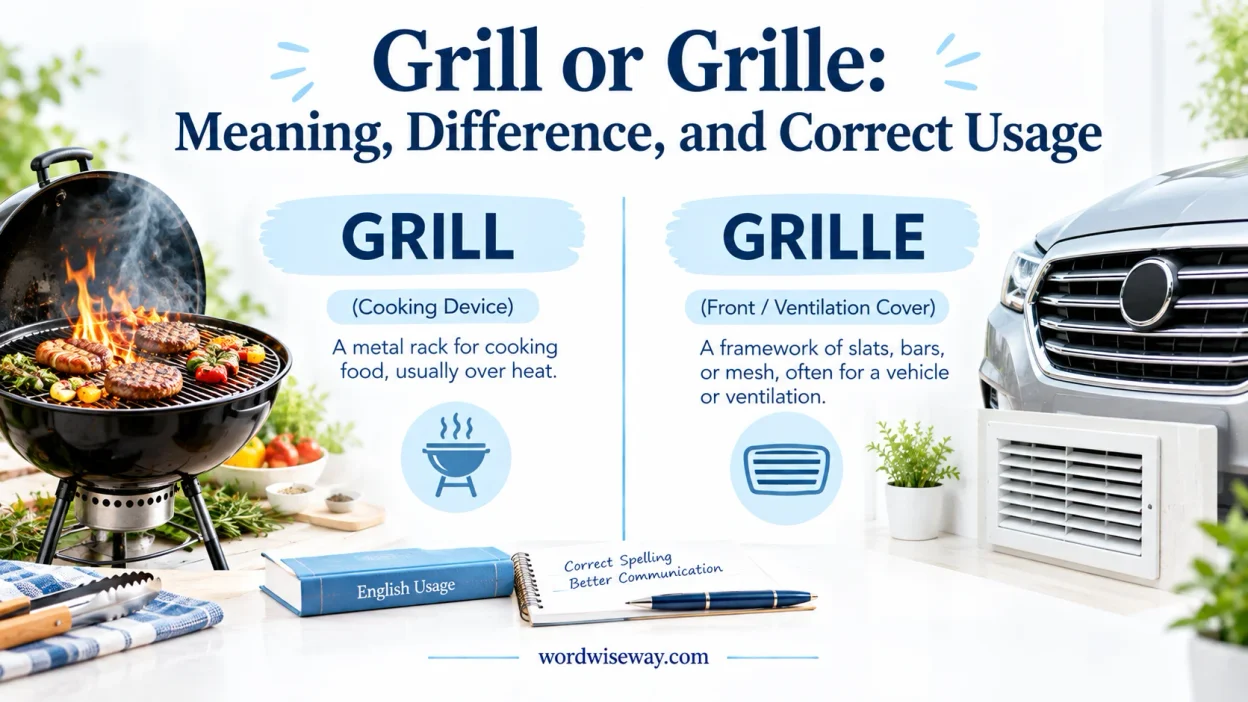
The meaning and difference between grill and grille become clearer when you understand how these words are used. Grill or Grille: Meaning, Difference, and Correct Usage explains why grill connects with cooking, where you cook food over heat, while grille often means a metal framework or decorative cover on cars or buildings.
The terms may look nearly identical, but their purposes differ in English. When you search for correct usage, both spellings can appear in writing, advertisements, and online stores, creating confusion. This guide also explores their history, spelling rules, and common mistakes to make the distinction easier to remember.
In daily life, grill can describe a cooking method, while grille can describe a car feature or home design element. British English and American English may show differences in usage, so your audience and context matter. Knowing these distinctions can make your writing clearer and more precise.
Quick Answer:
Grill and grille are both correct words, but they aren’t interchangeable in standard usage.
- Grill usually refers to cooking equipment, a cooking surface, or the act of cooking food with direct heat.
- Grill can also mean to question someone repeatedly or intensely.
- Grille usually refers to a framework of metal bars or openings that covers, protects, or allows airflow through something.
- Car grille is the standard term for the protective or decorative framework at the front of a vehicle.
- Grill and grille are pronounced the same: /ɡrɪl/.
A simple memory trick works well:
Grill = cooking or questioning.
Grille = a framework or covering.
For example, you might grill burgers on a grill, while a car has a front grille.
What Does “Grill” Mean?
The word grill has several established meanings, but its most familiar uses involve cooking and questioning. Cambridge defines a grill as equipment or a metal frame used for cooking food with strong or direct heat.
That makes grill a flexible word. It can function as both a noun and a verb, and its meaning depends on the sentence.
Grill as a Noun
As a noun, grill can mean a piece of cooking equipment or a metal frame where food cooks over heat.
Consider these examples:
- “Put the steaks on the grill.”
- “We bought a new gas grill.”
- “The vegetables are cooking on the grill.”
- “Clean the grill after dinner.”
In each sentence, grill relates to cooking.
The word can describe several types of equipment, including gas grills, charcoal grills, electric grills, and portable grills. The exact design can vary considerably, but the central idea remains the same: food cooks using direct heat.
Cambridge also lists grill as a US term for an informal restaurant serving grilled foods such as hamburgers, steak, and chicken.
Grill as a Verb
As a verb, grill means to cook food using direct heat.
For example:
- “We’ll grill chicken tonight.”
- “She grilled the vegetables with olive oil.”
- “They grilled the fish over hot coals.”
The noun identifies the equipment. The verb describes the action.
That distinction makes sentences easy to understand:
Noun: “The chicken is on the grill.”
Verb: “We’ll grill the chicken.”
Both uses belong to the same cooking family.
Grill as a Verb for Intense Questioning
There’s another important meaning of grill that has nothing to do with food.
To grill someone can mean to ask that person many questions, often persistently or for an extended period. Cambridge records this meaning as well.
For example:
- “The reporters grilled the spokesperson about the announcement.”
- “Her parents grilled her about where she had been.”
- “The interviewer grilled the candidate about the proposal.”
This meaning developed from the idea of subjecting something to intense heat. The figurative sense suggests that a person is under pressure from a barrage of questions.
So, if someone says, “I got grilled during the interview,” they aren’t talking about a barbecue.
What Does “Grille” Mean?
Grille is primarily a noun. It refers to a framework made from bars or similar structures that covers, protects, separates, or allows airflow through an opening.
Cambridge defines grille as a frame of metal bars used to cover something such as a window or machine.
You might encounter a grille in several settings:
- Cars
- Air vents
- Heating and cooling systems
- Machinery
- Windows
- Security structures
- Architectural openings
- Speaker equipment
The common thread is a structured framework or covering.
Grille as a Protective Framework
A grille can provide protection without completely blocking an opening.
For example:
“The security grille covered the window.”
The grille doesn’t necessarily create a solid wall. Instead, its bars form a protective barrier while leaving spaces between them.
That basic design explains why the word appears in mechanical, architectural, and security contexts.
Grille for Ventilation
You can also find grilles in ventilation systems.
A ventilation grille may cover an opening where air enters or leaves a room. The structure keeps the opening covered while allowing airflow.
For example:
- “Dust had collected around the ventilation grille.”
- “The technician removed the air grille.”
- “The ceiling grille needs cleaning.”
Here, grille has nothing to do with cooking.
Grille in Automotive English
One of the most familiar uses of grille appears in automotive language.
A car grille is the framework positioned at the front of many vehicles. Depending on the vehicle, it can serve functional purposes related to airflow and protection while also contributing to the vehicle’s exterior design.
For example:
- “The car’s grille was damaged.”
- “The mechanic replaced the front grille.”
- “The new model has a wider grille.”
This is why car grille is the standard phrase when referring to that front framework.
Key Differences
The easiest way to understand grill vs. grille is to focus on what the object does.
| Word | Main meaning | Common context | Example |
| Grill | Equipment or surface for cooking | Food | “Put the burgers on the grill.” |
| Grill | To cook with direct heat | Food preparation | “We’ll grill the chicken.” |
| Grill | To question intensely | Interviews or questioning | “The reporters grilled him.” |
| Grille | Framework or covering | Buildings, machinery, vehicles | “The car grille was damaged.” |
| Grille | Metal framework allowing airflow | Ventilation | “Clean the air grille.” |
The distinction becomes much easier when you stop looking at the spelling and look at the function.
If something helps you cook food, grill is generally the word you want.
If something forms a framework or protective covering, grille is generally the better choice.
Grill or Grille in Sentences
Context makes the difference especially clear.
Cooking Examples
- “The burgers are on the grill.”
- “We bought a new grill for the backyard.”
- “She likes to grill vegetables.”
- “The grill needs to be cleaned.”
All four sentences involve cooking.
Vehicle Examples
- “The front grille has a chrome finish.”
- “A stone damaged the car’s grille.”
- “The mechanic inspected the radiator grille.”
- “The new vehicle has a larger front grille.”
Here, grille describes a framework or covering.
Ventilation Examples
- “The air grille is covered with dust.”
- “The technician replaced the ceiling grille.”
- “Air passes through the ventilation grille.”
Again, the idea centers on an opening and its framework.
Questioning Examples
- “The journalist grilled the spokesperson.”
- “The coach grilled the players about the mistake.”
- “The interviewer grilled her about the details.”
These sentences use grill as a verb meaning to question someone persistently.
Grill or Grille for a Car?
When you’re talking about the framework at the front of a car, grille is the standard spelling.
The phrase car grille identifies the structured front component rather than a cooking appliance.
For example:
Correct: “The car’s front grille is damaged.”
Usually incorrect for this meaning: “The car’s front grill is damaged.”
People sometimes write car grill because grill and grille sound identical. However, the conventional spelling for the automotive component is grille.
The same distinction appears in phrases such as:
- front grille
- radiator grille
- vehicle grille
- car grille
- truck grille
- ventilation grille
The spelling isn’t based on how the word sounds. It depends on the meaning you intend.
Grill or Grille for Cooking?
For cooking equipment, grill is the correct choice.
Use grill in phrases such as:
- gas grill
- charcoal grill
- electric grill
- barbecue grill
- grill pan
- grill grate
- outdoor grill
- portable grill
For example:
“We used a charcoal grill to cook the vegetables.”
Using grille in this context would normally be a spelling mistake.
The same rule applies when grill functions as a verb:
“We plan to grill chicken for dinner.”
You wouldn’t replace grill with grille because the action is related to cooking rather than a framework.
Pronunciation
One reason grill and grille cause confusion is that they sound the same in standard English.
Both are pronounced /ɡrɪl/. Cambridge lists the same pronunciation for grille and grill.
The final e in grille doesn’t create a separate spoken syllable.
That means you can’t reliably choose the spelling simply by saying the word aloud. You have to use context.
Think about these two sentences:
“The steak is on the grill.”
“The car’s grille is damaged.”
When spoken, the key words sound alike. When written, their meanings become visible through their spelling.
Common Mistakes
Using “Grill” for a Car’s Front Grille
This is one of the most common spelling mix-ups.
Because grill and grille have identical pronunciation, writers sometimes use car grill when they mean car grille.
For standard usage, choose car grille when referring to the vehicle’s front framework.
Using “Grille” for Cooking Equipment
The opposite mistake occurs when someone writes grille for a barbecue or cooking appliance.
For example:
Incorrect for standard cooking terminology: “I bought a new charcoal grille.”
Correct: “I bought a new charcoal grill.”
The cooking meaning belongs to grill.
Confusing Grill and Grille Because They Sound Alike
Pronunciation is the trap.
English contains many pairs where spelling carries information that pronunciation doesn’t reveal. Grill and grille are a compact example.
Instead of asking, “Which one sounds right?” ask:
What am I describing?
- Food or cooking? → grill
- Questioning someone? → grill
- Bars or a protective framework? → grille
That one question solves most cases.
How to Remember
A simple memory trick can keep the two words from getting tangled.
Grill = Food or Questions
Think of two kinds of heat:
- Physical heat from cooking
- Figurative pressure from intense questioning
You can grill a steak and grill someone with questions.
Grille = Framework
Think of the extra e as part of a framework.
A grille can cover an opening while leaving spaces for air or visibility.
So remember:
Grill cooks. Grille covers.
It’s short, practical, and broad enough to handle most everyday examples.
Grill vs. Grille in American English
In US English, grill is widely used for outdoor cooking equipment and for the action of cooking food over direct heat. Cambridge’s US dictionary entry also recognizes grill as a noun for a frame of metal bars used to cook food and as a verb for cooking over a gas or coal fire.
US English also uses grill in the figurative sense of questioning someone extensively.
Meanwhile, grille remains the standard noun for a framework of bars that covers or protects an opening. Automotive and ventilation contexts are especially familiar examples.
One interesting regional point is that cooking terminology can vary between American and British English. Cambridge notes that the British cooking sense of grill can correspond to the American term broil for cooking under intense heat in a stove.
That difference doesn’t change the core spelling distinction between grill and grille.
Related Words and Phrases
Learning related expressions can make the distinction easier because the words tend to form recognizable groups.
Common Words With Grill
- grill
- grilling
- grilled
- grill pan
- grill grate
- gas grill
- charcoal grill
- electric grill
- barbecue grill
For example, grilling can describe the cooking process. It can also describe an extended session of questioning. Cambridge records both the cooking-related word family and the figurative questioning sense.
Common Words With Grille
- car grille
- front grille
- radiator grille
- ventilation grille
- security grille
- air grille
- metal grille
- speaker grille
These expressions share a central idea: a structured covering or framework.
A Practical Grill vs. Grille Case Study
Imagine you’re writing a short description of a vehicle and a weekend barbecue.
You might write:
“We parked the car near the patio and started the grill. The vehicle’s front grille had a few scratches, but the grill worked perfectly.”
Notice how both words appear in the same context.
The first grill refers to cooking equipment.
The second grille refers to the vehicle’s front framework.
This example shows why spelling matters even when pronunciation doesn’t help. A single letter can signal an entirely different object.
Now consider another sentence:
“The chef grilled the vegetables while the technician cleaned the ventilation grille.”
Again, the meanings are distinct:
- grilled = cooked with direct heat
- grille = framework covering an opening
Once you understand the underlying concepts, the difference stops feeling arbitrary.
Quick Comparison:
| If you’re talking about… | Use |
| Cooking burgers | grill |
| Cooking chicken | grill |
| A barbecue appliance | grill |
| A cooking surface | grill |
| Cooking with direct heat | grill |
| Intense questioning | grill |
| A car’s front framework | grille |
| A ventilation covering | grille |
| A security framework | grille |
| A metal framework over an opening | grille |
The pattern is remarkably consistent.
Grill is strongly connected with cooking and questioning.
Grille is strongly connected with frameworks and coverings.
Read More: Bleed or Bled: Correct Spelling, Meaning, and Usage
FAQs
Is a grill the same as a grille?
No. A grill usually relates to cooking food over heat, while a grille commonly refers to a metal framework or protective cover. The correct choice depends on the context.
What does grill mean in everyday English?
Grill commonly means to cook food directly over or under heat. It can also refer to the cooking appliance or surface used for grilling.
What does grille mean?
A grille is usually a framework made from metal or another material. You may see it covering an opening, protecting equipment, or forming part of a vehicle’s front design.
Why do cars have a grille?
A car grille covers an opening at the front of the vehicle. It can allow air to pass through while also protecting components behind the opening and contributing to the vehicle’s design.
Is grill used as a noun or a verb?
Grill can work as both a noun and a verb. As a noun, it can mean a cooking device or surface. As a verb, it means cooking food with direct heat.
Is grille only used for cars?
No. Although grille commonly appears in discussions about cars, the word can describe other metal or decorative frameworks. Its meaning depends on what the framework covers or protects.
Which spelling should you use for cooking?
Use grill when you’re talking about cooking food with heat. For example, you might grill vegetables, meat, or sandwiches on a grill.
Can grill and grille be confused in writing?
Yes. Their similar spelling and pronunciation can cause confusion, especially when discussing cars, cooking, or home design. Checking the context usually makes the correct choice clear.
Do British and American English use grill differently?
Both British and American English use grill, but particular cooking contexts can differ. Grille is generally used for a framework or cover rather than the cooking method.
How can you remember the difference between grill and grille?
Think of grill when you see food and heat. Think of grille when you see a framework, cover, or vehicle feature. This simple distinction works in most everyday contexts.
Conclusion
Understanding the difference between grill and grille becomes much easier once you connect each word with its usual context. Grill is strongly associated with cooking, food, and heat, while grille generally describes a framework, cover, or protective structure. Their similar appearance can cause confusion, but their meanings aren’t interchangeable in most situations.
When you’re writing about cars, home design, or decorative metalwork, grille is usually the appropriate choice. When you’re discussing cooking food or the equipment used for it, grill fits naturally. Paying attention to the surrounding words can quickly reveal which spelling belongs in your sentence.
A little practice can make this distinction second nature. Keep grill connected with cooking and grille connected with a framework or cover. Once you recognize that simple pattern, you’ll be able to choose the correct spelling confidently in everyday writing.

Emma Smith has dedicated 14 years to Princeton University’s English Department, mentoring students in textual interpretation, literary movements, and critical frameworks. Her research explores Shakespearean drama, Victorian serial fiction, postcolonial narrative theory, and manuscript studies and probing how literary forms evolve across cultures and centuries. Emma has delivered lectures at international humanities congresses and published findings in distinguished academic journals, underscoring her commitment to scholarly depth and vibrant teaching.