Jinx or Jynx: Correct Spelling, Meaning, and Usage becomes easier when you know that jinx is the correct spelling in standard English. Its meaning relates to bad luck, while Jynx appears mainly in pop culture, fantasy names, and Pokémon. This confusion often affects English learners, writers, and social media users who encounter both versions online. Understanding the origin and differences helps you avoid spelling mistakes and recognize the correct meaning.
In everyday usage, jinx often appears in the playful warning, “Don’t jinx it!” This expression connects with superstition and suggests that talking too confidently about good luck might spoil it. For learners and writers, these examples provide useful real usage tips. The ordinary English word is jinx, making it the suitable choice for writing, captions, and exams.
A simple guide can help you use the word confidently in professional communication and everyday English. The spelling, usage, and meaning become clearer once you separate the standard word from its fantasy and pop-culture appearances. Recognizing these common mistakes makes it easier to choose the valid form without confusion.
Quick Answer
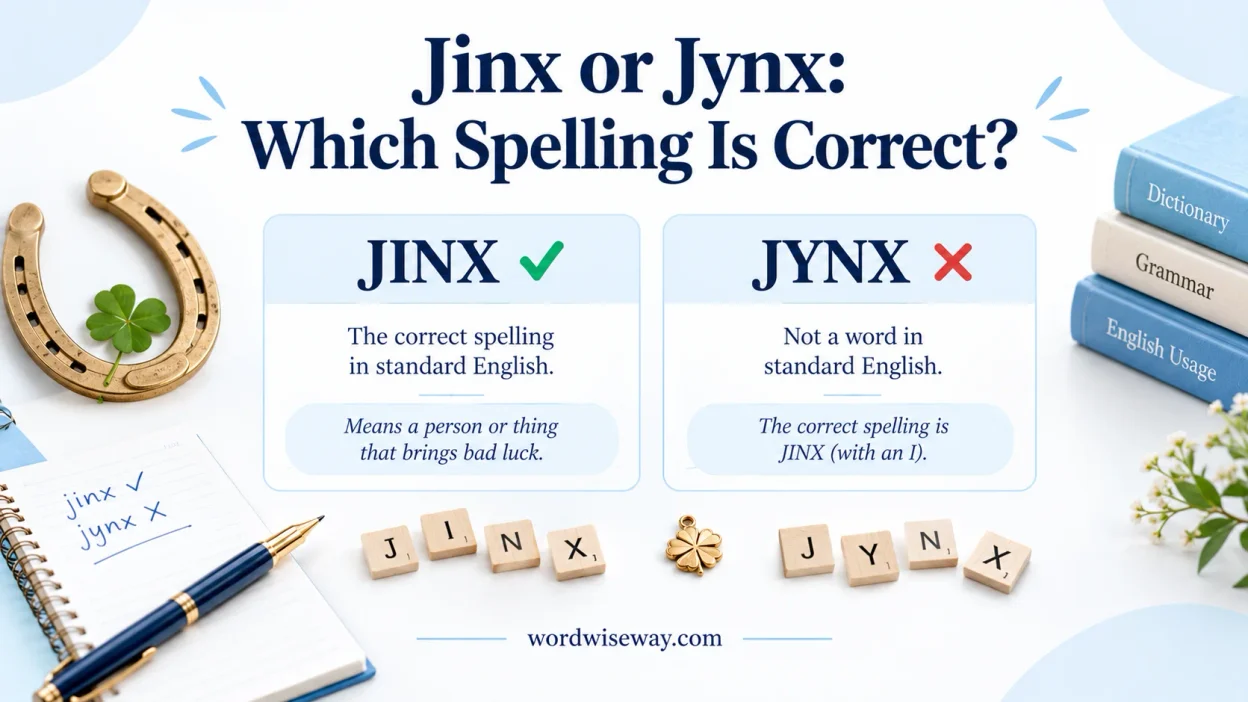
Jinx is the standard spelling of the English word meaning a person, thing, action, or situation associated with bad luck.
Jynx isn’t the standard spelling of that everyday English word. It can appear as a proper name, fictional name, username, brand name, or intentionally stylized spelling.
| Spelling | Standard English word? | Main use | Correct for ordinary bad luck? |
| Jinx | ✓ Yes | Noun and verb | ✓ Yes |
| Jynx | ✗ Not normally | Names and stylized uses | ✗ No |
For example:
- Don’t jinx our chances. ✓
- She thinks that necklace is a jinx. ✓
- I don’t want to jinx it. ✓
- Don’t jynx our chances. ✗
The simplest rule is straightforward: use jinx when you mean the ordinary English word.
What Does Jinx Mean?
The word jinx has a strong connection with superstition and bad luck. It can describe something believed to bring misfortune, someone thought to cause bad luck, or an action believed to spoil a favorable situation.
Interestingly, modern speakers don’t always use jinx seriously. The word often appears in playful conversation. Someone might say, “Don’t jinx it!” before an important event even when they don’t genuinely believe that words can control luck.
That flexibility gives jinx a useful place in everyday English.
Jinx as a Noun
As a noun, jinx refers to a person, thing, or circumstance associated with bad luck.
Consider this sentence:
That old superstition says the broken mirror is a jinx.
Here, jinx functions as a noun because it identifies the supposed source of misfortune.
You can also use the word for a person believed to bring bad luck:
Everyone jokingly called him a jinx after the team lost three games.
The speaker doesn’t necessarily claim that the person literally caused the losses. In casual English, jinx often carries a humorous or superstitious tone.
Other examples include:
- The losing streak made the players wonder whether they had a jinx.
- She blamed the jinx for another unlucky afternoon.
- They considered the old house a jinx.
- He joked that his lucky hat had become a jinx.
The exact meaning depends on context, but the underlying idea remains bad luck or an assumed source of bad luck.
Jinx as a Verb
Jinx also works as a verb. In this form, it means to bring bad luck to something or cause an outcome to go wrong through a supposed act of bad luck.
For example:
I don’t want to jinx our chances by celebrating too early.
Here, jinx describes the imagined act of causing a favorable outcome to fail.
The verb appears frequently in casual speech because it fits situations where people feel cautiously optimistic.
You might hear:
- Don’t jinx it.
- I think you jinxed us.
- Don’t say that or you’ll jinx the game.
- I hope I haven’t jinxed our plans.
- We were winning until someone said we couldn’t lose. They jinxed it.
In these examples, the word doesn’t necessarily express literal belief in supernatural forces. Often, it’s simply a playful way to say, “Don’t tempt fate.”
Common Expressions With Jinx
Some expressions have become especially common in conversational English.
Don’t jinx it means don’t say or do something that might supposedly cause a good situation to fail.
I don’t want to jinx it expresses caution about discussing a positive expectation too confidently.
You jinxed it jokingly blames someone after something goes wrong.
For example, imagine two friends watching a close game. One says, “We’re definitely going to win.” Moments later, the other team scores. The first friend might respond:
You jinxed it!
The statement usually isn’t a serious accusation. It’s a playful reaction to an unfortunate coincidence.
What Does Jynx Mean?
The spelling jynx causes confusion because it looks like a believable alternative to jinx. However, replacing the i with y doesn’t create a standard spelling variant.
When Jynx appears, it often functions as a proper name or stylized spelling rather than the ordinary word for bad luck.
That’s an important distinction.
Jynx as a Proper Name
A proper name can use an unusual spelling intentionally. Names don’t have to follow ordinary dictionary spelling patterns.
For instance, a fictional character could be named Jynx. A person could choose Jynx as a username. A creative project could use the spelling as part of its identity.
In those cases, changing Jynx to Jinx could actually create an error because the unusual spelling may be intentional.
This gives you a useful principle:
A spelling can be unusual without being a misspelling when it functions as a proper name.
The surrounding context tells you which interpretation makes sense.
Jynx vs. Jinx in Modern Usage
If you encounter Jynx online, don’t automatically assume the writer made a spelling mistake.
The word may represent:
- A character name
- A username
- A fictional identity
- A business or project name
- A stylized title
- A creative brand spelling
- Another proper noun
However, if someone writes about bad luck and uses jynx as an ordinary lowercase noun or verb, the standard spelling is jinx.
Compare these two situations:
Don’t jinx our chances.
This uses the standard English verb.
Jynx is the character’s name.
Here, the unusual spelling is intentional because it identifies a particular entity.
Key Differences
The difference becomes much clearer when you place both spellings side by side.
| Feature | Jinx | Jynx |
| Standard English word | ✓ Yes | ✗ No |
| Refers to bad luck | ✓ Yes | ✗ Not as the ordinary word |
| Works as a noun | ✓ Yes | ✗ Not normally |
| Works as a verb | ✓ Yes | ✗ Not normally |
| Common in everyday English | ✓ Yes | ✗ No |
| Can appear as a proper name | ✓ Yes | ✓ Yes |
| Can be intentionally stylized | ✓ Yes | ✓ Yes |
| Appropriate in formal writing for bad luck | ✓ Yes | ✗ No |
The key isn’t simply the letters I and Y. The real issue is function and context.
If you’re describing a supposed source of bad luck, choose jinx.
If you’re reproducing an intentional name spelled Jynx, preserve that spelling.
Why Do People Spell Jinx as Jynx?
English spelling often invites experimentation. People see familiar patterns and create alternatives that look distinctive, modern, or memorable.
Changing i to y can make a name look more unusual. That’s especially common in usernames, fictional names, creative projects, and stylized identities.
There’s another reason the mistake survives: jinx and jynx would normally be pronounced similarly in casual reading. Because the sound doesn’t immediately expose the spelling difference, people may encounter the word in conversation before seeing it written.
That creates a classic spelling trap.
Imagine hearing someone say a word repeatedly but never seeing it on a page. Your brain stores the sound first. When you finally write it, you may construct a spelling that looks reasonable rather than retrieving the conventional form.
That’s one reason jinx and jynx can become confused.
Creative Spelling vs. Standard Spelling
A creative spelling has a different job from a standard spelling.
Standard spelling helps readers recognize a conventional word quickly. Creative spelling helps distinguish a particular name or identity.
For example:
- jinx = the conventional English word
- Jynx = potentially an intentional name or stylization
Neither purpose should be confused with the other.
If you’re writing a school essay about superstition, use jinx. If you’re copying someone’s official name, preserve Jynx exactly as given.
How to Use Jinx in a Sentence
Once you know the meaning, using jinx becomes fairly simple. The word can describe a supposed source of bad luck or the act of causing that bad luck.
Jinx as a Noun
Use jinx as a noun when you’re naming the supposed source or condition of bad luck.
Examples:
- The team joked that the stadium was a jinx.
- She thought the necklace had become a jinx.
- He called himself a jinx after another unlucky result.
- They believed the old tradition carried a jinx.
In each sentence, jinx acts as a thing, person, or concept.
Jinx as a Verb
Use jinx as a verb when someone supposedly causes an unfavorable result.
Examples:
- Don’t jinx our plans.
- You jinxed the whole afternoon.
- I hope I didn’t jinx the result.
- Talking about victory too soon might jinx the team.
Notice how naturally the verb fits after a subject.
You jinxed it.
That’s one of the most recognizable everyday constructions.
Jinx as an Informal Expression
The phrase “Don’t jinx it” deserves special attention because it appears frequently in casual speech.
Suppose someone says:
“Everything is going perfectly.”
Another person might reply:
“Don’t jinx it.”
The second speaker means that talking too confidently about good fortune might supposedly cause the situation to change.
This idea connects jinx with the broader concept of tempting fate. The expression can be serious in a superstitious context, but it’s often humorous.
Jinx Pronunciation
Jinx is a one-syllable word.
Its pronunciation begins with the j sound and ends with the consonant cluster represented by -nx. The final sound combination can feel slightly compressed when spoken quickly.
Because Jynx uses the same basic letter pattern for its opening consonant and ending, people may pronounce the two spellings similarly when they encounter them as names.
However, pronunciation doesn’t determine standard spelling.
English contains countless words that share sounds while using different spellings. That’s why hearing jinx isn’t enough to decide whether the written form should contain i or y.
For standard English, the answer is jinx.
Jinx Plural and Related Forms
Knowing the related forms can prevent another set of spelling mistakes.
Plural Form: Jinxes
The plural of jinx is jinxes.
For example:
- The story contains several supposed jinxes.
- They blamed the team’s losses on different jinxes.
The ending -es makes the plural easier to pronounce.
Don’t write jinxs when you mean the standard plural.
Past Tense: Jinxed
The past tense of the verb jinx is jinxed.
Examples:
- You jinxed the game.
- She thought she had jinxed the celebration.
- His prediction supposedly jinxed their chances.
The spelling simply adds -ed.
Present Participle: Jinxing
The present participle is jinxing.
Examples:
- Stop jinxing everything before it happens.
- He worried that he was jinxing the team’s chances.
The spelling can look awkward because the letter sequence changes visually when -ing is added. Nevertheless, jinxing is the standard form.
Jinx or Jynx in Different Contexts
Context often solves the spelling puzzle before you even reach for a dictionary.
Talking About Bad Luck
When you mean bad luck, use jinx.
Correct:
That place has a reputation for being a jinx.
Incorrect as standard English:
That place has a reputation for being a jynx.
The first sentence uses the conventional noun.
Saying Someone Caused an Unfortunate Outcome
Use jinx when the word functions as a verb.
Correct:
Don’t jinx our chances.
The verb describes the supposed act of bringing bad luck.
Using a Name or Brand
A name may legitimately use Jynx.
If a character, username, company, or creative project officially uses Jynx, keep that spelling intact. Proper names often have deliberate spellings that differ from ordinary vocabulary.
In this context, correcting Jynx to Jinx could change the identity being referenced.
Writing for School or Professional Contexts
For formal writing, standard spelling matters even more.
If you’re discussing superstition, luck, sports, predictions, or unfortunate events, write jinx.
A sentence such as “You don’t want to jynx your chances” may look like a tiny typo, but small spelling errors can distract readers from otherwise strong writing.
The fix is simple:
Use jinx unless you’re intentionally referring to something named Jynx.
Common Mistakes
These errors usually come from treating jynx as though it were an ordinary spelling variant.
Mistake: Using Jynx for Bad Luck
Incorrect:
I don’t want to jynx the result.
Correct:
I don’t want to jinx the result.
Mistake: Assuming I and Y Are Interchangeable
English sometimes uses i and y in ways that can make spelling patterns unpredictable. That doesn’t mean you can swap them freely.
Words have established spellings. Jinx is the conventional form for this meaning.
Mistake: Changing an Intentional Name
If someone deliberately names a character Jynx, changing it to Jinx isn’t necessarily a correction.
For proper names, accuracy means preserving the chosen spelling.
Mistake: Thinking Pronunciation Determines Spelling
Two spellings can produce similar sounds while having different functions.
That’s why listening carefully won’t always solve the problem. You also need to understand what the word means and how you’re using it.
A Simple Case Study: Jinx or Jynx?
Consider this short scenario.
A student writes:
I hope I don’t jynx my chances of getting the opportunity.
The student means that saying something too confidently might cause bad luck.
The correct revision is:
I hope I don’t jinx my chances of getting the opportunity.
Now imagine a different sentence:
Jynx is the name of the fictional character.
In this case, Jynx should remain unchanged if that’s the character’s established name.
The spelling changes because the context changes, not because one spelling suddenly becomes universally correct.
This distinction is useful far beyond this particular word. English contains many unusual proper names that don’t follow ordinary spelling conventions.
Easy Way to Remember the Difference
Here’s the quickest memory trick:
Jinx = bad luck.
If you’re talking about something that might supposedly ruin your good fortune, choose jinx.
Think of the phrase:
Don’t jinx it.
That familiar expression locks the standard spelling into place.
Meanwhile, treat Jynx as a spelling that needs context. If it identifies a particular name or stylized term, preserve it exactly. If you’re simply trying to spell the ordinary word for bad luck, use jinx.
Read More: Disdain or Distain: Correct Spelling, Difference, and Usage
FAQs
Is Jinx the correct spelling in English?
Yes. Jinx is the standard spelling used in English when you mean bad luck, something believed to cause bad luck, or an action thought to bring bad luck.
Is Jynx a real English word?
Jynx appears as a proper name and in pop culture, but it isn’t the standard spelling of the everyday English word jinx. For normal writing, use jinx.
What does jinx mean?
A jinx can mean a person, thing, or situation believed to bring bad luck. As a verb, to jinx means to cause or supposedly cause something to go wrong through an unlucky action or statement.
What does “Don’t jinx it!” mean?
“Don’t jinx it!” is a playful warning. People say it when they think talking too confidently about a positive outcome might somehow cause it to fail.
Why do people spell jinx as Jynx?
The spelling Jynx can appear because of pop culture, fantasy names, usernames, and other creative contexts. Seeing it frequently can make the alternate spelling look correct.
Is Jynx related to Pokémon?
Yes. Jynx is the name of a Pokémon character. This familiar pop-culture use is one reason people may encounter Jynx even though jinx is the standard English spelling.
Can I use jinx in formal writing?
Yes. Jinx is a legitimate English word, so you can use it when the context calls for it. However, in professional writing, choose it only when its meaning fits the subject and tone.
Is jinx a noun or a verb?
Jinx works as both a noun and a verb. As a noun, it can refer to bad luck or something believed to cause it. As a verb, it means to bring or supposedly bring bad luck to something.
What is the difference between jinx and Jynx?
The main difference is context. Jinx is the standard English word, while Jynx is generally used as a name or creative spelling, including the Pokémon name.
How can I remember the correct spelling of jinx?
For ordinary English, remember the simple form J-I-N-X: jinx. If you’re writing about a specific name, character, or pop-culture reference spelled Jynx, keep that spelling instead.
Conclusion
Choosing between jinx or Jynx becomes straightforward once you focus on context. Jinx is the correct spelling for the standard English word connected with bad luck, superstition, and playful warnings. Jynx, meanwhile, belongs mainly to names and pop-culture references, so using it in ordinary English can create unnecessary confusion.
Whether you’re writing a caption, completing an exam, or preparing professional communication, jinx is the form you should normally choose. Remember the familiar phrase “Don’t jinx it!” and you’ll have a useful everyday example of how the word works as both a noun and a verb.
Once you understand the spelling, meaning, and usage, this small English distinction no longer needs to trip you up. Keep jinx for standard English, check the context when you encounter Jynx, and you’ll avoid one more surprisingly persistent spelling mistake.

Amelia Sanders has spent 14 years in Harvard University’s English Department, helping students navigate literary analysis, interpretive theory, and narrative techniques. Her academic pursuits center on 18th-century British prose, romantic poetry, diasporic writing, and digital editing exploring how textual choices influence cultural perspectives. Amelia has spoken at major international meetings and contributed essays to respected academic volumes, demonstrating her dedication to thoughtful scholarship and effective teaching.