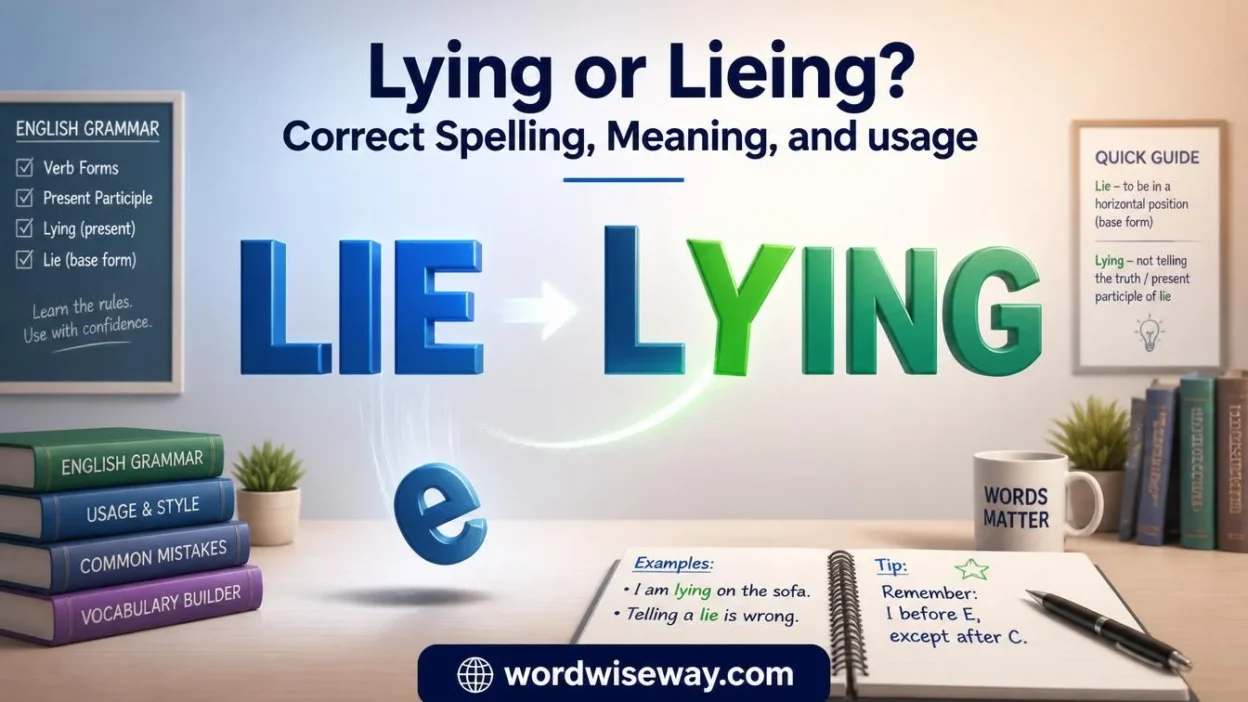
Many people search for Lying or Lieing? Correct Spelling, Meaning, and usage because both spellings look possible, but only one is correct in English.
This commonly misspelled word creates confusion among learners and native speakers because English spelling rules contain minor intricacies. The quick answer is that Lying is the Correct Spelling, while Lieing is an inaccurate word and a common misspelling that is not accepted in standard English. This spelling mistake often appears in writing, including an email, blog post, exam answer, or social media caption, where accurate professional writing improves your confidence.
The verb lie has multiple meanings and multiple uses, which explains the reason behind this term. It can mean telling an untruth or resting and recline in a flat position. When we change verbs by adding -ing, English sometimes drops letters, which explains why lie + ing becomes lying, not lieing. This article explains the difference, meaning, and usage of these words through simple examples, history, British rules, American rules, and real-life usage to help you use the correct spelling naturally in your everyday writing and writing bank.
Quick Answer:
Let’s get straight to it.
- Correct spelling: lying
- Incorrect spelling: lieing
Here’s the simple rule you need to remember:
When a verb ends in “ie,” you replace “ie” with “y” before adding “-ing.”
So:
- lie → lying ❌ not lieing
- die → dying
- tie → tying
That’s the whole secret hiding behind years of confusion.
But understanding why this rule exists makes it stick permanently. So let’s go deeper.
Understanding “Lie” in Lying or Lieing
Before we fix the spelling, we need to understand the word itself. “Lie” is one of those tricky English verbs that carries two completely different meanings.
Lie meaning: to not tell the truth
This is the meaning most people think of first.
- Example: He is lying about where he was last night.
- Meaning: He is being dishonest.
This form turns into lying in the present participle.
Lie meaning: to recline or rest
This one confuses even native speakers sometimes.
- Example: She is lying on the couch after a long day.
- Meaning: She is resting horizontally.
Same spelling rule applies here too.
Why two meanings matter in “Lying or Lieing?”
Both meanings:
- Use the same spelling rule
- Become lying, not “lieing”
- Follow identical grammar transformations
English loves words that behave like twins with different personalities. “Lie” is one of them.
Why “Lieing” Incorrect in Lying or Lieing
At first glance, “lieing” looks logical. You just add “ing” to the base word, right?
Not quite.
English spelling has hidden pattern rules that override intuition.
The hidden rule
When a verb ends in “-ie”, the structure changes before adding “-ing”:
- “ie” becomes “y”
- Then “-ing” is added
So:
- lie → lying
- die → dying
- tie → tying
Why English does this
The reason is pronunciation and readability.
If we wrote:
- lieing
It would create:
- awkward double vowel noise
- confusion in speech-to-text flow
- inconsistent spelling patterns across similar verbs
English tries (not always successfully) to keep spelling predictable.
Grammar Rule Behind Lying or Lieing
Let’s formalize it so it becomes crystal clear.
Rule: Verbs ending in “ie”
| Base Verb | Correct -ing Form | Incorrect Form |
| lie | lying | lieing ❌ |
| die | dying | dieing ❌ |
| tie | tying | tieing ❌ |
| vie | vying | vieing ❌ |
What’s happening here?
- The “ie” ending is replaced with “y”
- Then the “-ing” suffix attaches
- The base spelling changes slightly to protect pronunciation flow
This is not random. It’s a preserved historical spelling rule in English.
Why People Mistype “Lieing” in Lying or Lieing
This mistake is extremely common. And there are clear reasons for it.
Overgeneralization of “just add -ing”
Most verbs behave like this:
- play → playing
- run → running
- walk → walking
So people assume:
- lie → lieing (wrong pattern applied)
Visual confusion
“Lie” looks like it should follow “die”:
- die → dying
- lie → lieing (expected, but incorrect)
Your brain tries to match patterns even when English refuses to cooperate.
Fast typing culture
In texting and social media:
- spelling gets rushed
- autocorrect sometimes misses errors
- people copy incorrect versions without noticing
Memory Tricks for Lying or Lieing
Let’s lock this into memory so it doesn’t slip again.
Trick 1: The “Drop the E, Add Y” rule
Think of it like a small transformation:
- lie → remove “e” → ly → add “ing” → lying
Simple, clean, reliable.
Trick 2: The rhyme method
“If it ends in I-E, change it to Y before the -ing spree.”
A little silly. Very effective.
Trick 3: Visual image trick
Picture the word “lie” falling apart:
- the “e” drops off
- the remaining “li” stretches into “ly”
- “ing” attaches like a tail
Now you’ve got lying.
Real Examples of Lying or Lieing
Let’s see how this works in real life, not just grammar books.
Everyday communication
- Stop lying about it.
- I was lying down when you called.
Both are correct. Both natural.
Social media mistakes (real-world pattern)
Incorrect:
- “He is lieing again.”
Correct:
- “He is lying again.”
This mistake appears often in comments and posts because people type quickly and rely on intuition instead of rules.
Professional writing impact
In formal settings:
- emails
- academic essays
- reports
- job applications
A spelling error like “lieing” can:
- reduce credibility
- signal weak attention to detail
- distract the reader
Even if your idea is strong, small errors can blur the message.
Case Study: Why One Small Spelling Error Matters
Let’s imagine two candidates applying for a communication role.
Candidate A:
Writes:
“I believe honesty matters and I am always lying in my reports.”
Candidate B:
Writes:
“I believe honesty matters and I am always truthful in my reports.”
Now imagine Candidate A actually meant “lying” but typed it correctly in grammar but used “lieing” instead.
What happens?
- Recruiter notices inconsistency
- Trust slightly drops
- Attention shifts from ideas to errors
Even one spelling mistake can shift perception.
This is why Lying or Lieing? Which One Is Correct matters more than it seems.
Does It Really Matter If You Write “Lieing”?
Yes and no.
Informal situations
- texting friends
- casual chat
- quick replies
People will understand you.
Formal situations
- exams
- professional writing
- published content
Mistakes can affect:
- credibility
- readability
- trustworthiness
Common Confusions Related to Lying or Lieing
This confusion often comes with other tricky verb pairs.
Lie vs Lay
- lie → to rest
- lay → to place something down
Example:
- I lie down every night.
- I lay the book on the table.
Lying vs Laying
- lying → resting or not telling truth
- laying → placing something
Incorrect common usage:
- “I am laying on the bed.” ❌
Correct: - “I am lying on the bed.” ✅
Quick Cheat Sheet for Lying or Lieing
Here’s your instant reference guide:
- lie → lying
- die → dying
- tie → tying
- vie → vying
- lay → laying
Rule to remember:
If it ends in “ie,” change it to “y” before adding “-ing.”
Read More: Supercede or Supersede: Correct Spelling, Meaning, and Usage
FAQs
Q1. Is “Lying” or “Lieing” the correct spelling?
The correct spelling is Lying. The word Lieing is a common misspelling and is not accepted in standard English. You should always use Lying in formal and everyday writing.
Q2. Why do people confuse Lying with Lieing?
People confuse these words because English spelling rules can have many small details. Since the verb lie changes when adding -ing, many people think lie + ing becomes lieing, but the correct form is lying.
Q3. What does the word “Lying” mean?
Lying has two main meanings. It can mean telling an untruth, or it can describe someone resting or being in a flat position.
Q4. Is Lieing a real word in English?
No, Lieing is not considered a correct English word. It is an inaccurate spelling that happens because of misunderstanding English verb changes.
Q5. How does the verb “lie” change into “lying”?
When the verb lie takes the -ing form, the final e changes, creating lying instead of lieing. This follows English spelling patterns.
Q6. Can Lying be used in professional writing?
Yes, Lying can be used in professional writing, including emails, articles, reports, and other documents, as long as it matches the intended meaning.
Q7. What is the difference between lying and resting?
Lying can mean saying something untrue, while it can also mean resting or reclining in a flat position. The meaning depends on the context of the sentence.
Q8. Do British and American English use the same spelling for Lying?
Yes, both British English and American English use Lying as the correct spelling. There is no spelling difference between the two forms.
Q9. How can I remember the correct spelling of Lying?
A simple way to remember it is that lie + ing changes to lying. Avoid adding an extra “e” because Lieing is a common spelling mistake.
Q10. Why is correct spelling important in everyday writing?
Correct spelling helps your writing look clear and professional. Using the right words in emails, blog posts, exams, and captions improves readability and builds confidence.
Conclusion
Understanding the difference between Lying and Lieing helps you avoid a common spelling mistake in everyday and professional writing. The correct form is always Lying, whether you mean telling an untruth or resting in a flat position. Learning how the verb lie changes with the -ing form makes it easier to follow English spelling rules and use the right word with confidence.
Using correct spelling improves the quality of your emails, blog posts, exam answers, and other written work. Once you remember that lie + ing becomes lying, not lieing, you can easily avoid confusion and write with better accuracy in different situations.

Emma Smith has dedicated 14 years to Princeton University’s English Department, mentoring students in textual interpretation, literary movements, and critical frameworks. Her research explores Shakespearean drama, Victorian serial fiction, postcolonial narrative theory, and manuscript studies and probing how literary forms evolve across cultures and centuries. Emma has delivered lectures at international humanities congresses and published findings in distinguished academic journals, underscoring her commitment to scholarly depth and vibrant teaching.