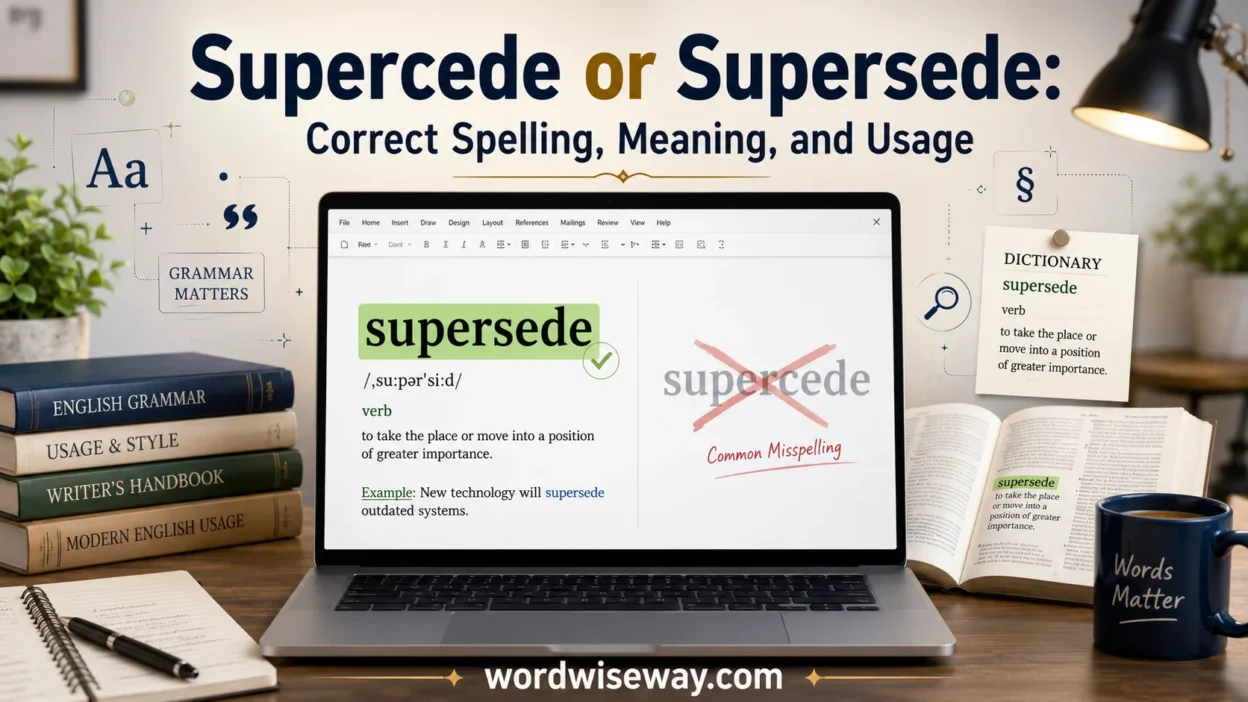
Supercede or Supersede: Correct Spelling, Meaning, and Usage helps explain why supersede is the correct spelling.
While paused during writing an email, article, or document, many writers have wondered about this commonly confused spelling pair. The English language creates confusion because experienced writers and professionals sometimes follow common spelling rules and naturally assume supercede is correct.
Spellcheck tools may not fully explain this mistake. The Supersede vs Supercede confusion occurs due to similar-looking verbs like precede and concede with the -cede pattern. However, supersede is the proper word, while supercede is a common spelling error.
The meaning of supersede is to take the place of something or someone that is no longer effective, valid, or relevant. It means replacing something in different contexts, such as a new law replacing an old law or new technology replacing outdated systems. Correct usage improves communication, language clarity, and accuracy in professional writing. British English and American English both use supersede.
Quick Answer:
The confusion between supercede or supersede: which spelling is correct comes from how English borrows structure from Latin but doesn’t always stay consistent.
People often assume:
- “cede” means “to go before”
- so “supercede” feels natural
But English says otherwise.
The standard accepted form in all major dictionaries is:
- Supersede ✔
And the incorrect form is:
- Supercede ✘
Even professional writers sometimes slip up because the mistake looks visually convincing. That makes this spelling trap especially sticky.
Supersede or Supercede: Comparison Table
Let’s make the difference crystal clear.
| Feature | Supersede | Supercede |
| Correct spelling | Yes | No |
| Accepted in dictionaries | Yes | No |
| Used in formal writing | Yes | Never |
| Found in academic texts | Yes | No |
| Common mistake frequency | Moderate | High |
| Meaning clarity | Clear and standard | Confusing |
What Does Supersede Mean in Simple Terms?
The word supersede means:
- To replace something older or less effective
- To take the place of something else
- To become the new version or authority
Think of it like upgrading your phone. The new model doesn’t just appear. It supersedes the old one.
Simple examples:
- “The new app supersedes the older version.”
- “Digital payments are superseding cash in many places.”
- “This rule supersedes all previous instructions.”
Notice how the word always carries a sense of replacement or replacement with authority.
Why People Get Confused Between Supercede and Supersede
Let’s break down the real reasons behind this spelling confusion.
1. Influence of similar words
Words like:
- precede
- recede
- secede
All use “cede,” so people assume supersede follows the same rule.
But English often breaks its own patterns.
2. Sound-based spelling guess
When you hear supersede, it sounds like:
- super + seed or super + seede
So many writers naturally choose “supercede” because it feels phonetic.
3. Autocorrect reinforcement
Some older documents and incorrect online content still use “supercede.”
This spreads the error further through autocorrect suggestions and repetition.
4. Lack of formal correction in casual writing
In messaging apps or informal writing, spelling errors survive longer. That builds habit.
The Real Origin of Supersede
To truly understand supercede or supersede – which spelling is correct, we need to look at where the word comes from.
The word originates from Latin:
- super = above or over
- sedere = to sit
So the original idea was:
“to sit above something and replace it”
That meaning evolved into modern English usage where one thing takes the place of another.
Over time, spelling shifted into supersede, not “supercede,” even though the pronunciation stayed similar.
This table alone is enough to settle the debate in most writing situations.
How to Remember the Correct Spelling Easily
If you keep forgetting supercede or supersede – which spelling is correct, try these memory tricks.
Trick 1: The “super + seed” idea
Think of “supersede” like planting a new seed that replaces the old one.
New seed replaces old growth. New version replaces old system.
Trick 2: Link it with “sede = sit”
Remember:
- “sede” comes from Latin meaning sit
- supersede = sit above and replace
Trick 3: Break it into sound chunks
Say it slowly:
- su-per-seed
Your brain will naturally resist “super-cede” once it hears the rhythm correctly.
Real-World Usage Examples of Supersede
Let’s see how professionals actually use the word.
Technology
- “The new operating system supersedes the previous version due to better security.”
Law
- “This amendment supersedes all earlier clauses in the agreement.”
Business
- “The revised contract supersedes the original contract signed in 2022.”
Education
- “The updated syllabus supersedes last year’s curriculum.”
Each example shows replacement with authority or improvement.
Common Mistakes Around Supersede
People who struggle with supercede or supersede – which spelling is correct often also make related errors.
Mixing with similar words:
- precede (come before)
- exceed (go beyond)
- proceed (move forward)
These look similar but behave differently.
Overcorrecting mistakes
Some writers try too hard and create:
- supercede
- supersed
- superseed
Only one survives formal grammar:
supersede
Case Study: Why Spelling Accuracy Matters in Real Writing
Let’s look at a real-world scenario.
Scenario: Business contract email error
A marketing manager writes:
“This agreement supercedes all previous contracts.”
At first glance, the meaning is clear. But in formal review:
- Legal team flags spelling error
- Document gets delayed
- Revision required before approval
Result:
- Small spelling mistake causes workflow delay
- Professional credibility takes a hit
Now compare with correct usage:
“This agreement supersedes all previous contracts.”
No delays. No corrections. Smooth approval.
This shows how supercede or supersede – which spelling is correct is not just grammar trivia. It has real consequences.
Why Correct Spelling Matters More Than You Think
Spelling is not just about rules. It affects perception.
1. Professional trust
Correct spelling signals attention to detail.
2. Academic performance
Exams often penalize spelling errors even when meaning is correct.
3. Online visibility
Search engines prefer correct spelling patterns for clarity.
4. Legal clarity
Contracts rely on precise wording to avoid ambiguity.
Quick Summary for Fast Readers
If you’re short on time, remember this:
- Correct spelling: supersede
- Incorrect spelling: supercede
- Meaning: to replace or take over
- Origin: Latin “super” + “sedere”
- Common mistake reason: confusion with “precede”
That’s it. Simple and clean.
Deep Dive Insight: Why English Keeps These Odd Spellings
English borrows words from Latin, French, and Germanic roots. But it rarely preserves spelling rules consistently.
That’s why we get:
- supersede instead of supercede
- receive instead of recieve
- believe instead of beleive
The language evolves through usage, not logic. That makes spelling irregular but stable over time.
So when you ask supercede or supersede – which spelling is correct, you are really seeing history in action.
Practical Writing Tips to Avoid the Mistake Forever
Here are a few habits that help:
- Turn on grammar tools while writing
- Keep a personal list of commonly misspelled words
- Practice writing the word in full sentences
- Read your text aloud before sending
- Trust dictionary spelling over intuition
Consistency beats memorization alone.
Read More: Receive or Recieve: Correct Spelling, Meaning, and Usage
FAQs
Q1. Why is supersede the correct spelling and not supercede?
Supersede is the correct spelling because it is the officially accepted English word. Supercede is a common spelling mistake caused by confusion with words like precede and concede that use the -cede pattern.
Q2. What does the word supersede mean?
Supersede means to replace something that is old, outdated, ineffective, or no longer valid. It shows that something new has taken the place of something existing.
Q3. Why do people often write supercede by mistake?
People often write supercede because the spelling looks natural when compared with similar words ending in -cede. This creates a false spelling pattern in the minds of many writers.
Q4. Is superseed a correct English word?
No, superseed is not a correct English word. The proper word is supersede, which should be used when describing replacement or taking someone’s place.
Q5. Can supersede be used in professional writing?
Yes, supersede is commonly used in professional English, including emails, legal documents, technical reports, and formal articles where accuracy matters.
Q6. What is the difference between supersede and replace?
Both words show a change, but supersede often suggests that something new replaces an older or less effective thing, while replace has a broader meaning.
Q7. Do British English and American English use different spellings of supersede?
No, both British English and American English use the same spelling: supersede. There is no regional spelling difference.
Q8. How can writers remember the correct spelling of supersede?
Writers can remember that supersede contains “sede” instead of “cede” at the end. Checking reliable dictionaries can also help prevent spelling errors.
Q9. What are some examples of things that can supersede each other?
Examples include a new law superseding an old law, new technology superseding outdated technology, or a better system superseding an older one.
Q10. Why is using the correct spelling of supersede important?
Using the correct spelling improves language clarity, shows professionalism, prevents misunderstandings, and helps readers understand the intended meaning accurately.
Conclusion:
A clear understanding of supersede helps writers avoid one of the most common spelling mistakes in English. Although supercede may look correct because of similar words like precede and concede, only supersede is the accepted form. Using the right spelling in emails, articles, documents, and professional writing improves accuracy and keeps communication clear.
Learning the difference between supersede, supercede, and superseed makes your writing more confident and effective. Whether you are creating a legal document, technical report, or everyday message, choosing the correct word helps you express the idea of replacement properly and maintain strong language skills.

Amelia Sanders has spent 14 years in Harvard University’s English Department, helping students navigate literary analysis, interpretive theory, and narrative techniques. Her academic pursuits center on 18th-century British prose, romantic poetry, diasporic writing, and digital editing exploring how textual choices influence cultural perspectives. Amelia has spoken at major international meetings and contributed essays to respected academic volumes, demonstrating her dedication to thoughtful scholarship and effective teaching.