Let’s vs Lets: Correct Spelling, Usage, and Difference helps writers understand why these two forms create confusion.
Contractions often confuse beginning writers and experienced writers because small changes like an apostrophe can change meaning. Let’s is a contraction of let us and is used for suggestions, while lets is a verb that means allow or permit. These words are not interchangeable, and choosing the correct one improves grammar, spelling, and writing clarity.
For example, let’s appears in invitations and suggestions, while lets shows permission in sentences like “She lets her cat outside every morning.” Understanding this distinction helps English learners and native speakers avoid common mistakes in academic writing, professional writing, emails, and social media posts. Good word usage improves communication and language skills.
Quick Answer
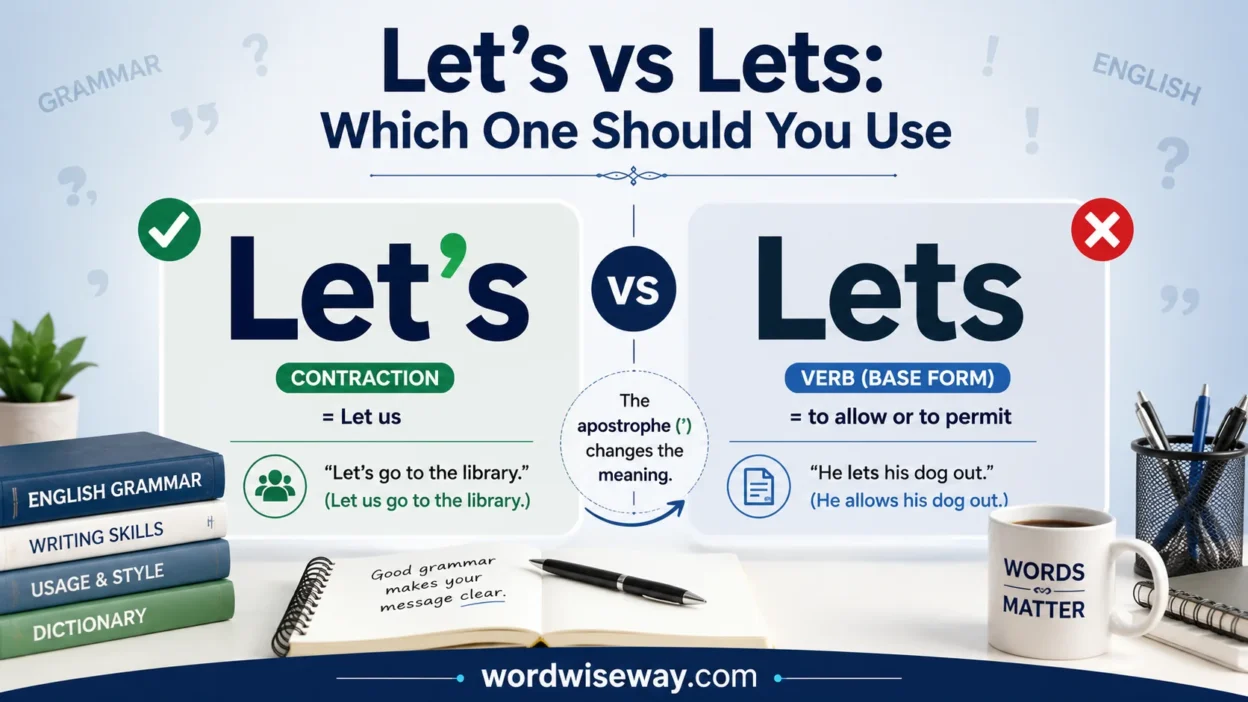
Understanding Let’s vs Lets becomes easier when you notice the small apostrophe. That tiny mark works like a grammar signpost and tells you that the meaning has changed. ✨
- 📝 Let’s = Let us
It is a contraction used for suggestions, invitations, or ideas.
Example: Let’s go for a walk. - ✅ Lets = Allows or permits
It is a verb that shows someone gives permission.
Example: She lets her brother use her laptop. - 🔍 Easy Trick to Remember
If you can replace the word with “let us,” use let’s. If the meaning is allowing something, use lets. - 📚 For Better Writing
Knowing the difference helps avoid grammar mistakes in emails, academic writing, and professional communication.
A small apostrophe can create a big difference in meaning, so checking this detail makes your sentences clearer and more accurate. 🌟
Let’s vs Lets Which One Should You Use: The Core Difference in Plain English
Let’s cut straight through the confusion.
- Let’s = contraction of let us
- Lets = a verb meaning allows or permits
That’s it. Everything else builds from that foundation.
So when you write:
- Let’s study → You are inviting someone to study with you
- She lets him study → She allows him to study
The meaning changes based on one thing: the apostrophe.
Think of the apostrophe as a “shortcut signal.” It tells your reader, “two words were merged here.”
Without it, you’re no longer in contraction territory. You’ve entered full verb grammar mode.
Understanding “Let’s” in Let’s vs Lets (Let Us in Disguise)
What “Let’s” Actually Means
“Let’s” is short for let us, but in modern English, nobody says “let us go” in casual speech unless they’re being formal or dramatic.
Instead, we naturally say:
- Let’s go
- Let’s eat
- Let’s talk
It signals shared action. It pulls people into a group decision.
Where You Use “Let’s”
You use “let’s” when:
- You’re making a suggestion
- You’re inviting someone
- You want group action
Examples That Show Real Usage
- Let’s finish this project before dinner
- Let’s watch a movie tonight
- Let’s not argue over small things
Notice something important. “Let’s” always includes the speaker. It is never about control. It’s about inclusion.
Why the Apostrophe Exists
The apostrophe in let’s replaces the missing letters in “us.”
So:
- let us → let’s
- It is not optional. 2. It is not stylistic. 3. It is grammatical structure.
Without it, meaning shifts entirely.
Tone and Feeling Behind “Let’s”
“Let’s” has emotional weight. It feels:
- Friendly
- Cooperative
- Encouraging
- Lightly persuasive
It’s one of the most social words in English because it builds shared intention.
Understanding “Lets” in Let’s vs Lets (The Permission Verb)
What “Lets” Means in Grammar
Now switch gears completely.
“Lets” is the third-person singular form of the verb let, which means:
- to allow
- to permit
- to give permission
This version does NOT include the speaker in action. It describes what someone else allows.
Sentence Pattern You Should Recognize
The structure usually looks like this:
Subject + lets + object + verb
For example:
- She lets her brother drive her car
- The app lets users save files offline
- The teacher lets students leave early
Where You Commonly See “Lets”
You’ll find “lets” in:
- Instructions
- Rules
- Descriptions of systems
- Everyday storytelling
Tone of “Lets”
Unlike “let’s,” this version feels:
- Neutral
- Functional
- Descriptive
- Non-emotional
It simply states what happens. No invitation. No inclusion.
A Simple Way to Picture It
Think of “lets” like a gatekeeper.
Someone is standing at a door saying:
“You can go in.”
That’s “lets.”
Side-by-Side Comparison
Here’s a quick breakdown that locks the difference into your memory.
| Word | Grammar Type | Meaning | Example Sentence |
| Let’s | Contraction (let us) | Suggests or invites action | Let’s go outside |
| Lets | Verb (third person) | Allows or permits action | He lets her speak freely |
This table alone solves most confusion instantly.
But let’s go deeper so it sticks permanently.
Fast Test Methods to Master Let’s vs Lets Without Thinking
The Replacement Trick (Most Reliable Method)
Replace let’s with “let us.”
- Let’s go → Let us go (works)
- She lets him go → She let us him go (does not work)
So:
- If replacement works → use let’s
- If it fails → use lets
This is the fastest grammar filter you can use.
The Subject Clue Method
Look at the subject of the sentence.
- If subject is I, we, you → likely “let’s”
- If subject is he, she, it, or name → likely “lets”
Examples:
- We should leave → Let’s leave
- She allows him to leave → She lets him leave
The Meaning Check Method
Ask yourself:
- Am I inviting someone? → use “let’s”
- Am I describing permission? → use “lets”
It’s a mindset shift more than memorization.
Common Mistakes in Let’s vs Lets Usage
Even fluent writers mix these up sometimes. Here’s where things go wrong.
1: Using “lets” in invitations
- Wrong: Lets go to the park
- Right: Let’s go to the park
2: Adding apostrophe everywhere
- Wrong: She let’s him play
- Right: She lets him play
3: Treating both as interchangeable
They are not interchangeable at all. Meaning collapses if you swap them randomly.
4: Writing how it sounds in speech
People often skip apostrophes in texting. That habit leaks into formal writing.
Real-Life Scenarios Where Let’s vs Lets Confusion Happens
Social Media Captions
People often write:
- “lets hang out”
Correct version:
- “let’s hang out”
Why it matters:
Captions set tone. One apostrophe changes friendliness.
School Writing
Students often confuse:
- “The teacher lets us go early”
- “Let’s go early”
One is permission. The other is suggestion.
Teachers mark this because it changes meaning completely.
Work Emails
Professional writing needs precision:
- Let’s schedule a meeting → collaboration
- The system lets users log in → functionality
Mixing them can confuse instructions.
Gaming and Online Chat
Fast typing leads to shortcuts:
- lets play (common typo)
- let’s play (correct invitation)
Even small errors affect clarity in team communication.
Mini Practice Section: Quick “Let’s vs Lets” Check
Try these mentally before looking at answers.
Fill in the blanks:
- ___ go to the beach tomorrow
- She ___ her dog sleep on the couch
- ___ not waste time
- The app ___ you customize settings
Answers:
- Let’s go to the beach tomorrow
- She lets her dog sleep on the couch
- Let’s not waste time
- The app lets you customize settings
If you got all right, your brain is already adapting to the pattern.
Why Let’s vs Lets Confusion Happens in English
English creates confusion here for a few reasons.
Contractions are everywhere
English loves shortening words:
- do not → don’t
- is not → isn’t
- let us → let’s
Spoken English hides structure
When people speak, they rarely notice apostrophes or grammar breaks.
Context does most of the work
English often relies on meaning instead of strict word forms.
So your brain guesses instead of analyzing. That’s where errors creep in.
Real Case Study: How a Small Apostrophe Changed Meaning
A student once wrote in a class announcement:
- “lets eat students”
What they meant:
- “Let’s eat, students”
What it looked like:
- A terrifying suggestion about eating students
One missing apostrophe completely flipped meaning.
This is why let’s vs lets is not just grammar. It’s clarity and safety in communication.
Final Clarity Rule for Let’s vs Lets
Here’s the simplest rule you need:
- If it means “let us” → use let’s
- If it means “allows someone” → use lets
That’s it. No extra layers needed.
Bonus Insight: Why Mastering Let’s vs Lets Improves Your Writing
Getting this right does more than fix grammar.
It improves:
- Professional communication
- Academic writing accuracy
- Clarity in messages
- Reader trust
People subconsciously trust writers who handle small details correctly.
And this tiny apostrophe is one of those details.
Read More: Loses or Losses: Correct Spelling, Meaning, and Usage
FAQs
1. What is the main difference between let’s and lets?
Let’s is a contraction of “let us” and is used for suggestions or invitations. Lets is a verb that means allowing or permitting something.
2. Is let’s always written with an apostrophe?
Yes, let’s always includes an apostrophe because it combines the words let and us into a shorter form.
3. Can lets and let’s be used interchangeably?
No, they cannot be exchanged. They have different meanings and perform different roles in a sentence.
4. How can I quickly remember the use of let’s?
Try replacing let’s with let us. If the sentence still makes sense, then let’s is the correct choice.
5. What type of word is lets?
Lets is a verb. It describes an action where someone allows or gives permission for something.
6. Why do writers confuse lets and let’s?
Many writers confuse them because both words sound the same when spoken. The apostrophe is the only visible difference.
7. Is let’s used in formal writing?
Yes, let’s can be used in formal writing when making suggestions, but writers should consider the style and purpose of the document.
8. What is an example sentence with lets?
“She lets her children play outside after school.” Here, lets means allows.
9. What is an example sentence with let’s?
“Let’s discuss this idea tomorrow.” Here, let’s means “let us” and suggests an action.
10. Why is understanding lets and let’s important?
Knowing the difference improves grammar accuracy, writing clarity, and communication skills, especially in academic and professional writing.
Conclusion
Understanding let’s vs lets is a small but important step toward better English writing. Although both words sound identical, their meanings are completely different. The apostrophe in let’s shows that it is a contraction of let us, while lets works as a verb that expresses permission or allowance.
Once you learn this simple difference, you can avoid common grammar mistakes and write with more confidence. Whether you are preparing emails, academic work, social media posts, or professional documents, using the correct form helps your message stay clear and effective.

Emma Smith has dedicated 14 years to Princeton University’s English Department, mentoring students in textual interpretation, literary movements, and critical frameworks. Her research explores Shakespearean drama, Victorian serial fiction, postcolonial narrative theory, and manuscript studies and probing how literary forms evolve across cultures and centuries. Emma has delivered lectures at international humanities congresses and published findings in distinguished academic journals, underscoring her commitment to scholarly depth and vibrant teaching.