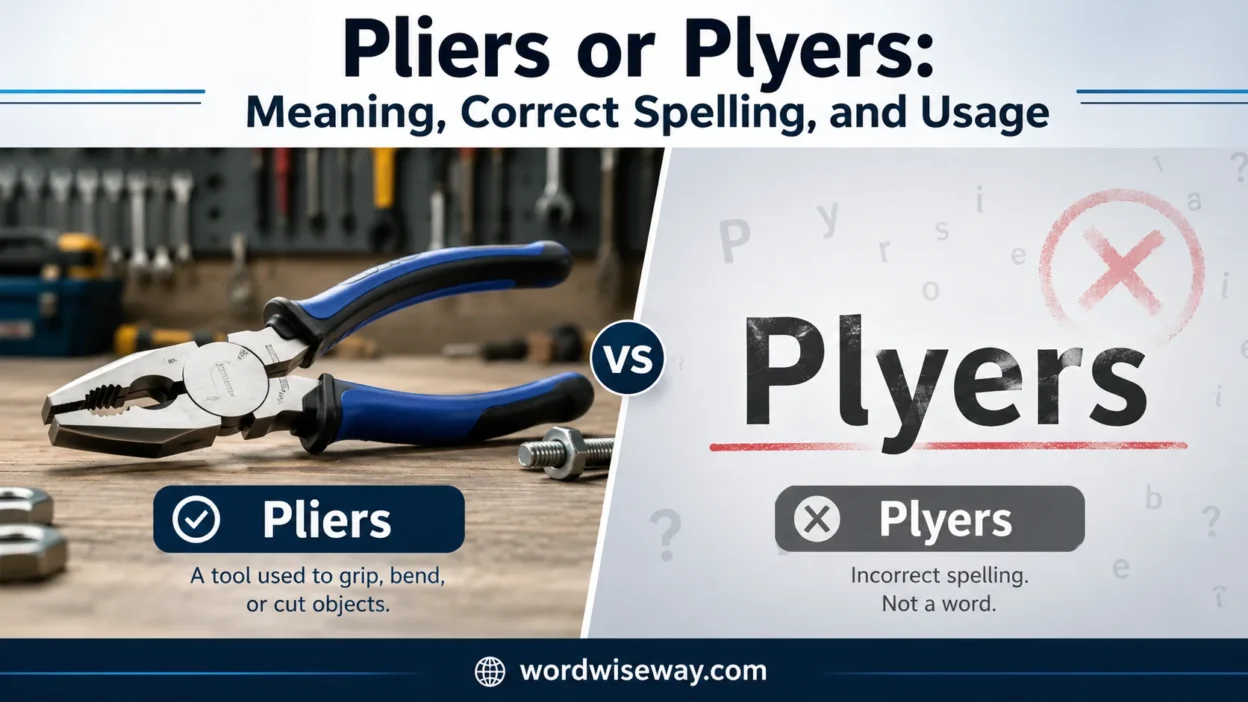
If you’ve searched for “Pliers vs Plyers?”, you’re not alone. This is a common spelling mistake that appears in school assignments, DIY guides, technical documents, and everyday writing. The correct spelling is pliers, while plyers is a nonstandard misspelling that is not accepted in modern English dictionaries or professional style guides.
Small spelling errors can have a surprisingly large impact on how your writing is perceived. Whether you’re preparing a business document, writing a product description, or creating educational content, using the correct terminology improves clarity, professionalism, and credibility.
This guide explains the difference between pliers and plyers, why the confusion happens, how to remember the correct spelling, and when to use the word confidently in both American and British English. You’ll also find practical examples, common mistakes to avoid, and a simple memory trick to help you remember the correct form every time.
Quick Answer or Comparison Table
| Feature | Pliers | Plyers |
| Standard spelling | Yes | No |
| Tool reference | Yes | No |
| Used in engineering | Yes | No |
| Accepted in dictionaries | Yes | Rare/archaic only |
| Recommended usage | Always | Avoid |
Meaning Pliers Vs Plyers
Pliers are a handheld tool used for gripping, bending, twisting, and cutting wires or other small materials. Plyers is a common misspelling and should be avoided in modern English. Whether you’re writing about DIY projects, engineering, or everyday tools, pliers is the only correct spelling in both US and UK English.
Truth Behind the Confusion
If you only remember one thing from this article, make it this:
👉 “Pliers” is the correct spelling for the hand tool.
👉 “Plyers” is almost always a spelling mistake.
That’s it. Simple.
But the interesting part is why people get it wrong so often. The answer sits in sound, typing habits, and how English quietly plays tricks on your brain.
Before we go deeper, let’s understand what “pliers” actually are in real life.
Pliers Meaning: What “Pliers” Actually Refers To
When we talk about pliers, we are not talking about grammar or abstract language. We are talking about a physical tool you’ve probably seen in a toolbox, garage, or repair kit.
Definition of Pliers
Pliers are a hand tool designed to:
- Grip objects firmly
- Bend or twist materials
- Cut wires or small metal parts
They usually have two handles joined by a pivot point, allowing you to apply force with precision.
A simple way to think about them:
“Pliers are like mechanical fingers that never get tired.”
Common Uses of Pliers in Real Life
You’ll find pliers in almost every repair situation. Here are some everyday uses:
- Fixing electrical wiring
- Bending metal hooks or wires
- Removing nails or pins
- Holding hot or sharp objects safely
- Jewelry making and crafting
- Plumbing adjustments
Even if you never think about tools much, someone in your home has likely used them recently.
Types of Pliers You Might See
Not all pliers are the same. They come in different shapes depending on the job.
| Type of Pliers | Main Use |
| Needle-nose pliers | Precision work in tight spaces |
| Slip-joint pliers | General gripping tasks |
| Cutting pliers | Cutting wires and cables |
| Locking pliers | Holding objects tightly in place |
| Lineman pliers | Electrical and heavy-duty work |
Each type has a slightly different “personality,” but they all belong to the same family.
Is “Plyers” a Correct Word or Just a Mistake?
Now we enter the heart of the confusion: plyers vs pliers.
Why “Plyers” Feels Correct But Isn’t
The word plyers looks believable because:
- It follows English spelling patterns
- It sounds almost identical to “pliers”
- Many people type it quickly without checking
But here’s the reality:
👉 Standard English does NOT recognize “plyers” as the tool.
If you open reliable dictionaries or technical references, you will consistently find only pliers.
Does “Plyer” Ever Exist?
Yes, but not in the way people assume.
- “Plyer” can sometimes appear as a rare or old word meaning someone who applies effort or works repeatedly at something.
- It is not used in modern tool vocabulary.
- It has no connection to hardware tools.
So if you write “plyers” when referring to tools, you are almost always making an error.
Dictionary Reality Check
To make it clearer:
| Word | Status | Meaning |
| Pliers | Correct | Hand tool for gripping and cutting |
| Plyers | Incorrect (for tools) | Rare, unrelated usage |
| Plyer | Rare/archaic | One who applies effort repeatedly |
The verdict is firm. In modern usage, pliers wins every time.
Why People Confuse Pliers and Plyers
This mistake is surprisingly common. It’s not about intelligence. It’s about how language behaves in real time.
Sound Similarity Trap
Say both words out loud:
- pliers
- plyers
They sound nearly identical. The human brain often prioritizes sound over spelling, especially when typing fast.
Typing Speed and Muscle Memory
When you type quickly:
- Your fingers guess patterns
- Your brain skips spelling checks
- Auto-correct may not always catch subtle errors
So “plyers” slips through easily.
Misleading Word Patterns in English
English has many similar-looking tool names:
- cutters
- grinders
- sanders
- plyers (looks like it fits, even though it doesn’t)
So your brain tries to “complete the pattern,” even when it’s wrong.
Real Examples
Let’s see how the correct and incorrect versions behave in real writing.
Correct Usage of Pliers
- I used pliers to fix the broken wire.
- She grabbed the metal ring with pliers and bent it carefully.
- The electrician always carries a pair of pliers in his belt.
- You need needle-nose pliers for this tiny screw.
Incorrect Usage (Plyers)
- I used plyers to fix the wire. ❌
- He grabbed the nail with plyers. ❌
Even though the meaning is still understandable, the spelling weakens credibility in writing.
What Changes When You Spell It Wrong
| Aspect | Pliers | Plyers |
| Correctness | ✔ | ✖ |
| Professional tone | Strong | Weak |
| Search engine accuracy | High | Low |
| Reader trust | High | Reduced |
In short, spelling matters more than people think.
How to Remember the Correct Spelling Easily
Let’s make this simple so you never forget again.
Memory Trick: The “Pair Rule”
Think of it like this:
👉 You almost always use a pair of pliers
The “i” in pliers reminds you of “pair-ish tool use.”
Visual Trick
Picture this:
- The letter “i” standing like a thin metal rod
- That rod looks like something you would grip with pliers
Now “pliers” feels visually connected to the tool.
Sound + Meaning Hook
Say this to yourself:
“I grip things with pliers, not plyers.”
Repetition builds memory faster than rules alone.
Related Words People Often Mix With Pliers
Language confusion rarely happens alone. Here are other tools people mix up with similar terms.
Pliers vs Tongs
- Pliers: used for precision work
- Tongs: used for cooking or handling food
Pliers vs Tweezers
- Pliers: stronger, industrial use
- Tweezers: small, delicate tasks
Pliers vs Clamp Tools
- Pliers: manual gripping
- Clamps: hold objects fixed for longer periods
Read More: “Free Rein” or “Free Reign”: Meaning and Choose the Correct One!
Case Study: Real-World Spelling Mistake Impact
Let’s look at a simple but real scenario.
Scenario: Online Hardware Store Listing
A small online seller listed a product as:
“Heavy-duty plyers for industrial use”
What happened next:
- Search engines showed lower ranking
- Customers reported spelling inconsistency
- Competitors outranked the listing
- Click-through rate dropped by noticeable margin
After correction to “pliers”, visibility improved and traffic stabilized.
Lesson From This Case
Even a single incorrect letter can:
- Reduce search visibility
- Affect trust
- Create confusion in product identity
In digital writing, spelling is not cosmetic. It’s structural.
Expert Insight about Pliers VS Plyers
Linguists often point out that English spelling evolves through usage, not logic alone. That’s why incorrect forms sometimes feel “right” before they are corrected.
One linguistic principle explains it well:
“Common usage shapes perception, but standard usage defines correctness.”
That is exactly what happens with pliers vs plyers.
Why Getting This Right Actually Matters
It may look like a small spelling issue, but it shows up in real situations:
- Job applications in technical fields
- Product descriptions
- School assignments
- Online searches
- DIY instructions
Correct spelling builds clarity. And clarity builds trust.
My Personal Experience:
While reviewing and editing educational articles and product-related content over the years, I’ve noticed that “plyers” is one of the most common spelling mistakes people make. It often appears in DIY blogs, online marketplace listings, student assignments, and even business documents.
I used to assume both spellings were acceptable because they sound almost identical when spoken. However, after checking trusted dictionaries and proofreading hundreds of pieces of content, it became clear that “pliers” is the only standard spelling used in modern English.
Since then, I always double check this word when editing technical or instructional content. Correcting this small mistake not only improves readability but also makes the writing look more professional and trustworthy. It’s a simple change, yet it can make a noticeable difference in how readers and search engines perceive your content.
These are my personal thoughts any one can deny from it.
FAQs
1. Which spelling is correct: pliers or plyers?
Ans: The only correct spelling is pliers. The spelling “plyers” is an error and is not recognized in standard English dictionaries.
2. What does the word pliers mean?
Ans: Pliers are a versatile handheld tool with jaws used for gripping, bending, cutting, and turning small objects or wires.
3. Why do people often misspell it as plyers?
Ans: People often make this spelling mistake because the verb “to ply” is spelled with a “y,” leading to confusion about the tool’s noun form.
4. Is pliers singular or plural?
Ans: The word pliers is a plurale tantum, meaning it only exists in the plural form; you refer to a single tool as “a pair of pliers.”
5. Does the spelling change between US and UK English?
Ans: No, both US and UK English style guides agree that pliers is the only correct spelling.
6. Are there any memory tricks to remember the correct spelling?
Ans: A quick memory trick is to remember that pliers are used to grip it—both “grip” and “it” share the letter “i,” just like the correct spelling of the tool.
7. Can using the word plyers hurt your professional credibility?
Ans: Yes, making a basic linguistic error in technical writing, business communication, or school assignments can hurt your credibility and trust.
8. What are the main functions of this tool in a DIY project?
Ans: In a DIY project, a pair of pliers from your toolbox is primarily used for gripping fasteners, bending metal components, and cutting electrical wires.
9. Are there different types of pliers?
Ans: Yes, the term covers a wide range of hand tools with unique usage rules, including needle-nose, slip-joint, linesman, and locking pliers.
10. Is plyers used in any other context?
Ans: Historically, “plyer” was an obsolete term for a worker who plied a trade, but it is never used in modern English to describe the mechanical tool.
Conclusion
In short, maintaining accuracy and precision in your vocabulary is essential for effective communication. While the spelling “plyers” is a common mistake, understanding the correct grammar and terminology prevents written confusion and ensures your formal documents remain professional. By sticking to the standard rules of language, you guarantee absolute clarity when describing the essential tools in your toolbox.

Evelyn Shaw has spent 14 years at Yale University’s English Department, leading students through close readings, genre studies, and interpretive methodologies. Her scholarly interests include Renaissance drama, gothic fiction, feminist literary criticism, and archival research and examining how texts generate meaning across historical periods. Evelyn has presented at major academic conferences and published essays in peer-reviewed journals, reflecting her passion for rigorous analysis and student-centered learning.