Many English learners assume that make do and make due are simply different spellings of the same expression. After teaching English for many years, I have seen this confusion appear repeatedly in classrooms, student assignments, business emails, and even professional articles. Since both expressions sound almost identical in everyday speech, many writers naturally choose the wrong spelling without realizing they have changed the meaning completely.
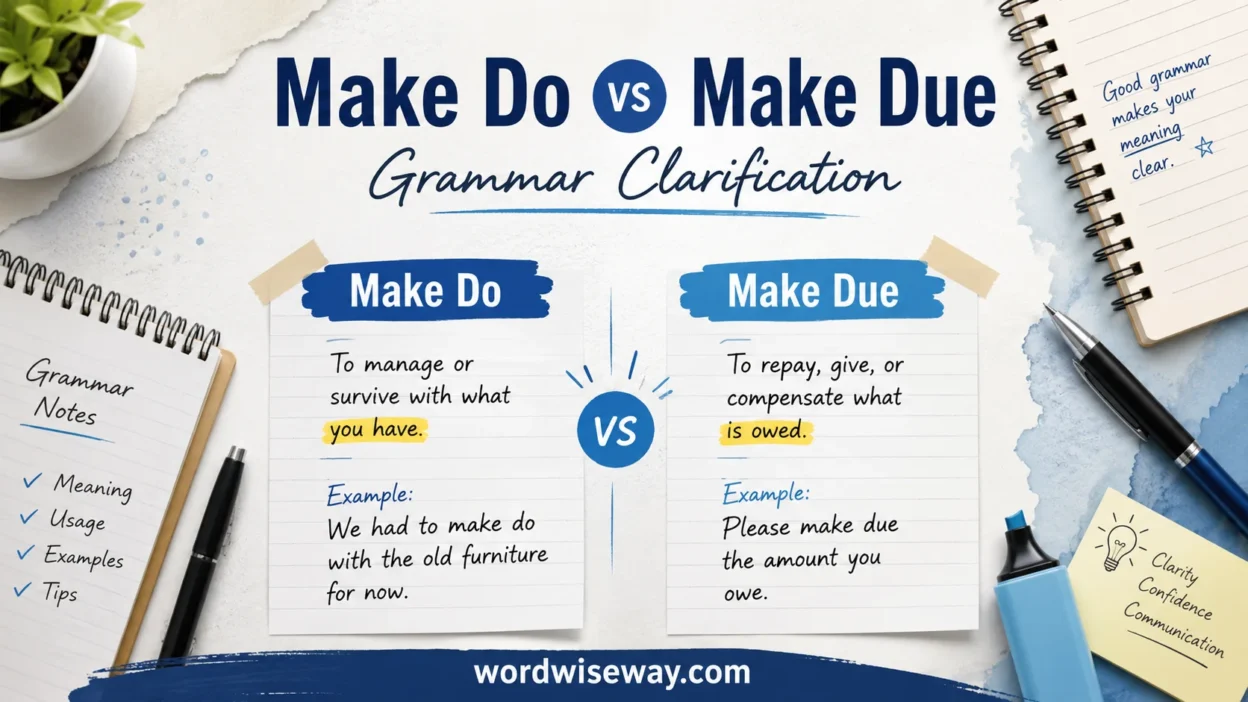
As an English language teacher, I always remind my students that mastering English is not only about learning grammar rules but also about understanding fixed expressions and how native speakers actually use them. The phrase make do is a well-established English idiom that means to manage with limited resources, while make due is incorrect in this context despite looking reasonable to many learners.
In this guide, I’ll explain the real difference between make do and make due, their meanings, correct usage, common mistakes, historical background, and practical examples from everyday English. By the end of this article, you’ll know exactly which expression to use and feel more confident in both your spoken and written English.
The Quick Answer
Let’s get straight to the point.
- Correct phrase: make do
- Incorrect usage in this context: make due
What it means:
- Make do = manage with what is available
- Make due = not a valid idiom in standard English
Simple rule you can trust:
If you mean coping with limited resources, always use “make do.”
That’s the entire foundation. Everything else builds on it.
Meaning of “Make Do”
The phrase make do works as a survival-style expression. It describes adapting when conditions fall short of expectations.
Core meaning:
To manage, cope, or get by using whatever you have.
Emotional tone behind it:
- Practical resilience
- Improvisation under pressure
- Quiet acceptance of limitation
Real-life examples:
- “We made do with one fan during the hot night.”
- “She made do without a charger until morning.”
- “They made do with leftovers after the guests arrived unexpectedly.”
Where you hear it most:
- Budget conversations
- Student life
- Emergency situations
- Travel improvisation
- Workplace shortages
It always carries the idea of less than ideal but still workable.
Why People Write “Make Due” in Make Do vs Make Due Grammar Clarification Discussions
This is where confusion gets interesting.
The word “due” already exists in many common phrases:
- due date
- due to
- payment due
- respect due
So the brain naturally assumes it fits here too.
But here’s the key difference:
- Due = something owed or expected
- Do = action or execution
When you say make do, you literally talk about doing what you can do.
When you say make due, you accidentally introduce the idea of obligation or payment. That changes meaning completely and breaks the idiom.
Why the mistake spreads:
- Spoken English sounds identical
- Autocorrect sometimes “corrects” it wrongly
- People guess based on logic instead of idiom rules
English loves misleading confidence traps like this.
Make Do vs Make Due Grammar Clarification: Fixed Expressions Matter
Here’s a truth many learners miss.
Some English phrases are not built word by word. They behave like locked units.
“Make do” is one of those units.
You cannot swap parts freely. If you do, the meaning collapses or disappears.
Examples of similar fixed expressions:
- by and large (not “by and broadly”)
- spick and span (not logically reconstructable)
- odds and ends (fixed pair structure)
These phrases survive because usage froze them over time.
Key insight:
Idioms are memory patterns, not grammar puzzles.
Historical Roots of Make Do in Make Do vs Make Due Grammar Clarification
The phrase make do carries a practical history.
Early usage:
The expression became widely known during wartime Britain through the phrase:
“make do and mend”
This slogan encouraged people to reuse, repair, and survive shortages rather than replace goods.
What happened next:
- “Make do and mend” shortened over time
- “Make do” stayed as a standalone phrase
- It entered everyday English usage
Why “do” survived:
Because it represented action, survival, and adaptation.
The word “due” never belonged to that structure historically, so it never entered the idiom.
Common Mistake Patterns
People repeat the same errors in predictable ways. Once you see them, you stop making them.
Frequent incorrect usage:
- “We will make due with what we have.”
- “She made due without help.”
- “They are making due under pressure.”
Correct versions:
- “We will make do with what we have.”
- “She made do without help.”
- “They are making do under pressure.”
Why this mistake sticks:
- Fast typing
- Voice-to-text misinterpretation
- Overthinking grammar rules
Quick comparison table:
| Incorrect Usage | Correct Usage | Meaning |
| make due with limited food | make do with limited food | cope with less food |
| made due in hard times | made do in hard times | adapted in hard times |
| will make due somehow | will make do somehow | will manage somehow |
Memory Trick
You don’t need heavy grammar rules to remember this.
Try this mental shortcut:
“You don’t get what is due. You just do what you can.”
Why it works:
- “Due” relates to what is owed
- “Do” relates to action and survival
Another quick anchor:
- DO = survival action
- DUE = deadlines and payments
If you feel unsure, ask yourself:
“Am I talking about coping?”
If yes, use do.
Read More: “Pliers” Vs “Plyers” Meaning, Correct Spelling, and Real Differences
Related Expressions in Make Do vs Make Due Grammar Clarification
English gives several ways to express similar ideas. But each carries a slightly different shade of meaning.
Closest alternatives:
- Do without
- Example: “We did without electricity for a day.”
- Get by
- Example: “They got by on a small income.”
- Manage with
- Example: “She managed with limited tools.”
- Scrape by
- Example: “He scraped by during college.”
Comparison table:
| Phrase | Strength | Tone |
| make do | neutral survival | practical |
| do without | absence focus | slightly negative |
| get by | general coping | informal |
| scrape by | struggle emphasis | intense |
Make Do vs Make Due Grammar Clarification in Real Life Scenarios
Let’s see how this phrase behaves in different environments.
Casual conversation:
“We don’t have chairs so we will make do with stools.”
Workplace email:
“The team will make do with existing resources for this project phase.”
Academic writing:
“Students often make do with limited research materials in remote areas.”
Social media caption:
“Out of coffee but still making do.”
Each usage keeps the same core idea: adaptation without ideal conditions.
Case Study: Communication Clarity and Make Do vs Make Due Grammar Clarification
Let’s look at a real communication scenario.
Situation:
A project team reports delays due to equipment shortages.
Version 1 (incorrect usage):
“The team will make due with reduced tools.”
Version 2 (correct usage):
“The team will make do with reduced tools.”
Impact difference:
- Version 1 confuses meaning for careful readers
- Version 2 communicates resilience clearly
- Version 2 sounds natural and professional
Observation:
Even small grammar errors can affect credibility in professional writing.
Quick Recap
Let’s lock it in clearly.
- Always use make do for coping or managing
- Never use make due in this idiom context
- Think of “do” as action and adaptation
- Treat the phrase as fixed, not flexible
- Trust usage over literal word substitution
Conclusion: Why Make Do vs Make Due Grammar Clarification Matters
Language precision builds trust. It shapes how people read your confidence and clarity.
The difference between make do and make due looks small. Yet it carries weight in writing quality. One reflects natural English usage. The other creates confusion.
Once you understand the logic behind idioms, you stop guessing and start recognizing patterns. That shift makes your writing sharper and more natural.
So next time resources run short or conditions feel tight, remember the rule. You don’t need perfection. You just need to make do.
My Personal Experience
As an English language teacher, I’ve seen many students write make due simply because it sounds the same as make do in everyday speech. Whenever I explain the history and meaning of the idiom with real-life examples, they quickly remember the correct phrase and rarely make the same mistake again. That experience has shown me that understanding context is far more effective than memorizing grammar rules alone.
FAQs
1. What is the correct phrase: Make Do or Make Due?
The correct phrase is Make Do, not Make Due.
2. Why do people confuse Make Do and Make Due?
Because do and due sound similar in spoken English, leading to confusion.
3. Is Make Due ever correct in English?
No, Make Due is considered incorrect usage in standard English.
4. What does Make Do mean?
It means to manage or cope with limited resources or difficult situations.
5. Why does Make Due look correct to some learners?
Because due is a familiar word related to deadlines and obligation, causing mix-ups.
6. Where is Make Do commonly used?
It is used in emails, essays, blogs, and business communication.
7. What mistake happens when people write Make Due?
It becomes a misspelling and creates incorrect usage in writing.
8. How does pronunciation affect this confusion?
In fast speech, do and due sound almost identical.
9. How can learners avoid this mistake?
By learning correct grammar rules, usage examples, and practicing writing.
10. Why is Make Do important in writing?
Because it ensures clarity, correct phrase usage, and professional communication.
Conclusion
Understanding Make Do versus Make Due is essential for clear and correct English writing. Many learners get confused due to similar pronunciation, but only Make Do is the standard and correct idiom. Using it properly improves clarity, reduces writing mistakes, and strengthens overall communication skills in academic, professional, and everyday situations.
Consistent practice with correct usage helps build stronger grammar awareness and better sentence formation. Over time, it also improves confidence in both spoken and written English. Small corrections like this can greatly enhance overall writing quality and precision.

Emma Smith has dedicated 14 years to Princeton University’s English Department, mentoring students in textual interpretation, literary movements, and critical frameworks. Her research explores Shakespearean drama, Victorian serial fiction, postcolonial narrative theory, and manuscript studies and probing how literary forms evolve across cultures and centuries. Emma has delivered lectures at international humanities congresses and published findings in distinguished academic journals, underscoring her commitment to scholarly depth and vibrant teaching.