5 Words for the Sound of Glass Breaking: Meanings and Examples explores how onomatopoeia makes descriptions of breaking glass clearer, more vivid, and easier to imagine.Sometimes, words alone aren’t enough to describe a noise. Writers use onomatopoeia, which means words that imitate sounds.
For example, glass breaking might produce a sudden crash, a sharp smash, or a light clink. These sound words help readers imagine the scene and understand different sounds. Learning their meanings and examples also expands your vocabulary.
Imagine a glass falling onto a hard floor. The impact might create a crash sound, followed by the cracking sound of glass. As broken glass scatters, you might hear a clatter, a tinkle, or a final crack. These descriptive words create auditory imagery and make writing more engaging. Understanding sound symbolism and other literary devices helps you choose expressions that fit the context.
Quick Answer:
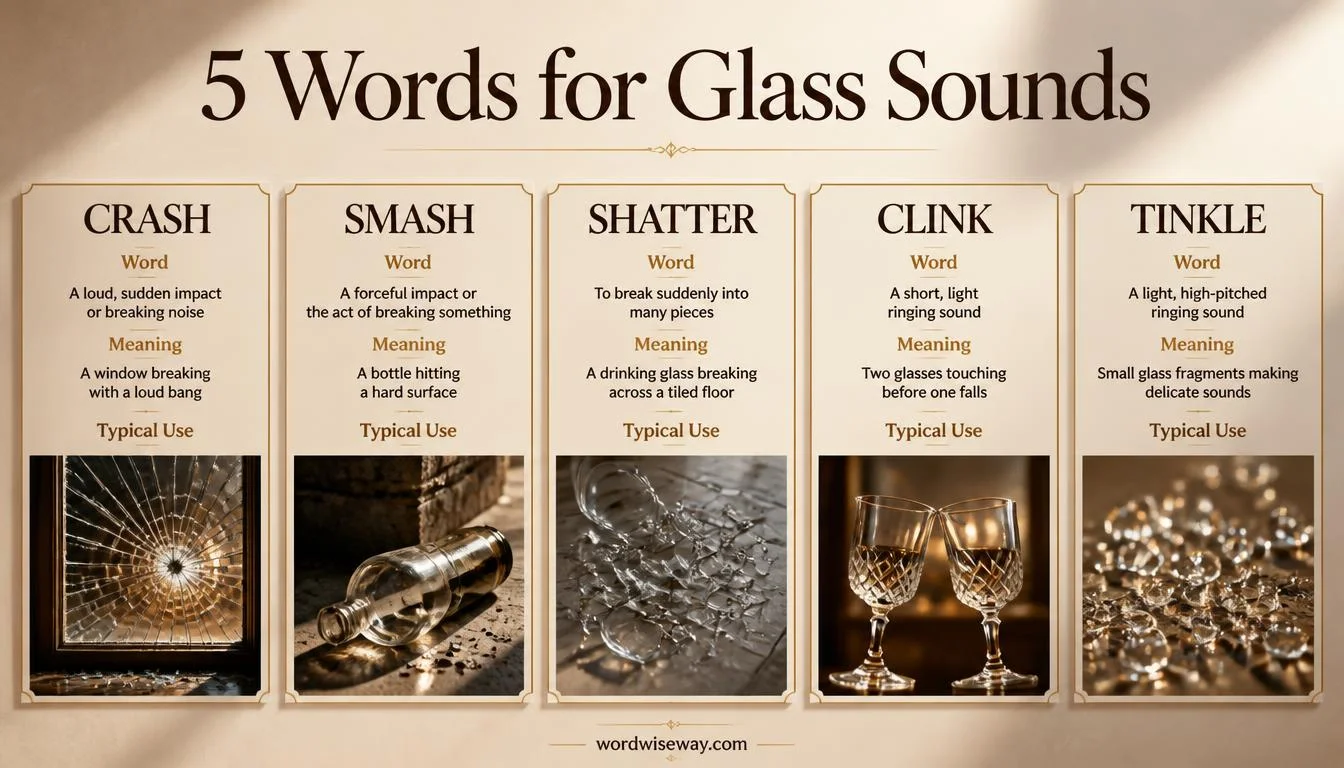
Five useful words associated with the sound of glass breaking are crash, smash, shatter, clink, and tinkle. Each describes a slightly different part of the event.
| Word | Meaning | Typical use |
| Crash | A loud, sudden impact or breaking noise | A window breaking with a loud bang |
| Smash | A forceful impact or the act of breaking something | A bottle hitting a hard surface |
| Shatter | To break suddenly into many pieces | A drinking glass breaking across a tiled floor |
| Clink | A short, light ringing sound | Two glasses touching before one falls |
| Tinkle | A light, high-pitched ringing sound | Small glass fragments making delicate sounds |
For the main noise of glass breaking, crash and smash often work well. Use shatter when you want to emphasize the glass breaking into pieces. Choose clink or tinkle when the sound involves lighter contact or delicate ringing rather than the main impact.
5 Words for the Sound of Glass Breaking
Crash
Crash describes a loud, sudden sound caused by a forceful impact or collision. It works particularly well when glass breaks with a startling noise that grabs everyone’s attention.
Imagine a large picture frame slipping from a wall and striking the floor. The impact produces a sharp, forceful noise followed by the sound of breaking glass. In this situation, crash captures the overall impact rather than the movement of each individual fragment.
The word also works when a large window breaks or glass furniture collapses. Its meaning isn’t limited to glass, either. Cars can crash, dishes can crash to the floor, and heavy objects can crash into one another.
Examples of crash in sentences:
- The glass vase fell from the shelf with a loud crash.
- A sudden crash came from the kitchen when the drinking glass hit the floor.
- The window crashed to the ground during the storm.
The third sentence uses crashed as a verb. Although people often use crash to describe the noise itself, the verb can also describe a forceful fall or collision.
When should you use crash?
Use crash when the event involves a loud, sudden impact. It’s especially helpful when you want readers to imagine the overall noise rather than focus on the exact way the glass breaks.
However, crash doesn’t always mean that something breaks. A heavy object can crash against a surface and remain intact. Context tells readers whether the impact resulted in broken glass.
Smash
Smash describes a forceful impact or the act of breaking something through a strong blow. It often suggests greater direct force than a simple collision, making it useful for describing glass that breaks after hitting a hard surface.
Consider a bottle that slips from someone’s hand and strikes a concrete floor. The word smash emphasizes the forceful contact and the resulting breakage. It can also describe someone deliberately breaking a glass object, although the context must establish whether the action was intentional.
Unlike crash, which often emphasizes the overall impact, smash draws attention to the force that breaks the object. The two words overlap, however, and either may fit a particular situation.
Examples of smash in sentences:
- The empty bottle hit the pavement and smashed into several pieces.
- We heard a loud smash from the next room.
- The falling branch smashed the glass panel in the greenhouse.
Notice that smash can function as both a verb and a noun. In the first and third examples, it describes the breaking action. In the second, it names the sound or event.
When should you use smash?
Choose smash when you want to emphasize forceful breaking. It’s particularly useful when describing a bottle, window, glass panel, or another fragile object that breaks after a strong impact.
For instance, “The bottle smashed against the floor” highlights the breaking action. “The bottle fell with a crash” focuses more on the noise accompanying the fall.
Both sentences can describe the same event, but each directs the reader’s attention differently.
Shatter
Shatter means to break suddenly into many pieces. It’s one of the most precise words for describing what happens when glass breaks apart.
Unlike crash and smash, shatter doesn’t primarily name a sound. Instead, it describes the breaking process and its result. A glass can shatter with a loud crash, connecting the physical event with the sound it produces.
Picture a thin drinking glass slipping from a countertop onto a hard kitchen floor. It breaks into numerous fragments scattered across the tiles. The sentence “The glass shattered across the floor” clearly communicates the result without needing an additional sound word.
The word also applies to windows, mirrors, ornaments, and other brittle objects. Beyond its literal meaning, shatter can describe something being badly damaged or destroyed, such as a person’s confidence or a long-held belief.
Examples of shatter in sentences:
- The drinking glass shattered when it struck the tiled floor.
- A stone hit the window and caused the glass to shatter.
- The delicate ornament fell from the shelf and shattered into tiny fragments.
These examples emphasize the breaking itself. If you want to describe the noise as well, combine shatter with a sound word.
For example: “The window shattered with a sharp crash.”
When should you use shatter?
Use shatter when the important detail is that glass breaks into many pieces. It’s especially useful in descriptive writing because it communicates the result of the impact in a single word.
Remember the distinction: glass shatters, and the shattering may produce a crash. This combination creates a more accurate description than treating the two words as exact synonyms.
Clink
Clink describes a short, light ringing sound produced when hard objects touch. Glassware often makes this sound when two drinking glasses meet gently or when a utensil touches the rim of a glass.
Unlike crash and smash, clink usually doesn’t describe the main noise of glass breaking. It represents a lighter sound that may occur before or after an accident involving glass.
Imagine two glasses touching on a dinner table. They produce a brief, clear ringing sound. If one glass then slips from the table and breaks, the event may begin with a clink and end with a crash.
This distinction matters because using clink for a loud, forceful break can give readers the wrong impression. The word suggests a small, distinct sound rather than a dramatic impact.
Examples of clink in sentences:
- The two glasses clinked together as the guests raised their drinks.
- I heard a faint clink when the glass ornament touched the metal frame.
- The spoon struck the side of the glass with a soft clink.
The first example describes glass touching glass. The other examples show that clink can also describe contact between glass and another hard material.
When should you use clink?
Use clink when the sound is light, brief, and ringing. It’s appropriate for glassware touching, small glass objects making contact, or a delicate sound that occurs around a breaking incident.
For example, “The glasses clinked before one slipped from the table” establishes the sequence of events. The word doesn’t suggest that the glasses actually broke.
Tinkle
Tinkle describes a light, high-pitched ringing sound. It often suggests a series of delicate notes rather than one heavy, forceful impact.
Glass can produce a tinkling sound when small pieces touch one another or strike a hard surface. However, the word is more appropriate for the light ringing associated with glass than for the loud noise of a large window shattering.
Imagine a small glass ornament falling onto a surface and producing several delicate ringing sounds as its pieces settle. Depending on the material and the way the fragments move, tinkle may convey the light quality of those sounds.
The word also describes the sound of small bells, wind chimes, and similar objects. It doesn’t automatically imply that anything has broken.
Examples of tinkle in sentences:
- The tiny glass pieces made a delicate tinkling sound as they settled.
- A faint tinkle came from the glass ornaments hanging near the window.
- The small glass beads tinkled against one another when the container moved.
Each sentence emphasizes a light, high-pitched sound. None requires a loud or forceful impact.
When should you use tinkle?
Choose tinkle when you want to describe a delicate ringing quality. It’s useful for small objects, light contact, and subtle sounds that follow a larger event.
For a realistic description of broken glass, consider the sequence carefully. A large pane might shatter with a crash, while small fragments could make lighter sounds afterward. The word tinkle may fit those later sounds, but it isn’t a universal description of breaking glass.
Comparison:
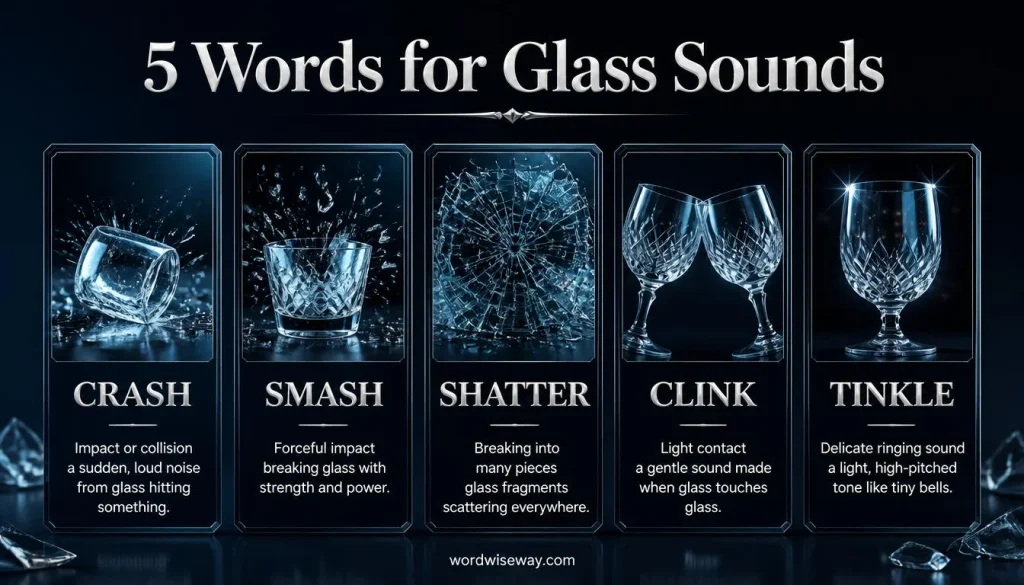
These five words overlap, but each highlights a different feature of an event involving glass. Comparing their meanings makes it easier to choose the right expression.
| Word | Main focus | Sound quality | Does it directly mean glass breaks? |
| Crash | Impact or collision | Loud and sudden | Sometimes; context matters |
| Smash | Forceful impact or breaking action | Forceful and often loud | Often, but not always |
| Shatter | Breaking into many pieces | May be loud, sharp, or followed by smaller sounds | Yes, when used literally |
| Clink | Brief contact between hard objects | Light and clear | No |
| Tinkle | Delicate ringing sounds | Light and high-pitched | No |
The table highlights an important difference: not every word associated with glass describes the same part of the event.
For example, consider a drinking glass falling onto a tiled floor. You might describe the sequence in three stages:
- Impact: The glass struck the floor with a crash.
- Breaking: The glass shattered into several pieces.
- Afterward: Small fragments made faint tinkling sounds as they settled.
This description uses each word for a specific purpose. It also avoids repeating the same adjective or sound word throughout the passage.
How to Choose the Right Word for the Sound of Breaking Glass
The best word depends on what you want readers to notice. Before choosing one, consider the force of the impact, the resulting damage, and the quality of the sound.
Consider the force of the impact
A forceful collision often calls for crash or smash. A gentle contact between two glasses is more likely to produce a clink.
Compare these sentences:
- The glass panel fell with a loud crash.
- The bottle smashed against the stone floor.
- The two glasses touched with a soft clink.
Each sentence gives readers a different impression of the event.
Focus on what happens to the glass
If the glass breaks into numerous pieces, shatter communicates the result directly. If you want to emphasize the impact that causes the breakage, smash may work better.
For example, “The mirror shattered into fragments” describes the result. “The falling object smashed the mirror” emphasizes the action that caused it.
Both expressions can describe the same incident without repeating the same information.
Listen to the quality of the sound
Sound descriptions become more precise when you distinguish a heavy impact from a delicate ringing noise.
A large glass object may produce a loud crash. By contrast, small pieces touching one another may produce light, high-pitched sounds that you can describe as tinkling.
However, the sound depends on the object, the surface, and the way the glass breaks. Not every broken glass produces a distinct ringing sound.
Match the word to your writing purpose
Different situations call for different levels of detail.
| Situation | Suitable word | Why it works |
| A window breaks after a heavy impact | Crash | Emphasizes the sudden, loud impact |
| A bottle breaks after striking concrete | Smash | Highlights forceful breaking |
| A glass breaks into many pieces | Shatter | Describes the resulting fragments |
| Two glasses touch gently | Clink | Captures brief, light contact |
| Small glass objects make delicate ringing sounds | Tinkle | Emphasizes a light, high-pitched sound |
Writing tip: You don’t need to use the most dramatic word every time. A precise word often creates a stronger image than an exaggerated description.
Examples of Words for the Sound of Glass Breaking in Sentences
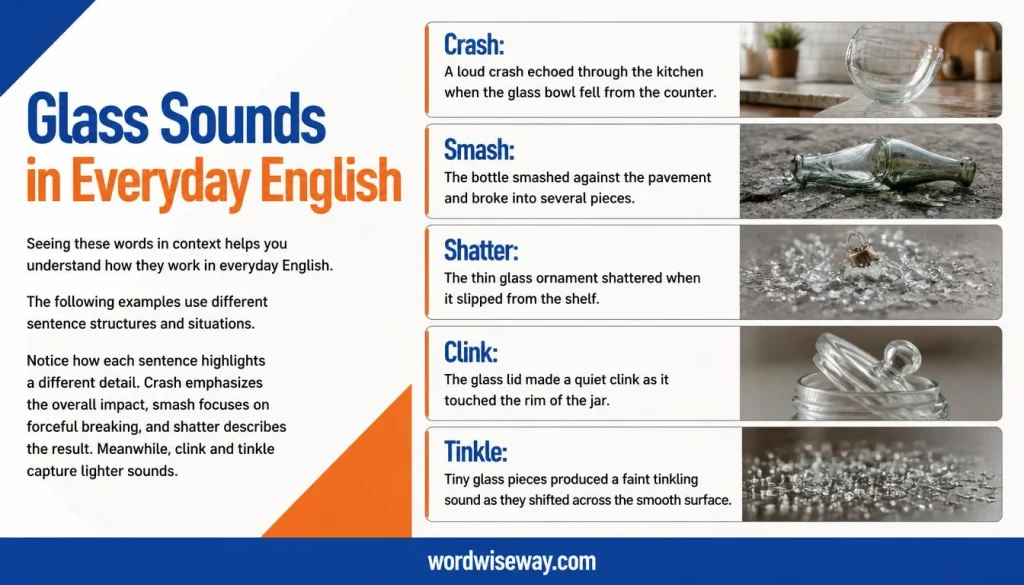
Seeing these words in context helps you understand how they work in everyday English. The following examples use different sentence structures and situations.
- Crash: A loud crash echoed through the kitchen when the glass bowl fell from the counter.
- Smash: The bottle smashed against the pavement and broke into several pieces.
- Shatter: The thin glass ornament shattered when it slipped from the shelf.
- Clink: The glass lid made a quiet clink as it touched the rim of the jar.
- Tinkle: Tiny glass pieces produced a faint tinkling sound as they shifted across the smooth surface.
Notice how each sentence highlights a different detail. Crash emphasizes the overall impact, smash focuses on forceful breaking, and shatter describes the result. Meanwhile, clink and tinkle capture lighter sounds.
A Short Case Study: Describing One Broken Glass in Different Ways
Suppose a drinking glass slips from a kitchen counter and lands on a tiled floor. You want to describe the event in a short story.
Version one:
“The glass fell with a loud crash.”
This sentence focuses on the sudden noise. Readers understand that something struck the floor, but they don’t know whether the glass broke.
Version two:
“The glass smashed against the tiles.”
This version emphasizes the forceful impact and suggests that the glass broke.
Version three:
“The glass shattered across the kitchen floor.”
Here, the emphasis falls on the breaking and the resulting pieces rather than the sound itself.
Version four:
“The glass shattered with a crash, and tiny fragments tinkled against the tiles.”
This version combines the words to describe different parts of the same event. The crash captures the main impact, while the tinkling describes the lighter sounds that follow.
The lesson is simple: choose words according to the details you want readers to imagine. One carefully selected word can be enough, but combining words can create a fuller description when the situation calls for it.
Read More: Otherwise: Comma Rules Explained With Clear Examples
FAQs
What word describes the sound of glass breaking?
The word crash often describes the loud sound of glass breaking. It works well when a glass object hits a hard surface and breaks suddenly.
Is crash a good example of onomatopoeia?
Yes, crash is a common example of onomatopoeia because its sound resembles the sudden noise of an object breaking or colliding with something.
What is the difference between smash and shatter?
Smash describes breaking something with force, while shatter emphasizes breaking into many small pieces. Both words can describe different aspects of breaking glass.
Which word describes the sound of small glass pieces falling?
Clatter describes several hard pieces hitting a surface, while tinkle suggests a lighter, delicate sound from small glass fragments.
Can crack describe the sound of glass breaking?
Yes, crack describes a short, sharp sound that occurs when glass splits or develops a fracture. It can also describe the sound before complete breakage.
How do you describe glass breaking in creative writing?
Use words such as crash, smash, crack, clatter, and tinkle. Choose the word that best matches the intensity and timing of the sound.
What is the quietest sound associated with broken glass?
Tinkle often describes a soft, delicate sound, such as small glass fragments lightly touching each other or falling onto a hard surface.
Why do writers use onomatopoeia for breaking glass?
Onomatopoeia helps readers imagine sounds without hearing them. Words like crash and clink make descriptions more vivid and help establish the scene’s atmosphere.
What is the difference between a crash and a clink?
A crash usually suggests a loud, forceful impact, while a clink describes a lighter, sharper sound when glass objects touch.
How can I choose the right word for the sound of breaking glass?
Consider what happens in the scene. Use crash for a loud impact, smash for forceful breaking, shatter for breaking into pieces, clatter for hard pieces striking surfaces, and tinkle for delicate sounds.
Conclusion
Choosing the right word for the sound of glass breaking can make your writing clearer and more engaging. Words like crash, smash, shatter, clink, and clatter each describe a different part of the experience. Some capture a sudden impact, while others suggest smaller pieces hitting the floor. Understanding these differences helps you describe sounds naturally without repeating the same expression.
When writing a story, article, or everyday description, think about the sound you want readers to imagine. A loud crash creates a different impression from a delicate tinkle. These small word choices bring scenes to life and help readers connect with the moment. Onomatopoeia makes it easier to turn ordinary descriptions into vivid, memorable writing.
The next time you describe breaking glass, choose a word that matches the action and its intensity. Experiment with different expressions to discover which one fits your sentence best. With practice, you’ll build a stronger vocabulary and use sound words more confidently in your writing.

Amelia Sanders has spent 14 years in Harvard University’s English Department, helping students navigate literary analysis, interpretive theory, and narrative techniques. Her academic pursuits center on 18th-century British prose, romantic poetry, diasporic writing, and digital editing exploring how textual choices influence cultural perspectives. Amelia has spoken at major international meetings and contributed essays to respected academic volumes, demonstrating her dedication to thoughtful scholarship and effective teaching.