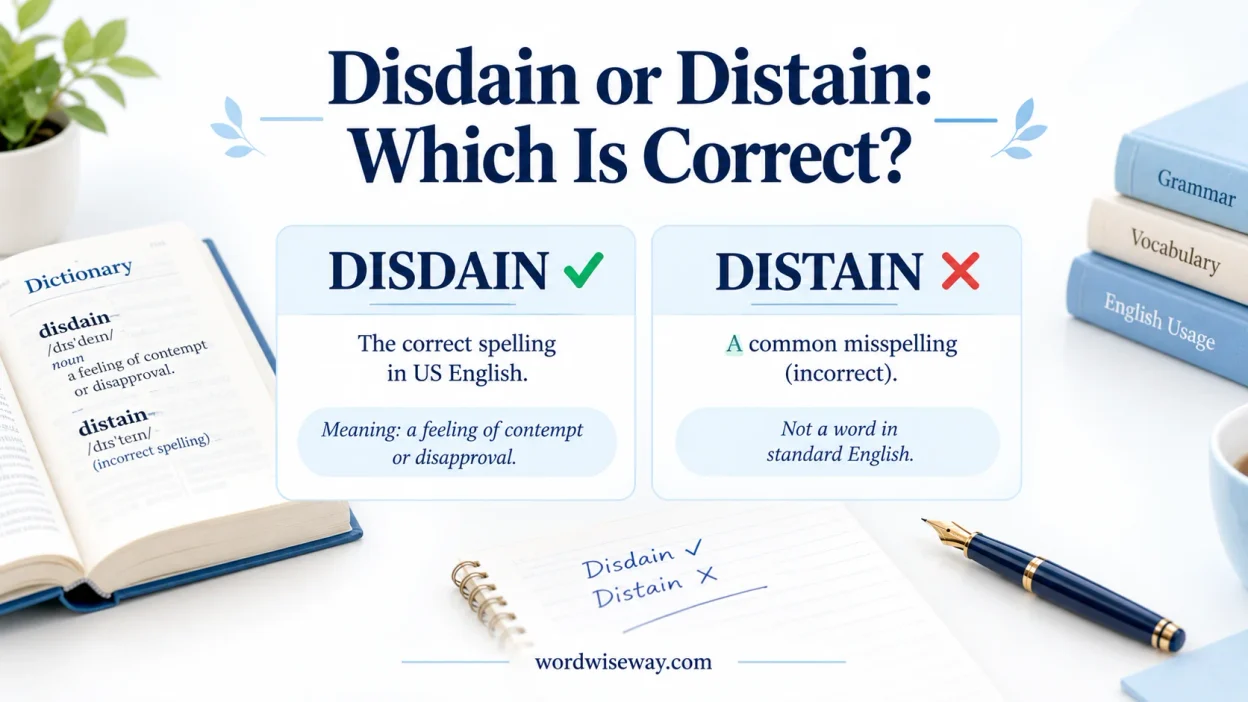
Disdain or Distain: Correct Spelling, Difference, and Usage can cause confusion because the two separate words differ by one letter and have similar pronunciation. Disdain is the correct spelling in standard English for strong dislike, disrespect, contempt, or a feeling that someone is unworthy of respect. It’s the commonly used choice in everyday English.
Distain is a real English word, but it’s an extremely rare, archaic word meaning to stain or disgrace something. It may appear in older dictionaries or publications, although modern readers often see it as a misspelling of disdain. The d sound and t sound can also seem almost identical in some regional dialects.
Disdain works as a noun, verb, and related adjective form, while disdainful, disdainfully, and disdainfulness are useful derivatives. In British English and American usage, disdain remains the appropriate choice when the context involves lack of respect. Knowing this difference helps you confidently choose the right word.
Quick Answer:
Disdain is the correct and widely used word when you mean contempt, strong dislike, or a feeling that someone or something isn’t worthy of respect.
Distain is a real but rare word with historical or specialized meanings associated with staining, discoloring, or sullying. It shouldn’t normally replace disdain.
| Word | Common modern use | Main meaning | Example |
| Disdain ✓ | Yes | Contempt, scorn, or lack of respect | He spoke about the dishonest scheme with disdain. |
| Distain | Rare | To stain, discolor, or sully in specialized or historical usage | The archaic text used distain in connection with staining. |
A useful rule is simple: If you mean contempt, choose disdain.
What Does Disdain Mean?
Disdain describes a strong feeling that someone or something is unworthy of respect, attention, or consideration. It often carries a sense of superiority. When you feel disdain toward something, you don’t merely dislike it. You regard it as beneath you or beneath the standard you expect.
For example, imagine a student who considers cheating completely unacceptable. If another student proudly admits to cheating, the first student might respond with disdain. The reaction involves more than simple disagreement. It reflects contempt for the behavior.
The word can function as both a noun and a verb, which makes it especially useful in formal and descriptive writing.
Disdain as a Noun
As a noun, disdain refers to the feeling itself.
You might have disdain for dishonesty, arrogance, cruelty, laziness, or poor behavior. The word commonly appears after phrases such as with disdain, in disdain, and hold in disdain.
Consider these examples:
- She looked at the broken promise with disdain.
- He spoke with obvious disdain for dishonest business practices.
- The critic expressed disdain for the poorly researched argument.
- They treated the outdated rule with disdain.
- His expression revealed his disdain for the proposal.
Notice the emotional weight of the word. Saying someone has disdain for an idea usually sounds stronger than saying they simply dislike it.
Disdain as a Verb
Disdain can also function as a verb. In this form, it means to consider something unworthy of your attention, approval, or dignity.
For example:
- She disdained the cheap publicity stunt.
- He disdains dishonest shortcuts.
- The manager disdained to respond to the insulting comment.
- They disdained the idea of taking credit for someone else’s work.
The construction disdain to + verb has a particularly formal tone. It suggests that someone considers an action beneath their dignity.
For instance, a sentence such as “She disdained to argue” means that she considered arguing unworthy of her attention.
Disdain in Everyday Context
You can use disdain when describing attitudes toward people, actions, ideas, institutions, habits, or objects. However, it usually works best when the feeling involves contempt or scorn, not mild annoyance.
Compare these situations:
- “I dislike rainy weather.” This expresses a preference.
- “I have disdain for dishonest behavior.” This expresses strong contempt.
- “She dislikes the new rule.” This could simply mean she doesn’t like it.
- “She treats the new rule with disdain.” This suggests she considers the rule foolish, inferior, or unworthy of respect.
That distinction matters because disdain isn’t simply a fancy synonym for dislike.
What Does Distain Mean?
Distain is a much less common word. Its historical and specialized uses relate to ideas such as staining, discoloring, or sullying.
This is where the spelling trap becomes especially sneaky. Someone may see distain and assume it is simply an alternative spelling of disdain. In modern standard usage, that assumption is usually wrong.
If a sentence says someone “looked upon the decision with distain,” the writer almost certainly intended disdain.
The rare word distain belongs to a different semantic territory. Its appearance in older texts can reflect meanings that aren’t part of ordinary contemporary conversation.
Distain as a Rare Word
The word distain has historical connections with the idea of staining or sullying something. Depending on the historical context, it can carry a sense related to discoloration or defilement.
Modern readers rarely need this word. That’s why spell-checkers, editors, and readers may flag distain when it appears in a sentence where the intended meaning is contempt.
Think of the two words as occupying different shelves:
Disdain → contempt, scorn, lack of respect
Distain → rare or historical meanings involving staining or sullying
Once you remember that divide, the spelling becomes far less troublesome.
Key Differences
The easiest way to understand disdain vs. distain is to focus on meaning rather than pronunciation.
| Feature | Disdain | Distain |
| Standard modern word | ✓ Yes | Rare |
| Means contempt | ✓ Yes | ✗ No |
| Means strong lack of respect | ✓ Yes | ✗ No |
| Can function as a noun | ✓ Yes | Historical usage varies |
| Can function as a verb | ✓ Yes | ✓ In rare usage |
| Associated with staining | ✗ No | ✓ Yes, in specialized or historical usage |
| Common in everyday writing | ✓ Yes | ✗ No |
| Usually the intended spelling | ✓ Yes | ✗ Usually not |
The practical difference is enormous despite the tiny spelling difference.
Disdain is an everyday vocabulary word. Distain belongs largely to unusual contexts where its specific historical sense matters.
Examples
Examples make the distinction much clearer than definitions alone.
Correct Examples With Disdain
Here are several natural examples:
- The teacher viewed plagiarism with disdain.
- She showed disdain for the dishonest argument.
- He spoke with disdain about the unfair treatment.
- The athlete disdained the idea of winning through cheating.
- They regarded the arrogant behavior with disdain.
- She disdained to respond to the needless insult.
- His disdain for corruption was obvious.
- The writer expressed disdain for shallow criticism.
Each example involves contempt, scorn, or a lack of respect.
When Distain May Be Correct
You may encounter distain in historical, literary, or specialized material where the writer intends a sense related to staining or sullying.
For example, an older text might use distain in a context involving something being marked, stained, or defiled. The exact meaning depends on the historical passage and its vocabulary.
That’s why you shouldn’t automatically “correct” every occurrence of distain without checking context. A rare word can still be intentional.
However, in normal contemporary writing, you shouldn’t use distain as a decorative spelling of disdain.
Incorrect Use of Distain
Consider this sentence:
She looked at the dishonest politician with distain.
If the intended meaning is contempt, the spelling should be disdain.
Correct:
She looked at the dishonest behavior with disdain.
Another example:
He has distain for people who lie.
Again, the intended word is disdain because the sentence describes contempt.
Correct:
He has disdain for people who lie.
The difference is only one letter. The meaning, however, changes completely.
Disdain Synonyms and Related Words
Several words overlap with disdain, but each carries its own shade of meaning.
Words Similar to Disdain
- Contempt: a strong feeling that someone or something is beneath respect.
- Scorn: open contempt or rejection.
- Derision: mocking someone or something with ridicule.
- Disrespect: a lack of proper respect.
- Aversion: a strong dislike or tendency to avoid something.
- Detestation: intense hatred or dislike.
These words aren’t interchangeable in every sentence.
For example, aversion can describe a strong dislike without implying superiority. Contempt, by contrast, often suggests that the target deserves little respect.
Disdain vs. Contempt
Disdain and contempt overlap heavily. Both can describe a feeling of superiority toward someone or something considered unworthy.
Still, contempt often emphasizes the judgment that someone or something has little value or deserves no respect. Disdain can emphasize the attitude of looking down on something.
Compare:
She showed disdain for the trivial argument.
She held the dishonest behavior in contempt.
Both sentences communicate strong disapproval, but their emotional coloring differs slightly.
Disdain vs. Scorn
Scorn often feels more openly dismissive. It can involve ridicule, rejection, or public contempt.
Disdain can remain quieter. A person might display disdain through a dismissive expression, tone, or refusal to take something seriously.
That distinction becomes useful when writing fiction or describing someone’s behavior. A character can show disdain without openly mocking anyone.
How to Remember Disdain
A simple memory trick can prevent the most common spelling mistake.
Remember:
Disdain = disrespect + contempt.
When you mean that someone looks down on a person, idea, action, or thing, disdain is usually the spelling you want.
You can also connect the word with the idea of looking down. Someone who feels disdain mentally places the object of their contempt beneath their standards.
By contrast, distain belongs to the much narrower world of staining or sullying.
The Meaning-Based Memory Trick
Use this quick mental test:
Does the sentence describe contempt?
If yes, use disdain.
Does the context genuinely involve staining, discoloration, or an old specialized meaning?
If yes, distain may be appropriate.
This approach works better than memorizing letters without understanding the meanings.
A Simple Spelling Check
When you’re proofreading, replace the disputed word mentally with contempt.
For example:
She treated the suggestion with contempt.
If that replacement preserves the intended meaning, disdain is probably the correct spelling.
But if the context refers to an actual stain or a historical sense of staining, investigate whether distain is being used deliberately.
Common Mistakes
The most frequent mistake is straightforward: writers spell disdain as distain when they mean contempt.
Other errors deserve attention too.
- Using distain as a modern alternative to disdain: The two words aren’t interchangeable.
- Treating disdain as ordinary dislike: Disdain usually conveys stronger contempt or superiority.
- Forgetting its verb form: Disdain can function as both a noun and a verb.
- Using disdain for every negative opinion: Words such as dislike, disapproval, and aversion may fit better in weaker contexts.
- Ignoring context: Rare words can have legitimate historical meanings.
Good word choice isn’t just about spelling. It also depends on selecting the word that expresses the exact shade of meaning you intend.
Disdain in a Sentence
The easiest way to become comfortable with disdain is to see how it behaves in different sentence patterns.
Noun Pattern
Subject + shows/expresses + disdain + for + noun
Example:
The editor expressed disdain for poorly supported claims.
With “With Disdain”
Subject + verb + with disdain
Example:
She dismissed the rumor with disdain.
This construction emphasizes the attitude behind the action.
Verb Pattern
Subject + disdains + noun
Example:
He disdains dishonest tactics.
“Disdain to” Pattern
Subject + disdains + to + verb
Example:
She disdained to answer the pointless accusation.
This structure sounds more formal and often appears in literary or serious prose.
More Natural Examples
- The researcher showed disdain for unsupported conclusions.
- She disdains shortcuts that compromise quality.
- He rejected the proposal with disdain.
- The critic’s disdain was obvious from his tone.
- They disdained to participate in the argument.
These examples show why disdain remains useful when you need to describe a strong dismissive attitude.
Read More: Angel or Angle: Meaning, Difference, and Correct Usage
FAQs
Is disdain the correct spelling?
Yes. Disdain is the standard spelling when you mean strong dislike, contempt, or a lack of respect toward someone or something.
What does distain mean?
Distain is a rare, archaic English word connected with staining or disgracing something. It’s rarely used in modern English.
Are disdain and distain pronounced the same?
They can sound very similar, particularly in some regional dialects. The main difference is the voiced d sound versus the unvoiced t sound.
Is distain simply a misspelling of disdain?
Not always. Distain is a genuine but uncommon word. However, in modern writing, it frequently appears when someone intended to write disdain.
When should you use disdain?
Use disdain when you want to express contempt, disrespect, or a strong feeling that someone or something is beneath consideration or respect.
Can disdain be used as a verb?
Yes. As a verb, disdain means to regard something as unworthy or beneath consideration. It can take an object in a sentence.
What is the adjective form of disdain?
The adjective is disdainful. It describes someone or something that shows contempt, disrespect, or a lack of regard.
Is disdain common in British English?
Yes. Disdain is a standard word in both British and American English, although pronunciation and some surrounding usage can vary by region.
Why do people confuse disdain with distain?
The confusion mainly comes from their nearly identical appearance and sound. They differ by only one letter, making distain look like a possible spelling variation.
How can I remember the difference between disdain and distain?
Remember that disdain relates to contempt or disrespect, while distain relates to staining or discoloring. For ordinary modern English, disdain is usually the word you need.
Conclusion
Choosing between disdain and distain becomes much easier once you separate their meanings. Disdain is the standard and widely used word for contempt, disrespect, or a strong feeling that someone or something deserves little regard. It’s the spelling you’ll normally want in everyday writing.
Distain isn’t simply a random spelling mistake. It’s a genuine but extremely rare and archaic word associated with staining or disgracing something. Still, because modern readers rarely encounter it, seeing distain in an ordinary sentence may indicate that the writer intended disdain.
When you’re unsure, look at the context rather than relying on pronunciation alone. If the sentence involves disrespect or contempt, choose disdain. If it refers to staining or discoloring, distain may be relevant, although its modern use is uncommon. Keeping that distinction in mind can help you write with greater confidence.