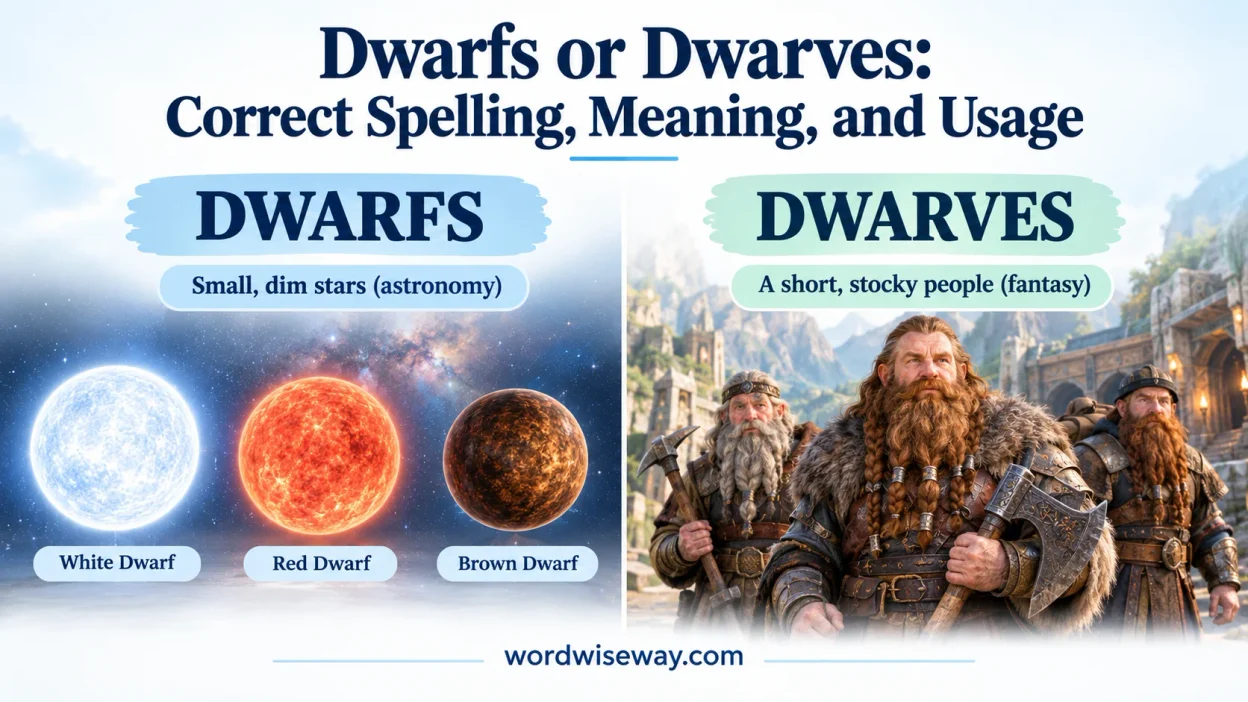
Dwarfs or Dwarves: Correct Spelling, Meaning, and Usage is a common grammar question about the noun dwarf and its plural nouns.
Dwarfs is the standard plural and safer plural in US English, especially for real-world use, science, and general writing.Dwarves is a newer variant popularized by English author J.R.R. Tolkien through fantasy fiction and literature, including The Hobbit and The Lord of the Rings.
His Tolkien spelling suits fantasy worlds, fantasy creatures, stories, games, and myth-inspired settings. The context usually decides which form fits best.As a verb, dwarf means to cause something to appear small in size. It is inflected as dwarfs in the third-person singular present tense.
The verb form differs from the noun form. A polite term for real-life people remains a matter of controversy, while spelling, usage, and plural form depend on the general context, scientific context, writing context, or fantasy context.
Quick Answer:
Dwarfs and dwarves are both correct plural forms of dwarf. The better choice depends on the context.
Use dwarfs in many scientific, astronomical, and general contexts. For example, astronomers discuss white dwarfs, red dwarfs, and brown dwarfs.
Use dwarves mainly when discussing fictional fantasy beings, particularly in Tolkien-inspired literature and modern fantasy.
| Word | Form | Common Use | Example |
| Dwarf | Singular | One person, creature, or object | A dwarf entered the cave. |
| Dwarfs | Plural | Science, astronomy, general usage | White dwarfs are stellar remnants. |
| Dwarves | Plural | Fantasy and fictional worlds | The dwarves guarded the kingdom. |
A useful rule is simple:
Science and factual terminology → dwarfs
Fantasy and fictional races → dwarves
That rule covers most everyday situations, although English has a few historical wrinkles.
Dwarf: Meaning and Singular Form
Before comparing dwarfs vs. dwarves, you need to understand the singular word dwarf.
A dwarf can describe a person, a fictional being, or an astronomical object, depending on the context. The word has a long history in English and appears in mythology, folklore, literature, science, and everyday language.
In traditional mythology and fantasy, a dwarf is often portrayed as a small supernatural or legendary being. Modern fantasy has expanded that idea considerably. Fictional dwarves may have their own languages, kingdoms, traditions, weapons, architecture, and political systems.
The word also has important scientific uses. Astronomers use dwarf in names for different kinds of stars and substellar objects. A single object can be called a white dwarf, red dwarf, or brown dwarf.
The word can also function as a verb. To dwarf something means to make it appear small when compared with something much larger.
For example:
The enormous mountain dwarfed the nearby buildings.
Here, dwarfed has nothing to do with fantasy creatures. It describes a dramatic difference in size.
Modern writing also requires care when using dwarf to refer to a person. The term has historical and medical associations that can make certain uses insensitive. Dwarfism is the established medical term for a group of conditions involving unusually short stature.
Dwarfs: Meaning and Usage
The spelling dwarfs follows a familiar English plural pattern. It appears when writers discuss more than one dwarf in general contexts and is especially common in scientific terminology.
Astronomy provides some of the clearest examples:
- White dwarfs
- Red dwarfs
- Brown dwarfs
These aren’t fantasy characters. They’re scientific categories with specific meanings.
For example:
Astronomers observed several white dwarfs in the distant star system.
The spelling dwarfs fits naturally because the sentence discusses astronomical objects.
The same form can also appear in general descriptions, depending on the established terminology and style of the subject.
Why Astronomers Write “White Dwarfs”
A white dwarf is the dense stellar remnant left behind by certain stars after they reach the later stages of their evolution.
Although a white dwarf can contain a mass comparable to the Sun, its size can be roughly similar to Earth’s. That gives the term “dwarf” a very specific scientific meaning.
Red dwarfs are another important example. They’re small, relatively cool stars and make up the majority of stars in the Milky Way.
Then there are brown dwarfs, which occupy an unusual middle ground. They are more massive than most planets but don’t have enough mass to sustain the same hydrogen-fusing process that powers ordinary stars.
These established scientific terms explain why you should write white dwarfs, not white dwarves.
Changing the spelling may make a scientific sentence look like it wandered out of a fantasy novel.
Dwarves: Meaning and Usage
Dwarves is the plural form strongly associated with fantasy.
You’ll commonly encounter it in stories featuring magical kingdoms, underground cities, legendary weapons, dragons, enchanted forests, and fictional races.
For example:
The dwarves built their kingdom beneath the mountains.
Here, dwarves immediately signals a fantasy setting.
The spelling became particularly influential through the work of J. R. R. Tolkien. His fictional Dwarves became one of the most recognizable fantasy peoples in modern literature.
Tolkien’s influence helped establish dwarves as a familiar spelling for fictional fantasy characters. Modern fantasy authors, games, films, and other media have continued that convention.
Why “Dwarves” Became Strong in Fantasy
Tolkien’s choice wasn’t accidental.
He deliberately used dwarves for the fictional people of Middle-earth. He even objected when publishers changed his preferred spelling to dwarfs during the publication process.
That distinction mattered to Tolkien because he wasn’t simply choosing between two interchangeable spellings. He was building the vocabulary of a fictional world.
As fantasy literature grew more popular, readers became increasingly familiar with dwarves as the plural associated with fictional races.
That association remains powerful today.
Key Difference
The easiest way to understand dwarfs vs. dwarves is to focus on context.
Dwarfs often appears in factual, scientific, and astronomical language. Dwarves usually appears when writers describe fictional fantasy beings.
| Sentence | Correct Form | Reason |
| Astronomers studied several white dwarfs. | Dwarfs | Astronomy |
| The dwarves forged weapons underground. | Dwarves | Fantasy |
| Red dwarfs are common in the Milky Way. | Dwarfs | Astronomy |
| The dwarves defended their mountain kingdom. | Dwarves | Fiction |
| Snow White and the Seven Dwarfs is the traditional title. | Dwarfs | Established title |
This distinction isn’t an absolute grammatical law. English allows both plural forms, and individual writers may use them differently.
Still, context provides a reliable guide.
Why Does English Have Two Plurals?
English has accumulated several irregular and alternative plural forms throughout its history. Dwarf is one example.
The plural dwarfs follows a regular pattern by adding -s.
The form dwarves resembles other English words whose plural forms developed with a spelling change, such as:
- wolf → wolves
- knife → knives
- wife → wives
- life → lives
However, English doesn’t apply that pattern consistently to every word ending in f.
For instance:
- roof → roofs
- chief → chiefs
- belief → beliefs
So you can’t create a universal rule saying every word ending in f must become ves.
With dwarf, both plural forms survived and became accepted.
That’s why dwarfs isn’t a misspelling of dwarves, and dwarves isn’t simply an incorrect version of dwarfs.
Dwarves and Tolkien
Tolkien’s influence deserves special attention because it shaped modern fantasy vocabulary.
His Middle-earth stories feature Dwarves as a distinct fictional people with their own history, culture, languages, and traditions. Major Dwarf characters appear in The Hobbit and The Lord of the Rings.
Tolkien also drew inspiration from older Northern European traditions. Several Dwarf names in The Hobbit came from Old Norse sources associated with dwarfs.
His creative choices gave dwarves a strong literary identity.
That influence spread far beyond Tolkien’s own books. Later fantasy novels, role-playing games, films, and video games frequently adopted dwarves for fictional fantasy peoples.
As a result, modern readers often recognize the spelling instantly.
When you see dwarves, you may expect a fantasy world. When you see dwarfs in a science article, you probably expect astronomy.
Dwarfs in Science and Astronomy
Science provides one of the strongest reasons to preserve the spelling dwarfs.
White Dwarfs
White dwarfs are extremely dense stellar remnants. They represent one of the final stages in the evolution of many stars.
A white dwarf doesn’t continue ordinary hydrogen fusion like a main-sequence star. Instead, it gradually cools over time.
Red Dwarfs
Red dwarfs are small stars with relatively low surface temperatures compared with hotter stars such as the Sun.
They’re extremely common in the Milky Way. Their abundance makes them important targets for astronomical research and the search for planets around other stars.
Brown Dwarfs
Brown dwarfs occupy a fascinating category between planets and stars.
They can be more massive than giant planets, yet they don’t possess enough mass to maintain the hydrogen fusion that powers ordinary stars.
These terms are firmly established. Therefore, scientific writing should retain dwarfs.
Dwarfs or Dwarves in Modern Writing
Choosing the correct form becomes easier when you identify the type of writing you’re doing.
Academic Writing
Academic writing should favor the established terminology of the field.
If your paper discusses astronomy, dwarfs is the appropriate choice for terms such as white dwarfs.
If you’re analyzing fantasy literature, dwarves may be the natural choice when referring to fictional characters.
Scientific Writing
Scientific terminology should remain precise.
Use:
- White dwarfs
- Red dwarfs
- Brown dwarfs
Avoid replacing established terms with dwarves simply because the latter is common in fantasy.
Fantasy Fiction
For fictional fantasy races, dwarves usually fits best.
For example:
The dwarves gathered inside the ancient stone hall.
The spelling immediately feels compatible with fantasy conventions.
General Nonfiction
General writing requires more attention to context.
If you’re discussing astronomy, use dwarfs.
If you’re explaining a fantasy novel, use dwarves when the fictional setting uses that convention.
The surrounding subject should guide your decision.
Dwarfs or Dwarves in Popular Culture
Popular culture has strengthened the distinction between these spellings.
Fantasy novels, films, games, and role-playing worlds frequently use dwarves for fictional peoples. The spelling has become almost a genre signal.
Scientific communication follows a different path. Astronomy continues to use dwarfs in established terms such as white dwarfs and red dwarfs.
Traditional fairy tales add another interesting layer.
The familiar title is Snow White and the Seven Dwarfs, not Snow White and the Seven Dwarves. This shows that older and traditional fictional usage doesn’t always follow the modern fantasy convention.
So the practical pattern looks like this:
| Context | Common Form |
| Astronomy | Dwarfs |
| Scientific writing | Dwarfs |
| General factual writing | Dwarfs |
| Tolkien-inspired fantasy | Dwarves |
| Modern fantasy fiction | Dwarves |
| Traditional fairy tales | Often Dwarfs |
Common Mistakes
Assuming Dwarves Is Always Correct
Fantasy has made dwarves extremely familiar. That familiarity can create a false rule.
Not every plural should become dwarves.
White dwarfs remains the standard astronomical expression.
Assuming Dwarfs Is Always Correct
The reverse mistake happens too.
Some writers learn that dwarfs is a legitimate plural and assume dwarves must be wrong.
It isn’t.
Dwarves is a well-established plural, especially in fantasy literature and fictional settings.
Changing the Spelling Without Considering Context
Context matters more than memorizing a rigid rule.
Compare:
The telescope detected several white dwarfs.
with:
The dwarves gathered beneath the mountain.
Both are correct because each sentence uses the plural that suits its subject.
Confusing Singular and Plural Forms
The singular remains dwarf.
The plural can be:
- One dwarf
- Two dwarfs
- Two dwarves
Dwarve isn’t normally the singular form.
That small distinction prevents a surprisingly common spelling error.
Dwarfs or Dwarves Example Sentences
Here are practical examples that show how context changes the preferred spelling.
Scientific example:
Astronomers discovered several white dwarfs in the nearby star system.
Fantasy example:
The dwarves returned to their mountain fortress before sunset.
Traditional fairy-tale example:
Snow White lived with the Seven Dwarfs.
Astronomy example:
Red dwarfs account for a large portion of the stars in our galaxy.
Fantasy example:
The dwarves forged a powerful sword beneath the ancient kingdom.
General example:
A lone dwarf appeared at the entrance to the cavern.
Notice that the pronunciation doesn’t provide the clue. The meaning and context do.
Simple Memory Trick
Need a quick way to remember the difference?
Think:
Science = dwarfs
Fantasy = dwarves
You can also remember it through two imaginary shelves.
On the science shelf, you’ll find white dwarfs, red dwarfs, and brown dwarfs.
On the fantasy shelf, you’ll find dwarves, dragons, elves, and enchanted kingdoms.
There’s one caveat. This is a practical memory trick, not an unbreakable grammar rule. Both plural forms have legitimate uses.
Read More: Inquiry or Enquiry: Which Spelling Is Correct?
FAQs
Is “dwarfs” or “dwarves” the correct spelling?
Both dwarfs and dwarves are accepted plural forms of dwarf. The better choice depends on the context. Dwarfs is commonly used in general and scientific writing, while dwarves is strongly associated with fantasy.
Should I use “dwarfs” in scientific writing?
Yes. Dwarfs is the usual choice in scientific contexts, especially when discussing astronomical objects such as dwarf stars. It is also a clear option for formal and general writing.
Why do fantasy stories use “dwarves”?
The spelling dwarves became strongly associated with fantasy through J.R.R. Tolkien’s works. It is now widely recognized when discussing fictional dwarf-like people in fantasy books, games, and stories.
Did Tolkien invent the word “dwarves”?
No. Tolkien did not invent the spelling from nothing. However, his fantasy works helped popularize dwarves and gave the form a strong connection with fictional fantasy worlds.
Is “dwarfs” grammatically correct?
Yes. Dwarfs is a grammatically correct plural form of dwarf. You can use it when the context does not specifically involve fantasy characters or Tolkien-inspired settings.
Can “dwarves” be used outside fantasy?
Yes, although dwarves is most strongly associated with fantasy. In ordinary or scientific writing, dwarfs is usually the more natural choice.
What is the plural of “dwarf” in American English?
In US English, both dwarfs and dwarves can function as plurals. Dwarfs is generally the safer choice for general and scientific contexts, while dwarves works well for fantasy.
Is “dwarf” also used as a verb?
Yes. As a verb, dwarf means to make something appear small compared with something else. Its third-person singular present form is dwarfs, not dwarves.
Which spelling should I use in a fantasy story?
Dwarves is usually the best choice for a fantasy story. Readers commonly associate this spelling with fictional fantasy peoples, especially in settings influenced by Tolkien and traditional fantasy literature.
Is there an easy way to remember “dwarfs” vs. “dwarves”?
A simple memory trick is to connect dwarfs with science and ordinary writing, while dwarves connects with fantasy. When you identify the setting first, choosing the spelling becomes much easier.
Conclusion
Choosing between dwarfs and dwarves becomes easier when you consider the context. Both are accepted plural forms of dwarf, but they have developed different patterns of use in modern English.
Dwarfs is generally the safer option for scientific, general, and everyday writing. You will commonly encounter it when discussing subjects such as astronomy or when the word does not refer to fictional fantasy characters.
Dwarves has a strong connection with fantasy literature and fictional worlds. The form became especially popular through Tolkien’s works and is now familiar in fantasy stories, games, and other imaginative settings.
The easiest rule is to match the spelling with the subject. Choose dwarfs for ordinary or scientific contexts and dwarves for fantasy contexts. If dwarf is being used as a verb, remember that the correct third-person singular form is dwarfs.

Emma Smith has dedicated 14 years to Princeton University’s English Department, mentoring students in textual interpretation, literary movements, and critical frameworks. Her research explores Shakespearean drama, Victorian serial fiction, postcolonial narrative theory, and manuscript studies and probing how literary forms evolve across cultures and centuries. Emma has delivered lectures at international humanities congresses and published findings in distinguished academic journals, underscoring her commitment to scholarly depth and vibrant teaching.